Access the Online Archive
Search the Historical Archive of the Pirelli Foundation for sources and materials. Select the type of support you are interested in and write the keywords of your research.
    Select one of the following categories
  • Documents
  • Photographs
  • Drawings and posters
  • Audio-visuals
  • Publications and magazines
  • All
Help with your research
To request to view the materials in the Historical Archive and in the libraries of the Pirelli Foundation for study and research purposes and/or to find out how to request the use of materials for loans and exhibitions, please fill in the form below. You will receive an email confirming receipt of the request and you will be contacted.
Pirelli Foundation Educational Courses

Select the education level of the school
Back
Primary schools
Pirelli Foundation Educational Courses
Please fill in your details and the staff of Pirelli Foundation Educational will contact you to arrange the dates of the course.

I declare I have read  the privacy policy, and authorise the Pirelli Foundation to process my personal data in order to send communications, also by email, about initiatives/conferences organised by the Pirelli Foundation.

Back
Lower secondary school
Pirelli Foundation Educational Courses
Please fill in your details and the staff of Pirelli Foundation Educational will contact you to arrange the dates of the course.
Back
Upper secondary school
Pirelli Foundation Educational Courses
Please fill in your details and the staff of Pirelli Foundation Educational will contact you to arrange the dates of the course.
Back
University
Pirelli Foundation Educational Courses

Do you want to organize a training programme with your students? For information and reservations, write to universita@fondazionepirelli.org

Visit the Foundation
For information about the Foundation’s activities, guided tours and accessibility,
please call +39 0264423971 or fill in the form below, providing details of your request in the notes field.

The time of the elderly serves to build memory and critical thinking, and to prepare for a better future

It is a slim book of barely 86 pages, flowing skilfully. The title is I venti (The Winds). Mario Vargas Llosa wrote it shortly before his death in April this year, and Einaudi has just published it. It can be read in just an hour. And it is the viewpoint of a noble father of world literature, a memoir and a kind of testament. It deserves our intelligent and heartfelt attention.

It is said that in Madrid, implicitly a metaphor for other cities, cinemas are closing because no one frequents them any more, and before long, deserted libraries and bookshops will also close, due to lack of visitors, and the same will happen to museums. Saddened and melancholic, only a few elderly people go to the protest rallies against these signs of waning knowledge and the civilised spirit of a community, and they are ignored.

All about them, technology and images triumph: the dystopia of the ‘Society of the Spectacle’, critically prophesied by Guy Debord in the mid-1960s, is worsened.  Digital reproductions of works of art on mobile phone and computer displays replace live paintings. Foolish passions arise for a ‘paper-free’ society without books or newspapers. Novels are written by artificial intelligence instead of the works of Tolstoy, Cervantes and Virginia Woolf. Algorithms instead of creativity of artists.

What of this artist, then? The book’s protagonist gets lost near the Biblioteca Nacional on Paseo de Recoletos, in the heart of the city. He is fragile and confused; he can’t even remember how to get home. He wanders, overwhelmed by memories and regrets. An old man adrift. The sharp headline “Triste, solitario y final” in the Sunday cultural supplement Robinson of La Repubblica quotes Osvaldo Soriano in support of Paolo Di Paolo‘s review of the sparse, ironic and compelling pages of Vargas Llosa’s posthumous novel that we mentioned. It is a conservative elegy to high culture. And a warning of the extent to which its degradation affects even social, economic and political freedoms.

The old masters are dying. To this writer’s great sorrow, the latest to pass away were Marco Onado and Goffredo Fofi, who died just a few days ago. They leave behind legacies of thoughts and words, in the hope that those of us who remain will continue to bring them to life and bear fruit in the form of new knowledge and intense stories, animated by intelligence and passion.

We are anxiously going through difficult times. The reality of armed wars and trade conflicts has upset the world’s balance, despite an international order and a series of economic understandings that we believed to be established values and practices. The gaps are widening – geographical, social, racial, cultural, gender-based and generational – and the world is restless, sorrowful and resentful. Disoriented by the crisis of traditional principles of authority and authoritativeness, invaded by sophisticated technologies. Yet we are becoming increasingly uncertain of the critical thinking that we all so desperately need to navigate the high-tech universe with sense and awareness.

Perhaps this is also why the death of an elderly person, strong in experience and capable of memory, affects us so much, darkening our controversial and precarious days.

In an era of widespread youthfulness and narcissism, this is a counterintuitive idea that praises the importance of the elderly. It is an interpretation of The Picture of Dorian Gray that tries to cheat the passing of time and avoid the related responsibilities. Perhaps, it is even a bad habit that the elderly cultivate for themselves.

Nevertheless, there must be an underlying imbalance if newspapers, economic reports and sociological surveys tell us that Italy is neither ‘a country for young people’ nor ‘a country for old people’.

In terms of young people, one fact stands out:  in the last ten years, 97,000 young graduates have left the country in search of better working and living conditions, and this figure is set to worsen over time. In 2023 alone, 21,000 left, which is 21% more than the previous year (we blogged about this on 24 June).

But Italy is not a good country for the old either.  The elderly population is large, but they are often lonely, vulnerable and frightened, and estranged from the frenetic pace of modern life. ISTAT certifies that a quarter of the Italian population is over 65 years old (a population of almost 59 million as of 1 January 2025), and 4,591,000 people are over 80 (50,000 more than in 2024). Life expectancy at birth is now 81.4 years for men and 85.5 years for women (an increase of almost five months since 2023). On the other hand, births continue to decline:  370,000 in 2024, with the fertility rate falling to 1.18 children per woman — one of the lowest in Europe.

People are living longer and better, but we are a country with a socially stagnant population. While it is true that 75 per cent of wealth is in the hands of those over 50 (La Stampa, 10 July, according to data from the Proof Society Report), the growing malfunctioning of welfare structures, as evidenced by the tragedy of ever-lengthening waiting lists for healthcare, and new family and social structures, are exacerbating the marginalisation of impoverished and semi-independent elderly individuals.

Here’s the deal: there is an Italy that needs to be understood more deeply, with a more balanced perspective and a more solid foundation of hope. Slogans aside, it is necessary to take a closer look at the country as a whole, and to learn to see beyond the stereotypes to understand the conditions in metropolitan suburbs, mountain villages and neglected rural areas. We must also care much more about issues of ‘common goods’ and the general values of communities. In short, we must build the foundations for good politics and effective public administration.

‘The Old and the Young’, to borrow the title of a great Luigi Pirandello novel, cannot be a theme played out in contrasts and juxtapositions. Rather, it should be considered in new and original ways. Across different social and generational groups. It should be considered at the fertile intersection of memory and future, historical awareness and open space for innovation. The events of Italian society itself offer exemplary testimony to this understanding.

Italo Calvino‘s words in ‘Invisible Cities’ are poignant: ‘A city can go through catastrophes and dark ages, see different generations follow one another in its houses, see those houses change stone by stone, but at the right moment and in different forms it must find its gods once again.’

Remembrance, therefore, is the responsibility of the elderly. Without succumbing to youthful narcissism and a desire for power, they should be useful by suggesting paths, nurturing doubts and questions, and providing material for critical thinking.

Our lifetime is naturally moving towards its end. It is therefore worth treasuring Enzo Bianchi‘s lesson:  add ‘life to days’, as you cannot add ‘days to life’.

In short, know how to be a teacher with a lower-case ‘t’ and have a story to tell:  teach, show, get people to read and re-read.

Let’s return, then, to where we started:  to the ‘winds’ of Vargas Llosa.  To literature and to the words that we elders must write and repeat.

Reading again, for example, José Saramago, who introduces the poems of Fernando Pessoa: ‘He was a man who knew languages and wrote verse.  He earned his bread and wine by putting words in the place of words; he wrote verses as they should be written, as if for the first time. He began by calling himself Fernando Pessoa — a person like everyone else.’

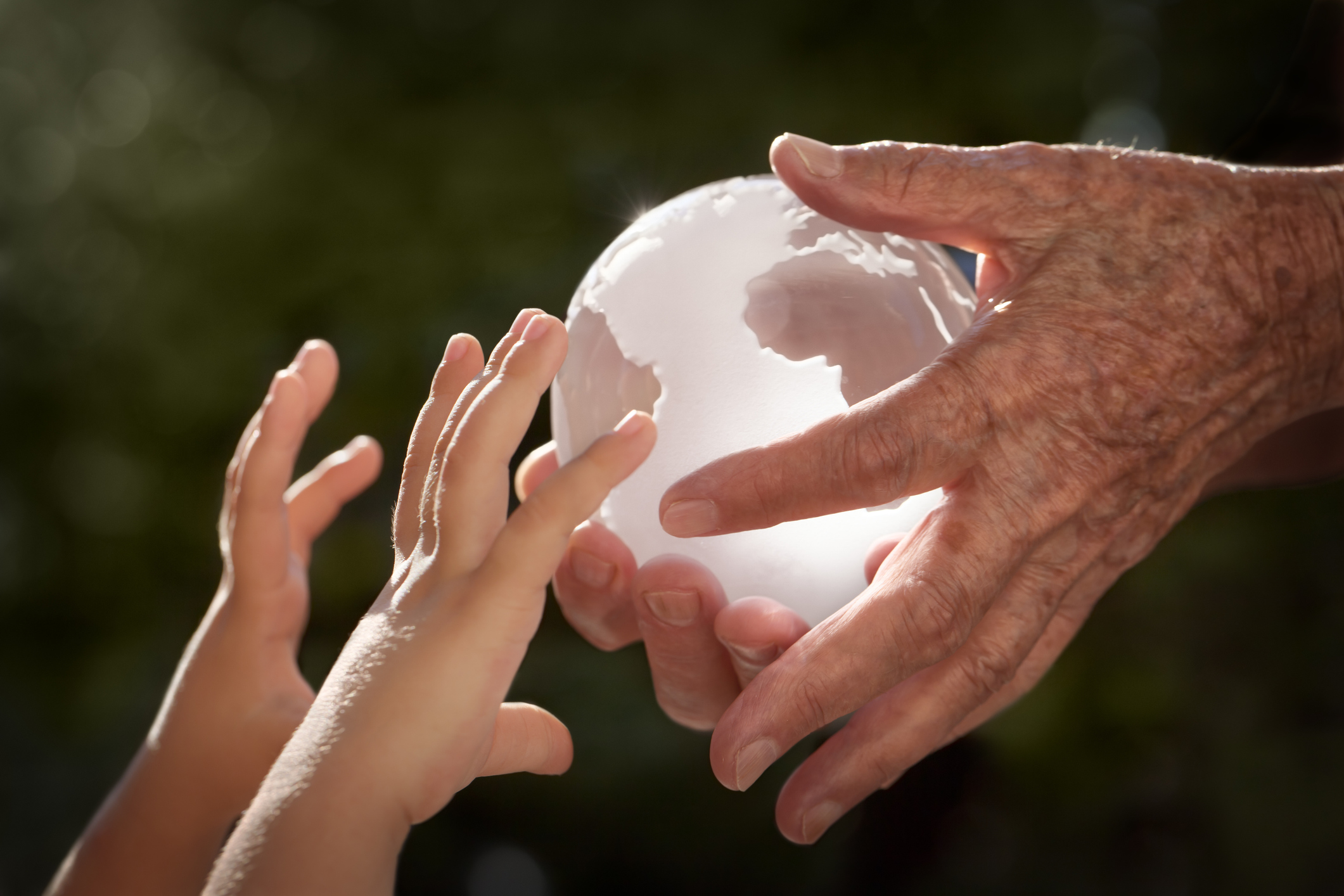
(photo Getty Images)

It is a slim book of barely 86 pages, flowing skilfully. The title is I venti (The Winds). Mario Vargas Llosa wrote it shortly before his death in April this year, and Einaudi has just published it. It can be read in just an hour. And it is the viewpoint of a noble father of world literature, a memoir and a kind of testament. It deserves our intelligent and heartfelt attention.

It is said that in Madrid, implicitly a metaphor for other cities, cinemas are closing because no one frequents them any more, and before long, deserted libraries and bookshops will also close, due to lack of visitors, and the same will happen to museums. Saddened and melancholic, only a few elderly people go to the protest rallies against these signs of waning knowledge and the civilised spirit of a community, and they are ignored.

All about them, technology and images triumph: the dystopia of the ‘Society of the Spectacle’, critically prophesied by Guy Debord in the mid-1960s, is worsened.  Digital reproductions of works of art on mobile phone and computer displays replace live paintings. Foolish passions arise for a ‘paper-free’ society without books or newspapers. Novels are written by artificial intelligence instead of the works of Tolstoy, Cervantes and Virginia Woolf. Algorithms instead of creativity of artists.

What of this artist, then? The book’s protagonist gets lost near the Biblioteca Nacional on Paseo de Recoletos, in the heart of the city. He is fragile and confused; he can’t even remember how to get home. He wanders, overwhelmed by memories and regrets. An old man adrift. The sharp headline “Triste, solitario y final” in the Sunday cultural supplement Robinson of La Repubblica quotes Osvaldo Soriano in support of Paolo Di Paolo‘s review of the sparse, ironic and compelling pages of Vargas Llosa’s posthumous novel that we mentioned. It is a conservative elegy to high culture. And a warning of the extent to which its degradation affects even social, economic and political freedoms.

The old masters are dying. To this writer’s great sorrow, the latest to pass away were Marco Onado and Goffredo Fofi, who died just a few days ago. They leave behind legacies of thoughts and words, in the hope that those of us who remain will continue to bring them to life and bear fruit in the form of new knowledge and intense stories, animated by intelligence and passion.

We are anxiously going through difficult times. The reality of armed wars and trade conflicts has upset the world’s balance, despite an international order and a series of economic understandings that we believed to be established values and practices. The gaps are widening – geographical, social, racial, cultural, gender-based and generational – and the world is restless, sorrowful and resentful. Disoriented by the crisis of traditional principles of authority and authoritativeness, invaded by sophisticated technologies. Yet we are becoming increasingly uncertain of the critical thinking that we all so desperately need to navigate the high-tech universe with sense and awareness.

Perhaps this is also why the death of an elderly person, strong in experience and capable of memory, affects us so much, darkening our controversial and precarious days.

In an era of widespread youthfulness and narcissism, this is a counterintuitive idea that praises the importance of the elderly. It is an interpretation of The Picture of Dorian Gray that tries to cheat the passing of time and avoid the related responsibilities. Perhaps, it is even a bad habit that the elderly cultivate for themselves.

Nevertheless, there must be an underlying imbalance if newspapers, economic reports and sociological surveys tell us that Italy is neither ‘a country for young people’ nor ‘a country for old people’.

In terms of young people, one fact stands out:  in the last ten years, 97,000 young graduates have left the country in search of better working and living conditions, and this figure is set to worsen over time. In 2023 alone, 21,000 left, which is 21% more than the previous year (we blogged about this on 24 June).

But Italy is not a good country for the old either.  The elderly population is large, but they are often lonely, vulnerable and frightened, and estranged from the frenetic pace of modern life. ISTAT certifies that a quarter of the Italian population is over 65 years old (a population of almost 59 million as of 1 January 2025), and 4,591,000 people are over 80 (50,000 more than in 2024). Life expectancy at birth is now 81.4 years for men and 85.5 years for women (an increase of almost five months since 2023). On the other hand, births continue to decline:  370,000 in 2024, with the fertility rate falling to 1.18 children per woman — one of the lowest in Europe.

People are living longer and better, but we are a country with a socially stagnant population. While it is true that 75 per cent of wealth is in the hands of those over 50 (La Stampa, 10 July, according to data from the Proof Society Report), the growing malfunctioning of welfare structures, as evidenced by the tragedy of ever-lengthening waiting lists for healthcare, and new family and social structures, are exacerbating the marginalisation of impoverished and semi-independent elderly individuals.

Here’s the deal: there is an Italy that needs to be understood more deeply, with a more balanced perspective and a more solid foundation of hope. Slogans aside, it is necessary to take a closer look at the country as a whole, and to learn to see beyond the stereotypes to understand the conditions in metropolitan suburbs, mountain villages and neglected rural areas. We must also care much more about issues of ‘common goods’ and the general values of communities. In short, we must build the foundations for good politics and effective public administration.

‘The Old and the Young’, to borrow the title of a great Luigi Pirandello novel, cannot be a theme played out in contrasts and juxtapositions. Rather, it should be considered in new and original ways. Across different social and generational groups. It should be considered at the fertile intersection of memory and future, historical awareness and open space for innovation. The events of Italian society itself offer exemplary testimony to this understanding.

Italo Calvino‘s words in ‘Invisible Cities’ are poignant: ‘A city can go through catastrophes and dark ages, see different generations follow one another in its houses, see those houses change stone by stone, but at the right moment and in different forms it must find its gods once again.’

Remembrance, therefore, is the responsibility of the elderly. Without succumbing to youthful narcissism and a desire for power, they should be useful by suggesting paths, nurturing doubts and questions, and providing material for critical thinking.

Our lifetime is naturally moving towards its end. It is therefore worth treasuring Enzo Bianchi‘s lesson:  add ‘life to days’, as you cannot add ‘days to life’.

In short, know how to be a teacher with a lower-case ‘t’ and have a story to tell:  teach, show, get people to read and re-read.

Let’s return, then, to where we started:  to the ‘winds’ of Vargas Llosa.  To literature and to the words that we elders must write and repeat.

Reading again, for example, José Saramago, who introduces the poems of Fernando Pessoa: ‘He was a man who knew languages and wrote verse.  He earned his bread and wine by putting words in the place of words; he wrote verses as they should be written, as if for the first time. He began by calling himself Fernando Pessoa — a person like everyone else.’

(photo Getty Images)