
A journey through books to understand the Milan crisis and develop responses that are neither justicialist nor populist


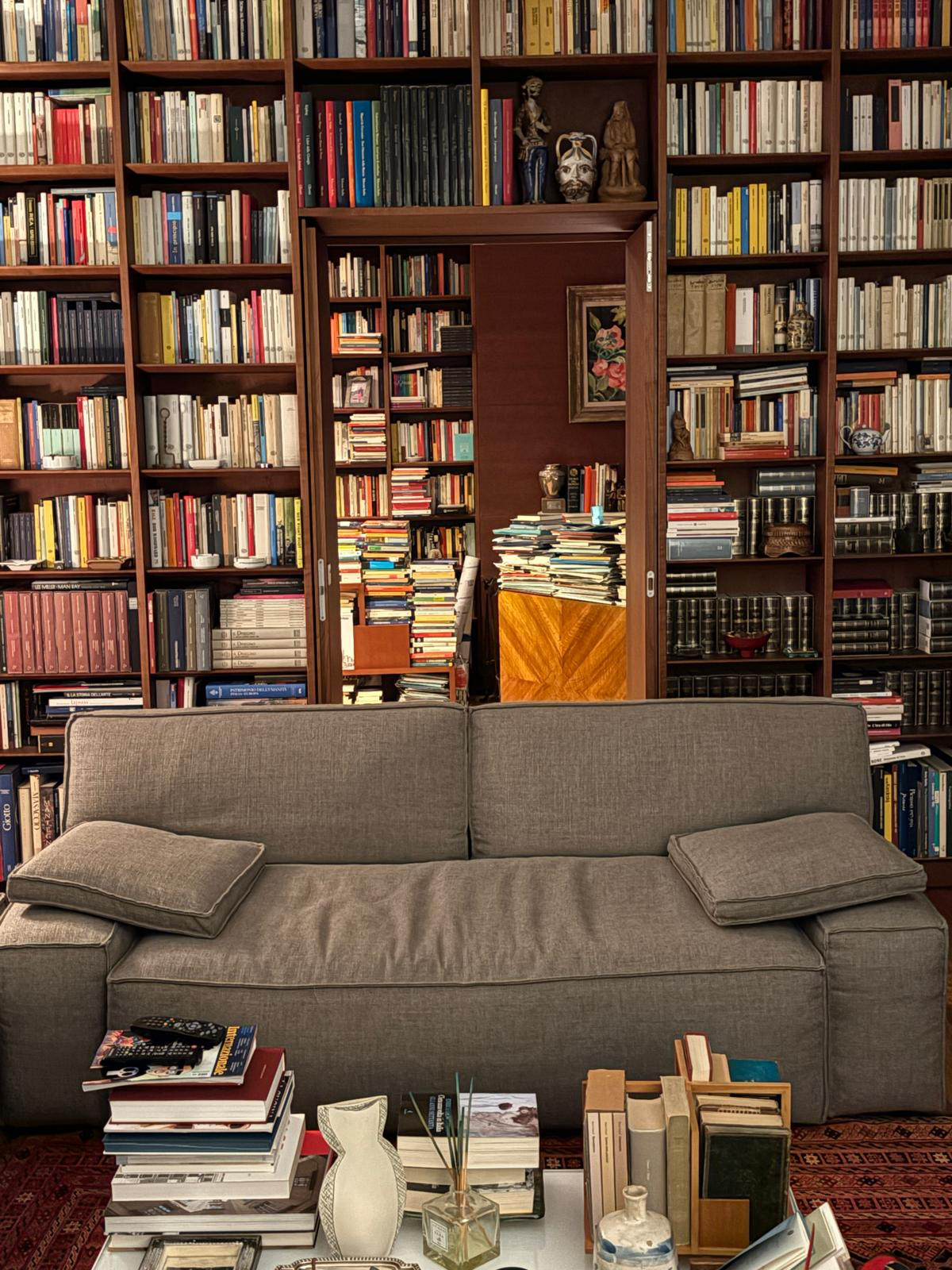
‘There’s no such thing as having too many books; only not having enough shelves,’ reads the caption of a beautiful photo of a stack of books, which has been circulating on Facebook (it must be thanks to an algorithm aimed at lovers of literature and readers). In these uncertain times, with so many questions about the future of Milan, amid a new storm of judicial, media, political and administrative issues, it is worth taking a break from the news for a moment and turning to books. Among their wise and witty pages, we can find useful ideas for critical reflection, following the suggestions of Alberto Manguel in Vivere con i libri (Einaudi) as he takes us on a journey through his library.
Firstly, take Italo Calvino‘s ‘Invisible Cities’. Let us turn to the final page of the dialogue between the mighty Kublai Khan and the wise Marco Polo. They discuss how to deal with ‘the hell of the living’, or ‘the hell we inhabit every day and create through our interactions’. Calvino’s Marco Polo says, ‘There are two ways to escape suffering it. The first is easy for many: accept the inferno and become such a part of it that you can no longer see it. The second is risky and demands constant vigilance and apprehension: seek and learn to recognise who and what, in the midst of inferno, are not inferno, then make them endure, give them space.’
An indication of method, then. With a solid ethical foundation: no resignation to degradation in the grey area of indifference, but rather a commitment to understanding and choosing how to act. Face the crisis by evaluating its implications, dangers and opportunities, and remember that the word ‘crisis’ comes from the Greek verb krino, meaning to distinguish, to separate, to judge. Taking a ‘risk’ (the word Calvin uses) in giving space and time to what ‘is not hell’. In Milan today, the challenge of designing the city as a community moving along the controversial and conflicting paths of modernity is political and cultural. The aim is to build a better, less unbalanced and more socially acceptable future.
Milan is a reformist city, as evidenced by the politically diverse experiences of its mayors, from the socialist Antonio Greppi during the reconstruction of the immediate post-war period, to Carlo Tognoli during the dynamic 1980s, and from centre-right mayors such as Luigi Albertini and Letizia Moratti, to centre-left mayors such as Giuliano Pisapia and the current mayor, Beppe Sala. It is dynamic, productive, sensitive to social dimensions and inclusive, and animated by the anxiety of ‘doing’. And at the same time by the sense of responsibility of ‘doing well’. And driven by the desire to ‘do good’. Its citizens have a civic spirit, and are certainly not hasty users of the city who are heedless of the community’s well-being. This civic spirit also affects its enterprises, both historically and in the present day.
In home libraries, it’s easy to find the medieval pages of Bonvesin della Riva (Le Meraviglie di Milano, which is not limited to architecture) and those of Bishop Ariberto d’Intimiano (‘Those who know what work is come to Milan. And those who come to Milan are free men’), work as identity and citizenship, the open city, the sense of change and progress, which occurred in the times of feudal power and corporations). Reproductions of Leonardo da Vinci‘s technical drawings of the ‘machines’ and gears of an ingenious and industrious city (the originals are in the ‘Atlantic Codex’ at the Ambrosiana). The civil lucidity of ‘Il Caffè’ by Verri and the other Milanese Enlightenment thinkers, who were attentive to ‘good government’ and the relationship between rights and duties, laws and justice, as indicated by Cesare Beccaria. And again, the economic intelligence of Carlo Cattaneo, and the literature marked by a strong moral sense of Alessandro Manzoni. And the widespread idea of progress and civilisation, social coexistence and development, the pain of living and the hope to be cultivated, community spirit and the passion for competitiveness (the two words have a common origin that connects them in an original way). All of these dimensions are found in the works of Testori, Gadda, Vittorini, Buzzati, Bianciardi and Scerbanenco over time. Light and shadow, civil society and social marginality, and even the spaces occupied by crime — to get an idea, just read Elementi di urbanistica noir by Gianni Biondillo, architect and writer, published by EuroMilano.
In short, the bookshelves are laden with intelligence and wisdom, not to mention novels and essays of more topical interest. Because ‘Milan is like the tip of an iceberg. Beneath lies its vast history. You can say “Milan, Milan” over and over, you can try writing it again and again’, to use Aldo Nove‘s description in ‘Milan is not Milan’ (Laterza) of the difficult and controversial representation of the city.
What emerges from this intellectual — and, ultimately, sentimental — journey (cities have a soul; they exert a fascination over those who live in, visit or observe them; they can make one fall in love) on the walls of a house full of books? The strong idea of a Milan that is multiple, plural and even contradictory — it ‘contains multitudes’, to borrow Walt Whitman’s wise words, loved by Vittorini — and, in any case, attentive to the concept of a ‘city that rises’ (Boccioni’s painting is a useful reference here). It is an awareness of history as a path that is bumpy rather than linear, a ‘sinuous course of things’, as Merleau-Ponty would say, and a strong will to emerge from recurrent historical crises. Thus, it recognises the characteristics of hell and is at peace with them, knowing full well that there is no heaven on leaving. However, there is the possibility of a better Milan until a new era of change requires us to define and establish new values and balances.
There are other writings to consider: those of Stendhal, who was so passionately attached to Milan that he requested that his epitaph in the Montmartre cemetery read ‘Milanese’. He was fascinated by the city’s blend of theatre and fashion, commerce and beautiful architecture, elegant wealth and popular vivacity (‘this people born for beauty…’), enterprise and the desire to ‘build a house or at least renovate the façade of the one inherited from his father’.
Examples of this trend, linking economic success to urban decorum and wealth to architecture, can be found in Nicolò Biddau‘s photographs in I cortili di Milano, Photo Publisher, (‘The courtyards of Milan are silent settings of an ancient theatre, where every stone and every detail tells a hidden story’) and in ‘Case milanesi’ by Orsina Simona Pierini and Alessandro Isastia, published by Hoepli. The beauty and dynamism of building.
In short, Stendhal recognised the characteristics of his time and cultivated a perspective that linked current events with future trends. His observations can now be found in the work of Carlo Ratti, an architect and academic who splits his time between Turin and the Massachusetts Institute of Technology (MIT) in Boston. Ratti is the curator of the 19th International Architecture Exhibition at the Venice Biennale, and is deeply involved in Smart City issues through his studio CRA – Carlo Ratti Associati, which is working on the master plan for the Porta Romana area of Milan. In an article in La Stampa on 18 July, he claims that ‘Milan has never had a contemplative soul, but has always been mercantile and pragmatic, combining business and culture, as Stendhal also recounted. It is a successful city, Italy’s gateway to the global economy. What my colleague Saskia Sassen calls a “global city”, and this is certainly not something to apologise for. The point now is not to eliminate the spectacle of modernity, but to ensure that the backstage still exists for students, migrants and innovators — for those who try and fail.’
In short, Milan, with its skyscrapers, finance, fashion and glamorous events, is keeping up with international trends. It is a place to live and yet also to be governed. Ratti argues that ‘the theme is success. When a city thrives and attracts people and capital, prices rise and the risk of exclusion increases. I believe we will see changes in the coming years, such as more affordable housing and tools to curb gentrification.’
These have been ‘boom years’. The city has been ‘a laboratory’. Now, Ratti says in Il Giorno on 20 July, ‘speculative bubbles must be avoided using effective tools to ensure the balance of the civitas — the city community — with incentives to build more affordable housing and a way to balance growth and inclusiveness’.
In fact, Milan is among the top ten cities in the world where the wealthy want to live, alongside Singapore, London, Hong Kong, Munich, Zurich and Paris, and ahead of Frankfurt and Barcelona (according to the Julius Baer Global Report, Il Sole24ore, 15 July). It is a record with many facets. However, if Milan were to become an exclusive city for the world’s rich, it would lose its soul and marginalise the middle classes, young people, new entrepreneurs who have not yet achieved economic success, intellectuals, creative people and ordinary, hard-working individuals. It would have restaurants and luxury shops, but not books, nor critical culture, nor therefore civil conscience.
To understand more, we can find other books on the shelves: ‘Milanesi si diventa’ by Carlo Castellaneta (Mondadori, 1991) is a novel about the welcoming capacity of a strict yet inclusive city that is generous with opportunities. Another is ‘Sulla formazione della classe dirigente – L’ultimo progetto di Raffaele Mattioli’, edited by Francesca Pino (Aragno, 2023), a collection of essays on the life and work of Raffaele Mattioli, a great banker, patron of the arts and leader of the Banca Commerciale Italiana from the early 1930s to the 1960s. Mattioli was one of the leaders of the reconstruction and then the Italian economic boom, as recounted by Elena Grazioli in ‘Raffaele Mattioli oltre la banca. published by Luni Editrice. Mattioli was originally from Abruzzo, but he was deeply Milanese in his economic style, as well as in his humanistic and financial culture. In summary, he was in favour of finance for enterprise, especially industry, rather than for speculators and those who want to ‘make money out of money’.
What do these books (and the many others we could read and quote) tell us? They tell us that Milan, with all its dynamism and eagerness to keep pace with, and sometimes even anticipate, change and innovation, suffers from the constraints of formal rules and bureaucracies. It is an enterprising city, that instead of obsessing about procedures, aims for results.
Today, without of course going into the merits of the ongoing judicial investigations, it is worth tackling the crisis without limiting ourselves to the chronicles and skirmishes of political propaganda (noting, however, that we do not seem to be facing a ‘new Tangentopoli’, as argued by Michele Serra in La Repubblica and Goffredo Buccini in Corriere della Sera on 20 July). In the necessary public debate, we must address the crux of the problems.
Milan’s pride is productive and can be used to its advantage. The social wounds of the metropolis must be healed and growth must be governed. But the laws must also be rewritten to overcome the stalemate imposed by ‘a labyrinth of rules, often opaque and contradictory’ (Carlo Ratti’s definition) that were written in the mid-twentieth century when the needs of urban planning, interests, finance and companies were different. Public administration must be made efficient and effective, working by results and not by procedures. Imbalances must be understood and addressed in an attempt to resolve them. Public services and common goods must be guaranteed. This is what citizenship means.
These are indeed the tasks of the ‘ruling class’, and they must be capable of seriously discussing the future as an alert civil conscience.
Milan, in fact, deserves it. Without being dazzled by the ‘thousand lights’, the greed of rents, or the ephemerality of events; nor by populist justicialism or the temptations of ‘degrowth’, however unfortunate they may be.
This is what the tour of the library shelves shows us: the robust and sensitive soul of a great city which asks to continue growing in a productive, inclusive, innovative and supportive way, as it has always done.