

Compassi d’Oro: the Italian international design awards confirm the country’s vocation and destiny as a great industrial nation


Italian companies are renowned for their unique blend of beautiful products, sophisticated technology, quality, functionality, innovation, and environmental and social sustainability. In this season of particularly tough and selective international competition, exacerbated by dramatic geopolitical events that destabilise the markets and American tariffs, our industrial world’s response to the crisis lies in pursuing technical excellence and strengthening the ethical and aesthetic values that inspire manufacturing — the so-called ‘beautiful and well-made’ Made in Italy.
The competitive strength of such an approach is confirmed by the list of twenty Compasso d’Oro (Golden Compass) winners and thirty-five special mention recipients, announced in early September by the jury chaired by Maite García Sanchís in the Italian Pavilion at the Osaka Expo, designed by Mario Cucinella.
This year’s theme for the award, which was created in 1954 by Gio Ponti and is promoted by the Industrial Design Association (ADI) in conjunction with the International Exhibitions, is ‘Designing the Future of Society for Our Lives’. Twelve of the twenty Compasso winners are products from Italian companies, including Pirelli, Generali Italia, Kartell, Bonotto, Fratelli Guzzini, iGuzzini, Campagnolo, Caimi Brevetti, Martinelli Luce, Vimar, Vetreria Vistosi and the Italian Institute of Technology for the INAIL Prosthetics Centre. This is indeed a sign of the excellence of Italian polytechnic culture, which combines humanistic values and scientific knowledge, and of its international competitiveness. The resilience of Italian exports, which exceed €620 billion despite the turbulence affecting global trade relations, is exemplary testimony to this. Most of the companies receiving the 35 mentions are also Italian, such as Irinox, Poliform, Archivi Olivetti, Fondazione Rovati, Mandelli 1953, Smeg, Elica, EssilorLuxottica and Venini.
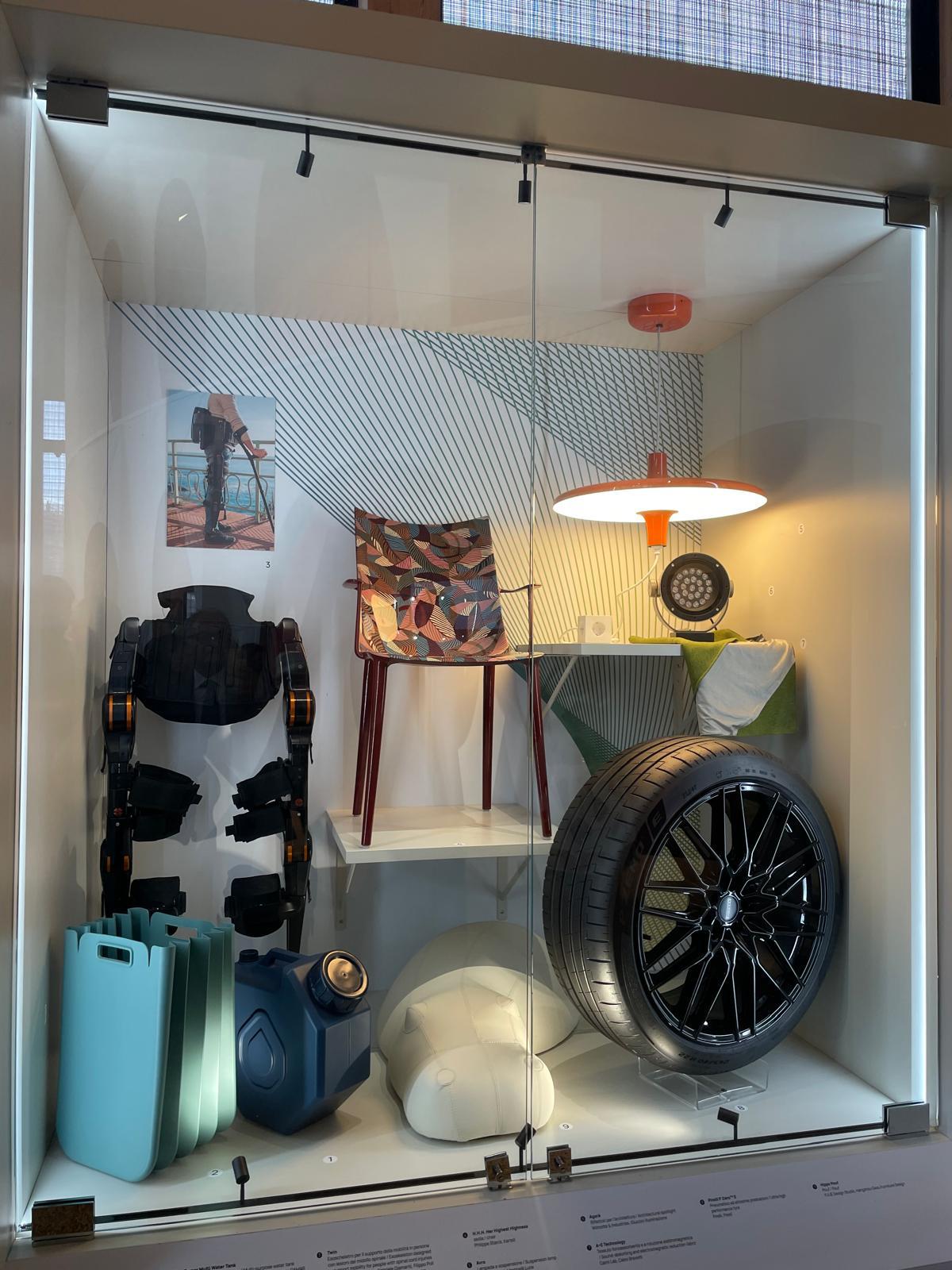
What do the award-winning products tell us? Let’s take a closer look at the P Zero E tyre, which is an excellent example of ‘Design for Mobility’. It is made mostly from natural or recycled materials and is an innovative synthesis of quality, performance and sustainability. ‘It was the first tyre to win the prestigious Compasso d’Oro award, which celebrates Pirelli’s design excellence and the innovative nature of products like the P Zero E. This confirms the important role that research and development play in driving progress and sustainability. This is partly thanks to the increasingly widespread use of advanced artificial intelligence techniques in all phases of development’, as Piero Misani, Executive Vice President and Chief Technical Officer of Pirelli, commented.
Other products that have been awarded include a bicycle wheel and a range of sustainable fabrics for luxury fashion, as well as sound-absorbing fabrics for work environments. The list also includes lighting systems and lamps, ergonomic seats, urban projectors, a digital services platform, and a modular exoskeleton. The result is an indication of Italian companies’ ability to market innovative products and services that provide original and effective solutions to living, dwelling and working needs. These solutions are tailored towards efficiency, well-being and quality, offering an alternative to mass consumerism that has a positive impact on the environment and social communities. In short, these are companies that are aligned with stakeholder values — the values and interests of the people and regions with which the industry interacts, and from which it draws its culture and social legitimacy.
Quality and sustainability are now values incorporated into the production systems and business models of ‘Italy that does Italy well’, as Symbola would put it. This involves doing business in a way that secures better positions in the highest value-added market niches and strengthens the consensus of sophisticated and demanding consumers. These values also signify an advanced corporate culture, with roots in the Italian manufacturing tradition and a vision for a future that prioritises quality of life, work and social customs.
Luciano Galimberti, president of the ADI, asserts that ‘design is experienced as a discipline that permeates our lives, transcending national borders and addressing global challenges through innovation, quality and sustainability’. Headed by Andrea Cancellato, the director of the ‘Osaka operation’, the Adi Design Museum offers an outstanding range of historical evidence. Kartell, Guzzini and Pirelli are recurring brands that exemplify a tradition of ‘design culture’ and ‘product culture’ which has stood the test of time and continues to evolve.
In her note in the Corriere della Sera on 6 September, Annachiara Sacchi wrote: ‘Solutions for a more aware humanity: connected and responsible, attentive to the circular economy and low environmental impact projects. We must also consider the choices that put design at the service of life, imagining it as a sort of Esperanto — a universal language that connects needs and visions.’
In short, design is a defining feature of contemporary Italy. It was one of the main tools that enabled the country to recover from the war, experience an economic boom and become a leading industrial power with a strong international market presence. It is a continually current, design-led characteristic.
Mario Vattani, Commissioner of the Italian Pavilion in Osaka, says, ‘It is precisely this idea of Italy that we want to promote: a nation capable of uniting culture and industry, creativity and innovation, and tradition and strategic vision.’
In other words, the Compasso d’Oro confirms and reinforces production and cultural decisions. In the wise words of Gio Ponti, ‘In Italy, art fell in love with industry, which is why industry is a cultural fact.’ It’s a strategic indication with a simple and essential name: design. And a qualifying adjective: sustainable.
This is a sustainability that must be insisted upon, despite headwinds blowing even within public opinion in major industrialised countries, starting with the USA. This involves overcoming regulatory and bureaucratic rigidities, which are affecting the EU Green Deal and causing serious damage to the European industrial system. The crisis in the automotive sector is an example of this. Instead, we need to establish effective common industrial policy tools that stimulate innovation, investment and productivity, and create a better ‘knowledge economy’. Valuable insights can be found in the reports prepared by Mario Draghi and Enrico Letta on behalf of the EU Commission last year. These reports must be retrieved and swiftly transformed into tangible choices, measures and investment decisions.
‘In the face of tensions over tariffs and geopolitics, and in the face of digital and environmental challenges, Europe must find strength in unity and in the valorisation of skills and innovation,’ advises Joseph Stiglitz, Nobel Prize winner in economics (IlSole24Ore, 8 September).
Moreover, this is a terrain in which Italian companies can move with ease. As documented in the seventh Consob Report on ‘non-financial reporting’, which was presented recently and covers what are commonly known as sustainability reports, 150 companies listed on Euronext Milan published such reports in 2024. This represents 72% of listed companies and 97% of market capitalisation. According to ItaliaOggi on 8 September, this is ‘a demonstration of how Italian companies are incorporating sustainability into their governance, long-term strategies, and even their top management incentive systems’.
In short, we need to become more competitive in a more effective and sustainable way. No less will do if we are to ensure that Italy continues to be a manufacturing country with an industrial future on which the quality and solidity of our economic, social and civil future also depend.
Courtesy of Padiglione Italia