Access the Online Archive
Search the Historical Archive of the Pirelli Foundation for sources and materials. Select the type of support you are interested in and write the keywords of your research.
    Select one of the following categories
  • Documents
  • Photographs
  • Drawings and posters
  • Audio-visuals
  • Publications and magazines
  • All
Help with your research
To request to view the materials in the Historical Archive and in the libraries of the Pirelli Foundation for study and research purposes and/or to find out how to request the use of materials for loans and exhibitions, please fill in the form below. You will receive an email confirming receipt of the request and you will be contacted.
Pirelli Foundation Educational Courses

Select the education level of the school
Back
Primary schools
Pirelli Foundation Educational Courses
Please fill in your details and the staff of Pirelli Foundation Educational will contact you to arrange the dates of the course.

I declare I have read  the privacy policy, and authorise the Pirelli Foundation to process my personal data in order to send communications, also by email, about initiatives/conferences organised by the Pirelli Foundation.

Back
Lower secondary school
Pirelli Foundation Educational Courses
Please fill in your details and the staff of Pirelli Foundation Educational will contact you to arrange the dates of the course.
Back
Upper secondary school
Pirelli Foundation Educational Courses
Please fill in your details and the staff of Pirelli Foundation Educational will contact you to arrange the dates of the course.
Back
University
Pirelli Foundation Educational Courses

Do you want to organize a training programme with your students? For information and reservations, write to universita@fondazionepirelli.org

Visit the Foundation
For information about the Foundation’s activities, guided tours and accessibility,
please call +39 0264423971 or fill in the form below, providing details of your request in the notes field.

Pordenonelegge, ‘the miracle of a city that becomes a book’, thanks to the connection between industry and culture

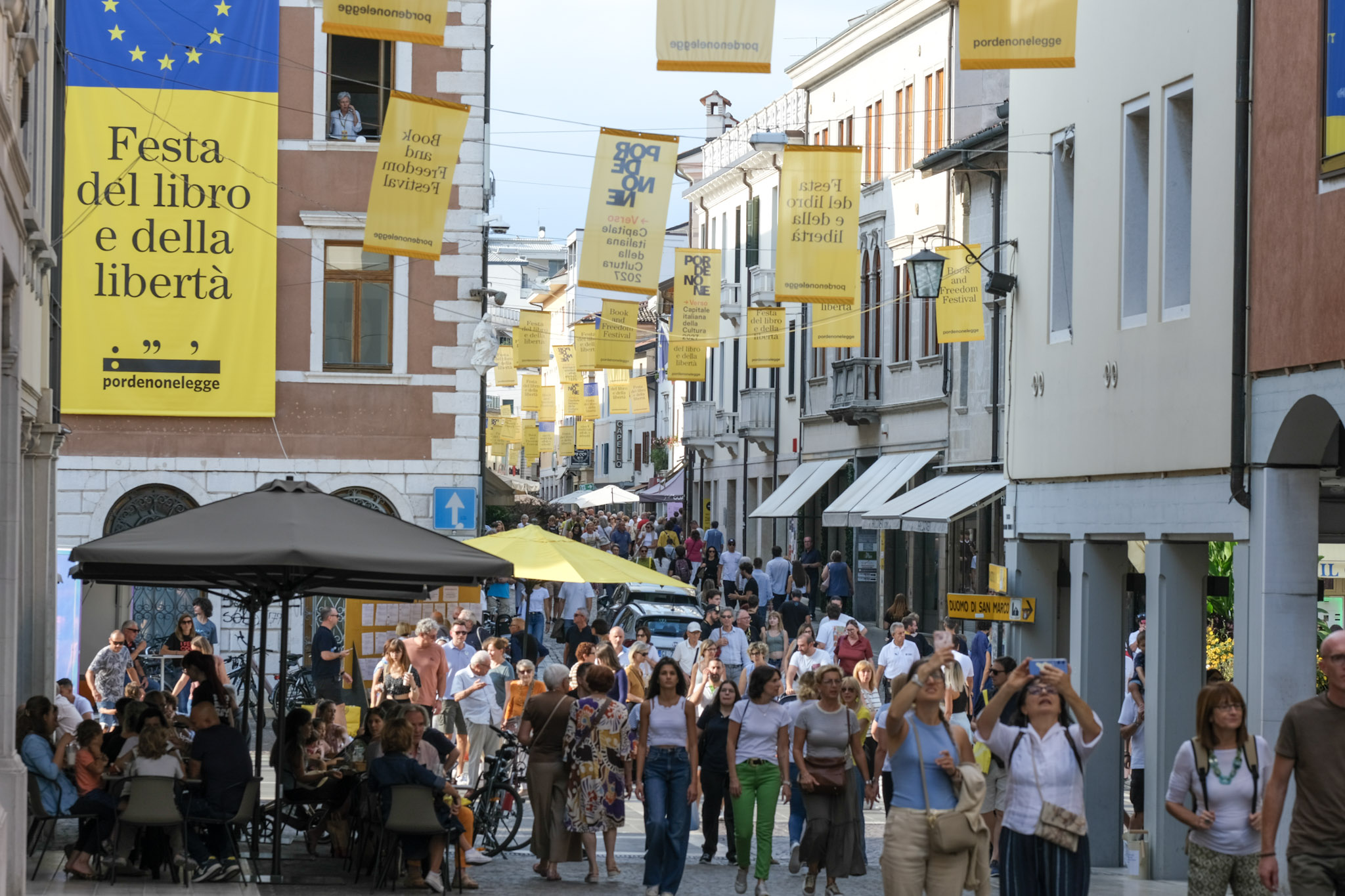
Like fishermen of ideas and words, to be used as the ingredients in delicious conversations and civil relations. Looking at this year’s posters for Pordenonelegge, the festival of good books and cultured and civilised encounters, light-hearted and curious thoughts come to mind:  there is a hook that, instead of catching a fish, lifts the corner of a yellow page to reveal the blue and starry edge of the European flag. And the exemplary slogan: ‘amoleggere’, meaning I love reading, adds even greater significance to this ‘Book and Freedom Festival’.

Yellow is the symbolic colour of Pordenonelegge, an initiative now in its 26th edition. In mid-September, it becomes a must-attend event for writers, readers and cultural figures, as well as young people, who come from all over Italy and abroad to listen to, read, discuss and understand that world of stories and ideas which, at times, seems doomed to decay and decline. Yet here, in the beautiful historic centre and in the yellow-decorated squares, it displays not only robust resilience, but also unexpected vitality. Its sights are now set on another ambitious goal: Pordenone as Italian Capital of Culture in 2027.

What are the roots of this industrial and cultural phenomenon? And what does it tell us about the prospects for the future of productive Italy, and that is, all things considered, of an Italy that has an extraordinary driving force in its history and its destiny in Europe?

This book festival is dedicated to Europe, fully aware of its limitations but also of the need to strengthen and develop (entrepreneurs from the north-east of Italy, including Friuli, are well aware of this through experience and culture). It was the determination of businessmen and businesswomen that led to the first edition in 2000 (a symbolic change of century and millennium). As Enzo Sellerio, with his profound, ironic and critical knowledge of books and ideas, would have said, ‘We are astonished’.

The initiative came from the Chamber of Commerce, which was chaired by Augusto Antonucci at the time.  Business associations provided significant support, including Confindustria, Confcommercio, Coldiretti, Confcooperative and Confartigianato. This was a book festival firmly rooted in the economic world and the forces of production, and local and regional politics followed.

Over time, this entrepreneurial spirit has grown stronger. For years, its most dynamic exponent has been Michelangelo Agrusti: a former DC parliamentarian, entrepreneur in the shipbuilding sector and president of Confindustria Alto Adriatico, which brings together companies in Pordenone, Gorizia and Trieste, as well as the Pordenonelegge Foundation. Industry and culture with a solid social and civil conscience.

The intentions were clear from the beginning: to attract the attention of the media, the publishing world, and the public to the city, enhancing the cultural, historical, and landscape riches of an area until then known primarily as a manufacturing hub. The aim was therefore to ‘help institutions, entrepreneurs, economic operators and citizens to broaden and deepen their knowledge, and to stimulate dialogue with intellectuals, publishers, authors and prominent national and international figures in literary, artistic and cultural fields’.

Over time, it has grown, and an average of 120,000 visitors per year have been recorded over the last few years. There has also been a strong economic return:  for every public euro invested, 10.24 euros benefit the local area (according to research by Bocconi University).

Agrusti argues: ‘Amoleggere this year is a declaration of interest in the present moment and in understanding its complexity.  Readers can not only inform themselves, but can also critically explore the issues with the knowledge that comes from understanding.’ And ‘this year too the miracle of the city becoming a book has been repeated.’

For this reason, Pordenonelegge is a festival conceived ‘on the threshold of history, an active observatory of contemporary reality.’ The special dedication to Europe ‘emphasises the institution that we all greatly need in our current historical and geopolitical context.  This institution is tasked with overcoming the risks of structural decline and the challenges of the existential crisis envisaged by the Draghi Report.’

Therefore, Europe is obliged to strengthen ‘its role as a point of reference for the founding values underlying the Treaties:  justice, democracy, freedom, the rule of law and respect for human rights. These are principles that the third millennium is calling into question in many parts of the world.’ The festival opened with a meeting with Shirin Ebadi, the Iranian writer and Nobel Peace Prize winner, and closed with Beethoven’s Ode to Joy.

Industry and culture, as we said, but also, more importantly, an industry that creates culture. And, better yet, ‘industry is culture’ if culture encompasses not only literature and art, theatre and music, but also science, technology, industrial or design patents, new high-tech products, artificial intelligence algorithms, innovative employment contracts for social relations, sustainable logistics organisation, and positive relationships between industry and the environment.

The importance of ‘material culture’, a concept dear to French historians of the Annales school, is also evident here in Friulian territory.

It was a peasant region in the post-war period, poor but industrious. It was marked by emigration to the strong industrial areas of Lombardy and the automotive region of Piedmont, but the people had a strong sense of pride in their roots, and among those who remained there was a widespread culture of work, cooperation and solidarity. During the boom years, the industry experienced a period of growth, beginning with the production of ‘white goods’ (household appliances, such as Zanussi and Electrolux), followed by light metalworking, woodworking, furniture production, textile machinery, and ceramics. More recently, shipbuilding and its sophisticated production chain have emerged.

The story of these transformations can be found in the concise yet comprehensive book Laboratorio Pordenone, written by Giuseppe Lupo, a historian who specialises in the relationship between literature and industry. He is the recent winner of the Friuli Venezia Giulia Literary Prize. ‘The economic miracle was not confined to Milan or Turin alone.  In fact, it was the peripheral areas that underwent the transition to modern civilisation in a less traumatic way than the big cities. In Pordenone, for example, the traditional way of life has never completely disappeared.  North-eastern Italy built its economic fortune on this mixture of industry and countryside, centuries-old customs and entrepreneurial daring — let’s call it an almost Calvinist mystique of work — helping to shape the figure of the metalmezzadro.’

The metalmezzadro was a common sight: half farmer and half metal worker. They were also frequently found in industrial plants across southern Italy, from Melfi to Termini Imerese.  However, there were some differences.  In southern Italian companies, harvest seasons (wheat, olives, grapes, etc.) coincided with peaks in factory absenteeism, whereas in the north-east there was a more harmonious balance of working periods.

In fact, Lupo writes that in Pordenone, ‘the old world continued to resist even in the presence of the new. The peasant soul — the one that spoke in dialect and felt rooted in the land — never fully succumbed to the advance of modernity. It was almost as if it were secretly resisting (or taking revenge on) the danger that modernity would homogenise everything, both in black-and-white Pordenone in the 1960s and in recent decades, when the demand for labour prompted Confindustria to devise a strategy to control the movement of individuals or families to the city and integrate them into the productive workforce.’

Lupo insists that,  ‘in the absence of cultural institutions, companies have had to act as drivers of development by promoting initiatives related to books, reading, art, cinema and theatre,  and this is how the Pordenonelegge festival came to be, one of the most important literary events in Italy.’ Why? ‘No material well-being can be achieved without culture, and this city uniquely expresses the relationship between business and the local area, even during a delicate phase such as the transition to Industry 4.0.’

Confirmation can be found in the Technology Hub, which is designed to incubate new businesses. It provides support in the form of technical skills and financial resources for the digital and environmental transition. It operates without bureaucratic rigidity and has a solid understanding of productivity. Another notable initiative is the Lef (or ‘Lean Experience Factory’), which was inaugurated in 2011 on the outskirts of Pordenone. Agrusti is its president. Lupo explains ‘It is a factory-school of sorts, or rather an experiential training centre that teaches how to optimise production processes.  Rather than being a model factory, it is a factory modeller because it works with the relevant parties to determine the most effective production model for specific industrial processes.  In short, it is an educational workshop, halfway between a practical factory and a conceptual one, and it applies to the Lef, but could work for the entire Pordenone system.’

Here it is again: the virtuous synthesis of ‘business is culture’.  The culture of know-how and of sharing knowledge. Pordenonelegge, with its ‘Festival of Books and Freedom’, is a fundamental tool for this.

(foto: Cozzarin)

Like fishermen of ideas and words, to be used as the ingredients in delicious conversations and civil relations. Looking at this year’s posters for Pordenonelegge, the festival of good books and cultured and civilised encounters, light-hearted and curious thoughts come to mind:  there is a hook that, instead of catching a fish, lifts the corner of a yellow page to reveal the blue and starry edge of the European flag. And the exemplary slogan: ‘amoleggere’, meaning I love reading, adds even greater significance to this ‘Book and Freedom Festival’.

Yellow is the symbolic colour of Pordenonelegge, an initiative now in its 26th edition. In mid-September, it becomes a must-attend event for writers, readers and cultural figures, as well as young people, who come from all over Italy and abroad to listen to, read, discuss and understand that world of stories and ideas which, at times, seems doomed to decay and decline. Yet here, in the beautiful historic centre and in the yellow-decorated squares, it displays not only robust resilience, but also unexpected vitality. Its sights are now set on another ambitious goal: Pordenone as Italian Capital of Culture in 2027.

What are the roots of this industrial and cultural phenomenon? And what does it tell us about the prospects for the future of productive Italy, and that is, all things considered, of an Italy that has an extraordinary driving force in its history and its destiny in Europe?

This book festival is dedicated to Europe, fully aware of its limitations but also of the need to strengthen and develop (entrepreneurs from the north-east of Italy, including Friuli, are well aware of this through experience and culture). It was the determination of businessmen and businesswomen that led to the first edition in 2000 (a symbolic change of century and millennium). As Enzo Sellerio, with his profound, ironic and critical knowledge of books and ideas, would have said, ‘We are astonished’.

The initiative came from the Chamber of Commerce, which was chaired by Augusto Antonucci at the time.  Business associations provided significant support, including Confindustria, Confcommercio, Coldiretti, Confcooperative and Confartigianato. This was a book festival firmly rooted in the economic world and the forces of production, and local and regional politics followed.

Over time, this entrepreneurial spirit has grown stronger. For years, its most dynamic exponent has been Michelangelo Agrusti: a former DC parliamentarian, entrepreneur in the shipbuilding sector and president of Confindustria Alto Adriatico, which brings together companies in Pordenone, Gorizia and Trieste, as well as the Pordenonelegge Foundation. Industry and culture with a solid social and civil conscience.

The intentions were clear from the beginning: to attract the attention of the media, the publishing world, and the public to the city, enhancing the cultural, historical, and landscape riches of an area until then known primarily as a manufacturing hub. The aim was therefore to ‘help institutions, entrepreneurs, economic operators and citizens to broaden and deepen their knowledge, and to stimulate dialogue with intellectuals, publishers, authors and prominent national and international figures in literary, artistic and cultural fields’.

Over time, it has grown, and an average of 120,000 visitors per year have been recorded over the last few years. There has also been a strong economic return:  for every public euro invested, 10.24 euros benefit the local area (according to research by Bocconi University).

Agrusti argues: ‘Amoleggere this year is a declaration of interest in the present moment and in understanding its complexity.  Readers can not only inform themselves, but can also critically explore the issues with the knowledge that comes from understanding.’ And ‘this year too the miracle of the city becoming a book has been repeated.’

For this reason, Pordenonelegge is a festival conceived ‘on the threshold of history, an active observatory of contemporary reality.’ The special dedication to Europe ‘emphasises the institution that we all greatly need in our current historical and geopolitical context.  This institution is tasked with overcoming the risks of structural decline and the challenges of the existential crisis envisaged by the Draghi Report.’

Therefore, Europe is obliged to strengthen ‘its role as a point of reference for the founding values underlying the Treaties:  justice, democracy, freedom, the rule of law and respect for human rights. These are principles that the third millennium is calling into question in many parts of the world.’ The festival opened with a meeting with Shirin Ebadi, the Iranian writer and Nobel Peace Prize winner, and closed with Beethoven’s Ode to Joy.

Industry and culture, as we said, but also, more importantly, an industry that creates culture. And, better yet, ‘industry is culture’ if culture encompasses not only literature and art, theatre and music, but also science, technology, industrial or design patents, new high-tech products, artificial intelligence algorithms, innovative employment contracts for social relations, sustainable logistics organisation, and positive relationships between industry and the environment.

The importance of ‘material culture’, a concept dear to French historians of the Annales school, is also evident here in Friulian territory.

It was a peasant region in the post-war period, poor but industrious. It was marked by emigration to the strong industrial areas of Lombardy and the automotive region of Piedmont, but the people had a strong sense of pride in their roots, and among those who remained there was a widespread culture of work, cooperation and solidarity. During the boom years, the industry experienced a period of growth, beginning with the production of ‘white goods’ (household appliances, such as Zanussi and Electrolux), followed by light metalworking, woodworking, furniture production, textile machinery, and ceramics. More recently, shipbuilding and its sophisticated production chain have emerged.

The story of these transformations can be found in the concise yet comprehensive book Laboratorio Pordenone, written by Giuseppe Lupo, a historian who specialises in the relationship between literature and industry. He is the recent winner of the Friuli Venezia Giulia Literary Prize. ‘The economic miracle was not confined to Milan or Turin alone.  In fact, it was the peripheral areas that underwent the transition to modern civilisation in a less traumatic way than the big cities. In Pordenone, for example, the traditional way of life has never completely disappeared.  North-eastern Italy built its economic fortune on this mixture of industry and countryside, centuries-old customs and entrepreneurial daring — let’s call it an almost Calvinist mystique of work — helping to shape the figure of the metalmezzadro.’

The metalmezzadro was a common sight: half farmer and half metal worker. They were also frequently found in industrial plants across southern Italy, from Melfi to Termini Imerese.  However, there were some differences.  In southern Italian companies, harvest seasons (wheat, olives, grapes, etc.) coincided with peaks in factory absenteeism, whereas in the north-east there was a more harmonious balance of working periods.

In fact, Lupo writes that in Pordenone, ‘the old world continued to resist even in the presence of the new. The peasant soul — the one that spoke in dialect and felt rooted in the land — never fully succumbed to the advance of modernity. It was almost as if it were secretly resisting (or taking revenge on) the danger that modernity would homogenise everything, both in black-and-white Pordenone in the 1960s and in recent decades, when the demand for labour prompted Confindustria to devise a strategy to control the movement of individuals or families to the city and integrate them into the productive workforce.’

Lupo insists that,  ‘in the absence of cultural institutions, companies have had to act as drivers of development by promoting initiatives related to books, reading, art, cinema and theatre,  and this is how the Pordenonelegge festival came to be, one of the most important literary events in Italy.’ Why? ‘No material well-being can be achieved without culture, and this city uniquely expresses the relationship between business and the local area, even during a delicate phase such as the transition to Industry 4.0.’

Confirmation can be found in the Technology Hub, which is designed to incubate new businesses. It provides support in the form of technical skills and financial resources for the digital and environmental transition. It operates without bureaucratic rigidity and has a solid understanding of productivity. Another notable initiative is the Lef (or ‘Lean Experience Factory’), which was inaugurated in 2011 on the outskirts of Pordenone. Agrusti is its president. Lupo explains ‘It is a factory-school of sorts, or rather an experiential training centre that teaches how to optimise production processes.  Rather than being a model factory, it is a factory modeller because it works with the relevant parties to determine the most effective production model for specific industrial processes.  In short, it is an educational workshop, halfway between a practical factory and a conceptual one, and it applies to the Lef, but could work for the entire Pordenone system.’

Here it is again: the virtuous synthesis of ‘business is culture’.  The culture of know-how and of sharing knowledge. Pordenonelegge, with its ‘Festival of Books and Freedom’, is a fundamental tool for this.

(foto: Cozzarin)