
Photographs that tell the story of the factory from the assembly line to the digital economy


Work, its value and the effort it requires. The projects and products, the techniques and the innovative ingenuity. Hands that consider how to improve upon what tradition and experience have already taught. The dignity in the eyes of the men and women who, despite everything, despite the sweat and dust, the weariness and the pain of movements repeated a thousand times yet never truly understood in the deepest sense of their purpose, ultimately conveyed one thing with clarity: all that bustling about and building, turning and assembling, grinding and filing, shaping and applying colour, applying chemical formulas and fitting tiny mechanical contraptions into larger machines… All that labour, in short, whilst being part of an ancient and brutal exchange – work in exchange for wages, toil in exchange for well-being – went beyond those gestures and that very exchange. The idea of humanity.
Work is dignity. It is an essential part of a person. It is an essential value of what Simone Weil called ‘the working-class condition’, which coincided with the human condition itself at certain moments. Our Constitution speaks of work as a source of dignity and a value right from the outset.
These insights emerge from a series of initiatives exploring the relationship between industrial work and photography, and between ‘techne’ and the representation of the unique creative and constructive capacity that has shaped the history of Italian industrial work and the country’s technological progress over time. And today there is a growing sense, particularly among businesses, of the importance of documenting the evolution of industrial activity over time, and the transformations of the factory in step with the development of new technologies. The spread of the digital economy (right up to the establishment of AI in all work processes) makes this need for documentation all the more urgent.
What were we like? How did we become what we are today? How we are changing as we move from the era of analogue and Fordist industrialisation to the new digital age. Documenting to preserve memories, but also to raise awareness of a ‘human adventure’ in which industry remains a key component.
The work of documenting. There are currently numerous photographic projects underway, ranging from the re-examination and promotion of historical archives to the documentation of current events. These projects involve AEM, the Ansaldo Foundation, Pirelli, and a range of other industrial firms, including small and medium-sized enterprises. They aim to bring to life the story of Italy, which arrived late to large-scale industrialisation in the second half of the nineteenth century. However, it proved itself capable of ‘doing well’ in the second half of the twentieth century, becoming Europe’s second-largest industrial nation after Germany. Today, with a newfound self-awareness, Italy has decided to press ahead with the transition from ‘know-how’ to ‘knowledge-sharing’ as part of a Confindustria initiative, constructing a new narrative of the factory, industrial activity and the sophisticated modernisation associated with it. Research, science and technology, combined with design, creative and manufacturing expertise. A veritable ‘civilisation of machines’ in which the human person continues to occupy a central place.
A newly published book, ‘Sguardi sulla fabbrica’ (Glimpses of the factory), published by Mimesis on the initiative of the Isec Foundation, edited by Giorgio Bigatti and Tatiana Agliani, and with the support of the AEM Foundation and the Pirelli Foundation, provides guidance on this journey. These glimpses are ‘the story of Uliano Lucas’, brought to life through a fresh exploration of his invaluable archive as a photographer who, better and more than any other great Italian photographer, documented industrial life (the photographs are currently on display at the Mudima in Milan)
There are 120 photographs, selected from over hundreds of thousands of shots. With remarkable intensity, they chronicle the evolution of the myriad forms of work in an Italy that, from the early 1970s to the present day, has become one of Europe’s leading industrial nations – a transformation achieved hastily and without paying too much heed to wages, working conditions or the environment. And, despite everything, it is heading towards a clear destiny: to continue as a land of factories, increasingly high-tech, increasingly ‘beautiful’, that is, well-designed, sustainable, bright, and thus productive and competitive. A neo-industrial Italy: many of Lucas’s photographs in the fields of aerospace and energy bear this out.
Lucas chronicles the evolution of manual labour over time and without triumphalism. And he documents the very way of representing work and of participating in that special economic and social era which, despite its contradictions and conflicts, gave rise to the world of Italian industry. In the great factories of Turin, Milan and Ivrea: Fiat, Pirelli, Alfa Romeo, Olivetti and the chemical firm Montedison. And in the workshops of Lumezzane in the Brescia area and in the Brembana Valley. From home-based work in the Mantua area to the ceramics factories in Sassuolo and the ‘white goods’ industry in the north-east (washing machines, fridges, dishwashers and kitchen appliances). And the heaviness of Italsider’s steel and the apparent lightness of the textile and clothing industry, the jewellery workshops and shoe factories in the Marche region. And much more.
Industrial ‘Made in Italy’ takes a thousand forms, from Fordist mass production to its emergence in the new high-tech manufacturing of the 1990s, whilst overalls, gestures, faces and attitudes change. From Mirafori and Bicocca, cities as grand as the (fascinating but ultimately fleeting) ideology of ‘small is beautiful’.
We grow. Images of energy and aerospace are pathways to a future that is already here, testaments to the ‘future of memory’. The offices, with their staff, reflect a process that has significant social consequences, with multiple and contradictory implications.
Uliano Lucas witnessed, studied and documented almost all of these transformations. He did so with a dry, austere gaze and through rigorous, minimalist shots. There is never a hint of rhetoric or propagandistic bias.
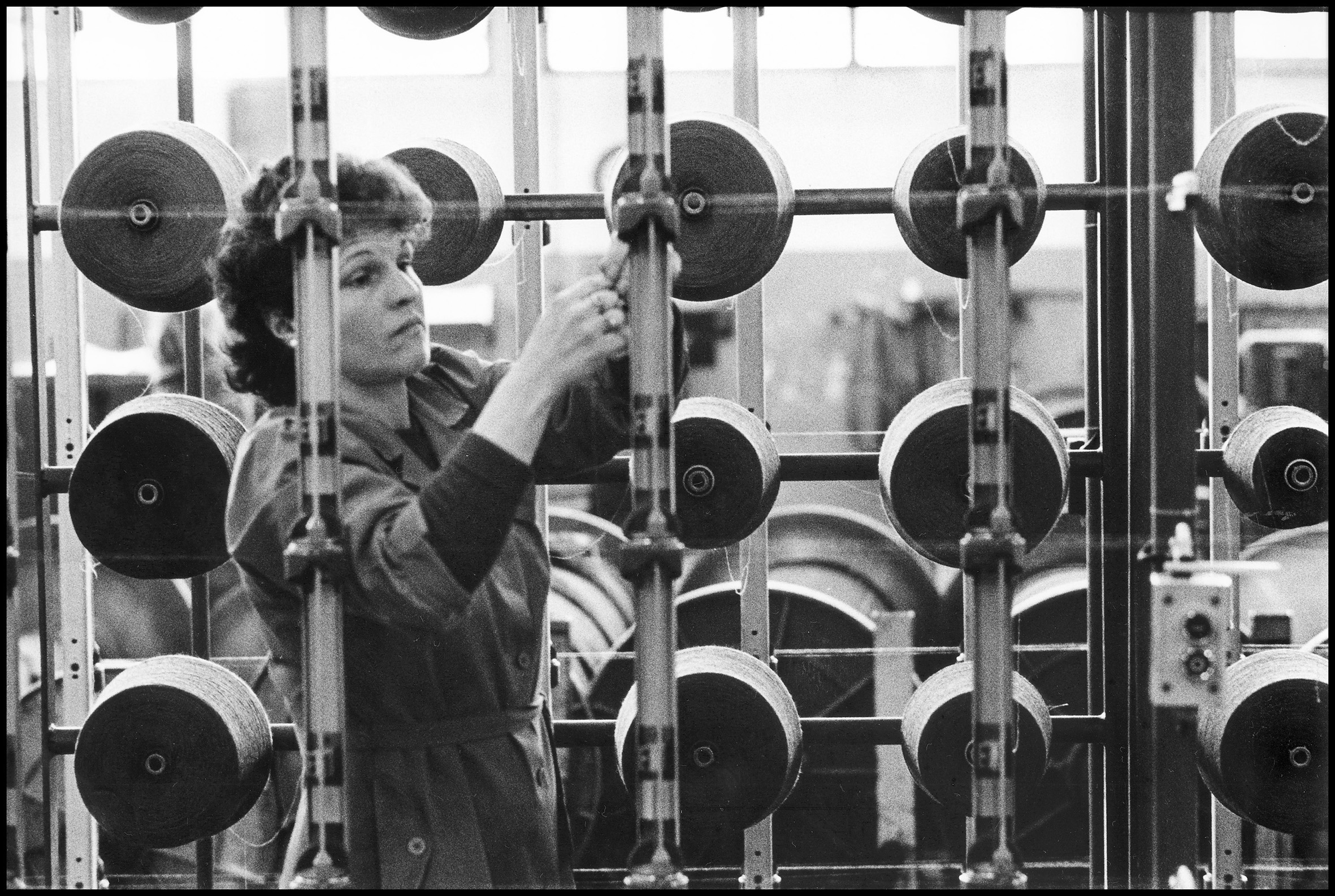
A great reporter, if anything, who throughout his life placed his work, his techniques, trade union struggles and the evolution of forms and methods at the heart of a kind of mission: to bear witness, to document, to tell the story. A novel of work through images. The photograph of the female worker amongst the spools at the Marzotto textile mill is one of the most beautiful in the book.
Thinking of Uliano, with his kind yet stern and sincere gaze, I am reminded of that fine description of a reporter that Ryszard Kapuscinski gives of himself: ‘A cynic is not cut out for this profession’
There is a widespread recognition that work is central to the Republic, as enshrined in Article 1 of its founding document, the Constitution. And a strong belief in the ethics of hope, achieved precisely through work, for a better quality of life.
That man, who had emigrated from a small Sardinian village, standing there in all his strength, laden with suitcases, in front of the Pirelli Tower in the autumn of 1968, as he waited for the tram that would take him to Rho and from there to the factory, is the perfect symbol of this.
A photographer, such as Uliano Lucas, who focuses on the essence of the image, can also be a true, great poet.
(Photo: Uliano Lucas, Lanificio Marzotto, Valdagno (Vicenza), 1988)