

Quality of life means well-being and values, and therefore Europe, security and development
What is quality of life? Widespread prosperity, skilled and well-paid work, comfortable housing, effective services for health, schooling, culture and sport. And then a condition that stimulates enterprise and innovation, a civilised and safe environment, the possibility to plan a better future for oneself and one’s children. In short, a life that is pleasant, free and worth living. Come to think of it, much of what Italy generally offers, despite its shadows and disparities. Even if we do like to attribute to this country of ours the definition that Benedetto Croce gave to Naples, in the wake of European travellers on the Grand Tour: ‘A paradise inhabited by devils’.
However, quality of life cannot be assessed only in the microcosm of the local community, in the ‘overland’ Italy, or in the dimension of the ‘particular’ at a time of dramatic crises in geopolitical relations, fractures in international trade, and resounding productive and social upheavals caused by digital technologies. It is linked to major themes such as freedom, social inclusion, and strengthening democracy, which is being undermined by authoritarian forces. Thus, it is also linked to the revival of Europe, an area that, during the second half of the 20th century, developed, experimented with and grew the model of an original synthesis between liberal democracy, the market economy and welfare; between freedom, innovation and solidarity.
Quality of life indeed. So it is worth thinking not only about ‘what we are not, what we do not want’, but also about political and social projects worth considering and realising, in the name of a better human and civilised condition.
Let us look at Italy, then, putting aside stereotypes, prejudices and clichés. Recent surveys provide us with data and analyses to help, including the annual quality of life ranking from Il Sole 24 Ore (1 December), the Censis report on the social state of the country (5 December), and ISTAT data on the economy, employment and wages.
Let us take a closer look, starting with the ‘well-being maps’ of Il Sole 24 Ore (the first edition of the census dates back to 1990). Trento, Bolzano and Udine lead the way, with the business newspaper proclaiming the ‘triumph of the Alpine arc’. Then come Bologna, Bergamo, Treviso and Verona. Milan is eighth, having recovered four positions since last year, although it drops to second-to-last place for ‘safety’. It is followed by Padua, Parma, and so on for all 107 Italian provinces.
One noteworthy fact is that Siena, ranked 21st overall, has the highest quality of life for women. This is a situation that political, economic and social forces would do well to carefully reflect on, given that the gender gap is closing too slowly and is one of the most negative aspects of the situation in Italy.
Reggio Calabria is at the bottom of the list again this year, preceded by Syracuse, Crotone and Naples. As always, the south is performing poorly: to find the best-placed southern city in the ranking, one has to go to 39th place with Cagliari, while Bari is 67th and Palermo 97th. Rome, the capital, is in 46th place, having gained 13 places over last year.
The 90 indicators used take into account wealth and consumption, business and work, demographics, society and health, the environment and services, justice and security, and culture and leisure. In-depth analysis is provided by gender, age and social conditions. This year’s analyses show a country that is still divided, but is slowly improving, despite the ongoing issues of stark inequalities, ageing populations, demographic stagnation, young people leaving the country, low wages and hardship. And in the most dynamic and attractive metropolitan areas, social problems are growing, starting with housing.
In the opinion of many Europeans, Italy is a country where people live well, thanks to a comprehensive welfare system (especially with regard to social security) and a national health system that works better than elsewhere, partly due to the public-private partnership.
And yet, widespread discontent is growing. ‘The winter of our discontent’, to quote the opening lines of Shakespeare’s Richard III, is gaining more and more supporters. Social unrest is becoming increasingly acute, especially among the middle classes, who feel they have lost purchasing power and are experiencing a deterioration in living conditions. ‘Wages in a nosedive: -8.8% compared to 2021,’ writes La Stampa on 6 December, citing Istat data. Wages will grow slightly this year, thanks in part to labour contracts being renewed, but not enough to close the gap that separates us from the rest of productive Europe.
These issues are reflected in the findings of the 59th annual Censis Report, which portrays a disheartened Italy that is struggling to make ends meet, is disillusioned with current politics and is increasingly abstaining from elections (at the last regional elections, for example, less than half of the electorate voted). Most worryingly of all, 30% of respondents expressed their support for autocrats such as Putin, Orbán, Erdoğan, Xi Jinping and Trump. In short, democracy is in a bad way. The perceived poor quality of life and loss of hope are undermining its foundations.
The preferred international leader is Pope Leo XIV, with 66.7% support.
In their free time, Italians have a lot of sex (62.5% declare having very frequent relationships, even ‘virtual’ ones). They spend a lot of money on smartphones, but not on books. They complain about low incomes, and they age badly.
What’s going on? ‘Politics no longer knows how to listen; it only looks at the polls, and it neglects the middle class. And yet, it is precisely these people who have resisted fears and decline and worked to save Italy’, comments Giuseppe De Rita, president of Censis, who has always been a keen critic and observer of the changes in our social situation (La Stampa, 7 December). Politicians and trade unions would do well to listen to him. It is the salaried middle class, especially the industrial middle class, that acts as the connective tissue of our industries, providing ideas and manpower to companies striving to grow and emerge from the crisis.
Chiara Saraceno, a sophisticated sociologist, offers an insightful summary, emphasising ‘the mistrust in Europe and welfare, with 78.5% having no confidence in essential health services in a country that lives from day to day. Deindustrialisation is taking its toll, and a growing segment of society is becoming impoverished.’
What would it take to change things? Rebuilding trust in employment, especially among young people, in politics, in good administration, in enterprise and business, and in opportunities to build a better future, also to better cope with demographic decline and the ‘brain drain abroad’, and to attract capital and investment, and promote creative intelligence.
Therefore, the Treccani Institute is right to choose ‘trust’ as its word of the year, based on the number of clicks from young people on its website.
Trust is a personal horizon, and above all it is political and professional.
Trust that Italy will succeed. Above all, it is a matter of trust in Europe, precisely at a time when the EU is experiencing deep difficulties and crisis.
Here is another point to consider: Europe’s future and responsibilities, starting with the US National Security Strategy document that has been causing a stir in international, and especially European, public opinion for a few days now. It affirms ‘the economic decline of Europe and the real and even darker prospect of the erasure of civilisation’, which is being undermined ‘by unstable minority governments trampling on the principles of democracy to suppress opposition’, while the EU ‘undermines political freedom and sovereignty’. Sovereignty that must be returned to nation states, with the end of the EU.
It is the formalised (but far from unexpected) fracture of the West as we knew it in 20th-century liberal democracies, and the realisation of Europe’s isolation with regard to its own security. It is also the crisis of the union between freedom and welfare that we discussed at the beginning, when we were under the protective military umbrella of the US and NATO.
Now, in order to defend and revive those European values, the EU ‘dances alone’ and must learn to survive. In the face of what Corriere della Sera (8 December) calls the ‘Putin-Trump Axis on Europe’, the Kremlin having declared its full agreement with the US document’s positions, La Stampa (8 December) speaks of ‘Atlantic Divorce’, while Quotidiano Nazionale (Il Resto del Carlino, La Nazione and Il Giorno) headlines ‘Europe under siege’. Moscow declares, ‘We are with Trump’, and La Repubblica also headlines ‘Europe under siege’.
What should be done? The comments in major Italian newspapers between Saturday and Monday were already indicative of both the unease and the need for a clear reaction. Antonio Polito, writing in Corriere della Sera, quotes Mark Twain as saying that ‘the news about the death of Europe seems grossly exaggerated’, even though the crisis must be tackled with foresight and responsibility. This requires opposition to the pro-Putin and pro-MAGA populist movement within Europe. This is a difficult political and cultural battle, but Europe is not without resources to fight it.
Andrea Malaguti, writing in La Stampa, calls for ‘a return to the solidarity of the countries that created the European Union’, without ambiguity, in order to carry more weight within NATO and relaunch Europe as an economic power and a major international player. He suggests starting with the implementation of the Draghi Plan. Agnese Pini, writing in Quotidiano Nazionale, notes that ‘we must make transparency and the rule of law our identity because the strength of Europe is not a mythical past or ethnic homogeneity, but the promise of equal rights for all, including minorities’. In short, to build an ‘alternative narrative of European civilisation’ and to ‘stop seeing ourselves as an appendage of someone else’s world’.
Europe must be reformed, strengthened, freed from bureaucracy and relaunched, without breaking ties with the US or considering running NATO alone (we cannot afford it and don’t have the technological or militarily capability). However, we must insist on our autonomy, and the relationship between the EU and Britain is essential in this respect. In Il Sole24Ore, Sergio Fabbrini discusses ‘European defence in the post-American era’, exploring ways to maintain security and democracy while engaging in dialogue with other international players interested in achieving global balance, as an alternative to the current rough confrontation between the US, China and Russia.
In short, it is a question of values and freedom. This is certainly a new course for the EU. We should remember Jean Monnet‘s lesson that Europe has always found a way to relaunch itself in the face of difficulties.
Thus, it is worth listening to Jürgen Habermas, one of the most influential German political philosophers and one of the fathers of 20th-century democratic thought. Europe is alone, caught between Chinese expansion and Trump’s hollowed-out democracy. Therefore, ‘further political integration, at least at the heart of the European Union, has never been so vital to our survival as it is today, yet has never seemed so unlikely’ (from a lecture delivered on 19 November at the Siemens Foundation in Munich). Habermas is right, as is another great European thinker, Michel Foucault, who said, ‘Freedom is not something you possess; it is something you practise’. What we need now is a liberal and democratic vision and a reconstruction of trust.
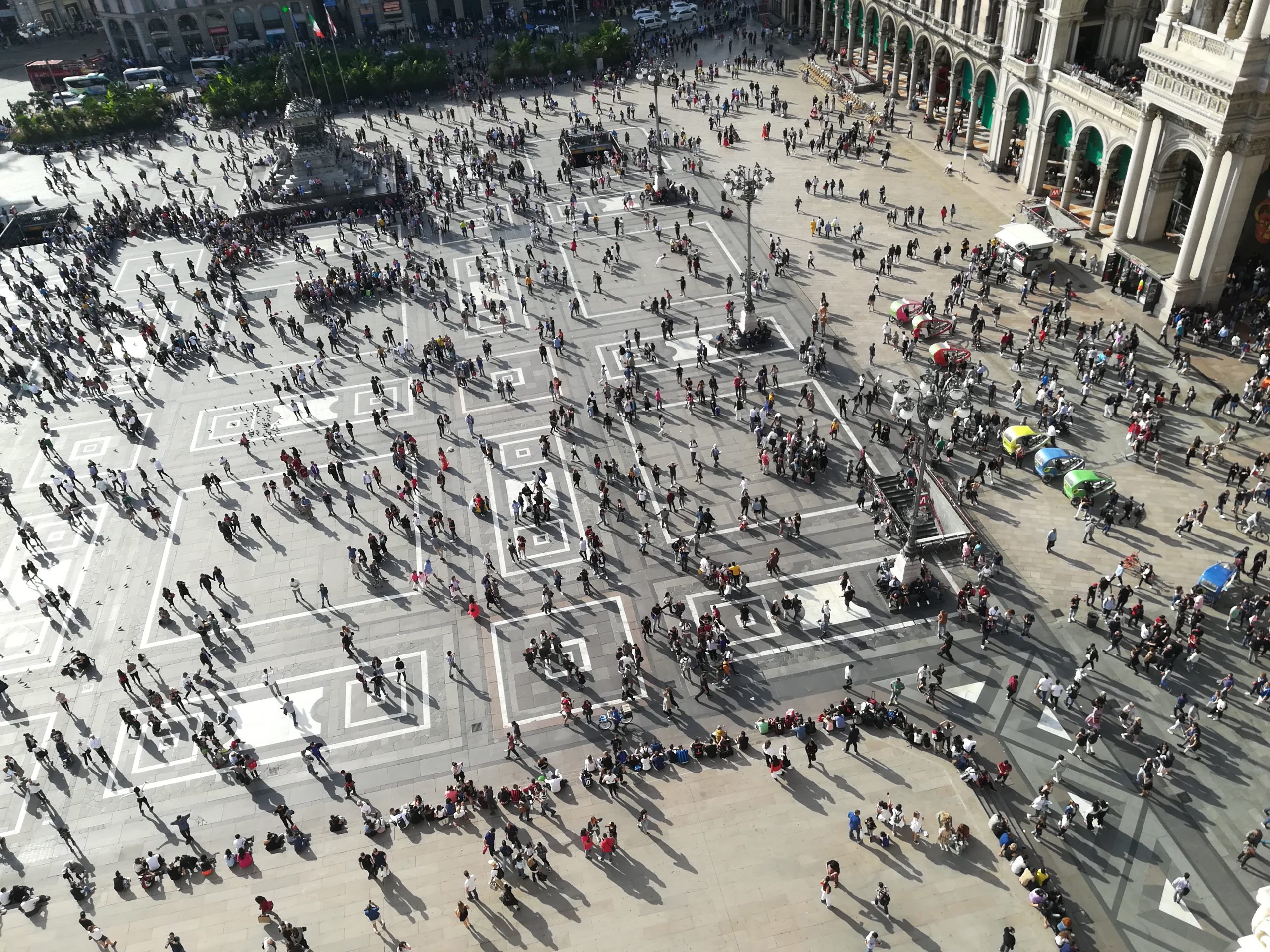
(photo Getty images)
What is quality of life? Widespread prosperity, skilled and well-paid work, comfortable housing, effective services for health, schooling, culture and sport. And then a condition that stimulates enterprise and innovation, a civilised and safe environment, the possibility to plan a better future for oneself and one’s children. In short, a life that is pleasant, free and worth living. Come to think of it, much of what Italy generally offers, despite its shadows and disparities. Even if we do like to attribute to this country of ours the definition that Benedetto Croce gave to Naples, in the wake of European travellers on the Grand Tour: ‘A paradise inhabited by devils’.
However, quality of life cannot be assessed only in the microcosm of the local community, in the ‘overland’ Italy, or in the dimension of the ‘particular’ at a time of dramatic crises in geopolitical relations, fractures in international trade, and resounding productive and social upheavals caused by digital technologies. It is linked to major themes such as freedom, social inclusion, and strengthening democracy, which is being undermined by authoritarian forces. Thus, it is also linked to the revival of Europe, an area that, during the second half of the 20th century, developed, experimented with and grew the model of an original synthesis between liberal democracy, the market economy and welfare; between freedom, innovation and solidarity.
Quality of life indeed. So it is worth thinking not only about ‘what we are not, what we do not want’, but also about political and social projects worth considering and realising, in the name of a better human and civilised condition.
Let us look at Italy, then, putting aside stereotypes, prejudices and clichés. Recent surveys provide us with data and analyses to help, including the annual quality of life ranking from Il Sole 24 Ore (1 December), the Censis report on the social state of the country (5 December), and ISTAT data on the economy, employment and wages.
Let us take a closer look, starting with the ‘well-being maps’ of Il Sole 24 Ore (the first edition of the census dates back to 1990). Trento, Bolzano and Udine lead the way, with the business newspaper proclaiming the ‘triumph of the Alpine arc’. Then come Bologna, Bergamo, Treviso and Verona. Milan is eighth, having recovered four positions since last year, although it drops to second-to-last place for ‘safety’. It is followed by Padua, Parma, and so on for all 107 Italian provinces.
One noteworthy fact is that Siena, ranked 21st overall, has the highest quality of life for women. This is a situation that political, economic and social forces would do well to carefully reflect on, given that the gender gap is closing too slowly and is one of the most negative aspects of the situation in Italy.
Reggio Calabria is at the bottom of the list again this year, preceded by Syracuse, Crotone and Naples. As always, the south is performing poorly: to find the best-placed southern city in the ranking, one has to go to 39th place with Cagliari, while Bari is 67th and Palermo 97th. Rome, the capital, is in 46th place, having gained 13 places over last year.
The 90 indicators used take into account wealth and consumption, business and work, demographics, society and health, the environment and services, justice and security, and culture and leisure. In-depth analysis is provided by gender, age and social conditions. This year’s analyses show a country that is still divided, but is slowly improving, despite the ongoing issues of stark inequalities, ageing populations, demographic stagnation, young people leaving the country, low wages and hardship. And in the most dynamic and attractive metropolitan areas, social problems are growing, starting with housing.
In the opinion of many Europeans, Italy is a country where people live well, thanks to a comprehensive welfare system (especially with regard to social security) and a national health system that works better than elsewhere, partly due to the public-private partnership.
And yet, widespread discontent is growing. ‘The winter of our discontent’, to quote the opening lines of Shakespeare’s Richard III, is gaining more and more supporters. Social unrest is becoming increasingly acute, especially among the middle classes, who feel they have lost purchasing power and are experiencing a deterioration in living conditions. ‘Wages in a nosedive: -8.8% compared to 2021,’ writes La Stampa on 6 December, citing Istat data. Wages will grow slightly this year, thanks in part to labour contracts being renewed, but not enough to close the gap that separates us from the rest of productive Europe.
These issues are reflected in the findings of the 59th annual Censis Report, which portrays a disheartened Italy that is struggling to make ends meet, is disillusioned with current politics and is increasingly abstaining from elections (at the last regional elections, for example, less than half of the electorate voted). Most worryingly of all, 30% of respondents expressed their support for autocrats such as Putin, Orbán, Erdoğan, Xi Jinping and Trump. In short, democracy is in a bad way. The perceived poor quality of life and loss of hope are undermining its foundations.
The preferred international leader is Pope Leo XIV, with 66.7% support.
In their free time, Italians have a lot of sex (62.5% declare having very frequent relationships, even ‘virtual’ ones). They spend a lot of money on smartphones, but not on books. They complain about low incomes, and they age badly.
What’s going on? ‘Politics no longer knows how to listen; it only looks at the polls, and it neglects the middle class. And yet, it is precisely these people who have resisted fears and decline and worked to save Italy’, comments Giuseppe De Rita, president of Censis, who has always been a keen critic and observer of the changes in our social situation (La Stampa, 7 December). Politicians and trade unions would do well to listen to him. It is the salaried middle class, especially the industrial middle class, that acts as the connective tissue of our industries, providing ideas and manpower to companies striving to grow and emerge from the crisis.
Chiara Saraceno, a sophisticated sociologist, offers an insightful summary, emphasising ‘the mistrust in Europe and welfare, with 78.5% having no confidence in essential health services in a country that lives from day to day. Deindustrialisation is taking its toll, and a growing segment of society is becoming impoverished.’
What would it take to change things? Rebuilding trust in employment, especially among young people, in politics, in good administration, in enterprise and business, and in opportunities to build a better future, also to better cope with demographic decline and the ‘brain drain abroad’, and to attract capital and investment, and promote creative intelligence.
Therefore, the Treccani Institute is right to choose ‘trust’ as its word of the year, based on the number of clicks from young people on its website.
Trust is a personal horizon, and above all it is political and professional.
Trust that Italy will succeed. Above all, it is a matter of trust in Europe, precisely at a time when the EU is experiencing deep difficulties and crisis.
Here is another point to consider: Europe’s future and responsibilities, starting with the US National Security Strategy document that has been causing a stir in international, and especially European, public opinion for a few days now. It affirms ‘the economic decline of Europe and the real and even darker prospect of the erasure of civilisation’, which is being undermined ‘by unstable minority governments trampling on the principles of democracy to suppress opposition’, while the EU ‘undermines political freedom and sovereignty’. Sovereignty that must be returned to nation states, with the end of the EU.
It is the formalised (but far from unexpected) fracture of the West as we knew it in 20th-century liberal democracies, and the realisation of Europe’s isolation with regard to its own security. It is also the crisis of the union between freedom and welfare that we discussed at the beginning, when we were under the protective military umbrella of the US and NATO.
Now, in order to defend and revive those European values, the EU ‘dances alone’ and must learn to survive. In the face of what Corriere della Sera (8 December) calls the ‘Putin-Trump Axis on Europe’, the Kremlin having declared its full agreement with the US document’s positions, La Stampa (8 December) speaks of ‘Atlantic Divorce’, while Quotidiano Nazionale (Il Resto del Carlino, La Nazione and Il Giorno) headlines ‘Europe under siege’. Moscow declares, ‘We are with Trump’, and La Repubblica also headlines ‘Europe under siege’.
What should be done? The comments in major Italian newspapers between Saturday and Monday were already indicative of both the unease and the need for a clear reaction. Antonio Polito, writing in Corriere della Sera, quotes Mark Twain as saying that ‘the news about the death of Europe seems grossly exaggerated’, even though the crisis must be tackled with foresight and responsibility. This requires opposition to the pro-Putin and pro-MAGA populist movement within Europe. This is a difficult political and cultural battle, but Europe is not without resources to fight it.
Andrea Malaguti, writing in La Stampa, calls for ‘a return to the solidarity of the countries that created the European Union’, without ambiguity, in order to carry more weight within NATO and relaunch Europe as an economic power and a major international player. He suggests starting with the implementation of the Draghi Plan. Agnese Pini, writing in Quotidiano Nazionale, notes that ‘we must make transparency and the rule of law our identity because the strength of Europe is not a mythical past or ethnic homogeneity, but the promise of equal rights for all, including minorities’. In short, to build an ‘alternative narrative of European civilisation’ and to ‘stop seeing ourselves as an appendage of someone else’s world’.
Europe must be reformed, strengthened, freed from bureaucracy and relaunched, without breaking ties with the US or considering running NATO alone (we cannot afford it and don’t have the technological or militarily capability). However, we must insist on our autonomy, and the relationship between the EU and Britain is essential in this respect. In Il Sole24Ore, Sergio Fabbrini discusses ‘European defence in the post-American era’, exploring ways to maintain security and democracy while engaging in dialogue with other international players interested in achieving global balance, as an alternative to the current rough confrontation between the US, China and Russia.
In short, it is a question of values and freedom. This is certainly a new course for the EU. We should remember Jean Monnet‘s lesson that Europe has always found a way to relaunch itself in the face of difficulties.
Thus, it is worth listening to Jürgen Habermas, one of the most influential German political philosophers and one of the fathers of 20th-century democratic thought. Europe is alone, caught between Chinese expansion and Trump’s hollowed-out democracy. Therefore, ‘further political integration, at least at the heart of the European Union, has never been so vital to our survival as it is today, yet has never seemed so unlikely’ (from a lecture delivered on 19 November at the Siemens Foundation in Munich). Habermas is right, as is another great European thinker, Michel Foucault, who said, ‘Freedom is not something you possess; it is something you practise’. What we need now is a liberal and democratic vision and a reconstruction of trust.
(photo Getty images)