


There is still space in the night of Europe to invest in safety and our values
‘Watchman, what is left of the night?’ The question posed in the Book of Isaiah (21:11-12) resurfaces whenever we need to find answers to fear and uncertainty, and to the dramatic turning points of life that accompany extremely difficult human and social conditions. It is a desperate appeal against anguish, loneliness and the unknown.
Yes, ‘what is left of the night?’ The watchman’s answer is ambiguous: ‘Morning has come, but also the night. If you would inquire, then inquire. Come back yet again’.
In short, our journey to the end of the night will eventually come to an end, but how? It is by no means certain that dawn will bring better times, but there is hope, and there is defeat. One thing remains certain: we must ‘ask’, that is, get busy, choose, understand the meaning of what has been done and try to change the course of time. The words of Shakespeare, spoken by Ophelia in Hamlet, come to mind: ‘I leave you rosemary for remembrance, violets for thoughts…’
How much night remains for Europe, caught between the abandonment theorised in the White House National Security Document of the Trump administration and Putin’s aggression, heavy strategic competition with Beijing’s economy, and internal tensions between nationalistic selfishness, bureaucratic stupidity, and a lack of political culture regarding the future?
The rosemary for remembrance speaks of a time when Europe was proud of its economic power. Sheltered by the security guaranteed at low cost by NATO, and therefore above all by the US, Europe was able to strengthen its democratic systems and expand investment in well-being, quality of life, and welfare systems. Europe, on the whole, was a happy part of the world: a cultured and civilised space in the West where democracy, free enterprise, sophisticated culture and social solidarity flourished. There was also manufacturing Europe: the success of technè and know-how; the wonder of technology; the beauty of Bauhaus-inspired design; and a soft power presumed to be envied around the world. Good culture often stimulates arrogance, and there was also the sophisticated critical thinking of the Frankfurt School. What more could you ask for? Almost no one thought about the night watchman anymore.
Then everything changed, and not for the better. The violets now speak of profound anguish because ‘positive’ and ‘integrated’ globalisation has collapsed and been replaced by unruly and overbearing free trade (trade agreements that are well-written and observed, the pursuit of mutual benefit, sustainability agreements and ‘gentlemen’s agreements’ that are attentive to the common interest and values in order to build economic value). Today, Joseph Nye‘s concept of soft power (cultural diplomacy, building positive relationships, multilateral appeal, empathy based on shared interests and values, and the authoritative role of international organisations) is studied, remembered, praised and mourned, especially a few months after his death in May this year. However, it is also sidelined in the libraries of the new powerful lovers of hard power, especially high-tech hard power.
Here we are again at the darkest point of the night. Russia’s invasion of Ukraine three years ago shattered the positive relations between the EU and Moscow, putting an end to the convenience of low-cost energy, a favourable condition, especially for German industry, which is a major consumer of Russian natural gas. Tensions in the Middle East, such as Hamas’ deadly aggression and Israel’s harsh military response resulting in tens of thousands of civilian casualties in Gaza, including thousands of children, have exacerbated the climate of hostility. After eighty years of peace, Europe has found itself at the centre of a series of conflicts. Moreover, we have done everything we could to avoid fully understanding the deadly lessons that came to us from the wars and massacres in the Balkans in the nineties.
The situation is becoming increasingly bleak for us Europeans. The West seems to no longer exist, with the USA on one side and Europe on the other. ‘Is the West still a community of destiny?’ asks Andrea Malaguti with concern (La Stampa, 14 December). More precisely, the White House seems ready to talk about Europe, but only in terms of individual states with which to cherry-pick agreements and deals. The EU is never taken into account in the strategic document we mentioned at the beginning.
This anti-United Europe stance has old, authoritative roots: ‘ What is Europe’s telephone number?’ Henry Kissinger, the US Secretary of State in the 1970s, used to joke.
‘The EU is going the wrong way’ is one of Trump’s most recent and harshest criticisms of Europe’s stance on Ukraine. Authoritative commentators recall that Trump considers ‘Europe an enemy’ (Nathalie Tocci in La Stampa on 12 December) and ‘some European parties true enemies of civilisation’ (Yascha Mounk, also in La Stampa). Giuliano da Empoli writes in the same publication, ‘We are at the end of the West, and Europe is just whistling. Thus, the imperial logic is reborn.’ Germano Dottori, an analyst at Limes, claims, ‘Donald wants to weaken Europe. He could reach an agreement with Moscow and move towards a new Yalta’ (Quotidiano Nazionale/Il Resto del Carlino, 12 December).
Tensions, dialogue, changes of pace, certainly, uncertainties, which Putin is leveraging to strengthen his position in complex diplomacy.
Giovanni Orsina, a historian at Luiss University, is confident overall: ‘The US and the EU have a deep bond; breaking up is not possible’ (National Daily/Il Resto del Carlino, 12 December). And the Italian government is certainly convinced too, as evidenced by a statement from Prime Minister Giorgia Meloni that ‘unity between the EU and Washington is crucial for a just peace in Ukraine’ (Corriere della Sera, 9 December).
So, how is Europe responding? What is the EU doing? Is it really aware of the very serious crisis we are going through, which requires strong, strategic and politically challenging choices?
From this point of view, too, careful reading of the newspapers helps us to understand. We are living in dramatic times; democracy is at stake. Europe must wake up and react,’ claims Michael Ignatieff, Professor of History at Harvard (La Repubblica, 9 December). And Giampiero Massolo, former Secretary General of the Farnesina, is convinced that ‘the EU is not on the margins, there are countries capable of cooperating’ (Quotidiano Nazionale/Il Resto del Carlino, 9 December). And Mounk adds, ‘The EU must restart from the Draghi plan’, i.e. from the ambitious project of building the single market, and from a trillion-euro annual investment over ten years to strengthen Europe’s strategic autonomy, security (including energy), innovation and industry. Bernard Guetta clarifies, ‘Europe is a strong and advanced economic power. That’s why it’s Trump’s target. But it must bridge an enormous gap and attract democracies that no longer wish to submit to the USA and China’ (La Stampa, 14 December).
The EU is not, in other words, on the margins, even if it is in considerable difficulty: it is weak and internally divided, and still reeling from the controversial positions of its main historical ally, the USA.
Ferruccio de Bortoli is right when he writes, ‘We Europeans are educated but weak’ (Corriere della Sera, 9 December), and he is right to recall our strengths: the rule of law, the achievements of the market economy and civil values. He insists that those who govern in Brussels and the capitals of major European countries must not abdicate their responsibilities, and must defend democracy, autonomy and strategic security, starting with freedom and security in Ukraine. However, Massolo argues that ‘in the security sector, Europe’s defence depends more on collaboration between willing governments (including British and Asian partners) than on EU institutions’. And the US cannot be done without for the foreseeable future’ (Corriere della Sera, 14 December).
In recent debates, figures such as Mario Monti and Romano Prodi have reiterated the urgency of Europe making its own security choices in dialogue with the US, while being fully aware of its own strengths, including ethical, cultural and economic ones. Renowned economist Marcello Messori hopes for ‘more EU cooperation to counter Trump’s anti-integration plan’ (Il Sole 24 Ore, 12 December). A number of prominent European figures, including Jacques Attali, Pascal Lamy, Enrico Letta, Paolo Gentiloni, Josep Borrell and Javier Cercas, have signed a manifesto reiterating the urgent need for action on ‘European independence’.
It’s a tough challenge, but it’s important to be clear (as the saying goes, a pessimist is an optimist with experience). Yet historical experience teaches us that it is precisely in difficult times that unexpected leaders emerge from the ruling class, capable of taking responsibility and defending their rights.
It is often said that cinema is a factory of illusions, but it can also offer glimpses of truth and possibility. The future will reflect on it. ‘Darkest Hour’ is an excellent 2017 film directed by Joe Wright and starring Gary Oldman in a masterful performance. And it tells the story of how, during the tragic hours following the defeat at Dunkirk, Winston Churchill was faced with a dramatic decision: whether to yield to pressure from large sections of his party and negotiate a peace with Hitler, or to resist. He is confronted with a frightened, confused and distrustful Parliament, and in the end they are dragged along the line of continuing the war against the Nazis. Parliament approves with deep conviction, and his main opponent, Lord Halifax, is forced to admit, ‘Churchill mobilised the English language and sent it into battle’.
It was not a victory of clever rhetoric, but of democratic, political and civil values. This is a true ‘warning to Europe’, to use Thomas Mann‘s words,
and we are in times of this magnitude. The night of Isaiah’s vigilant watchman certainly cannot lead to European defeat.
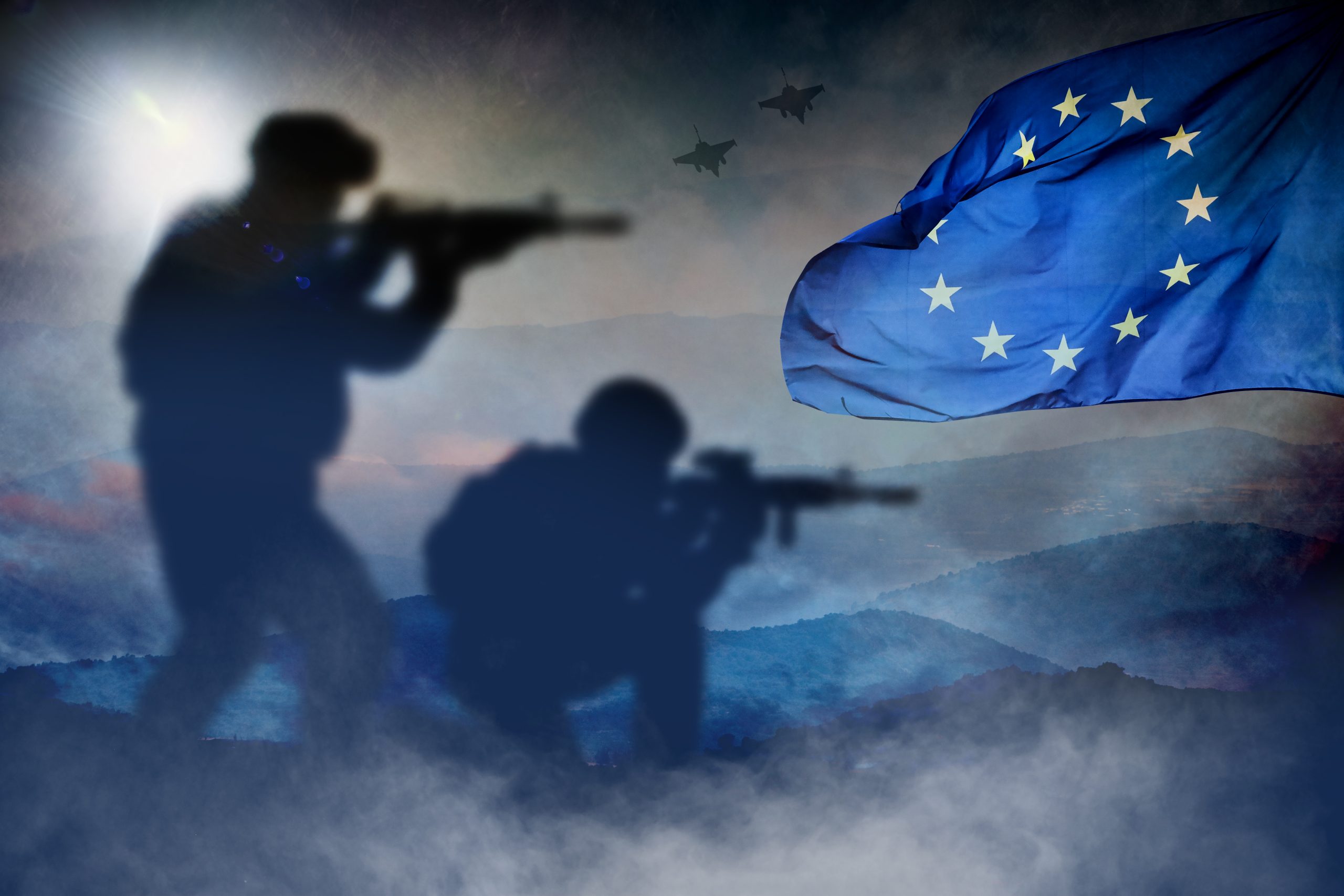
(photo Getty Images)
‘Watchman, what is left of the night?’ The question posed in the Book of Isaiah (21:11-12) resurfaces whenever we need to find answers to fear and uncertainty, and to the dramatic turning points of life that accompany extremely difficult human and social conditions. It is a desperate appeal against anguish, loneliness and the unknown.
Yes, ‘what is left of the night?’ The watchman’s answer is ambiguous: ‘Morning has come, but also the night. If you would inquire, then inquire. Come back yet again’.
In short, our journey to the end of the night will eventually come to an end, but how? It is by no means certain that dawn will bring better times, but there is hope, and there is defeat. One thing remains certain: we must ‘ask’, that is, get busy, choose, understand the meaning of what has been done and try to change the course of time. The words of Shakespeare, spoken by Ophelia in Hamlet, come to mind: ‘I leave you rosemary for remembrance, violets for thoughts…’
How much night remains for Europe, caught between the abandonment theorised in the White House National Security Document of the Trump administration and Putin’s aggression, heavy strategic competition with Beijing’s economy, and internal tensions between nationalistic selfishness, bureaucratic stupidity, and a lack of political culture regarding the future?
The rosemary for remembrance speaks of a time when Europe was proud of its economic power. Sheltered by the security guaranteed at low cost by NATO, and therefore above all by the US, Europe was able to strengthen its democratic systems and expand investment in well-being, quality of life, and welfare systems. Europe, on the whole, was a happy part of the world: a cultured and civilised space in the West where democracy, free enterprise, sophisticated culture and social solidarity flourished. There was also manufacturing Europe: the success of technè and know-how; the wonder of technology; the beauty of Bauhaus-inspired design; and a soft power presumed to be envied around the world. Good culture often stimulates arrogance, and there was also the sophisticated critical thinking of the Frankfurt School. What more could you ask for? Almost no one thought about the night watchman anymore.
Then everything changed, and not for the better. The violets now speak of profound anguish because ‘positive’ and ‘integrated’ globalisation has collapsed and been replaced by unruly and overbearing free trade (trade agreements that are well-written and observed, the pursuit of mutual benefit, sustainability agreements and ‘gentlemen’s agreements’ that are attentive to the common interest and values in order to build economic value). Today, Joseph Nye‘s concept of soft power (cultural diplomacy, building positive relationships, multilateral appeal, empathy based on shared interests and values, and the authoritative role of international organisations) is studied, remembered, praised and mourned, especially a few months after his death in May this year. However, it is also sidelined in the libraries of the new powerful lovers of hard power, especially high-tech hard power.
Here we are again at the darkest point of the night. Russia’s invasion of Ukraine three years ago shattered the positive relations between the EU and Moscow, putting an end to the convenience of low-cost energy, a favourable condition, especially for German industry, which is a major consumer of Russian natural gas. Tensions in the Middle East, such as Hamas’ deadly aggression and Israel’s harsh military response resulting in tens of thousands of civilian casualties in Gaza, including thousands of children, have exacerbated the climate of hostility. After eighty years of peace, Europe has found itself at the centre of a series of conflicts. Moreover, we have done everything we could to avoid fully understanding the deadly lessons that came to us from the wars and massacres in the Balkans in the nineties.
The situation is becoming increasingly bleak for us Europeans. The West seems to no longer exist, with the USA on one side and Europe on the other. ‘Is the West still a community of destiny?’ asks Andrea Malaguti with concern (La Stampa, 14 December). More precisely, the White House seems ready to talk about Europe, but only in terms of individual states with which to cherry-pick agreements and deals. The EU is never taken into account in the strategic document we mentioned at the beginning.
This anti-United Europe stance has old, authoritative roots: ‘ What is Europe’s telephone number?’ Henry Kissinger, the US Secretary of State in the 1970s, used to joke.
‘The EU is going the wrong way’ is one of Trump’s most recent and harshest criticisms of Europe’s stance on Ukraine. Authoritative commentators recall that Trump considers ‘Europe an enemy’ (Nathalie Tocci in La Stampa on 12 December) and ‘some European parties true enemies of civilisation’ (Yascha Mounk, also in La Stampa). Giuliano da Empoli writes in the same publication, ‘We are at the end of the West, and Europe is just whistling. Thus, the imperial logic is reborn.’ Germano Dottori, an analyst at Limes, claims, ‘Donald wants to weaken Europe. He could reach an agreement with Moscow and move towards a new Yalta’ (Quotidiano Nazionale/Il Resto del Carlino, 12 December).
Tensions, dialogue, changes of pace, certainly, uncertainties, which Putin is leveraging to strengthen his position in complex diplomacy.
Giovanni Orsina, a historian at Luiss University, is confident overall: ‘The US and the EU have a deep bond; breaking up is not possible’ (National Daily/Il Resto del Carlino, 12 December). And the Italian government is certainly convinced too, as evidenced by a statement from Prime Minister Giorgia Meloni that ‘unity between the EU and Washington is crucial for a just peace in Ukraine’ (Corriere della Sera, 9 December).
So, how is Europe responding? What is the EU doing? Is it really aware of the very serious crisis we are going through, which requires strong, strategic and politically challenging choices?
From this point of view, too, careful reading of the newspapers helps us to understand. We are living in dramatic times; democracy is at stake. Europe must wake up and react,’ claims Michael Ignatieff, Professor of History at Harvard (La Repubblica, 9 December). And Giampiero Massolo, former Secretary General of the Farnesina, is convinced that ‘the EU is not on the margins, there are countries capable of cooperating’ (Quotidiano Nazionale/Il Resto del Carlino, 9 December). And Mounk adds, ‘The EU must restart from the Draghi plan’, i.e. from the ambitious project of building the single market, and from a trillion-euro annual investment over ten years to strengthen Europe’s strategic autonomy, security (including energy), innovation and industry. Bernard Guetta clarifies, ‘Europe is a strong and advanced economic power. That’s why it’s Trump’s target. But it must bridge an enormous gap and attract democracies that no longer wish to submit to the USA and China’ (La Stampa, 14 December).
The EU is not, in other words, on the margins, even if it is in considerable difficulty: it is weak and internally divided, and still reeling from the controversial positions of its main historical ally, the USA.
Ferruccio de Bortoli is right when he writes, ‘We Europeans are educated but weak’ (Corriere della Sera, 9 December), and he is right to recall our strengths: the rule of law, the achievements of the market economy and civil values. He insists that those who govern in Brussels and the capitals of major European countries must not abdicate their responsibilities, and must defend democracy, autonomy and strategic security, starting with freedom and security in Ukraine. However, Massolo argues that ‘in the security sector, Europe’s defence depends more on collaboration between willing governments (including British and Asian partners) than on EU institutions’. And the US cannot be done without for the foreseeable future’ (Corriere della Sera, 14 December).
In recent debates, figures such as Mario Monti and Romano Prodi have reiterated the urgency of Europe making its own security choices in dialogue with the US, while being fully aware of its own strengths, including ethical, cultural and economic ones. Renowned economist Marcello Messori hopes for ‘more EU cooperation to counter Trump’s anti-integration plan’ (Il Sole 24 Ore, 12 December). A number of prominent European figures, including Jacques Attali, Pascal Lamy, Enrico Letta, Paolo Gentiloni, Josep Borrell and Javier Cercas, have signed a manifesto reiterating the urgent need for action on ‘European independence’.
It’s a tough challenge, but it’s important to be clear (as the saying goes, a pessimist is an optimist with experience). Yet historical experience teaches us that it is precisely in difficult times that unexpected leaders emerge from the ruling class, capable of taking responsibility and defending their rights.
It is often said that cinema is a factory of illusions, but it can also offer glimpses of truth and possibility. The future will reflect on it. ‘Darkest Hour’ is an excellent 2017 film directed by Joe Wright and starring Gary Oldman in a masterful performance. And it tells the story of how, during the tragic hours following the defeat at Dunkirk, Winston Churchill was faced with a dramatic decision: whether to yield to pressure from large sections of his party and negotiate a peace with Hitler, or to resist. He is confronted with a frightened, confused and distrustful Parliament, and in the end they are dragged along the line of continuing the war against the Nazis. Parliament approves with deep conviction, and his main opponent, Lord Halifax, is forced to admit, ‘Churchill mobilised the English language and sent it into battle’.
It was not a victory of clever rhetoric, but of democratic, political and civil values. This is a true ‘warning to Europe’, to use Thomas Mann‘s words,
and we are in times of this magnitude. The night of Isaiah’s vigilant watchman certainly cannot lead to European defeat.
(photo Getty Images)