

La musica sbarca in fabbrica
19 September 2017

Accessibility Come visit us.
Find out moreHelp with your research To access the Historical Archive's documents and materials, please fill out the form to request an appointment.
Request an appointmentHelp with your research To access the Historical Archive's documents and materials, please fill out the form to request an appointment.
Request an appointmentThe Pirelli Foundation Educational Programs
Explore pathsCome visit us.
Come visit us.
To access the Historical Archive's documents and materials, please fill out the form to request an appointment.
Grazie per la tua richiesta
Riceverai una mail di conferma dell'avvenuta ricezione della richiesta e sarai ricontattato.
Grazie per la tua richiesta
Abbiamo ricevuto la tua richiesta. Sarai ricontattato dallo staff di Fondazione Pirelli Educational.
Grazie per la tua richiesta
Abbiamo ricevuto la tua richiesta. Sarai ricontattato al più presto.
A survey conducted by several authors reveals the situation, problems and perspectives of the Italian industrial system regarding Intangible assets
Production, well-being and profit are also achieved with intangible organisational assets. Indeed, corporate culture at the highest levels. Contributions, attitudes, approaches to the product and to its manufacturing process which are part of the heritage of every company and which give it a different imprinting depending on the circumstances, on the history and on the current condition of each manufacturing organisation. Training and sharing, therefore, but not just that. This is what – in synthetic terms – is summarised under the terms Intangible assets and which has been studied in a collective survey conducted by the INAPP (the Italian National Institute for the Analysis of Public Policies) which was established following the transformation of ISFOL with the role of checking and directing social and employment policies in Italy.
“Intangible assets survey. I risultati della Rilevazione statistica sugli investimenti intangibili delle imprese” (The results of the statistical survey on intangible investments of companies) is therefore a research conducted by several authors on one of the most important aspects of management and of the very essence of businesses.
Following a necessary classification of the state of affairs regarding intangible investments in Italy and in the rest of Europe, the survey immediately sets its cognitive objectives and investigates the characteristics of investments in corporate training. Attention is drawn to the levels of expenditure incurred by companies and the determining factors that lead to their investment choices, and then a closer look is taken at the situation of Italian companies concerning this aspect of their organisation and management. The text is not always easy to read, however it is facilitated by an extensive range of diagrams and tables (instructive, for example, is the diagram that relates the industrial sector investigated with the classification of the importance of intangible investments in terms of expenditure per employee).
What emerges is not a framework composed only of difficulties. The authors write: “If, on the one hand, intangible investments on the part of Italian companies have not yet reached an optimal level, on the other a growing awareness is spreading among companies as to the importance of these investments to improve their performance objectives in terms of competitiveness and internationalisation”.Corporate culture that therefore grows and evolves. With everything that still remains to be done. Indeed, the authors go on to write: “Corporate training is the most widespread intangible activity among Italian companies but they tend to invest mainly in training courses rather than in less structured training methods, capable of fostering informal learning, demonstrating a poorly innovative methodological structure”.
Intangible assets survey. I risultati della Rilevazione statistica sugli investimenti intangibili delle imprese (The results of the statistical survey on intangible investments of companies)
et.al.
Inapp (ex Isfol), 2017
A survey conducted by several authors reveals the situation, problems and perspectives of the Italian industrial system regarding Intangible assets
Production, well-being and profit are also achieved with intangible organisational assets. Indeed, corporate culture at the highest levels. Contributions, attitudes, approaches to the product and to its manufacturing process which are part of the heritage of every company and which give it a different imprinting depending on the circumstances, on the history and on the current condition of each manufacturing organisation. Training and sharing, therefore, but not just that. This is what – in synthetic terms – is summarised under the terms Intangible assets and which has been studied in a collective survey conducted by the INAPP (the Italian National Institute for the Analysis of Public Policies) which was established following the transformation of ISFOL with the role of checking and directing social and employment policies in Italy.
“Intangible assets survey. I risultati della Rilevazione statistica sugli investimenti intangibili delle imprese” (The results of the statistical survey on intangible investments of companies) is therefore a research conducted by several authors on one of the most important aspects of management and of the very essence of businesses.
Following a necessary classification of the state of affairs regarding intangible investments in Italy and in the rest of Europe, the survey immediately sets its cognitive objectives and investigates the characteristics of investments in corporate training. Attention is drawn to the levels of expenditure incurred by companies and the determining factors that lead to their investment choices, and then a closer look is taken at the situation of Italian companies concerning this aspect of their organisation and management. The text is not always easy to read, however it is facilitated by an extensive range of diagrams and tables (instructive, for example, is the diagram that relates the industrial sector investigated with the classification of the importance of intangible investments in terms of expenditure per employee).
What emerges is not a framework composed only of difficulties. The authors write: “If, on the one hand, intangible investments on the part of Italian companies have not yet reached an optimal level, on the other a growing awareness is spreading among companies as to the importance of these investments to improve their performance objectives in terms of competitiveness and internationalisation”.Corporate culture that therefore grows and evolves. With everything that still remains to be done. Indeed, the authors go on to write: “Corporate training is the most widespread intangible activity among Italian companies but they tend to invest mainly in training courses rather than in less structured training methods, capable of fostering informal learning, demonstrating a poorly innovative methodological structure”.
Intangible assets survey. I risultati della Rilevazione statistica sugli investimenti intangibili delle imprese (The results of the statistical survey on intangible investments of companies)
et.al.
Inapp (ex Isfol), 2017
Condensed into a book are the essential elements for understanding and applying the new frontiers of corporate organisation
The company wishing to develop must also renovate from an organisational point of view. Indeed, organisational innovation seems to be one of the best ways to reach increasingly higher development and growth goals. A method – that of organisational innovation – that today seems to be a very powerful tool in itself: the digital transformation of organisations. The result of the merger of new digital technologies with corporate skills and processes, the digital transformation of companies is one of those complex issues, often covered in a confusing way, which needs valid and reliable tools for interpretation.
This is exactly what Francesco Venier (professor and researcher of business organisation at the University of Trieste) has attempted to do with his “Trasformazione digitale e capacità organizzativa. Le aziende italiane e la sfida del cambiamento” (Digital Transformation and organisational capacity. Italian companies and the challenge of change) published just a few weeks ago.
The author discusses the topic with a simple diagram. First of all, he investigates the aspects linked to the analysis of the situation and namely the need and the ability to understand what is happening around and within companies. Then Venier considers the organisational planning ability required to seize the opportunities offered by digital transformation. Lastly, he explores the genuine capacity to apply the changes that digital transformation can cause in manufacturing organisations.
Of course, everything is then influenced by the subjective conditions in which each company finds itself. This is why Venier writes: “Since all businesses can access the same repertoire of knowledge, resulting from scientific elaboration, school education, training, managerial literature, it is apparent that, ceteris paribus, all businesses should be able to enjoy the same ability to generate a durable economic result or at least converge toward the same organisational model. All this, however, does not in fact happen because the organisational systems are designed and implemented by those involved, following the rules of organisational grammar, yes, but also the unwritten rules that are incorporated into the social dimension of the organisation, making it unique”.
The book is not always straightforward to understand, but Giovanni Costa (Professor Emeritus of Business strategy and Business organisation at the University of Padua) is right in his preface when he defines the literary work of Venier as a sort of compass for entrepreneurs and managers.
Trasformazione digitale e capacità organizzativa.Le aziende italiane e la sfida del cambiamento (Digital Transformation and organisational capacity. Italian companies and the challenge of change)
Francesco Venier
Eut Edizioni Università di Trieste, 2017

Condensed into a book are the essential elements for understanding and applying the new frontiers of corporate organisation
The company wishing to develop must also renovate from an organisational point of view. Indeed, organisational innovation seems to be one of the best ways to reach increasingly higher development and growth goals. A method – that of organisational innovation – that today seems to be a very powerful tool in itself: the digital transformation of organisations. The result of the merger of new digital technologies with corporate skills and processes, the digital transformation of companies is one of those complex issues, often covered in a confusing way, which needs valid and reliable tools for interpretation.
This is exactly what Francesco Venier (professor and researcher of business organisation at the University of Trieste) has attempted to do with his “Trasformazione digitale e capacità organizzativa. Le aziende italiane e la sfida del cambiamento” (Digital Transformation and organisational capacity. Italian companies and the challenge of change) published just a few weeks ago.
The author discusses the topic with a simple diagram. First of all, he investigates the aspects linked to the analysis of the situation and namely the need and the ability to understand what is happening around and within companies. Then Venier considers the organisational planning ability required to seize the opportunities offered by digital transformation. Lastly, he explores the genuine capacity to apply the changes that digital transformation can cause in manufacturing organisations.
Of course, everything is then influenced by the subjective conditions in which each company finds itself. This is why Venier writes: “Since all businesses can access the same repertoire of knowledge, resulting from scientific elaboration, school education, training, managerial literature, it is apparent that, ceteris paribus, all businesses should be able to enjoy the same ability to generate a durable economic result or at least converge toward the same organisational model. All this, however, does not in fact happen because the organisational systems are designed and implemented by those involved, following the rules of organisational grammar, yes, but also the unwritten rules that are incorporated into the social dimension of the organisation, making it unique”.
The book is not always straightforward to understand, but Giovanni Costa (Professor Emeritus of Business strategy and Business organisation at the University of Padua) is right in his preface when he defines the literary work of Venier as a sort of compass for entrepreneurs and managers.
Trasformazione digitale e capacità organizzativa.Le aziende italiane e la sfida del cambiamento (Digital Transformation and organisational capacity. Italian companies and the challenge of change)
Francesco Venier
Eut Edizioni Università di Trieste, 2017
There are too few graduates in Italy. Especially in the sectors relating to digital innovation, the real foundation of economic growth, in the so-called STEM world (science, technology, engineering and mathematics). And amongst those graduates, too many of them go abroad to look for new and better work and life opportunities. This is the scenario of the summary of recent research and statistics at a time when we are celebrating a better-than-expected economic growth rate (GDP up by 1.5% in 2017 and perhaps the same again in 2018, according to the most recent analyses by Bankitalia and the Confindustria Research Centre) but we nevertheless need to note that this is the lowest rate of growth among the major countries of the EU and it has not yet made any notable inroads into the heart of the problem of the social crisis: the lack of work and thus of a future for the young generations.
Let us look at some statistics. According to the annual OECD report “Education at a Glance 2017”, 30% of Italian graduates (in the groups between 25 and 64 years old, corresponding to the population of working age) have a diploma in humanistic disciplines, social sciences and information and only 24% in the STEM disciplines (compared with 35% in Germany, by contrast): there are too many lawyers, professors and media consultants, not enough engineers and mathematicians, too much traditional classical culture and not enough science, to summarise the situation. Certainly, as well as the statistics about the titles of the diplomas, we also need to discuss the contents of the courses and their quality. And it would also be well worthwhile remembering (as we have often done in this blog) that it is precisely the characteristics of the innovation under way that require, in particular, multi-disciplinary courses, “multi-technical” cultures, engineer-philosophers and humanists conscious of the enormous scientific value of the golden age of Humanism. It remains a fact that we have few engineers and we could use a lot more of them.
Here are some more statistics from the OECD Report: only 18% of Italians aged between 25 and 64 have a degree, compared with the OECD average of 37% (we trail in last); and if we examine the youngest generations, 25-34 years old, the divergence remains wide: 26% of graduates in Italy against 57% for the OECD average. Furthermore, we continue to invest too little in education: barely 4% of GDP, against the OECD average of 5.2%. If competitiveness is measured on the basis of human capital, we are not at all well-placed.
In the “Global Human Capital Report 2017” by the World Economic Forum, Italy is only in 35th place, given its low level of participation in the labour market, attributable particularly to the “gender gap” (there are very few women, even though the percentage has been increasing over the years and they are primarily concentrated within the graduates of the educational processes) and to the high level of youth unemployment, aggravated by the strong phenomenon of the “NEETs” (youngsters who neither study nor work, a regrettable top ranking for Italy in Europe: 19.9%, EU data, July 2017).
We could do a lot better, suggests the World Economic Forum, if we invested in order to improve the contributions of our human capital along the lines of what the most advanced economies are doing. This is another reason to return to the relationship between high-quality training, particularly in scientific subjects, and the opportunities for work and growth. And once again the OECD Report reminds us that the level of graduate employment in Italy varies from 71% for the “Arts” to 85% for “engineering, industrial manufacturing and construction”.
Adding to the imbalance between demand and supply, another factor which weighs on the Italian situation and slows down the processes of economic development (the economy is finally growing, after a decade of crisis, but very little) is the phenomenon of the “brain drain”: from 2008 until 2015 (according to an analysis by the Confindustria Research Centre/“IlSole24Ore” report of 15th September) 51% of the Italians who took up residence abroad were aged between 15 and 39 – 260,000 people. For the most part with highly rated qualifications. And thus at a very substantial cost for our country. Paying for the education of so many youngsters (calculated as ever by the Confindustria Research Centre) cost their families and the public purse 42.8 billion euros. In other words, nearly 43 billion of public and private investment in education which will benefit those countries in which our youngsters have gone to work and live. 43 billion “up in smoke” for the Italian economy. The worst thing is that this statistic is becoming ever more costly: 14 billion in 2015 alone. One point of GDP. The “brain drain” costs one point of GDP, of wealth, of growth. Everything leads us to think that in 2016 and 2017 the phenomenon will continue to show a similar alarming dimension.
What can be done? We need to invest in innovation. And in training. In further education colleges (with much greater focus on technical colleges) and in universities, by improving the quality of the courses and their relevance to the development of the digital world (not least in order to give our youngsters the critical knowledge and requisite competencies to understand and “manage” the transformations which are under way). And to continue to provide a stimulus for companies so that their investments in research, innovation and digital technologies forges ahead too. Competitiveness requires a fundamental stimulus in the form of human capital which knows not only how to deal with the challenges of innovation, but also how to define them, to anticipate them, to “get a handle” on them.
It is perhaps useful to re-read Keynes: “We are suffering from a new malaise… technological unemployment. A form of unemployment caused by the fact that we are discovering new methods to save labour at a pace which is faster than that at which we are discovering new ways to employ labour. But this is simply a temporary mis-alignment”. This was in 1930, when Keynes wrote a book which was a great success, “Possibilità economiche per i nostri nipoti” (Economic possibilities for our grandchildren). Today, almost ninety years later, it is worthwhile reflecting upon the even faster technological transformation currently under way and on the speed of change and its problems. The “temporary mis-alignment”, as Keynes, the economic commentator, knew very well, needs to be managed. Specifically, thanks to policies for innovation and labour.
In the current debate about the characteristics and the consequences of the digital economy, about the effects of “Industry 4.0”, differing opinions challenge each other, not just between economists, but also between hi-tech entrepreneurs: whether robots will destroy labour or stimulate new forms of labour, whether and how the Keynesian “re-alignment” can be achieved. One fact is certain: not innovating does not create work. Or, reversing the concept, “only innovation can create new jobs” (Luca De Biase, “IlSole24Ore, 20th August). Therefore, it is better to invest. The digital economy is not the promised land. But it should nevertheless be supported.

There are too few graduates in Italy. Especially in the sectors relating to digital innovation, the real foundation of economic growth, in the so-called STEM world (science, technology, engineering and mathematics). And amongst those graduates, too many of them go abroad to look for new and better work and life opportunities. This is the scenario of the summary of recent research and statistics at a time when we are celebrating a better-than-expected economic growth rate (GDP up by 1.5% in 2017 and perhaps the same again in 2018, according to the most recent analyses by Bankitalia and the Confindustria Research Centre) but we nevertheless need to note that this is the lowest rate of growth among the major countries of the EU and it has not yet made any notable inroads into the heart of the problem of the social crisis: the lack of work and thus of a future for the young generations.
Let us look at some statistics. According to the annual OECD report “Education at a Glance 2017”, 30% of Italian graduates (in the groups between 25 and 64 years old, corresponding to the population of working age) have a diploma in humanistic disciplines, social sciences and information and only 24% in the STEM disciplines (compared with 35% in Germany, by contrast): there are too many lawyers, professors and media consultants, not enough engineers and mathematicians, too much traditional classical culture and not enough science, to summarise the situation. Certainly, as well as the statistics about the titles of the diplomas, we also need to discuss the contents of the courses and their quality. And it would also be well worthwhile remembering (as we have often done in this blog) that it is precisely the characteristics of the innovation under way that require, in particular, multi-disciplinary courses, “multi-technical” cultures, engineer-philosophers and humanists conscious of the enormous scientific value of the golden age of Humanism. It remains a fact that we have few engineers and we could use a lot more of them.
Here are some more statistics from the OECD Report: only 18% of Italians aged between 25 and 64 have a degree, compared with the OECD average of 37% (we trail in last); and if we examine the youngest generations, 25-34 years old, the divergence remains wide: 26% of graduates in Italy against 57% for the OECD average. Furthermore, we continue to invest too little in education: barely 4% of GDP, against the OECD average of 5.2%. If competitiveness is measured on the basis of human capital, we are not at all well-placed.
In the “Global Human Capital Report 2017” by the World Economic Forum, Italy is only in 35th place, given its low level of participation in the labour market, attributable particularly to the “gender gap” (there are very few women, even though the percentage has been increasing over the years and they are primarily concentrated within the graduates of the educational processes) and to the high level of youth unemployment, aggravated by the strong phenomenon of the “NEETs” (youngsters who neither study nor work, a regrettable top ranking for Italy in Europe: 19.9%, EU data, July 2017).
We could do a lot better, suggests the World Economic Forum, if we invested in order to improve the contributions of our human capital along the lines of what the most advanced economies are doing. This is another reason to return to the relationship between high-quality training, particularly in scientific subjects, and the opportunities for work and growth. And once again the OECD Report reminds us that the level of graduate employment in Italy varies from 71% for the “Arts” to 85% for “engineering, industrial manufacturing and construction”.
Adding to the imbalance between demand and supply, another factor which weighs on the Italian situation and slows down the processes of economic development (the economy is finally growing, after a decade of crisis, but very little) is the phenomenon of the “brain drain”: from 2008 until 2015 (according to an analysis by the Confindustria Research Centre/“IlSole24Ore” report of 15th September) 51% of the Italians who took up residence abroad were aged between 15 and 39 – 260,000 people. For the most part with highly rated qualifications. And thus at a very substantial cost for our country. Paying for the education of so many youngsters (calculated as ever by the Confindustria Research Centre) cost their families and the public purse 42.8 billion euros. In other words, nearly 43 billion of public and private investment in education which will benefit those countries in which our youngsters have gone to work and live. 43 billion “up in smoke” for the Italian economy. The worst thing is that this statistic is becoming ever more costly: 14 billion in 2015 alone. One point of GDP. The “brain drain” costs one point of GDP, of wealth, of growth. Everything leads us to think that in 2016 and 2017 the phenomenon will continue to show a similar alarming dimension.
What can be done? We need to invest in innovation. And in training. In further education colleges (with much greater focus on technical colleges) and in universities, by improving the quality of the courses and their relevance to the development of the digital world (not least in order to give our youngsters the critical knowledge and requisite competencies to understand and “manage” the transformations which are under way). And to continue to provide a stimulus for companies so that their investments in research, innovation and digital technologies forges ahead too. Competitiveness requires a fundamental stimulus in the form of human capital which knows not only how to deal with the challenges of innovation, but also how to define them, to anticipate them, to “get a handle” on them.
It is perhaps useful to re-read Keynes: “We are suffering from a new malaise… technological unemployment. A form of unemployment caused by the fact that we are discovering new methods to save labour at a pace which is faster than that at which we are discovering new ways to employ labour. But this is simply a temporary mis-alignment”. This was in 1930, when Keynes wrote a book which was a great success, “Possibilità economiche per i nostri nipoti” (Economic possibilities for our grandchildren). Today, almost ninety years later, it is worthwhile reflecting upon the even faster technological transformation currently under way and on the speed of change and its problems. The “temporary mis-alignment”, as Keynes, the economic commentator, knew very well, needs to be managed. Specifically, thanks to policies for innovation and labour.
In the current debate about the characteristics and the consequences of the digital economy, about the effects of “Industry 4.0”, differing opinions challenge each other, not just between economists, but also between hi-tech entrepreneurs: whether robots will destroy labour or stimulate new forms of labour, whether and how the Keynesian “re-alignment” can be achieved. One fact is certain: not innovating does not create work. Or, reversing the concept, “only innovation can create new jobs” (Luca De Biase, “IlSole24Ore, 20th August). Therefore, it is better to invest. The digital economy is not the promised land. But it should nevertheless be supported.
“Man (here in the factory) does not lose his aptitudes, he does not relinquish his genius. A measure of his abilities can be recognised in the object, in the product, in the goods. A docile machine helps him”. These are the words of Leonardo Sinisgalli, an engineer and a poet, originally from Basilicata yet Milanese due to his choice of career and life, the “signature” of the Pirelli Magazine and then “Civiltà delle macchine” (Car civilization). They were written in 1949. And now they are the caption beneath a “calandretta” (small calender), a device for tyres dating back to the early 20th Century, installed in the entrance hall of Pirelli headquarters here in Milan, to remind everyone, every day, of the importance of the factory: a testimony to hard work and technique, which marks the time and becomes a metaphor of the best industrial condition. People. And their “doing, and doing well”. Indeed, “the machine, when docile, helps”.
Factories are changing. And so are machines. They are becoming digital. Computers. Robots. Web relations. Big data. Quality manufacturing remains. But with a hi tech soul. Obviously, people’s jobs and skills are changing too.
“The beautiful factory”, one that is safe, bright, environmentally and socially sustainable, has a new face and a new culture. It also needs a new tale.
Taking its cue from Settimo Torinese, the Pirelli plant that is “wired”, designed by Renzo Piano (the central structure between the two production facilities, which hosts the offices, amenities and research and development laboratories) in recent years has built its story through images (photographs by Peter Lindbergh and Carlo Furgeri Gilbert) and then a theatrical story (“Settimo – La fabbrica e il lavoro” (Settimo – Factory and work), for the Piccolo Teatro theatre in Milan, directed by Serena Sinigaglia).
Now the challenge is even more ambitious: can the “beautiful factory” and the “digital” factory have its own music?
In the heart of the 20th Century, the steel and assembly chain factory built a sound that interpreted its tough, tiring, screeching soul, with the “four sounds of the siren” of Shostakovich’s Second Symphony, for example (performed ninety years ago in fact, in 1927, to celebrate the tenth anniversary of the October Revolution). Today, beyond any rhetoric, what does contemporary industry sound like?
This is how “Il canto della fabbrica” (The factory’s song) came to be, after a meeting between a composer, Francesco Fiore, and a musical group par excellence, the Italian Chamber Orchestra, directed by Salvatore Accardo and the people and machines of the Pirelli industrial pole in Settimo Torinese. Observation, listening and discovery. And dialogue. Amid the machines (mixers, calenders, “Next Mirs” robots) and the violins, cellos and violas. Amid the technicians of industry. And the musicians. Rhythms from which to draw inspiration and to process differently. And silences, as breaks from production and “interior space for the resonance of music” (the innovative lesson by a great Italian musician, Salvatore Sciarrino). Production turns into sound. The music from the Orchestra is an original interpretation of this in the form of a musical tale.
According to the maestro, Fiore: “During a factory visit to Settimo I got the idea that the piece should be inspired by contemporary industry and its rhythms of production, but it should also be designed specifically for the art of Salvatore Accardo and for the characteristics of his Orchestra. A factory intended as a place built by man intervening in the natural environment to create his workplace, and where knowledge and shared work must find a synthesis in an end product: specifically, music”.
These are the inspiring themes: “The silent ballet of the enormous robots at work, with their movements marked by a mechanical grace so different from natural human movements; the depth from which the chemical compound is obtained, and then transformed into the finished product; the coexistence of old and new, human toil and apparently unperturbed and tireless robots, old machinery and latest-generation computers.I tried to pour all these ingredients into my piece: as if from an idea or an original cell (in this specific case the notes E – C – F – C sharp) one could, through processing and preparation, create something that does not lose touch with the generating element, but indeed follows the various ramifications, at times contradictory or conflicting as is the case in a developing process”.
Fiore continues: “While I was working on my composition, one aspect became increasingly clear, namely that the solo violin assumed the role of human thought in the concept of my piece: something that has the task of summarising the impulses and the possibilities given by the raw material and of reprocessing everything in a synthesis of clarification”.
The solo part “was therefore conceived not for the violin, but more specifically for the violin as it is understood by Salvatore Accardo: an instrument where reason and sentiment are balanced and mitigate each other, and where individual talent is enhanced by being placed at the service of the spiritual growth of society”.
Music and community. Creativity. And rigour in interpretation and implementation. Dialectic. And dialogue. A “search”. From these points of view too, the culture of the factory finds a musical representation. According to Salvatore Accardo: “With Francesco Fiore, a great connoisseur of the expressive potential and techniques of our Orchestra, we spent a year rehearsing, experimenting with sounds and harmonies.And we shared the importance of “doing things by hand”, of touching the raw material, in this case musical, instrumental, plying it according to the characteristics of the performers, renewing an ancient skill.The close relationship between the composer and the performer is an essential side to creating music”.
“Doing things by hand” is also used to refer to factory work: manufacturing. And it is fascinating – insists Accardo – “this creative convergence between musicians and technicians, men and women of musical culture and engineers and workers. Work and sound. Synthesis of extraordinary charm and profound emotion”.
How does one translate all this into a composition? “It was immediately clear that the profound meaning of the piece lay in the dichotomy between the orchestra’s part and that of the violin.While in some way the orchestral part could represent (through its severity and the rigidly structured counterpoint) the world of modern digital manufacturing machines, acting inexorably in the heart of the factory, the part entrusted to the violin instead used a language that was sometimes capricious, virtuosistic, meditative and unpredictable in order to guide – as if it were the human thought – the entire path of the piece toward an ideal synthesis”.
From this point of view, another aspect of the musical tale emerges: the ongoing relationship between tradition and innovation. A topic which also marks the entire history of the Pirelli Foundation.
There is indeed a habit that continues to grow. Testified, for example, by a concert by John Cage, in 1954, among the musician’s most innovative and creative seasons. Where? At the Pirelli Cultural Centre in Milan. Work. Factory. Music. Signs of time.
Once again, as in the best Italian tradition, the scientific knowledge and the “téchne” (the ability to produce good factories) meet with the humanities. They express polytechnical culture. Which, over time, here at Pirelli plants too, takes the form of literature, drama, film, photography, visual art. And music. Creativity draws on mechanical rigour. Mathematics, expressed in digital form, guide production. But maths can also give rise to notes, chords, harmonies. Bach was a master of this art. His metamorphosis, in the encounter with the changing of time, also resonates in this “Song”.Indeed a “search”, as in the lesson by Bach.
Relations therefore intensify between Pirelli, Accardo and the Italian Chamber Orchestra (a dialogue and collaboration that have been going strong for years, also with the concert rehearsal seasons open to Pirelli employees, to see how a concert “comes to life”). And the relationship between Pirelli and MiTo Settembre Musica is strengthened. Concerts in the workplace, in the factory, in the Settimo Torinese industrial pole in 2010, 2011 and 2014 (with an extraordinary performance of Beethoven’s Seventh Symphony before an audience of more than a thousand people) and then in 2016 in the Pirelli Auditorium in Bicocca, in Milan, have underlined the commitment to give back to music its leading role as the protagonist of great popular culture, with the awareness that people have never stopped loving classical music and, if anything ask, especially among the new generations, for more profound, original relations, packed with intelligence and emotions, open to the idea of a modernity that knows how to live among tradition and innovation.
The “Canto della fabbrica” takes this one step further. Work and industry make music. And its representation chooses the workplace in particular better to express it. Unprecedented harmonies.

“Man (here in the factory) does not lose his aptitudes, he does not relinquish his genius. A measure of his abilities can be recognised in the object, in the product, in the goods. A docile machine helps him”. These are the words of Leonardo Sinisgalli, an engineer and a poet, originally from Basilicata yet Milanese due to his choice of career and life, the “signature” of the Pirelli Magazine and then “Civiltà delle macchine” (Car civilization). They were written in 1949. And now they are the caption beneath a “calandretta” (small calender), a device for tyres dating back to the early 20th Century, installed in the entrance hall of Pirelli headquarters here in Milan, to remind everyone, every day, of the importance of the factory: a testimony to hard work and technique, which marks the time and becomes a metaphor of the best industrial condition. People. And their “doing, and doing well”. Indeed, “the machine, when docile, helps”.
Factories are changing. And so are machines. They are becoming digital. Computers. Robots. Web relations. Big data. Quality manufacturing remains. But with a hi tech soul. Obviously, people’s jobs and skills are changing too.
“The beautiful factory”, one that is safe, bright, environmentally and socially sustainable, has a new face and a new culture. It also needs a new tale.
Taking its cue from Settimo Torinese, the Pirelli plant that is “wired”, designed by Renzo Piano (the central structure between the two production facilities, which hosts the offices, amenities and research and development laboratories) in recent years has built its story through images (photographs by Peter Lindbergh and Carlo Furgeri Gilbert) and then a theatrical story (“Settimo – La fabbrica e il lavoro” (Settimo – Factory and work), for the Piccolo Teatro theatre in Milan, directed by Serena Sinigaglia).
Now the challenge is even more ambitious: can the “beautiful factory” and the “digital” factory have its own music?
In the heart of the 20th Century, the steel and assembly chain factory built a sound that interpreted its tough, tiring, screeching soul, with the “four sounds of the siren” of Shostakovich’s Second Symphony, for example (performed ninety years ago in fact, in 1927, to celebrate the tenth anniversary of the October Revolution). Today, beyond any rhetoric, what does contemporary industry sound like?
This is how “Il canto della fabbrica” (The factory’s song) came to be, after a meeting between a composer, Francesco Fiore, and a musical group par excellence, the Italian Chamber Orchestra, directed by Salvatore Accardo and the people and machines of the Pirelli industrial pole in Settimo Torinese. Observation, listening and discovery. And dialogue. Amid the machines (mixers, calenders, “Next Mirs” robots) and the violins, cellos and violas. Amid the technicians of industry. And the musicians. Rhythms from which to draw inspiration and to process differently. And silences, as breaks from production and “interior space for the resonance of music” (the innovative lesson by a great Italian musician, Salvatore Sciarrino). Production turns into sound. The music from the Orchestra is an original interpretation of this in the form of a musical tale.
According to the maestro, Fiore: “During a factory visit to Settimo I got the idea that the piece should be inspired by contemporary industry and its rhythms of production, but it should also be designed specifically for the art of Salvatore Accardo and for the characteristics of his Orchestra. A factory intended as a place built by man intervening in the natural environment to create his workplace, and where knowledge and shared work must find a synthesis in an end product: specifically, music”.
These are the inspiring themes: “The silent ballet of the enormous robots at work, with their movements marked by a mechanical grace so different from natural human movements; the depth from which the chemical compound is obtained, and then transformed into the finished product; the coexistence of old and new, human toil and apparently unperturbed and tireless robots, old machinery and latest-generation computers.I tried to pour all these ingredients into my piece: as if from an idea or an original cell (in this specific case the notes E – C – F – C sharp) one could, through processing and preparation, create something that does not lose touch with the generating element, but indeed follows the various ramifications, at times contradictory or conflicting as is the case in a developing process”.
Fiore continues: “While I was working on my composition, one aspect became increasingly clear, namely that the solo violin assumed the role of human thought in the concept of my piece: something that has the task of summarising the impulses and the possibilities given by the raw material and of reprocessing everything in a synthesis of clarification”.
The solo part “was therefore conceived not for the violin, but more specifically for the violin as it is understood by Salvatore Accardo: an instrument where reason and sentiment are balanced and mitigate each other, and where individual talent is enhanced by being placed at the service of the spiritual growth of society”.
Music and community. Creativity. And rigour in interpretation and implementation. Dialectic. And dialogue. A “search”. From these points of view too, the culture of the factory finds a musical representation. According to Salvatore Accardo: “With Francesco Fiore, a great connoisseur of the expressive potential and techniques of our Orchestra, we spent a year rehearsing, experimenting with sounds and harmonies.And we shared the importance of “doing things by hand”, of touching the raw material, in this case musical, instrumental, plying it according to the characteristics of the performers, renewing an ancient skill.The close relationship between the composer and the performer is an essential side to creating music”.
“Doing things by hand” is also used to refer to factory work: manufacturing. And it is fascinating – insists Accardo – “this creative convergence between musicians and technicians, men and women of musical culture and engineers and workers. Work and sound. Synthesis of extraordinary charm and profound emotion”.
How does one translate all this into a composition? “It was immediately clear that the profound meaning of the piece lay in the dichotomy between the orchestra’s part and that of the violin.While in some way the orchestral part could represent (through its severity and the rigidly structured counterpoint) the world of modern digital manufacturing machines, acting inexorably in the heart of the factory, the part entrusted to the violin instead used a language that was sometimes capricious, virtuosistic, meditative and unpredictable in order to guide – as if it were the human thought – the entire path of the piece toward an ideal synthesis”.
From this point of view, another aspect of the musical tale emerges: the ongoing relationship between tradition and innovation. A topic which also marks the entire history of the Pirelli Foundation.
There is indeed a habit that continues to grow. Testified, for example, by a concert by John Cage, in 1954, among the musician’s most innovative and creative seasons. Where? At the Pirelli Cultural Centre in Milan. Work. Factory. Music. Signs of time.
Once again, as in the best Italian tradition, the scientific knowledge and the “téchne” (the ability to produce good factories) meet with the humanities. They express polytechnical culture. Which, over time, here at Pirelli plants too, takes the form of literature, drama, film, photography, visual art. And music. Creativity draws on mechanical rigour. Mathematics, expressed in digital form, guide production. But maths can also give rise to notes, chords, harmonies. Bach was a master of this art. His metamorphosis, in the encounter with the changing of time, also resonates in this “Song”.Indeed a “search”, as in the lesson by Bach.
Relations therefore intensify between Pirelli, Accardo and the Italian Chamber Orchestra (a dialogue and collaboration that have been going strong for years, also with the concert rehearsal seasons open to Pirelli employees, to see how a concert “comes to life”). And the relationship between Pirelli and MiTo Settembre Musica is strengthened. Concerts in the workplace, in the factory, in the Settimo Torinese industrial pole in 2010, 2011 and 2014 (with an extraordinary performance of Beethoven’s Seventh Symphony before an audience of more than a thousand people) and then in 2016 in the Pirelli Auditorium in Bicocca, in Milan, have underlined the commitment to give back to music its leading role as the protagonist of great popular culture, with the awareness that people have never stopped loving classical music and, if anything ask, especially among the new generations, for more profound, original relations, packed with intelligence and emotions, open to the idea of a modernity that knows how to live among tradition and innovation.
The “Canto della fabbrica” takes this one step further. Work and industry make music. And its representation chooses the workplace in particular better to express it. Unprecedented harmonies.
A dissertation presented at Padua University investigates the bonds between corporations and environment conservation
Business and the environment are not mutually incompatible. This assumption is widely shared but not so widely implemented. Even less applied are the consequences that this manufacturing concept brings about: more attention to the environment can bolster the growth of companies as never before. A new and more complex corporate culture is created.
Exploring what these concepts imply and background is important. This was the task that Valentina Trevisan set with her dissertation entitled “Made in Italy Turns Green: Communicating the Environmental Sustainability of Italian Companies” presented at the end of the Master’s Degree Course in Communication Strategies at the “Marco Fanno” Department of Economics and Management, Padua University.
Her research focused on the cultural and life changes imposed by the need to protect the environment and on the consequences that this has brought about in the relationships between companies and markets.
“Since postmodernism is characterised by a new figure of consumer, companies need to offer products and services in line with needs of this new figure”, she stated in the introduction. Companies “have detected the signs of different consumptions and have needed to evolve to keep up with market needs”. The objective – i.e., understanding how Italian companies have responded to these impulses – is achieved by analysing the new consumption modes, investigating changes to what is known as the “product lifecycle” and examining the concepts of green marketing and of social corporate responsibility and thus of the environmental impact of the Made in Italy economy.
The dissertation focuses on Italian case studies in the areas of tanning (Montebello), design (Alisea), clothing (Wrad Living) and food processing (Barilla, Syngenta). The entire work is actually full of practical examples, such as that of Patagonia and of the waste disposal system implemented in Modena.
Valentina Trevisan’s work ends with more than just certainties (and this is certainly a merit in itself). She admits that the matter of the culture of sustainability is still controversial in Italy and underlines that “responsibility” is a “founding element of corporate and personal behaviour”.
Permeated with great trust in corporate activities and consumer awareness, one may not agree with Trevisan’s research but it still makes for a worthy read.
Made in Italy turns Green: Communicating the Environmental Sustainability of Italian Companies
Valentina Trevisan
Padua University, Department of Language and Literary Studies “Marco Fanno” Department of Economics and Management Master’s Degree Course in Communication Strategies, 2017
A dissertation presented at Padua University investigates the bonds between corporations and environment conservation
Business and the environment are not mutually incompatible. This assumption is widely shared but not so widely implemented. Even less applied are the consequences that this manufacturing concept brings about: more attention to the environment can bolster the growth of companies as never before. A new and more complex corporate culture is created.
Exploring what these concepts imply and background is important. This was the task that Valentina Trevisan set with her dissertation entitled “Made in Italy Turns Green: Communicating the Environmental Sustainability of Italian Companies” presented at the end of the Master’s Degree Course in Communication Strategies at the “Marco Fanno” Department of Economics and Management, Padua University.
Her research focused on the cultural and life changes imposed by the need to protect the environment and on the consequences that this has brought about in the relationships between companies and markets.
“Since postmodernism is characterised by a new figure of consumer, companies need to offer products and services in line with needs of this new figure”, she stated in the introduction. Companies “have detected the signs of different consumptions and have needed to evolve to keep up with market needs”. The objective – i.e., understanding how Italian companies have responded to these impulses – is achieved by analysing the new consumption modes, investigating changes to what is known as the “product lifecycle” and examining the concepts of green marketing and of social corporate responsibility and thus of the environmental impact of the Made in Italy economy.
The dissertation focuses on Italian case studies in the areas of tanning (Montebello), design (Alisea), clothing (Wrad Living) and food processing (Barilla, Syngenta). The entire work is actually full of practical examples, such as that of Patagonia and of the waste disposal system implemented in Modena.
Valentina Trevisan’s work ends with more than just certainties (and this is certainly a merit in itself). She admits that the matter of the culture of sustainability is still controversial in Italy and underlines that “responsibility” is a “founding element of corporate and personal behaviour”.
Permeated with great trust in corporate activities and consumer awareness, one may not agree with Trevisan’s research but it still makes for a worthy read.
Made in Italy turns Green: Communicating the Environmental Sustainability of Italian Companies
Valentina Trevisan
Padua University, Department of Language and Literary Studies “Marco Fanno” Department of Economics and Management Master’s Degree Course in Communication Strategies, 2017
A recently published book describes the steps of the human capital recruitment process and the internal and external constraints the process is submitted to
Companies cannot exist without the men and women who make them work. This is true but not the real issue. Identifying the right people for the job is the defining factor. This is particularly the case when conditions are not perfect. Good corporate culture also implies details like these.
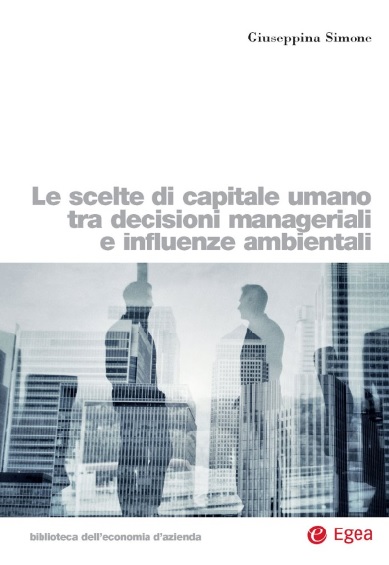
To learn more, you can read “Le scelte di capitale umano tra decisioni manageriali e influenze ambientali” (Human Capital Choices: Managerial Decisions and Environmental Influences) written by Giuseppina Simone (who teaches Human Resources and Organization Skills at Calabria University after having held tenures in various universities across Europe). The book analyses human capital renewal decisions from the two-fold view point of the internal debate across the various management levels and the external implications of reduction of human resource availability consequent to an“environmental” shock.
The author starts by describing the features of the so-called “human capital” in the scope of the current market scenarios before moving onto the issue of human resource renewal and the relationships of this process with the various company levels and external conditioning. IThe book analyses the decisions and behaviours of the various management levels involved in the renewal strategies (structuration, acquisition and disinvestment) and the combination of strategic human resources (bundling, integration and development).
It then turns to applying theory to the real world by examining a single, yet very important case study. The element that the author calls “conceptual perspective” is investigated in the relationship between Principal-Agent (P-A) in football clubs. The research analysed data of the Italian “Serie A” football championship from the 1960-1961 season to the 1991-1992 season and the results suggest that the various management levels involved in the specifically adopted decisions cause different P-A issues. The same example is investigated in the relationship between external conditioning and corporate decisions. In this case, the exogenous shock which occurs is the legal constraint which limits the resort to the international market. Starting from the literature on human capital, the author explores the effect of this constraint on human capital decisions with respect to the options concerning the acquisition or internal development of specific skills and how such decisions change after the shock.
Giuseppina Simone’s book has a great worth: it clearly presents an issue which often defeats accurate explanations. And it does so by describing an unusual reality.
Le scelte di capitale umano tra decisioni manageriali e influenze ambientali (Human Capital Choices: Managerial Decisions and Environmental Influences)
Giuseppina Simone
Egea, 2017
A recently published book describes the steps of the human capital recruitment process and the internal and external constraints the process is submitted to
Companies cannot exist without the men and women who make them work. This is true but not the real issue. Identifying the right people for the job is the defining factor. This is particularly the case when conditions are not perfect. Good corporate culture also implies details like these.
To learn more, you can read “Le scelte di capitale umano tra decisioni manageriali e influenze ambientali” (Human Capital Choices: Managerial Decisions and Environmental Influences) written by Giuseppina Simone (who teaches Human Resources and Organization Skills at Calabria University after having held tenures in various universities across Europe). The book analyses human capital renewal decisions from the two-fold view point of the internal debate across the various management levels and the external implications of reduction of human resource availability consequent to an“environmental” shock.
The author starts by describing the features of the so-called “human capital” in the scope of the current market scenarios before moving onto the issue of human resource renewal and the relationships of this process with the various company levels and external conditioning. IThe book analyses the decisions and behaviours of the various management levels involved in the renewal strategies (structuration, acquisition and disinvestment) and the combination of strategic human resources (bundling, integration and development).
It then turns to applying theory to the real world by examining a single, yet very important case study. The element that the author calls “conceptual perspective” is investigated in the relationship between Principal-Agent (P-A) in football clubs. The research analysed data of the Italian “Serie A” football championship from the 1960-1961 season to the 1991-1992 season and the results suggest that the various management levels involved in the specifically adopted decisions cause different P-A issues. The same example is investigated in the relationship between external conditioning and corporate decisions. In this case, the exogenous shock which occurs is the legal constraint which limits the resort to the international market. Starting from the literature on human capital, the author explores the effect of this constraint on human capital decisions with respect to the options concerning the acquisition or internal development of specific skills and how such decisions change after the shock.
Giuseppina Simone’s book has a great worth: it clearly presents an issue which often defeats accurate explanations. And it does so by describing an unusual reality.
Le scelte di capitale umano tra decisioni manageriali e influenze ambientali (Human Capital Choices: Managerial Decisions and Environmental Influences)
Giuseppina Simone
Egea, 2017
The central bankers who met in Jackson Hole again this year are optimistic. They insist on “fostering a dynamic global economy”, hence the name of their meeting, taking a stance against the narrow-minded protectionism that the Trump administration has brought to light in the USA as well. They believe that today’s economic growth can improve despite geopolitical fragility and international tensions. Mario Draghi, BCE, reasserted the opinion that the recovery is being consolidated. Of course, the opinion of the bankers is based on facts and figures. The OCSE predicts that the major world economies will all close 2017 positively with a simultaneousness that has not been seen since 2007 when the Great Recession started. International Monetary Fund estimates a world growth of 3.5% this year destined to improve in 2018, against the 3.2% of 2016. The Wall Street Journal amplified the echo and devoted a lengthy article to the positive results of Mediterranean Europe, including Spain, Portugal, Italy and even Greece after years of struggle.
Does that mean that all is well? Caution is the word. A 1.5% growth of the gross domestic product of Italy is expected in 2017, which is better than the past years but still lagging behind the rest of the Europe Union (with an average of 2.2%).
It was Governor of the Bank of Italy Ignazio Visco’s turn to damp the enthusiasm of propaganda-prone politicians: “The recovery in Italy is conjunctural, not structural”, he warned at the Meeting of Comunione e Liberazione in Rimini last week. For the change to occur “it is necessary to proceed in the current direction”, that is with “reforms” and “innovation”, to “make companies grow more able to compete on international level”. There is another element of fragility which should not be underestimated: economic recovery is based on exports and on improving the domestic market but it does not generate employment. In other words, it is a “jobless recovery”. The younger generations suffer from this the most.
The political challenge is to consolidate productive and social dynamism evolving towards “Industry 4.0” and to make our companies digital (the tax relief actions implemented by the Gentiloni government to support companies investing in machinery, innovation, research, patents and high-tech move in this direction). It is an economic challenge for entrepreneurs: investing more, making their companies grown, winning space on the international market.
The industry is the engine of Italian recovery. In factories. And in manufacturing services. Innovation incentives are the impulse in this case. The automotive industry as a whole is doing well. Rumours about FCA (the interest of Chinese investors, the suggestions of an alliance with Volkswagen for commercial vehicles and other agreements for making next-generation cars) were heard in August and are indicative of an obvious drive on industrial level and of the attraction potential which offers the possibility of expressing even more value. Positive data concern premium industries as a whole: pharmaceuticals, chemicals, rubber and mechatronics, in addition to the traditional areas of excellence of Italian-made products (farming and food, furniture and fashion). This is confirmed also by Mediobanca in the report on the 2065 large and medium-large Italian companies: third year of growth for factories, with a 1.9% increase of revenue in 2016 (“Corriere della Sera”, 11 August). Investments are also on the rise, with an increase of 7.3% in 2016 in manufacturing, the highest since 2010, while regretfully public investments dropped by 26.9%.
It is precisely the issue of investments that brings the discussion back to the limits of Italian politics.
Companies are on the move. Confindustria, invited by Assolombarda, will be calling the regional association representatives to Milan for a meeting on October 2 to discuss the topics of European investments, investments in innovation and “Industry 4.0”, with the idea of seeking alliances with companies in Germany and France on these themes. With the due exceptions, the political world does not appear to be coping with the economic challenges in progress. The Gentiloni government is doing what it can, with intelligence and sense of responsibility. The debate between and within the political parties has other concerns: electoral law, alliances, roles and future of the leaders. In addition to arguing on how immigration is managed, privileging slogans (often racist) over political decisions. Economic is moving forward, in Europe too. Unfortunately, our politicians are personalistic and provincial.

The central bankers who met in Jackson Hole again this year are optimistic. They insist on “fostering a dynamic global economy”, hence the name of their meeting, taking a stance against the narrow-minded protectionism that the Trump administration has brought to light in the USA as well. They believe that today’s economic growth can improve despite geopolitical fragility and international tensions. Mario Draghi, BCE, reasserted the opinion that the recovery is being consolidated. Of course, the opinion of the bankers is based on facts and figures. The OCSE predicts that the major world economies will all close 2017 positively with a simultaneousness that has not been seen since 2007 when the Great Recession started. International Monetary Fund estimates a world growth of 3.5% this year destined to improve in 2018, against the 3.2% of 2016. The Wall Street Journal amplified the echo and devoted a lengthy article to the positive results of Mediterranean Europe, including Spain, Portugal, Italy and even Greece after years of struggle.
Does that mean that all is well? Caution is the word. A 1.5% growth of the gross domestic product of Italy is expected in 2017, which is better than the past years but still lagging behind the rest of the Europe Union (with an average of 2.2%).
It was Governor of the Bank of Italy Ignazio Visco’s turn to damp the enthusiasm of propaganda-prone politicians: “The recovery in Italy is conjunctural, not structural”, he warned at the Meeting of Comunione e Liberazione in Rimini last week. For the change to occur “it is necessary to proceed in the current direction”, that is with “reforms” and “innovation”, to “make companies grow more able to compete on international level”. There is another element of fragility which should not be underestimated: economic recovery is based on exports and on improving the domestic market but it does not generate employment. In other words, it is a “jobless recovery”. The younger generations suffer from this the most.
The political challenge is to consolidate productive and social dynamism evolving towards “Industry 4.0” and to make our companies digital (the tax relief actions implemented by the Gentiloni government to support companies investing in machinery, innovation, research, patents and high-tech move in this direction). It is an economic challenge for entrepreneurs: investing more, making their companies grown, winning space on the international market.
The industry is the engine of Italian recovery. In factories. And in manufacturing services. Innovation incentives are the impulse in this case. The automotive industry as a whole is doing well. Rumours about FCA (the interest of Chinese investors, the suggestions of an alliance with Volkswagen for commercial vehicles and other agreements for making next-generation cars) were heard in August and are indicative of an obvious drive on industrial level and of the attraction potential which offers the possibility of expressing even more value. Positive data concern premium industries as a whole: pharmaceuticals, chemicals, rubber and mechatronics, in addition to the traditional areas of excellence of Italian-made products (farming and food, furniture and fashion). This is confirmed also by Mediobanca in the report on the 2065 large and medium-large Italian companies: third year of growth for factories, with a 1.9% increase of revenue in 2016 (“Corriere della Sera”, 11 August). Investments are also on the rise, with an increase of 7.3% in 2016 in manufacturing, the highest since 2010, while regretfully public investments dropped by 26.9%.
It is precisely the issue of investments that brings the discussion back to the limits of Italian politics.
Companies are on the move. Confindustria, invited by Assolombarda, will be calling the regional association representatives to Milan for a meeting on October 2 to discuss the topics of European investments, investments in innovation and “Industry 4.0”, with the idea of seeking alliances with companies in Germany and France on these themes. With the due exceptions, the political world does not appear to be coping with the economic challenges in progress. The Gentiloni government is doing what it can, with intelligence and sense of responsibility. The debate between and within the political parties has other concerns: electoral law, alliances, roles and future of the leaders. In addition to arguing on how immigration is managed, privileging slogans (often racist) over political decisions. Economic is moving forward, in Europe too. Unfortunately, our politicians are personalistic and provincial.
Thank you for your request
You will receive an email confirming your subscription to the newsletter.