


Pirelli, in 800 immagini la pubblicità che fece epoca
04 July 2017

Accessibility Come visit us.
Find out moreHelp with your research To access the Historical Archive's documents and materials, please fill out the form to request an appointment.
Request an appointmentHelp with your research To access the Historical Archive's documents and materials, please fill out the form to request an appointment.
Request an appointmentThe Pirelli Foundation Educational Programs
Explore pathsCome visit us.
Come visit us.
To access the Historical Archive's documents and materials, please fill out the form to request an appointment.
Grazie per la tua richiesta
Riceverai una mail di conferma dell'avvenuta ricezione della richiesta e sarai ricontattato.
Grazie per la tua richiesta
Abbiamo ricevuto la tua richiesta. Sarai ricontattato dallo staff di Fondazione Pirelli Educational.
Grazie per la tua richiesta
Abbiamo ricevuto la tua richiesta. Sarai ricontattato al più presto.
Pirelli communications have always conveyed quality, innovation and experimentation. From the “artist” advertising in the early 20th Century to the creations by the leaders in Italian and international graphic design throughout the 1950s and ’60s, from “Pirelli” magazine to the Centro agency – a truly unique advertising house agency offering a full service – through to the global campaigns of the 1990s, for over 140 years, Pirelli communications have marked the history of advertising and culture. The company historic archive, which is kept at the Pirelli Foundation, includes the testimony of an extraordinary visual communication heritage: hundreds of sketches and original designs, thousands of paste-up layouts and prints, hundreds of videos on film and tape. A heritage that the Pirelli Foundation protects and discloses via restoration work, digitalisation and cataloguing processes.
A smaller time frame but in no way less interesting. The volume of archive materials we have received is significantly more than this. The archive fund of the Centro agency (Pirelli Group’s in-house advertising agency, which was in operation between 1960 and 1988) is made up of thousands of layouts and executive prints, created to advertise Pirelli products: tyres, cables and the myriad articles making up the “diversified products” sector (shoes, watches, mattresses, belts, tubes, to name but a few) also produced by subsidiary brands, such as Solari, Superga, Sapsa. The season of “designer” publicity, devised by more than 200 authors (many were identified between 1910 and the late 1960s), gave way to the season of advertising agencies, the biggest mentioned earlier, Centro, and then the major international agencies, such as Young & Rubicam and Armando Testa. In the background, epochal historic changes, which also affect the world of communications and advertising: the establishment of marketing theories, the onset of the digital world, the use of “testimonials”. Pirelli is at the cutting edge.In the 1960s, it experiments with unprecedented advertising strategies, which focus on the consumer first and foremost, making him or her the lead figure in the advertising campaign itself (such as the “Ti cerco, ti filmo, ti premio” (I seek you, I film you, I reward you) campaign in 1974, whereby the driver becomes the lead figure in Carosello; or in the Pirelli MotoVelo campaigns marked by a youthful tone, the language of comic books, gadgets and competitions to involve their target audience).1978 was the year of a campaign that could be defined as an epic undertaking in the pre-digital era: 140 cars used to compose the P of Pirelli, photographed by Adrian Hamilton from a height of 85 metres. In the 1980s, Pirelli experimented with the first graphic productions created on a computer, starting with “Pirellibility”, a TV advert made by the Cucumber Studio for the English Pirelli, referred to by the graphic magazines of the time as one of the first video advertisements entirely digitally-made; in the 1990s came the global breakthrough in Pirelli advertising, now concentrated into a single message for all its international markets and to the image of a endorsers from the world of cinema and sports : in 1993, Sharon Stone, following her success in Basic Instinct; in 1994, under the explosive headline “La potenza è nulla senza controllo” (Power is nothing without control), the campaign with Carl Lewis in stilettos was launched, and became a world-wide success destined to make the history of advertising; over the following years, other sports champions lent their image to Pirelli advertising: the sprinter Marie-José Pérec and the footballer Ronaldo. The volume also gives an account of the growing use of audio-visual advertising in the years in question.From the Carosello in the early 1970s, to the explosion of TV advertising in the 1980s – a host of different ads in the many countries where Pirelli is present – through to the TV ads in the 1990s, with the triumph of post-production special effects: Carl Lewis climbing up the Statue of Liberty, Marie-José Pérec running over lava, Ronaldo in the balance over Corcovado, posing as Christ our Saviour.
To allow the reader to enjoy audio-visual advertising – as well as a lot of extra contents – the volume is accompanied by an app and by a website, which can be accessed using the QR code or typing in the address advbook.fondazionepirelli.org. After a few initial essays dedicated to the historical context (Antonio Calabrò), to the international advertising context (Paola Dubini), to the evolution of techniques, languages and strategies in Pirelli communication (Carlo Vinti e Michele Galluzzo) and to the corporate image (Giancarlo Rocco di Torrepadula), the advertising campaigns are presented in the form of 800 illustrations (paste-up layouts, prints, photographs, video stills), split into institutional campaigns, social advertising (a sector where even Pirelli is at the cutting edge, with campaigns produced by the Centro agency to promote cancer research or sustainable mobility) and product advertising. Testifying to an historic period that had so far barely been explored, where Pirelli advertising confirms itself to be Publicity with a capital P

Pirelli communications have always conveyed quality, innovation and experimentation. From the “artist” advertising in the early 20th Century to the creations by the leaders in Italian and international graphic design throughout the 1950s and ’60s, from “Pirelli” magazine to the Centro agency – a truly unique advertising house agency offering a full service – through to the global campaigns of the 1990s, for over 140 years, Pirelli communications have marked the history of advertising and culture. The company historic archive, which is kept at the Pirelli Foundation, includes the testimony of an extraordinary visual communication heritage: hundreds of sketches and original designs, thousands of paste-up layouts and prints, hundreds of videos on film and tape. A heritage that the Pirelli Foundation protects and discloses via restoration work, digitalisation and cataloguing processes.
A smaller time frame but in no way less interesting. The volume of archive materials we have received is significantly more than this. The archive fund of the Centro agency (Pirelli Group’s in-house advertising agency, which was in operation between 1960 and 1988) is made up of thousands of layouts and executive prints, created to advertise Pirelli products: tyres, cables and the myriad articles making up the “diversified products” sector (shoes, watches, mattresses, belts, tubes, to name but a few) also produced by subsidiary brands, such as Solari, Superga, Sapsa. The season of “designer” publicity, devised by more than 200 authors (many were identified between 1910 and the late 1960s), gave way to the season of advertising agencies, the biggest mentioned earlier, Centro, and then the major international agencies, such as Young & Rubicam and Armando Testa. In the background, epochal historic changes, which also affect the world of communications and advertising: the establishment of marketing theories, the onset of the digital world, the use of “testimonials”. Pirelli is at the cutting edge.In the 1960s, it experiments with unprecedented advertising strategies, which focus on the consumer first and foremost, making him or her the lead figure in the advertising campaign itself (such as the “Ti cerco, ti filmo, ti premio” (I seek you, I film you, I reward you) campaign in 1974, whereby the driver becomes the lead figure in Carosello; or in the Pirelli MotoVelo campaigns marked by a youthful tone, the language of comic books, gadgets and competitions to involve their target audience).1978 was the year of a campaign that could be defined as an epic undertaking in the pre-digital era: 140 cars used to compose the P of Pirelli, photographed by Adrian Hamilton from a height of 85 metres. In the 1980s, Pirelli experimented with the first graphic productions created on a computer, starting with “Pirellibility”, a TV advert made by the Cucumber Studio for the English Pirelli, referred to by the graphic magazines of the time as one of the first video advertisements entirely digitally-made; in the 1990s came the global breakthrough in Pirelli advertising, now concentrated into a single message for all its international markets and to the image of a endorsers from the world of cinema and sports : in 1993, Sharon Stone, following her success in Basic Instinct; in 1994, under the explosive headline “La potenza è nulla senza controllo” (Power is nothing without control), the campaign with Carl Lewis in stilettos was launched, and became a world-wide success destined to make the history of advertising; over the following years, other sports champions lent their image to Pirelli advertising: the sprinter Marie-José Pérec and the footballer Ronaldo. The volume also gives an account of the growing use of audio-visual advertising in the years in question.From the Carosello in the early 1970s, to the explosion of TV advertising in the 1980s – a host of different ads in the many countries where Pirelli is present – through to the TV ads in the 1990s, with the triumph of post-production special effects: Carl Lewis climbing up the Statue of Liberty, Marie-José Pérec running over lava, Ronaldo in the balance over Corcovado, posing as Christ our Saviour.
To allow the reader to enjoy audio-visual advertising – as well as a lot of extra contents – the volume is accompanied by an app and by a website, which can be accessed using the QR code or typing in the address advbook.fondazionepirelli.org. After a few initial essays dedicated to the historical context (Antonio Calabrò), to the international advertising context (Paola Dubini), to the evolution of techniques, languages and strategies in Pirelli communication (Carlo Vinti e Michele Galluzzo) and to the corporate image (Giancarlo Rocco di Torrepadula), the advertising campaigns are presented in the form of 800 illustrations (paste-up layouts, prints, photographs, video stills), split into institutional campaigns, social advertising (a sector where even Pirelli is at the cutting edge, with campaigns produced by the Centro agency to promote cancer research or sustainable mobility) and product advertising. Testifying to an historic period that had so far barely been explored, where Pirelli advertising confirms itself to be Publicity with a capital P
Memories and documents covering sixty years of a bank’s business condensed into a book
A company is made up of men and women. Obviously, there are machines and equipment, technologies and procedures too. But these come to nothing without the presence of those who have the ability to operate them. Telling the true tale of companies is the same as telling the tale of the people who have contributed towards making it a success. This is because, upon closer inspection, corporate culture is not about machines, but rather about the minds who control them. This applies to factories, and also to banks.
“Il San Paolo di Torino, 1946-2006. Storia narrata da chi in gran parte l’ha vissuta” (San Paolo in Turin, 1946-2006. Story told by those who experienced most of it) is an interesting example of the tale of a company – in this case a bank -, told by those who spent the most part of their lives inside its offices. A courageous book. Starting with the title, which says it all about the tone of the text: a story told by those who experience most of it. Not a story of numbers, therefore, but of people.
The book, curated by the Associazione Studi Storici del San Paolo (San Paolo Historic Study Association), tells the tale of one of Italy’s biggest banking institutions from post WWII to the merger with Banca Intesa, that gave rise to the modern-day group in 2007, number one in Italy and one of the biggest in Europe. Throughout the pages (about 300), there is as we said no mention of numbers as the be-all and end-all, but instead the book offers a testimony to the social, cultural, ethical and solidarity values of the Bank, the affairs of which (from its fusion with IMI to the one with Intesa) are interwoven with the history of Turin, of Italy and beyond, considering the influence that San Paolo had on national and international affairs.
Obviously, it starts with an analysis of a large quantity of documents (balance sheets, circular letters, newspaper articles), with the addition of tales by those who refer to themselves as “sanpaolini”, in other words the people who worked in the bank’s offices.
The profound sense of belonging to the Bank is thus documented. The book becomes a sort of choral tale of lives, which is strengthened further by the many photographs and period document reproductions shown in its pages. Corporate tradition that is manifested in words and pictures.
In short, it is attention to accounts but also to the people that emerges from the pages of this book, which should be read with care and appreciated for what it is: the result of many work experiences that outline the culture of a significant company.The supportive implication established by the authors and by the editor is also appealing: the proceeds from the sale of the book will go to the Fondazione FARO onlus non-profit organisation in Turin, which provides free assistance at home and in hospital to sufferers of serious illnesses and their relatives, and which supports medical and scientific research.
Il San Paolo di Torino, 1946-2006. Storia narrata da chi in gran parte l’ha vissuta (San Paolo in Turin, 1946-2006: Story told by those who experienced most of it)
et.al.
Associazione Studi Storici del Sanpaolo
2017

Memories and documents covering sixty years of a bank’s business condensed into a book
A company is made up of men and women. Obviously, there are machines and equipment, technologies and procedures too. But these come to nothing without the presence of those who have the ability to operate them. Telling the true tale of companies is the same as telling the tale of the people who have contributed towards making it a success. This is because, upon closer inspection, corporate culture is not about machines, but rather about the minds who control them. This applies to factories, and also to banks.
“Il San Paolo di Torino, 1946-2006. Storia narrata da chi in gran parte l’ha vissuta” (San Paolo in Turin, 1946-2006. Story told by those who experienced most of it) is an interesting example of the tale of a company – in this case a bank -, told by those who spent the most part of their lives inside its offices. A courageous book. Starting with the title, which says it all about the tone of the text: a story told by those who experience most of it. Not a story of numbers, therefore, but of people.
The book, curated by the Associazione Studi Storici del San Paolo (San Paolo Historic Study Association), tells the tale of one of Italy’s biggest banking institutions from post WWII to the merger with Banca Intesa, that gave rise to the modern-day group in 2007, number one in Italy and one of the biggest in Europe. Throughout the pages (about 300), there is as we said no mention of numbers as the be-all and end-all, but instead the book offers a testimony to the social, cultural, ethical and solidarity values of the Bank, the affairs of which (from its fusion with IMI to the one with Intesa) are interwoven with the history of Turin, of Italy and beyond, considering the influence that San Paolo had on national and international affairs.
Obviously, it starts with an analysis of a large quantity of documents (balance sheets, circular letters, newspaper articles), with the addition of tales by those who refer to themselves as “sanpaolini”, in other words the people who worked in the bank’s offices.
The profound sense of belonging to the Bank is thus documented. The book becomes a sort of choral tale of lives, which is strengthened further by the many photographs and period document reproductions shown in its pages. Corporate tradition that is manifested in words and pictures.
In short, it is attention to accounts but also to the people that emerges from the pages of this book, which should be read with care and appreciated for what it is: the result of many work experiences that outline the culture of a significant company.The supportive implication established by the authors and by the editor is also appealing: the proceeds from the sale of the book will go to the Fondazione FARO onlus non-profit organisation in Turin, which provides free assistance at home and in hospital to sufferers of serious illnesses and their relatives, and which supports medical and scientific research.
Il San Paolo di Torino, 1946-2006. Storia narrata da chi in gran parte l’ha vissuta (San Paolo in Turin, 1946-2006: Story told by those who experienced most of it)
et.al.
Associazione Studi Storici del Sanpaolo
2017
The summary of the results of project #WELCO on collaborative welfare practices opens up new scenarios for corporate culture too
A company grows better in a place that shares common social principles. It is the cohesion of a system made up of entrepreneurship, work and sociability that is often the winning formula to achieve growth and development. However, examples to follow are required, as are stories from which inspiration can be drawn. “Il Welfare collaborativo. Ricerche e pratiche di aiuto condiviso” (Collaborative welfare. Research and shared help practices) curated by Sergio Pasquinelli for the Istituto per la Ricerca Sociale – Institute of Social Research – (IRS), is a good example of something to read better to understand the bonds between the territory and welfare.
The research starts with project #WELCO on collaborative welfare practices in the Lombardy region. It includes a collection of experiences that entail interaction, exchange, mutual support among individuals and organisations. The logic underpinning the investigation is that of connection, of inclusion and of prevention of social fragility. An area where companies can also play their part.
The project was promoted by IRS – in partnership with ARS, the Association for Social Research – and was conducted with entities from the tertiary sector, with social partners from Lombardy and the Municipality of Milan.The spheres of activity taken into consideration are: family, mobility, digital platforms, and territorial hubs.The history, evolution and prospective activities of each are illustrated.
The conclusions of the investigation identify first of all all five key words: trust, proximity, belonging, affinity and leadership. Words which, on closer inspection, can also be found in any good corporate culture. On each one, the curator “practices” a spot-on analysis of the bonds with reality. So, for example, he identifies the concept of “convenient faith”, i.e. compatible with the real means of the territory and of the entities involved. He then moves on to the comparison between collaborative welfare and sharing economy reasoning on the pros and cons and on the confusion that a superficial glance may generate. Then collaborative welfare itself is represented properly in a graph that groups together the conditions of the territory and of the people with the interests of the latter.
The work curated by Pasquinelli is not always easy to read, yet it is a useful tool to find out a little more about new aspects of the territory – mid-way between economy and sociality -, in which companies and workers can play a new and compelling game.
Il Welfare collaborativo.Ricerche e pratiche di aiuto condiviso (Collaborative welfare. Research and shared help practices)
curated by Sergio Pasquinelli
Istituto per la Ricerca Sociale, 2017
The summary of the results of project #WELCO on collaborative welfare practices opens up new scenarios for corporate culture too
A company grows better in a place that shares common social principles. It is the cohesion of a system made up of entrepreneurship, work and sociability that is often the winning formula to achieve growth and development. However, examples to follow are required, as are stories from which inspiration can be drawn. “Il Welfare collaborativo. Ricerche e pratiche di aiuto condiviso” (Collaborative welfare. Research and shared help practices) curated by Sergio Pasquinelli for the Istituto per la Ricerca Sociale – Institute of Social Research – (IRS), is a good example of something to read better to understand the bonds between the territory and welfare.
The research starts with project #WELCO on collaborative welfare practices in the Lombardy region. It includes a collection of experiences that entail interaction, exchange, mutual support among individuals and organisations. The logic underpinning the investigation is that of connection, of inclusion and of prevention of social fragility. An area where companies can also play their part.
The project was promoted by IRS – in partnership with ARS, the Association for Social Research – and was conducted with entities from the tertiary sector, with social partners from Lombardy and the Municipality of Milan.The spheres of activity taken into consideration are: family, mobility, digital platforms, and territorial hubs.The history, evolution and prospective activities of each are illustrated.
The conclusions of the investigation identify first of all all five key words: trust, proximity, belonging, affinity and leadership. Words which, on closer inspection, can also be found in any good corporate culture. On each one, the curator “practices” a spot-on analysis of the bonds with reality. So, for example, he identifies the concept of “convenient faith”, i.e. compatible with the real means of the territory and of the entities involved. He then moves on to the comparison between collaborative welfare and sharing economy reasoning on the pros and cons and on the confusion that a superficial glance may generate. Then collaborative welfare itself is represented properly in a graph that groups together the conditions of the territory and of the people with the interests of the latter.
The work curated by Pasquinelli is not always easy to read, yet it is a useful tool to find out a little more about new aspects of the territory – mid-way between economy and sociality -, in which companies and workers can play a new and compelling game.
Il Welfare collaborativo.Ricerche e pratiche di aiuto condiviso (Collaborative welfare. Research and shared help practices)
curated by Sergio Pasquinelli
Istituto per la Ricerca Sociale, 2017
“I am not afraid that artificial intelligence might give computers the ability to think like human beings. I am more worried about people who might think like computers, without values or compassion, without any concern for the consequences”. These words are from Tim Cook, CEO and thus “number one” of Apple, the technological giant. These are the hot days of the middle of June. In Cambridge, in the township area of Boston. For the farewell ceremony of the graduates of the MIT, the prestigious Massachusetts Institute of Technology. In his speech to the students it was actually Cook, an engineer who studied as a manager and who was called twenty years ago by Steve Jobs to join the heights of Apple, who insists not so much upon the extraordinary progress of technology, but above all upon the moral and civil responsibilities which that progress involves. A sound ethical and cultural reflection, then, as well as one on corporate values (in Italy this was published by the Corriere della Sera newspaper on 18th June). Relating to “new bright ideas which can change the world”.
Welcome, indeed, to technology (including in the themes of the subjects for final examinations: our technological future and concerns which need to be addressed). Welcome to the robots which radically modify production processes and products and which, when they are connected to the networks along which “big data” travel, have become key players in the “digital” revolution which is transforming our industry and services. They are welcome even though they are being experienced as tools which cut out some of our traditional jobs. Precisely because “high tech” and “digital” plans and processes improve the quality and productivity of work, reinforce knowledge and competencies, and improve security (more technology equals fewer mishaps). Even if they open up unprecedented cultural and political questions, set down challenges and create social apprehension.
It is true that various working practices and an equal number of professions are disappearing from the horizon. But new ones are being created. And surely the challenge is that of managing this transition in a socially balanced manner, ensuring that the new technologies do not aggravate any existing professional, compensational or social inequalities. This is a political question. And a cultural one. About how society is managed. About values. About new rules. About a more efficient construction of a new “welfare state” (not the income generated by citizens, but how prepared they are to take on the changes in the job market). Not forgetting, of course, about corporate “governance” (more and better training is needed, and more space and responsibility for new ideas).
So, we are in no way faced with a sort of technological neo-enlightenment. Far from it. If anything, measurements are made with the critical investigation of dialectics between technological benefits and risks, problems and opportunities. Open topics on the comprehension and management of new competencies, with responsibility and a sense of limitation. Philosophical and anthropological questions indeed.
This is the essence of Cook’s thoughts for the MIT. Starting from a slogan which has defined the history of Apple (“Think different”) and from the inspiration of Steve Jobs to “make it possible for the madmen – the anti conformists, the rebels, the troublemakers, all those people who see things differently – to do their jobs better”. The entrepreneurial spirit, by the way (we have already discussed this several times in this blog) is a creative spirit, and often a heretical spirit. Something to be kept alive over time. And something which must be mixed into another essential dimension of a company: productivity, the mass nature of processes, the standard quality of products. To innovate. To make profits. To invest. To create work. To support competitiveness in times of ever faster and more intensive changes. It is difficult to bring all these aspects together. It is a fragile balance. Ever moving. But indispensable. Exams which every good entrepreneur and competent manager know how to pass successfully.
Cook makes the point: “At the MIT you have learned how science and technology have the power to improve the world. Thanks to the discoveries made in this very place, millions of people are living better, more productive and more satisfying lives. And if we ever manage to solve even just one of the world’s major problems, from cancer to climate change, or educational inequality, it will be thanks to technology”.
High-tech rhetoric? No. Cook goes on: “Technology alone is not enough. And sometimes it can be part of the problem”. He quotes the importance of the views of Pope Francis (“the most incredible meeting of my life”) about the responsibility of managing change, of giving a soul to the economy and of creating better social balances. He underlines the negative aspects of the technologies themselves (“the threats to security and privacy, fake news and social media which are becoming antisocial”). And he confirms that the use of the positive strengths of technology “depends on us. It depends on our values and our commitment towards our loved ones, our neighbours, our communities; it depends on our love of beauty and on the conviction that our faiths are interconnected, on our sense of civic duty and on the goodness of our soul”.
This is an American speech. We are pointing out its resonance with the words of great Italian entrepreneurs, from Adriano Olivetti to Pirelli, as well as of the medium-sized and small entrepreneurs who even today drive forward areas and communities where their companies are growing thanks to their values, their quality, their “lathe-based moral commitment”, and their “beautiful factories” which are sustainable, both environmentally and socially.
Cook’s observations are useful. They are also coloured by the teachings of the so-called “practical philosophy” which has for some time taken hold in Silicon Valley and which gives guidance on the value of people, on leadership, on the limits of success, on responsibility, on “what is it that really matters apart from material achievement?”. “Socrate lavora alla Apple” (Socrates works at Apple), is the heading of “La Lettura” (The Reading) in the “Corriere della Sera” newspaper (18th June), relating to an interview with Andrew James Taggart, a philosopher at the University of Wisconsin, a proponent of “practical philosophy” and consultant for entrepreneurs and artists. Socrates is cited in view of his ability to pose questions which were awkward and out of keeping with common good sense: “It is a mistake to proclaim that technological experts are guiding the industrial revolution. It would instead be more appropriate to say that innovation and entrepreneurship need individuals with a background in social and human sciences in order to generate ideas and tell stories relating to something which for the time being does not exist but which could exist in the future. Philosophy provides two essential contributions: asking questions which other people could not even imagine; investigating fundamental issues with the purpose of demonstrating that it is possible to imagine alternatives to our tangible reality. Philosophy, like art, resorts to the posterity of the imagination with a view to future creation”.
“Think different”, precisely. A philosophical rule. And one which is fundamental for an innovative company.

“I am not afraid that artificial intelligence might give computers the ability to think like human beings. I am more worried about people who might think like computers, without values or compassion, without any concern for the consequences”. These words are from Tim Cook, CEO and thus “number one” of Apple, the technological giant. These are the hot days of the middle of June. In Cambridge, in the township area of Boston. For the farewell ceremony of the graduates of the MIT, the prestigious Massachusetts Institute of Technology. In his speech to the students it was actually Cook, an engineer who studied as a manager and who was called twenty years ago by Steve Jobs to join the heights of Apple, who insists not so much upon the extraordinary progress of technology, but above all upon the moral and civil responsibilities which that progress involves. A sound ethical and cultural reflection, then, as well as one on corporate values (in Italy this was published by the Corriere della Sera newspaper on 18th June). Relating to “new bright ideas which can change the world”.
Welcome, indeed, to technology (including in the themes of the subjects for final examinations: our technological future and concerns which need to be addressed). Welcome to the robots which radically modify production processes and products and which, when they are connected to the networks along which “big data” travel, have become key players in the “digital” revolution which is transforming our industry and services. They are welcome even though they are being experienced as tools which cut out some of our traditional jobs. Precisely because “high tech” and “digital” plans and processes improve the quality and productivity of work, reinforce knowledge and competencies, and improve security (more technology equals fewer mishaps). Even if they open up unprecedented cultural and political questions, set down challenges and create social apprehension.
It is true that various working practices and an equal number of professions are disappearing from the horizon. But new ones are being created. And surely the challenge is that of managing this transition in a socially balanced manner, ensuring that the new technologies do not aggravate any existing professional, compensational or social inequalities. This is a political question. And a cultural one. About how society is managed. About values. About new rules. About a more efficient construction of a new “welfare state” (not the income generated by citizens, but how prepared they are to take on the changes in the job market). Not forgetting, of course, about corporate “governance” (more and better training is needed, and more space and responsibility for new ideas).
So, we are in no way faced with a sort of technological neo-enlightenment. Far from it. If anything, measurements are made with the critical investigation of dialectics between technological benefits and risks, problems and opportunities. Open topics on the comprehension and management of new competencies, with responsibility and a sense of limitation. Philosophical and anthropological questions indeed.
This is the essence of Cook’s thoughts for the MIT. Starting from a slogan which has defined the history of Apple (“Think different”) and from the inspiration of Steve Jobs to “make it possible for the madmen – the anti conformists, the rebels, the troublemakers, all those people who see things differently – to do their jobs better”. The entrepreneurial spirit, by the way (we have already discussed this several times in this blog) is a creative spirit, and often a heretical spirit. Something to be kept alive over time. And something which must be mixed into another essential dimension of a company: productivity, the mass nature of processes, the standard quality of products. To innovate. To make profits. To invest. To create work. To support competitiveness in times of ever faster and more intensive changes. It is difficult to bring all these aspects together. It is a fragile balance. Ever moving. But indispensable. Exams which every good entrepreneur and competent manager know how to pass successfully.
Cook makes the point: “At the MIT you have learned how science and technology have the power to improve the world. Thanks to the discoveries made in this very place, millions of people are living better, more productive and more satisfying lives. And if we ever manage to solve even just one of the world’s major problems, from cancer to climate change, or educational inequality, it will be thanks to technology”.
High-tech rhetoric? No. Cook goes on: “Technology alone is not enough. And sometimes it can be part of the problem”. He quotes the importance of the views of Pope Francis (“the most incredible meeting of my life”) about the responsibility of managing change, of giving a soul to the economy and of creating better social balances. He underlines the negative aspects of the technologies themselves (“the threats to security and privacy, fake news and social media which are becoming antisocial”). And he confirms that the use of the positive strengths of technology “depends on us. It depends on our values and our commitment towards our loved ones, our neighbours, our communities; it depends on our love of beauty and on the conviction that our faiths are interconnected, on our sense of civic duty and on the goodness of our soul”.
This is an American speech. We are pointing out its resonance with the words of great Italian entrepreneurs, from Adriano Olivetti to Pirelli, as well as of the medium-sized and small entrepreneurs who even today drive forward areas and communities where their companies are growing thanks to their values, their quality, their “lathe-based moral commitment”, and their “beautiful factories” which are sustainable, both environmentally and socially.
Cook’s observations are useful. They are also coloured by the teachings of the so-called “practical philosophy” which has for some time taken hold in Silicon Valley and which gives guidance on the value of people, on leadership, on the limits of success, on responsibility, on “what is it that really matters apart from material achievement?”. “Socrate lavora alla Apple” (Socrates works at Apple), is the heading of “La Lettura” (The Reading) in the “Corriere della Sera” newspaper (18th June), relating to an interview with Andrew James Taggart, a philosopher at the University of Wisconsin, a proponent of “practical philosophy” and consultant for entrepreneurs and artists. Socrates is cited in view of his ability to pose questions which were awkward and out of keeping with common good sense: “It is a mistake to proclaim that technological experts are guiding the industrial revolution. It would instead be more appropriate to say that innovation and entrepreneurship need individuals with a background in social and human sciences in order to generate ideas and tell stories relating to something which for the time being does not exist but which could exist in the future. Philosophy provides two essential contributions: asking questions which other people could not even imagine; investigating fundamental issues with the purpose of demonstrating that it is possible to imagine alternatives to our tangible reality. Philosophy, like art, resorts to the posterity of the imagination with a view to future creation”.
“Think different”, precisely. A philosophical rule. And one which is fundamental for an innovative company.
A book tells the tale of how managers become entrepreneurs. The theory and the life experience of those who have travelled this path
One can become an entrepreneur in a number of ways. Identifying how is interesting but it is also important to understand how an economic system can come out of a crisis, develop and grow. More generally, the path that leads to entrepreneurship is nevertheless an experience to be told, perhaps because it is possible to learn from it for other similar experiences.
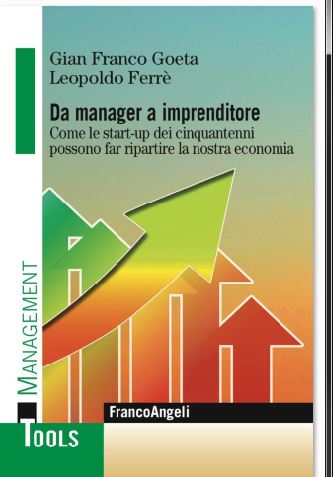
It is for all these different reasons put together that it is useful to read “Da manager a imprenditore. Come le start–up dei cinquantenni possono far ripartire la nostra economia” (From manager to entrepreneur. How the start-up companies of fifty year-olds can restart our economy) written by two authors, namely Gian Franco Goeta (who has worked as an executive coach for over 20 years, a profession which he pioneered in Italy) and Leopoldo Ferré (with thirty years of experience in accompanying people, teams and organisations to innovate, transform and improve).
Both authors in fact begin not with an analysis of individual case studies of companies but instead with an overview. The theory is this: to restart growth, Italy needs to generate 3 million jobs over the next few years. This is the only way it can give a future to its youths and keep its over 55s active, as the latter will be around one million more by 2030. Is it feasible to expect existing companies to be able to offer incremental employment in suitable proportions, when over the last few decades their ranks have been drastically reduced? Or for occupational growth to be guaranteed by the traditional deus ex machina, the State, considering the debt accrued?The answer is no. According to the authors, in fact, the problem may only be solved by multiplying new entrepreneurial initiatives.Also and perhaps most of all for those who were once managers.
The book then focuses on this new entrepreneurial class, carrier of experience and important skills which differ greatly from previous competences.
Based on their own experience, the two authors set themselves the objective of making it possible to ensure that the passage from manager to entrepreneur “is not a blind leap into the unknown, but rather a systematic path that reinforces the awareness of their own potential and of their own limitations, increasing the likelihood of success, building a sustainable business in time, stimulating the growth of the skills required, helping the individuals find the right partners, approaching customers, and so on”.
The story begins with the suggestive image of a passage from “elitist entrepreneurship to mass entrepreneurship” and then looks at the emerging success factors, the preliminary path travelled by a new entrepreneur and lastly the model and thebusiness plan to be implemented.The book then covers tales from several managers who have become entrepreneurs and it ends with an array of “expert analyses” on the matter.
The book by Goeta and Ferré should be read attentively and with vigilance. It is a tool to understand a reality that differs greatly from the past.
Da manager a imprenditore. Come le start-up dei cinquantenni possono far ripartire la nostra economia (From manager to entrepreneur. How the start-up companies of fifty year-olds can restart our economy)
Gian Franco Goeta, Leopoldo Ferré
Franco Angeli, 2017
A book tells the tale of how managers become entrepreneurs. The theory and the life experience of those who have travelled this path
One can become an entrepreneur in a number of ways. Identifying how is interesting but it is also important to understand how an economic system can come out of a crisis, develop and grow. More generally, the path that leads to entrepreneurship is nevertheless an experience to be told, perhaps because it is possible to learn from it for other similar experiences.
It is for all these different reasons put together that it is useful to read “Da manager a imprenditore. Come le start–up dei cinquantenni possono far ripartire la nostra economia” (From manager to entrepreneur. How the start-up companies of fifty year-olds can restart our economy) written by two authors, namely Gian Franco Goeta (who has worked as an executive coach for over 20 years, a profession which he pioneered in Italy) and Leopoldo Ferré (with thirty years of experience in accompanying people, teams and organisations to innovate, transform and improve).
Both authors in fact begin not with an analysis of individual case studies of companies but instead with an overview. The theory is this: to restart growth, Italy needs to generate 3 million jobs over the next few years. This is the only way it can give a future to its youths and keep its over 55s active, as the latter will be around one million more by 2030. Is it feasible to expect existing companies to be able to offer incremental employment in suitable proportions, when over the last few decades their ranks have been drastically reduced? Or for occupational growth to be guaranteed by the traditional deus ex machina, the State, considering the debt accrued?The answer is no. According to the authors, in fact, the problem may only be solved by multiplying new entrepreneurial initiatives.Also and perhaps most of all for those who were once managers.
The book then focuses on this new entrepreneurial class, carrier of experience and important skills which differ greatly from previous competences.
Based on their own experience, the two authors set themselves the objective of making it possible to ensure that the passage from manager to entrepreneur “is not a blind leap into the unknown, but rather a systematic path that reinforces the awareness of their own potential and of their own limitations, increasing the likelihood of success, building a sustainable business in time, stimulating the growth of the skills required, helping the individuals find the right partners, approaching customers, and so on”.
The story begins with the suggestive image of a passage from “elitist entrepreneurship to mass entrepreneurship” and then looks at the emerging success factors, the preliminary path travelled by a new entrepreneur and lastly the model and thebusiness plan to be implemented.The book then covers tales from several managers who have become entrepreneurs and it ends with an array of “expert analyses” on the matter.
The book by Goeta and Ferré should be read attentively and with vigilance. It is a tool to understand a reality that differs greatly from the past.
Da manager a imprenditore. Come le start-up dei cinquantenni possono far ripartire la nostra economia (From manager to entrepreneur. How the start-up companies of fifty year-olds can restart our economy)
Gian Franco Goeta, Leopoldo Ferré
Franco Angeli, 2017
A piece of research interprets the topic of communication and the tale of a company with tools for analysing meaning
The tale of production is part of a company. A tale of men and of things, of how the organisation of production or a product came to be, is not just a cultural expression but also – in fact from now on – more than a commercial promotional tool as well as the expression of the image the company wants to convey.
It is also based on this premise that Elia Bozzato built his research work. Specifically by placing in sequence the aspects of the narrative technique with those of production and industrial brands. Bozzato explains this in the initial lines of his work: “From a certain point onwards it was no longer possible to generate loyalisation merely by advertising what one produced, and it became necessary to communicate a company’s identity and values as a group, as an individual or as a corporation, and tell one’s tale”.This is how modern company storytelling began. In various forms and scans. Which is what Bozzato analyses in his last developments summed up in the concept of brand storytelling, in other words telling the tale of a brand seen as an element of identity of the company, synthesis, centre, “core” of its particular way of understanding production and hence its production culture.
Bozzato thus begins with an investigation into brand storytelling and then moves on to the influences deriving from the current context consisting of social organisation and new communication tools, and then an analysis of storytelling and its interpretation with semiotic tools.
The author explains as follows before addressing semiotic schemes that can be used to interpret brand storytelling: “Today, the brand world is no longer merely built on a logo and a corporate image, or on a story told in just 30 seconds in an advert, or on printed banners; it emerges from an intrinsic and coordinated combination of various elements, distinguished by various formats and consisting of several co-ordinated messages, conveyed over multiple channels. Transmedia universes all around us, the stories are still there, it is just a little more difficult to distinguish them, they talk to us efficiently and with an increasingly stronger involvement and with increasingly astounding and pervasive technologies”.So, charming communication technology, but also a strong change in corporate image, are part of a complex whole consisting of storytelling, communication, marketing, product and business that Bozzato tries to interpret, managing to provide tools that are useful to everyone.
The work that stems from all this is not always easy to read, but it is worth the effort to get to the bottom of it.
Storytelling Storyshowing. Analisi sperimentale della comunicazione di marca attraverso l’occhio semiotico (Experimental analysis of brand communication through the semiotic eye)
Elia Bozzato
Milan Polytechnic School of Design Communication Design
A piece of research interprets the topic of communication and the tale of a company with tools for analysing meaning
The tale of production is part of a company. A tale of men and of things, of how the organisation of production or a product came to be, is not just a cultural expression but also – in fact from now on – more than a commercial promotional tool as well as the expression of the image the company wants to convey.
It is also based on this premise that Elia Bozzato built his research work. Specifically by placing in sequence the aspects of the narrative technique with those of production and industrial brands. Bozzato explains this in the initial lines of his work: “From a certain point onwards it was no longer possible to generate loyalisation merely by advertising what one produced, and it became necessary to communicate a company’s identity and values as a group, as an individual or as a corporation, and tell one’s tale”.This is how modern company storytelling began. In various forms and scans. Which is what Bozzato analyses in his last developments summed up in the concept of brand storytelling, in other words telling the tale of a brand seen as an element of identity of the company, synthesis, centre, “core” of its particular way of understanding production and hence its production culture.
Bozzato thus begins with an investigation into brand storytelling and then moves on to the influences deriving from the current context consisting of social organisation and new communication tools, and then an analysis of storytelling and its interpretation with semiotic tools.
The author explains as follows before addressing semiotic schemes that can be used to interpret brand storytelling: “Today, the brand world is no longer merely built on a logo and a corporate image, or on a story told in just 30 seconds in an advert, or on printed banners; it emerges from an intrinsic and coordinated combination of various elements, distinguished by various formats and consisting of several co-ordinated messages, conveyed over multiple channels. Transmedia universes all around us, the stories are still there, it is just a little more difficult to distinguish them, they talk to us efficiently and with an increasingly stronger involvement and with increasingly astounding and pervasive technologies”.So, charming communication technology, but also a strong change in corporate image, are part of a complex whole consisting of storytelling, communication, marketing, product and business that Bozzato tries to interpret, managing to provide tools that are useful to everyone.
The work that stems from all this is not always easy to read, but it is worth the effort to get to the bottom of it.
Storytelling Storyshowing. Analisi sperimentale della comunicazione di marca attraverso l’occhio semiotico (Experimental analysis of brand communication through the semiotic eye)
Elia Bozzato
Milan Polytechnic School of Design Communication Design
Thank you for your request
You will receive an email confirming your subscription to the newsletter.