Access the Online Archive
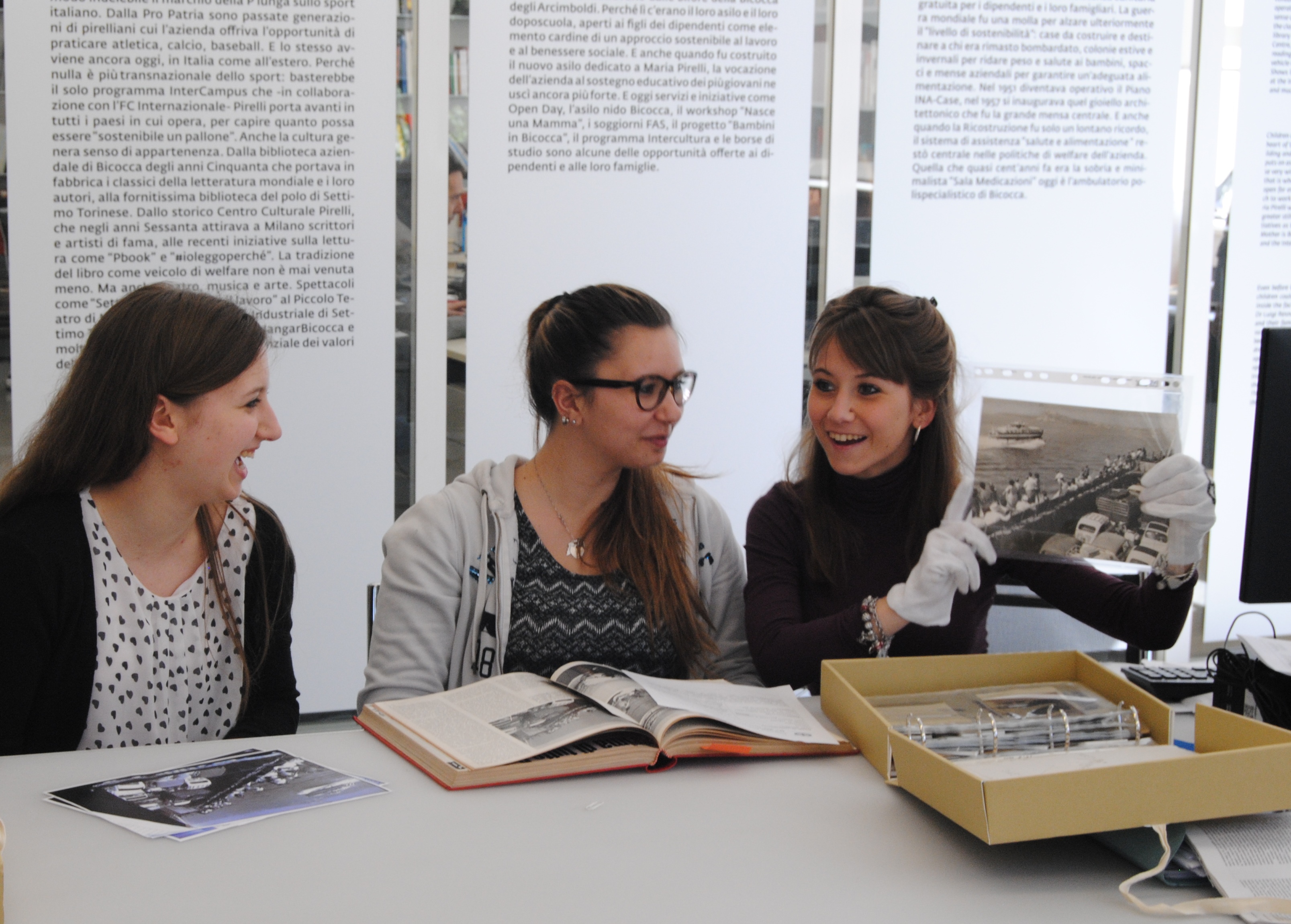
Search the Historical Archive of the Pirelli Foundation for sources and materials. Select the type of support you are interested in and write the keywords of your research.
    Select one of the following categories
  • Documents
  • Photographs
  • Drawings and posters
  • Audio-visuals
  • Publications and magazines
  • All
Help with your research
To request to view the materials in the Historical Archive and in the libraries of the Pirelli Foundation for study and research purposes and/or to find out how to request the use of materials for loans and exhibitions, please fill in the form below. You will receive an email confirming receipt of the request and you will be contacted.
Pirelli Foundation Educational Courses

Select the education level of the school
Back
Primary schools
Pirelli Foundation Educational Courses
Please fill in your details and the staff of Pirelli Foundation Educational will contact you to arrange the dates of the course.

I declare I have read  the privacy policy, and authorise the Pirelli Foundation to process my personal data in order to send communications, also by email, about initiatives/conferences organised by the Pirelli Foundation.

Back
Lower secondary school
Pirelli Foundation Educational Courses
Please fill in your details and the staff of Pirelli Foundation Educational will contact you to arrange the dates of the course.
Back
Upper secondary school
Pirelli Foundation Educational Courses
Please fill in your details and the staff of Pirelli Foundation Educational will contact you to arrange the dates of the course.
Back
University
Pirelli Foundation Educational Courses

Do you want to organize a training programme with your students? For information and reservations, write to universita@fondazionepirelli.org

Visit the Foundation
For information about the Foundation’s activities, guided tours and accessibility,
please call +39 0264423971 or fill in the form below, providing details of your request in the notes field.

The “inclusive liberalism” and reformism of the Draghi government reinvigorate the political sphere

In times of crisis, marked by a pandemic that’s slowly receding after a long period filled with sorrow and hardship, and economic difficulties that are worsening among fears of inflation and global instability (the sudden increase in energy prices is just one of its many facets), it’s best to devise new economic and social theories rather than vainly hope to go back to “how we used to be”. Hence, Michele Salvati and Norberto Dilmore examine “inclusive liberalism” in their book published by Feltrinelli, and attempt to outline “a possible future for our corner of the world”. Salvati is one of the most clear-headed political scientists in Italy, and he’s been pondering how to combine freedom and a better social balance for a long time. Norberto Dilmore is the pseudonym chosen by a representative from the Italian economic sphere, and his chosen assumed first name is meant to evoke the figure of Norberto Bobbio, one of the most authoritative Italian intellectuals and progressive exponent of the various attempts to blend liberal culture (in the tradition of Piero Gobetti and the Rosselli brothers) with the best reformist socialism. Their perspective, however, entails leaving behind traditional comparisons between the ideas of Keynes and Friedman in order to identify innovative ways to interpret and shape governments, so as to make them more suitable to the unprecedented dimensions of a “digital society” and the new relations between economic growth and good social equality standards.

Its starting point lies in the notion that retracing the great European political mindset, which takes into account sustainability, reforms, the fight against inequality, new and better development opportunities for the new generations in particular, becomes paramount when looking for a “paradigm shift” allowing us to build an economy with less inequality – the consequence of mismanaged globalisation, the cause of increasingly wider geographical, social, personal, gender and cultural gaps. The attainment of inclusive liberalism and reformism, entrepreneurial dynamism and social inclusion, competitiveness and solidarity. All values included in Salvati and Dilmore’s book and that underlie the archetypal European culture: liberal democracy and welfare, promotion of individual rights and social responsibility – a path that’s extraordinarily relevant right now, in these times of crisis and radical transformation.

There’s also another viable concept, however, found in the best contemporary writings on economics, as well as in the works by Stiglitz, Krugman, Fitoussi and Federico Caffè, innovative interpreter of Keynes’s ideas and the intellectual inspiration of Italian Prime Minister Mario Draghi: “A virtuous triangle composed by companies, State and civil society”, which could lead to new development trajectories lying outside traditional debates revolving around the question, “More State or more market?”. A concept by Philippe Aghion, French economist and professor at the London School of Economics, at Harvard and at the Collège de France, which he unravels in his latest book, published in Italy by Marsilio Editori with title Il potere della distruzione creatrice – Innovazione, crescita e futuro del capitalismo (The Power of Creative Destruction: Economic Upheaval and the Wealth of Nations), written collaboratively with two other economists from the Collège de France, Céline Antonin and Simon Brunelli. As the title suggests, the book refers to the theories of Joseph Schumpeter concerning the creative power of innovation, but also to the monopolistic tendency of more dynamic market players, which ends up destroying the very market that made them. The aim is to demonstrate how a new, balanced relationship between politics, entrepreneurs and civil society could counteract both the decline of capitalism and the rise of demagogic populism while reviving the market economy (in a transparent, well-regulated and sustainable fashion) and, above all, liberal democracy itself. The authors analyse the technological evolution, argue against bizarre theories suggesting that robots should be taxed in order to stop the digital evolution in businesses and safeguard traditional jobs, reject notions of a “happy degrowth” and propose new ways to connect British innovation with the best European welfare traditions.

Here’s the deal: in order to talk about “inclusive liberalism” and reformism, Italy really needs a decent political set-up. These past years have unfortunately seen reformist politics getting crushed under populist and sovereignist pressures and overcome by erroneous and useless reactions to plausible solutions to real social hardship issues, as well as the collapse of confidence in a better future.

Now, however, in Italy and more generally in Europe, we see signs allowing for some fragile hope towards a recovery. The re-election of a president like Sergio Mattarella and the strengthening of the Draghi government, with its demanding programme of reforms in line with the EU Recovery Plan‘s priorities concerning the Next Generation (environment, digital economy, innovation, training, education) are veritable cornerstones on Italy’s path to recovery. The intimations made by Mattarella in his speech, concerning the “dignity” of work, culture, institutions, laws, rights of women and young people, are the foundations on which we can restore Italian politics, reinstate confidence and build better opportunities for the future.

Democracy and development are at stake, notwithstanding the heavy crisis – yet, it’s precisely in these difficult times and in spite of the uncertainties, downfalls, gloomy undertones and irresponsible behaviour lying right at the heart of Italian politics, that the country is showing it possesses positive “social capital” as well as an extraordinary recovery force.

Something that has also been noticed by influential international observers, such as The Economist, for instance, which last December declared Italy “country of the year for 2021”, setting temporarily aside its traditional tendency to severely – at times even ruthlessly – criticise the Italian Republic. Now, instead, the current issue of the weekly British magazine affirms that “Southern Europe is reforming itself”, recalling how “the old PIGS” (Portugal, Italy, Greece and Spain, bundled up in a rather offensive acronym) “are airborne, even as northern countries fall to earth”. When discussing the growing weight of Mediterranean Europe, also owing to a change in international assets, The Economist continues to acknowledge the positive reformist impetus that is driving Italian legislature, pensions and economy under the leadership of Mario Draghi, as well as the beneficial effects the country is exerting on the rest of the EU. There are still doubts, that’s true, but positive forces are rising, and “inclusive liberalism” could really be the way forward.

In times of crisis, marked by a pandemic that’s slowly receding after a long period filled with sorrow and hardship, and economic difficulties that are worsening among fears of inflation and global instability (the sudden increase in energy prices is just one of its many facets), it’s best to devise new economic and social theories rather than vainly hope to go back to “how we used to be”. Hence, Michele Salvati and Norberto Dilmore examine “inclusive liberalism” in their book published by Feltrinelli, and attempt to outline “a possible future for our corner of the world”. Salvati is one of the most clear-headed political scientists in Italy, and he’s been pondering how to combine freedom and a better social balance for a long time. Norberto Dilmore is the pseudonym chosen by a representative from the Italian economic sphere, and his chosen assumed first name is meant to evoke the figure of Norberto Bobbio, one of the most authoritative Italian intellectuals and progressive exponent of the various attempts to blend liberal culture (in the tradition of Piero Gobetti and the Rosselli brothers) with the best reformist socialism. Their perspective, however, entails leaving behind traditional comparisons between the ideas of Keynes and Friedman in order to identify innovative ways to interpret and shape governments, so as to make them more suitable to the unprecedented dimensions of a “digital society” and the new relations between economic growth and good social equality standards.

Its starting point lies in the notion that retracing the great European political mindset, which takes into account sustainability, reforms, the fight against inequality, new and better development opportunities for the new generations in particular, becomes paramount when looking for a “paradigm shift” allowing us to build an economy with less inequality – the consequence of mismanaged globalisation, the cause of increasingly wider geographical, social, personal, gender and cultural gaps. The attainment of inclusive liberalism and reformism, entrepreneurial dynamism and social inclusion, competitiveness and solidarity. All values included in Salvati and Dilmore’s book and that underlie the archetypal European culture: liberal democracy and welfare, promotion of individual rights and social responsibility – a path that’s extraordinarily relevant right now, in these times of crisis and radical transformation.

There’s also another viable concept, however, found in the best contemporary writings on economics, as well as in the works by Stiglitz, Krugman, Fitoussi and Federico Caffè, innovative interpreter of Keynes’s ideas and the intellectual inspiration of Italian Prime Minister Mario Draghi: “A virtuous triangle composed by companies, State and civil society”, which could lead to new development trajectories lying outside traditional debates revolving around the question, “More State or more market?”. A concept by Philippe Aghion, French economist and professor at the London School of Economics, at Harvard and at the Collège de France, which he unravels in his latest book, published in Italy by Marsilio Editori with title Il potere della distruzione creatrice – Innovazione, crescita e futuro del capitalismo (The Power of Creative Destruction: Economic Upheaval and the Wealth of Nations), written collaboratively with two other economists from the Collège de France, Céline Antonin and Simon Brunelli. As the title suggests, the book refers to the theories of Joseph Schumpeter concerning the creative power of innovation, but also to the monopolistic tendency of more dynamic market players, which ends up destroying the very market that made them. The aim is to demonstrate how a new, balanced relationship between politics, entrepreneurs and civil society could counteract both the decline of capitalism and the rise of demagogic populism while reviving the market economy (in a transparent, well-regulated and sustainable fashion) and, above all, liberal democracy itself. The authors analyse the technological evolution, argue against bizarre theories suggesting that robots should be taxed in order to stop the digital evolution in businesses and safeguard traditional jobs, reject notions of a “happy degrowth” and propose new ways to connect British innovation with the best European welfare traditions.

Here’s the deal: in order to talk about “inclusive liberalism” and reformism, Italy really needs a decent political set-up. These past years have unfortunately seen reformist politics getting crushed under populist and sovereignist pressures and overcome by erroneous and useless reactions to plausible solutions to real social hardship issues, as well as the collapse of confidence in a better future.

Now, however, in Italy and more generally in Europe, we see signs allowing for some fragile hope towards a recovery. The re-election of a president like Sergio Mattarella and the strengthening of the Draghi government, with its demanding programme of reforms in line with the EU Recovery Plan‘s priorities concerning the Next Generation (environment, digital economy, innovation, training, education) are veritable cornerstones on Italy’s path to recovery. The intimations made by Mattarella in his speech, concerning the “dignity” of work, culture, institutions, laws, rights of women and young people, are the foundations on which we can restore Italian politics, reinstate confidence and build better opportunities for the future.

Democracy and development are at stake, notwithstanding the heavy crisis – yet, it’s precisely in these difficult times and in spite of the uncertainties, downfalls, gloomy undertones and irresponsible behaviour lying right at the heart of Italian politics, that the country is showing it possesses positive “social capital” as well as an extraordinary recovery force.

Something that has also been noticed by influential international observers, such as The Economist, for instance, which last December declared Italy “country of the year for 2021”, setting temporarily aside its traditional tendency to severely – at times even ruthlessly – criticise the Italian Republic. Now, instead, the current issue of the weekly British magazine affirms that “Southern Europe is reforming itself”, recalling how “the old PIGS” (Portugal, Italy, Greece and Spain, bundled up in a rather offensive acronym) “are airborne, even as northern countries fall to earth”. When discussing the growing weight of Mediterranean Europe, also owing to a change in international assets, The Economist continues to acknowledge the positive reformist impetus that is driving Italian legislature, pensions and economy under the leadership of Mario Draghi, as well as the beneficial effects the country is exerting on the rest of the EU. There are still doubts, that’s true, but positive forces are rising, and “inclusive liberalism” could really be the way forward.

Freedom versus authority?

What is happening in contemporary societies, interpreted according to a key duality of our modern times.

Freedom to undertake an enterprise, as well as to criticise, to change one’s mind, to develop oneself by following one path rather than the other, to express one’s opinion or disagreement. Key principles in any good society, as well as in any good production organisation. Freedom that, however, does not signify free will and even less the right to wreck everything. Freedom against authority, then, or freedom that, incorporating an appropriate degree of authority, can grow and become more powerful. A complex theme, no doubt, especially nowadays. This is why, a (careful) reading of La porta dell’autorità (Authority’s gateway), a book collaboratively written by Mauro Magatti (sociologist and economist, full professor of Sociology at the Faculty of Social and Political Sciences at the Università Cattolica del Sacro Cuore of Milan) and Monica Martinelli (associate professor at the same university) is very useful.

The book focuses on observing what happened in the past and what is happening today and starts from the consideration that challenging, to the point of rejecting, authority as a restriction to one’s freedom of self-expression is truly part of our late twentieth century’s heritage. A heritage whose weight is still felt today when the pillars on which authority stood – tradition, patriarchy, education, the Church – are being challenged. All in the name of asserting one’s individuality in a horizontal society without patriarchs or masters. Yet, the two authors explain how, just like the phoenix, authority is always rising from its own ashes, taking new forms that may be more fleeting and undefined but nonetheless equally effective. In other words, we are witnessing a proliferation of forces demanding the return of an authoritarian, tyrannical and conservative patriarchy or, in subtler and more insidious ways, of a technocratic dominion actually bent on taking us beyond the human condition as we know it, and there are also those who want to erect walls or others who, in the name of individual freedom, reject all obligations (including those related to the more tragic aspects of contemporary life).

According to the book, what we are experiencing pretty much everywhere today is the starkest – at least on the surface – conflict between freedom and authority (in terms of economy and production, too).

What can we do, then? Magatti and Martinelli are adamant: we cannot go back, rather, we need to move forward, finding new ways to conceive a duality that is as fundamental as it is complex. As the book very clearly explains, a world without authority is not possible, unless freedom is forfeited – a freedom whose limit becomes the source of action, contextualising the way we see the world. Namely, we need to re-establish a connection between generations, acknowledging the fact that authority is the juncture between those who were and those who will be (and not only in a temporal sense). In this way, authority can be seen like a gateway that, while framing and as such defining a direction, at the same time opens onto a future that does not yet exists but is forthcoming. A condition that, upon closer examination, applies to society as a whole as well as to its sections, such as institutions, businesses, groups. Magatti and Martinelli’s book makes for a challenging read that everyone should undertake.

La porta dell’autorità (Authority’s gateway)

Mauro Magatti, Monica Martinelli

Vita e Pensiero, 2021

What is happening in contemporary societies, interpreted according to a key duality of our modern times.

Freedom to undertake an enterprise, as well as to criticise, to change one’s mind, to develop oneself by following one path rather than the other, to express one’s opinion or disagreement. Key principles in any good society, as well as in any good production organisation. Freedom that, however, does not signify free will and even less the right to wreck everything. Freedom against authority, then, or freedom that, incorporating an appropriate degree of authority, can grow and become more powerful. A complex theme, no doubt, especially nowadays. This is why, a (careful) reading of La porta dell’autorità (Authority’s gateway), a book collaboratively written by Mauro Magatti (sociologist and economist, full professor of Sociology at the Faculty of Social and Political Sciences at the Università Cattolica del Sacro Cuore of Milan) and Monica Martinelli (associate professor at the same university) is very useful.

The book focuses on observing what happened in the past and what is happening today and starts from the consideration that challenging, to the point of rejecting, authority as a restriction to one’s freedom of self-expression is truly part of our late twentieth century’s heritage. A heritage whose weight is still felt today when the pillars on which authority stood – tradition, patriarchy, education, the Church – are being challenged. All in the name of asserting one’s individuality in a horizontal society without patriarchs or masters. Yet, the two authors explain how, just like the phoenix, authority is always rising from its own ashes, taking new forms that may be more fleeting and undefined but nonetheless equally effective. In other words, we are witnessing a proliferation of forces demanding the return of an authoritarian, tyrannical and conservative patriarchy or, in subtler and more insidious ways, of a technocratic dominion actually bent on taking us beyond the human condition as we know it, and there are also those who want to erect walls or others who, in the name of individual freedom, reject all obligations (including those related to the more tragic aspects of contemporary life).

According to the book, what we are experiencing pretty much everywhere today is the starkest – at least on the surface – conflict between freedom and authority (in terms of economy and production, too).

What can we do, then? Magatti and Martinelli are adamant: we cannot go back, rather, we need to move forward, finding new ways to conceive a duality that is as fundamental as it is complex. As the book very clearly explains, a world without authority is not possible, unless freedom is forfeited – a freedom whose limit becomes the source of action, contextualising the way we see the world. Namely, we need to re-establish a connection between generations, acknowledging the fact that authority is the juncture between those who were and those who will be (and not only in a temporal sense). In this way, authority can be seen like a gateway that, while framing and as such defining a direction, at the same time opens onto a future that does not yet exists but is forthcoming. A condition that, upon closer examination, applies to society as a whole as well as to its sections, such as institutions, businesses, groups. Magatti and Martinelli’s book makes for a challenging read that everyone should undertake.

La porta dell’autorità (Authority’s gateway)

Mauro Magatti, Monica Martinelli

Vita e Pensiero, 2021

Development and global risks – today’s scenario

The collection of contributions and research assembled for the 75th anniversary of the UN makes for an important toolbox for everyone


Interdependence. Deep connections that often go unnoticed. The awareness of how complex the current economic and social systems are also entails this observation: every action generated by a specific economic and social “site” affects other parts of the system. It is true for all organisations and it is a complex theory that could nonetheless find some applications. Confirmation and instances of all this can be found in the body of research collected in Le Nazioni Unite di fronte alle nuove sfide economico-sociali 75 anni dopo la loro fondazione (New socio-economic challenges faced by the United Nations 75 years after its foundation), recently published in volume 23 of La Comunità Internazionale (The international community), the quarterly review of the SIOI, Società Italiana per l’Organizzazione Internazionale (Italian Society for International Organisation). The publication includes a series of contributions conceived for a study session organised, as mentioned in the title, for the 75th anniversary of the UN, and represents a good handbook for those who wish to learn more about the complexities we experience today.

The series of contributions collected in “Sfide economico-sociali e agenda 2030: gli obiettivi di sviluppo sostenibile” (“Socio-economic challenges and 2030 agenda: the sustainable development goals”) is especially important to read, and can be summarised in Staffan de Mistura’s words: “Conflicts and economic injustice, economic issues, are closely linked, and therefore if we want to deal with the many conflicts we have before our eyes we need to focus our attention on the connection between geopolitics, economy and crisis.” The other research papers unfold from this statement. Starting from a contextualisation of the relationships between the 2030 Agenda and conflicts, to continue with the theme of “climate change, human rights and business activities”, and other topics such as gender equality, sustainable development and the new digital technologies. What arises is a scenario that encompasses steps made forward and backward, conflicts and attempted cooperation, friction and collaborations that, in hindsight, frame the space which almost all current economic and social systems occupy.

Readers of this series of studies included in the volume 23 of SIOI will certainly find more than one useful tool to better understand what is happening just on our doorstep, whether at home or at work. Moreover, it is a must-read for those entrepreneurs or managers who are in charge of a business that, one way or another, operates on the international stage.

Le Nazioni Unite di fronte alle nuove sfide economico-sociali 75 anni dopo la loro fondazione (New socio-economic challenges faced by the United Nations 75 years after its foundation)

Various authors.

La Comunità Internazionale, Quarterly review of the Società Italiana per l’Organizzazione Internazionale, volume 23, 2021

The collection of contributions and research assembled for the 75th anniversary of the UN makes for an important toolbox for everyone


Interdependence. Deep connections that often go unnoticed. The awareness of how complex the current economic and social systems are also entails this observation: every action generated by a specific economic and social “site” affects other parts of the system. It is true for all organisations and it is a complex theory that could nonetheless find some applications. Confirmation and instances of all this can be found in the body of research collected in Le Nazioni Unite di fronte alle nuove sfide economico-sociali 75 anni dopo la loro fondazione (New socio-economic challenges faced by the United Nations 75 years after its foundation), recently published in volume 23 of La Comunità Internazionale (The international community), the quarterly review of the SIOI, Società Italiana per l’Organizzazione Internazionale (Italian Society for International Organisation). The publication includes a series of contributions conceived for a study session organised, as mentioned in the title, for the 75th anniversary of the UN, and represents a good handbook for those who wish to learn more about the complexities we experience today.

The series of contributions collected in “Sfide economico-sociali e agenda 2030: gli obiettivi di sviluppo sostenibile” (“Socio-economic challenges and 2030 agenda: the sustainable development goals”) is especially important to read, and can be summarised in Staffan de Mistura’s words: “Conflicts and economic injustice, economic issues, are closely linked, and therefore if we want to deal with the many conflicts we have before our eyes we need to focus our attention on the connection between geopolitics, economy and crisis.” The other research papers unfold from this statement. Starting from a contextualisation of the relationships between the 2030 Agenda and conflicts, to continue with the theme of “climate change, human rights and business activities”, and other topics such as gender equality, sustainable development and the new digital technologies. What arises is a scenario that encompasses steps made forward and backward, conflicts and attempted cooperation, friction and collaborations that, in hindsight, frame the space which almost all current economic and social systems occupy.

Readers of this series of studies included in the volume 23 of SIOI will certainly find more than one useful tool to better understand what is happening just on our doorstep, whether at home or at work. Moreover, it is a must-read for those entrepreneurs or managers who are in charge of a business that, one way or another, operates on the international stage.

Le Nazioni Unite di fronte alle nuove sfide economico-sociali 75 anni dopo la loro fondazione (New socio-economic challenges faced by the United Nations 75 years after its foundation)

Various authors.

La Comunità Internazionale, Quarterly review of the Società Italiana per l’Organizzazione Internazionale, volume 23, 2021

A clear picture for a better and deeper understanding

Our reality as described by the director of the Bank of Italy


A well executed and well explained economic and social study aimed at developing awareness and culture (including corporate culture). A condition to be attained and then safeguarded, as well as fostered through good reading. Such is the essence of “Assicurare la ripresa” (“How to guarantee the recovery”), a contribution by Luigi Federico Signorini, CEO of the Bank of Italy and president of IVASS, the Italian Insurance Supervisory Authority, recently published by the Bank and offering a significantly valuable overview of Italy’s current economic situation and prospects.

Signorini does not mince words and his piece is extremely clear. He immediately starts, as an economist would, with a few figures, to describe the situation; he then relates these figures (obtained from real life, not through theoretical equations), to the reality experienced by companies and individuals, which includes issues to be tackled and, of course, the circumstances generated by the COVID-19 pandemic. Concrete, rather than theoretical, economy then, which entails dealing with the raw material and the energy crises, as well as the expectations of those directly involved and the hopes of those others (pretty much everyone) who would like to see a different future. Hopes that, somehow, might actually be fulfilled, despite the many doubts raised, weighed up and properly contextualised by the author. The same is with risks – “Supporting families and companies in risk management activities“, we are told, “is one of the factors that can best contribute to the growth of social welfare and competitiveness in the economic system.”

Clarity, then, above all. To suitably differentiate between “forecasts” and actual “facts”, for instance, to properly distinguish suppositions from certainties. The article also includes an assertion that, far from undermining this, is rather further proof of the author’s earnestness: “Uncertainty around this growth scenario is very high.”

Hence, Signorini paints a crystal-clear picture of reality, a much needed and useful tool to further understand where we stand and the direction we might take. As said above, an excellent reading to develop one’s self-aware culture.

Assicurare la ripresa (“How to guarantee the recovery”)

Luigi Federico Signorini

Contribution to the Swiss Re webinar of 19 January 2022

Our reality as described by the director of the Bank of Italy


A well executed and well explained economic and social study aimed at developing awareness and culture (including corporate culture). A condition to be attained and then safeguarded, as well as fostered through good reading. Such is the essence of “Assicurare la ripresa” (“How to guarantee the recovery”), a contribution by Luigi Federico Signorini, CEO of the Bank of Italy and president of IVASS, the Italian Insurance Supervisory Authority, recently published by the Bank and offering a significantly valuable overview of Italy’s current economic situation and prospects.

Signorini does not mince words and his piece is extremely clear. He immediately starts, as an economist would, with a few figures, to describe the situation; he then relates these figures (obtained from real life, not through theoretical equations), to the reality experienced by companies and individuals, which includes issues to be tackled and, of course, the circumstances generated by the COVID-19 pandemic. Concrete, rather than theoretical, economy then, which entails dealing with the raw material and the energy crises, as well as the expectations of those directly involved and the hopes of those others (pretty much everyone) who would like to see a different future. Hopes that, somehow, might actually be fulfilled, despite the many doubts raised, weighed up and properly contextualised by the author. The same is with risks – “Supporting families and companies in risk management activities“, we are told, “is one of the factors that can best contribute to the growth of social welfare and competitiveness in the economic system.”

Clarity, then, above all. To suitably differentiate between “forecasts” and actual “facts”, for instance, to properly distinguish suppositions from certainties. The article also includes an assertion that, far from undermining this, is rather further proof of the author’s earnestness: “Uncertainty around this growth scenario is very high.”

Hence, Signorini paints a crystal-clear picture of reality, a much needed and useful tool to further understand where we stand and the direction we might take. As said above, an excellent reading to develop one’s self-aware culture.

Assicurare la ripresa (“How to guarantee the recovery”)

Luigi Federico Signorini

Contribution to the Swiss Re webinar of 19 January 2022

Big Data – learn it better in order to do better

A recently published handbook for the benefit of corporate social impact and corporate management

Learning, in order to do good with some cognizance. What is more, learning in order to better conciliate philanthropy with efficiency and effectiveness, and corporate social impact with the necessary processes and the need for profit. Learning, after all, not only to develop a good corporate culture but also to make it more dynamic and insightful. These are important milestones that can be achieved thanks to tools capable of providing accurate information, which we then need to be able to appropriately read and interpret, especially nowadays, in an era driven by a constant flow of news, by Big Data, speed and complexity.

This is why a careful reading (and study) of Data Science for Social Good. Philanthropy and Social Impact in a Complex World, a book curated by Massimo Lapucci (secretary general of the CRT Foundation) and Ciro Cattuto (professor in Computer Science at the University of Turin) is paramount. Possessing the tools to collect, sort, understand and interpret data actually means being much further along the path towards enhancing the relevance of organisations (and not just philanthropic ones) that affect the social systems in which they operate.

This book curated by Lapucci and Cattuto can be considered a handbook for the application of data science in those complex and sensitive spheres that have an impact on society. Data Science for Social Good examines how computer science, complex systems and computational social science can be applied to challenges such as humanitarian responses, public health and sustainable development. The book also provides an overview of the scientific approaches to social impact – how social needs are identified, interventions focused, impact measured – complemented by the perspectives of investors and philanthropists.

The introduction written by Lapucci is followed by a series of contributions on the value and meaning of data, some centring on specific examples such as the UN Global Pulse, globally acknowledged nowadays as a world-class facility on the employment of Big Data and artificial intelligence for the public good. The work then explores the ways in which data is gathered and analysed, issues and solutions to better join up these processes and, finally, the sector’s prospects in a world transformed by the COVID-19 pandemic.

Reading the material that Lapucci and Cattuto have collected is not always easy and straightforward, but it will certainly be useful to all those people involved in corporate activities that bear an impact on society. A book to be explored, therefore – and a good handbook that, with some others, should be kept at hand on one’s desk.


Data Science for Social Good. Philanthropy and Social Impact in a Complex World

Massimo Lapucci, Ciro Cattuto (curated by)

Springer, 2021

A recently published handbook for the benefit of corporate social impact and corporate management

Learning, in order to do good with some cognizance. What is more, learning in order to better conciliate philanthropy with efficiency and effectiveness, and corporate social impact with the necessary processes and the need for profit. Learning, after all, not only to develop a good corporate culture but also to make it more dynamic and insightful. These are important milestones that can be achieved thanks to tools capable of providing accurate information, which we then need to be able to appropriately read and interpret, especially nowadays, in an era driven by a constant flow of news, by Big Data, speed and complexity.

This is why a careful reading (and study) of Data Science for Social Good. Philanthropy and Social Impact in a Complex World, a book curated by Massimo Lapucci (secretary general of the CRT Foundation) and Ciro Cattuto (professor in Computer Science at the University of Turin) is paramount. Possessing the tools to collect, sort, understand and interpret data actually means being much further along the path towards enhancing the relevance of organisations (and not just philanthropic ones) that affect the social systems in which they operate.

This book curated by Lapucci and Cattuto can be considered a handbook for the application of data science in those complex and sensitive spheres that have an impact on society. Data Science for Social Good examines how computer science, complex systems and computational social science can be applied to challenges such as humanitarian responses, public health and sustainable development. The book also provides an overview of the scientific approaches to social impact – how social needs are identified, interventions focused, impact measured – complemented by the perspectives of investors and philanthropists.

The introduction written by Lapucci is followed by a series of contributions on the value and meaning of data, some centring on specific examples such as the UN Global Pulse, globally acknowledged nowadays as a world-class facility on the employment of Big Data and artificial intelligence for the public good. The work then explores the ways in which data is gathered and analysed, issues and solutions to better join up these processes and, finally, the sector’s prospects in a world transformed by the COVID-19 pandemic.

Reading the material that Lapucci and Cattuto have collected is not always easy and straightforward, but it will certainly be useful to all those people involved in corporate activities that bear an impact on society. A book to be explored, therefore – and a good handbook that, with some others, should be kept at hand on one’s desk.


Data Science for Social Good. Philanthropy and Social Impact in a Complex World

Massimo Lapucci, Ciro Cattuto (curated by)

Springer, 2021

Crucial and “light” power in Mattarella and Draghi’s words

Words have extraordinary power, as also exemplified by the three terms – “health”, “economic” and “social” – that President Mattarella used in the short statement he made just after receiving the official news that he had been re-elected, in order to pinpoint the critical areas that Italy needs to tackle. Three clear key words that demand a political response, government programmes, Parliamentary reforms, for our health and for sustainable development.

Mario Draghi, feeling emboldened now that his position as Prime Minister has been secured once more – thanks to Mattarella’s re-election, in fact – also has a preference for terse and precise language. Indeed, his three-word slogan, “whatever it takes”, saved the euro and Europe (and thus also Italy’s economic and social hold), and has now gone down in the history of good statecraft. And in fact, Draghi is now doing precisely “whatever it takes” in terms of reforms and investments that are necessary to lead the country out of the hardship brought on by the pandemic and the recession.

Here’s another key word that often occurs in public speeches: “knowledge” – which also means “skill” and, of course, “training” and “education”.

“Young people”, asserted Draghi in a speech he held in September 2017 at Trinity College in Dublin, “don’t want to live on benefits. They want to work and increase their life opportunities.” And those in power have the responsibility to address “a legacy of dashed hopes, anger and, ultimately, distrust in the values of our society and in the identity of democracy.” Trust that needs to be rebuilt without “raising any false hopes”, however, but through guidance and decisions that give rise to concrete hopes instead, because “depriving young people of their future is one of the worst forms of inequality.” Therefore, “education is the primary productive expenditure in which we must invest”.

And now that Draghi is in power, he’s turning his words into reality, actualising his plans into concrete activities, regulations, funding opportunities, and the decisions made as part of the PNRR, the Italian recovery and resilience plan, as per the indications of the European Recovery Plan, are following suit.

Words are important – they are “stones”, as Carlo Levi taught us. But they’re also “light”, though not vague and ethereal, as Italo Calvino explains in his Lezioni americane (Six memos for the next millennium). “Take life lightly, for lightness does not mean superficiality but rather gliding above things, without a weight on your heart.” Or, to quote Paul Valéry’s poetry, “We must be as light as the bird that flies, not as the feather.”

What about the responsible and institutional “lightness” of Mattarella and the organisational and pragmatic “lightness” of Draghi’s good governance, then – easy feats? “Easiness is a form of perfection that contains the substance of a lengthy commitment”, to use words by Paolo Conte, a songwriter whose lyrics are extraordinarily poetic.

Mattarella is a jurist, with an extensive and sophisticated humanistic background. Through education and experience, he became well acquainted with the meaning of two Latin phrases: “Rem tene, verba sequentur” (“Grasp the subject, the words will follow”), but also “Nomina sunt consequentia rerum” (“Words are consequences of facts”). And if it’s true that Latin is a form of reasoning, these mean that words define the world, narrate its story and hint at its future, though only if deeply connected with the substance of things. Otherwise, it’s just empty rhetoric, something a good jurist is well aware of.

Mario Draghi is an economist. He studied humanities at the excellent Jesuit high school Massimiliano Massimo Institute in Rome, so that he, too, knows very well the value of words and the importance of data. At university, he learned from professor Federico Caffè, amongst other things, the import of an “economy of affect”, which entails values, human rights, expectations for a better quality of life and work, and brought his own original interpretation to a powerful idea in social reformism: “Reformists prefer a little to everything, the achievable to the utopian, gradual transformation to a sudden transformation of the ‘system’ that is always postponed”.

Both Mattarella and Draghi remind us that the ancient Romans termed “eloquens” a person “who speaks well, ethically”, as opposed to “loquens”, a person who simply “speaks”, often inappropriately – even in our times, political life is rife with such people, and that small “e” at the beginning makes all the difference.

Then again, “Latin is a precise, essential language. It will be abandoned not because it will become inadequate in meeting the new needs of progress, but because the new people will no longer be adequate for it. When the era of demagogues and charlatans begins, when any oaf can speak publicly, with impunity and without being kicked off the stage, a language such as Latin becomes redundant. And their secret lies in the exploitation of a sloppy, evasive language that nonetheless “sounds” good, so that they can speak for hours without actually saying anything. Something that cannot be done in Latin.” – a harsh and very contemporary assessment by Giovannino Guareschi, a sharp and sensitive Italian author from the 1950s.

Today, the fact that we are reconsidering learning classical languages (Latin and Greek, the languages of philosophy and science, as well as of poetry and drama) as part of a “polytechnic culture”, bodes well in terms of knowledge.

Going back to words and subtle lexical differences, another example comes to mind: the French language distinguishes between “écrivain”, a writer (novelist, essayist, a good author) and “écrivant”, someone whose job entails writing technical, ordinary, bureaucratic language – writers and scribes, in other words.

Paying attention to differences is key in a world where people speak and write meaninglessly and senselessly, foolishly heedless to the responsibility they have.

Mattarella is from Sicily and his strong, righteous attitude is completely at odds with that represented in Il gattopardo (The leopard), a novel set in Sicily in which those in power used words to deceive the people – something he knows well but that, out of his strong personal and political ethics, chooses not to emulate. Moreover, Mattarella is no doubt familiar with another great Sicilian author, Leonardo Sciascia, who, in his novel Gli zii di Sicilia (Sicilian uncles), wrote, “I believe in Sicilians who don’t speak much, who don’t get worked up, in Sicilians who keep things inside and suffer in silence: those poor people who greet us with a tired gesture, as if they belonged to the past; and colonel Carini, always so quiet and distant, choked by melancholy and boredom yet always ready for action: a man who doesn’t seem to hold much hope, yet he is hope itself, the silent fragile hope held by the best Sicilian people… A kind of hope, I mean, that fears itself, afraid of words, close to and intimate with death, rather. These people need to be known and loved for their silence, for the words they hold in their heart, unuttered.”

Just what we were saying: people of few concise words. And again, still by Sciascia, “I believe in the mystery of words and that words can become life, destiny, just as they become beauty.”

Beauty is a “light” word, a key term. It’s a commitment that concerns work and life and – why not? – governance, too.

Words have extraordinary power, as also exemplified by the three terms – “health”, “economic” and “social” – that President Mattarella used in the short statement he made just after receiving the official news that he had been re-elected, in order to pinpoint the critical areas that Italy needs to tackle. Three clear key words that demand a political response, government programmes, Parliamentary reforms, for our health and for sustainable development.

Mario Draghi, feeling emboldened now that his position as Prime Minister has been secured once more – thanks to Mattarella’s re-election, in fact – also has a preference for terse and precise language. Indeed, his three-word slogan, “whatever it takes”, saved the euro and Europe (and thus also Italy’s economic and social hold), and has now gone down in the history of good statecraft. And in fact, Draghi is now doing precisely “whatever it takes” in terms of reforms and investments that are necessary to lead the country out of the hardship brought on by the pandemic and the recession.

Here’s another key word that often occurs in public speeches: “knowledge” – which also means “skill” and, of course, “training” and “education”.

“Young people”, asserted Draghi in a speech he held in September 2017 at Trinity College in Dublin, “don’t want to live on benefits. They want to work and increase their life opportunities.” And those in power have the responsibility to address “a legacy of dashed hopes, anger and, ultimately, distrust in the values of our society and in the identity of democracy.” Trust that needs to be rebuilt without “raising any false hopes”, however, but through guidance and decisions that give rise to concrete hopes instead, because “depriving young people of their future is one of the worst forms of inequality.” Therefore, “education is the primary productive expenditure in which we must invest”.

And now that Draghi is in power, he’s turning his words into reality, actualising his plans into concrete activities, regulations, funding opportunities, and the decisions made as part of the PNRR, the Italian recovery and resilience plan, as per the indications of the European Recovery Plan, are following suit.

Words are important – they are “stones”, as Carlo Levi taught us. But they’re also “light”, though not vague and ethereal, as Italo Calvino explains in his Lezioni americane (Six memos for the next millennium). “Take life lightly, for lightness does not mean superficiality but rather gliding above things, without a weight on your heart.” Or, to quote Paul Valéry’s poetry, “We must be as light as the bird that flies, not as the feather.”

What about the responsible and institutional “lightness” of Mattarella and the organisational and pragmatic “lightness” of Draghi’s good governance, then – easy feats? “Easiness is a form of perfection that contains the substance of a lengthy commitment”, to use words by Paolo Conte, a songwriter whose lyrics are extraordinarily poetic.

Mattarella is a jurist, with an extensive and sophisticated humanistic background. Through education and experience, he became well acquainted with the meaning of two Latin phrases: “Rem tene, verba sequentur” (“Grasp the subject, the words will follow”), but also “Nomina sunt consequentia rerum” (“Words are consequences of facts”). And if it’s true that Latin is a form of reasoning, these mean that words define the world, narrate its story and hint at its future, though only if deeply connected with the substance of things. Otherwise, it’s just empty rhetoric, something a good jurist is well aware of.

Mario Draghi is an economist. He studied humanities at the excellent Jesuit high school Massimiliano Massimo Institute in Rome, so that he, too, knows very well the value of words and the importance of data. At university, he learned from professor Federico Caffè, amongst other things, the import of an “economy of affect”, which entails values, human rights, expectations for a better quality of life and work, and brought his own original interpretation to a powerful idea in social reformism: “Reformists prefer a little to everything, the achievable to the utopian, gradual transformation to a sudden transformation of the ‘system’ that is always postponed”.

Both Mattarella and Draghi remind us that the ancient Romans termed “eloquens” a person “who speaks well, ethically”, as opposed to “loquens”, a person who simply “speaks”, often inappropriately – even in our times, political life is rife with such people, and that small “e” at the beginning makes all the difference.

Then again, “Latin is a precise, essential language. It will be abandoned not because it will become inadequate in meeting the new needs of progress, but because the new people will no longer be adequate for it. When the era of demagogues and charlatans begins, when any oaf can speak publicly, with impunity and without being kicked off the stage, a language such as Latin becomes redundant. And their secret lies in the exploitation of a sloppy, evasive language that nonetheless “sounds” good, so that they can speak for hours without actually saying anything. Something that cannot be done in Latin.” – a harsh and very contemporary assessment by Giovannino Guareschi, a sharp and sensitive Italian author from the 1950s.

Today, the fact that we are reconsidering learning classical languages (Latin and Greek, the languages of philosophy and science, as well as of poetry and drama) as part of a “polytechnic culture”, bodes well in terms of knowledge.

Going back to words and subtle lexical differences, another example comes to mind: the French language distinguishes between “écrivain”, a writer (novelist, essayist, a good author) and “écrivant”, someone whose job entails writing technical, ordinary, bureaucratic language – writers and scribes, in other words.

Paying attention to differences is key in a world where people speak and write meaninglessly and senselessly, foolishly heedless to the responsibility they have.

Mattarella is from Sicily and his strong, righteous attitude is completely at odds with that represented in Il gattopardo (The leopard), a novel set in Sicily in which those in power used words to deceive the people – something he knows well but that, out of his strong personal and political ethics, chooses not to emulate. Moreover, Mattarella is no doubt familiar with another great Sicilian author, Leonardo Sciascia, who, in his novel Gli zii di Sicilia (Sicilian uncles), wrote, “I believe in Sicilians who don’t speak much, who don’t get worked up, in Sicilians who keep things inside and suffer in silence: those poor people who greet us with a tired gesture, as if they belonged to the past; and colonel Carini, always so quiet and distant, choked by melancholy and boredom yet always ready for action: a man who doesn’t seem to hold much hope, yet he is hope itself, the silent fragile hope held by the best Sicilian people… A kind of hope, I mean, that fears itself, afraid of words, close to and intimate with death, rather. These people need to be known and loved for their silence, for the words they hold in their heart, unuttered.”

Just what we were saying: people of few concise words. And again, still by Sciascia, “I believe in the mystery of words and that words can become life, destiny, just as they become beauty.”

Beauty is a “light” word, a key term. It’s a commitment that concerns work and life and – why not? – governance, too.

“Of Uncommon Size and Robust Elegance”: The Pirelli Factory in Via Ponte Seveso, Milan

G.B. Pirelli & C., a limited partnership for the manufacture and sale of elastic rubber items, was brought into being before the notary public Stefano Allocchio on 28 January 1872. As we read in the notarial deed of incorporation, the company was to have continued operations for 9 years, with a share capital of 215,000 lire and its headquarters in the municipality of Corpi Santi di Milano. Here, in Via Ponte Seveso, now Via Fabio Filzi, the Peregrini brothers’ company began work in early April on construction of the factory. Production started in June 1873, initially limited to technical articles made of rubber.

The factory was described by the periodical L’industriale  as “of uncommon size and not without the robust elegance of which many foreign factories are proud”. As we see in a watercolour by Salvatore Corvaja, the first Pirelli factory covered 1,000 square metres, in the open countryside, with the office building on the left and the production plant on the right. It employed 40 workers and 5 office clerks, but it was destined to grow rapidly, as production expanded, and in 1876 it began producing consumer items and in 1879 came electric and telegraph cables. By 1881 the number of workers had increased to 200 and the factory had been enlarged, though it maintained the same structure, as we see in the view printed on a letterhead a few years later.

Production of elastic thread started up in 1883, involving a particularly complex process that led to a huge and immediate increase in terms of the number of employees and the size of the company organisation. By 1884, the workforce had doubled (400 workers) and the area occupied by the factory reached 7,400 square metres, 6,150 of which were covered, with 4 steam engines with a total output of 160 horsepower, 12 mixers, 3 rolling presses, and 14 vulcanisers. This expansion is well illustrated in an 1888 drawing by Antonio Bonamore, which shows how the area has significantly expanded and the number of buildings has increased, now with 4 chimneys. Bicycle tyres entered the Pirelli product catalogue in 1890, and they were followed by car tyres in 1901.

And the factory expanded once again, until it had filled all the available space, while the city grew up all around it: this is documented by the view published for the first time in a price list of 1900, later taken up and adapted by Domenico Bonamini in 1922. New land needed to be purchased, and it was found in the area not far from the Bicocca: thus began the story of the second Pirelli production site, which was to shape the landscape and the history of Milan.

G.B. Pirelli & C., a limited partnership for the manufacture and sale of elastic rubber items, was brought into being before the notary public Stefano Allocchio on 28 January 1872. As we read in the notarial deed of incorporation, the company was to have continued operations for 9 years, with a share capital of 215,000 lire and its headquarters in the municipality of Corpi Santi di Milano. Here, in Via Ponte Seveso, now Via Fabio Filzi, the Peregrini brothers’ company began work in early April on construction of the factory. Production started in June 1873, initially limited to technical articles made of rubber.

The factory was described by the periodical L’industriale  as “of uncommon size and not without the robust elegance of which many foreign factories are proud”. As we see in a watercolour by Salvatore Corvaja, the first Pirelli factory covered 1,000 square metres, in the open countryside, with the office building on the left and the production plant on the right. It employed 40 workers and 5 office clerks, but it was destined to grow rapidly, as production expanded, and in 1876 it began producing consumer items and in 1879 came electric and telegraph cables. By 1881 the number of workers had increased to 200 and the factory had been enlarged, though it maintained the same structure, as we see in the view printed on a letterhead a few years later.

Production of elastic thread started up in 1883, involving a particularly complex process that led to a huge and immediate increase in terms of the number of employees and the size of the company organisation. By 1884, the workforce had doubled (400 workers) and the area occupied by the factory reached 7,400 square metres, 6,150 of which were covered, with 4 steam engines with a total output of 160 horsepower, 12 mixers, 3 rolling presses, and 14 vulcanisers. This expansion is well illustrated in an 1888 drawing by Antonio Bonamore, which shows how the area has significantly expanded and the number of buildings has increased, now with 4 chimneys. Bicycle tyres entered the Pirelli product catalogue in 1890, and they were followed by car tyres in 1901.

And the factory expanded once again, until it had filled all the available space, while the city grew up all around it: this is documented by the view published for the first time in a price list of 1900, later taken up and adapted by Domenico Bonamini in 1922. New land needed to be purchased, and it was found in the area not far from the Bicocca: thus began the story of the second Pirelli production site, which was to shape the landscape and the history of Milan.

Milan-Turin, There and Back: The Partnership Between Pirelli Foundation Educational and the Educational Department of the Lavazza Museum Is Now Under Way

This year, a direct line links Milan and Turin through schools across all Italy. For the first time, the educational departments of the Pirelli Foundation and of the Lavazza Museum have joined forces to introduce students to the two companies, both of which have a history of developing innovative materials and products. These are two companies that, right from the outset, have valued their corporate culture and have kept a constant focus on sustainability over time. It is indeed some aspects of sustainability, such as focusing on people and workplaces, the search for sustainable raw materials, and the use of renewable energy, that are at the centre of three courses being put on for school and university students.

On the Road to Innovation is a course for upper secondary schools, illustrating the changes, innovations and technological inventions that Pirelli has introduced since it was founded 150 years ago this year, while also going to the heart of Lavazza in the A Cure of Excellence: The Tierra! Project in which the students will find out about the history of coffee.

This partnership also means that university students will learn about the business stories of the two companies, which both arose from the great entrepreneurial spirit of their founders, Giovanni Battista Pirelli and Luigi Lavazza in two special courses: The Company Past and Present and Angelo Moriondo and Luigi Lavazza: Entrepreneurs in the World of Coffee. Architecture students, in particular, will be able to examine the urban transformations that have reshaped some large areas of Milan and Turin, thanks to the interventions of Pirelli and Lavazza, respectively in the Bicocca area, with the Pirelli Headquarters designed by Vittorio Gregotti, and in the Nuvola Lavazza by Cino Zucchi, which is also home to the Lavazza Museum (The Architectures of Industry and The Lavazza Museum in a Cloud)

For more information, please write to scuole@fondazionepirelli.org (Pirelli Foundation), info.museo@lavazza.com (Lavazza Museum)

This year, a direct line links Milan and Turin through schools across all Italy. For the first time, the educational departments of the Pirelli Foundation and of the Lavazza Museum have joined forces to introduce students to the two companies, both of which have a history of developing innovative materials and products. These are two companies that, right from the outset, have valued their corporate culture and have kept a constant focus on sustainability over time. It is indeed some aspects of sustainability, such as focusing on people and workplaces, the search for sustainable raw materials, and the use of renewable energy, that are at the centre of three courses being put on for school and university students.

On the Road to Innovation is a course for upper secondary schools, illustrating the changes, innovations and technological inventions that Pirelli has introduced since it was founded 150 years ago this year, while also going to the heart of Lavazza in the A Cure of Excellence: The Tierra! Project in which the students will find out about the history of coffee.

This partnership also means that university students will learn about the business stories of the two companies, which both arose from the great entrepreneurial spirit of their founders, Giovanni Battista Pirelli and Luigi Lavazza in two special courses: The Company Past and Present and Angelo Moriondo and Luigi Lavazza: Entrepreneurs in the World of Coffee. Architecture students, in particular, will be able to examine the urban transformations that have reshaped some large areas of Milan and Turin, thanks to the interventions of Pirelli and Lavazza, respectively in the Bicocca area, with the Pirelli Headquarters designed by Vittorio Gregotti, and in the Nuvola Lavazza by Cino Zucchi, which is also home to the Lavazza Museum (The Architectures of Industry and The Lavazza Museum in a Cloud)

For more information, please write to scuole@fondazionepirelli.org (Pirelli Foundation), info.museo@lavazza.com (Lavazza Museum)

Ways to change

The Italian version of IMPACT: Reshaping capitalism to drive real change, a book that outlines a future where good corporate culture is best realised, has been released in Italy


We should pay attention to profits, but also to ethics; we should focus on being successful across the board, not just in terms of budget – surely, this is the future of economy and production. A future whose main features have already been outlined, though several companies and large territories still find it difficult to grasp them; a future that, at a global level, already has a name: impact revolution. Impact. La rivoluzione che sta cambiando il capitalismo (IMPACT: Reshaping capitalism to drive real change), written by Ronald Cohen and recently published in the Italian language, revolves precisely around this concept,

The work sort of summarises the brand new future that awaits our economic and social systems, something that it is clearly explained from the beginning: “The world must change, but we cannot change it by throwing money at old ideas that no longer work; we need new ideas and approaches.” In other words, it means that we need to find an alternative way to build a new world where inequality can decrease, where natural resources can regenerate and where people can benefit from a shared wealth. These expectations do not entail establishing sanctimonious companies dedicated to charity for charity’s sake, but something that is completely new as compared to the past (and, largely, to the present). Cohen – venture capitalist, entrepreneur, philanthropist, innovator in the field of social finance – attempts to impose some order on the ideas revolving around the impact revolution. Starting precisely from explaining what ‘impact revolution’ means and entails (in these same pages, the notion of so-called “triple helix of risk-return-impact” makes an appearance), to then go on and narrate the stories of entrepreneurs who got it before anyone else, and ending by outlining the role of investors who are already driving companies towards the concept of “impact in their products”. Subsequently, Cohen deals with the effects of the impact revolution within large enterprises and then with the meaning of philanthropy, “to ensure that people’s life and the environment improve as much as possible.” Finally, the last two sections of the book are dedicated to how much governments and institutions can do and to how much progress we still need to make.

As the author writes at one point: “We cannot hold on to a system that actively seeks to have a positive impact while it simultaneously gives rise to negative consequences that force governments to spend a fortune to solve them.”

Ronald Cohen’s book is, unquestionably, a fascinating and visionary one, to be read and perused with much care – with Italy and Italian companies in mind, too.

Impact. La rivoluzione che sta cambiando il capitalismo (original title: IMPACT: Reshaping capitalism to drive real change)

Ronald Cohen

LUISS University Press, 2022

The Italian version of IMPACT: Reshaping capitalism to drive real change, a book that outlines a future where good corporate culture is best realised, has been released in Italy


We should pay attention to profits, but also to ethics; we should focus on being successful across the board, not just in terms of budget – surely, this is the future of economy and production. A future whose main features have already been outlined, though several companies and large territories still find it difficult to grasp them; a future that, at a global level, already has a name: impact revolution. Impact. La rivoluzione che sta cambiando il capitalismo (IMPACT: Reshaping capitalism to drive real change), written by Ronald Cohen and recently published in the Italian language, revolves precisely around this concept,

The work sort of summarises the brand new future that awaits our economic and social systems, something that it is clearly explained from the beginning: “The world must change, but we cannot change it by throwing money at old ideas that no longer work; we need new ideas and approaches.” In other words, it means that we need to find an alternative way to build a new world where inequality can decrease, where natural resources can regenerate and where people can benefit from a shared wealth. These expectations do not entail establishing sanctimonious companies dedicated to charity for charity’s sake, but something that is completely new as compared to the past (and, largely, to the present). Cohen – venture capitalist, entrepreneur, philanthropist, innovator in the field of social finance – attempts to impose some order on the ideas revolving around the impact revolution. Starting precisely from explaining what ‘impact revolution’ means and entails (in these same pages, the notion of so-called “triple helix of risk-return-impact” makes an appearance), to then go on and narrate the stories of entrepreneurs who got it before anyone else, and ending by outlining the role of investors who are already driving companies towards the concept of “impact in their products”. Subsequently, Cohen deals with the effects of the impact revolution within large enterprises and then with the meaning of philanthropy, “to ensure that people’s life and the environment improve as much as possible.” Finally, the last two sections of the book are dedicated to how much governments and institutions can do and to how much progress we still need to make.

As the author writes at one point: “We cannot hold on to a system that actively seeks to have a positive impact while it simultaneously gives rise to negative consequences that force governments to spend a fortune to solve them.”

Ronald Cohen’s book is, unquestionably, a fascinating and visionary one, to be read and perused with much care – with Italy and Italian companies in mind, too.

Impact. La rivoluzione che sta cambiando il capitalismo (original title: IMPACT: Reshaping capitalism to drive real change)

Ronald Cohen

LUISS University Press, 2022

Many ways to rebuild, from here onwards

A collection of essays and research articles focused on the multiple aspects of “rebuilding”, which falls on institutions, companies and individuals


Rebuilding – a difficult, yet not impossible, mission that nowadays pretty much everyone has to undertake: from individuals and institutions to families and companies. Rebuilding something that – not always and not entirely, yet for most part and most people – has been shattered not by war but by a pandemic, which has turned upside down, in rather a short time, lives, organisations, enterprises, plans and projects for the future. It’s around this goal – understood in both material and cultural terms – that the contributions collected in the recently published “Ricostruzioni” (“Rebuilding”), the latest 2021 issue of il Mulino, journal of culture and politics, revolves around.

Rebuilding, then, after a war, after famine, after a natural disaster such as an earthquake or a flood and, of course, after a pandemic. In other words, restarting virtuous processes, in order to brighten up the future for our communities, for a fairer society and a more sustainable economy. This collection of essays attempts to address this topic from every possible angle and, indeed, succeeds in doing so.

It starts by exploring the concept of rebuilding (whether it is best to keep things as they are or to renovate them), and goes on to examine aspects related to the economy, as well as features concerning the political and social structures that might be involved in rebuilding, without neglecting more specific and particular themes such as trusting institutions, necessary reforms in the healthcare system, the need to look beyond the pandemic (which will pass, one way or another), in order to find cues and resources that can be used to create a country that will be better than the one left behind.

The collection of essays and research published by il Mulino also includes insightful pieces that at first sight may appear unrelated to our current situation – such as stories about the aftermath of some of the wars we fought – as well as others concerning the environment and climate change.

An excerpt from the diaries of Piero Calamandrei perfectly summarises the whole work: “No longer independence, but ‘interdependence’: this is not a new term, and if we don’t want the past to repeat itself and exacerbate yesterday’s errors, it needs to come to stand for the new feeling of freedom which, out of so much pain, will give rise to a future that will be different from the past; freedom understood as consciousness of human solidarity, which brings together individuals and peoples, as awareness of their mutual dependence; as a condition for social justice to be respected and defended first in others, rather than in ourselves; as reciprocity and collaboration within a larger unity.”

The latest 2021 issue of il Mulino certainly makes for compelling reading.

Ricostruzioni (“Rebuilding”)

Various authors.

Il Mulino, 4/21

A collection of essays and research articles focused on the multiple aspects of “rebuilding”, which falls on institutions, companies and individuals


Rebuilding – a difficult, yet not impossible, mission that nowadays pretty much everyone has to undertake: from individuals and institutions to families and companies. Rebuilding something that – not always and not entirely, yet for most part and most people – has been shattered not by war but by a pandemic, which has turned upside down, in rather a short time, lives, organisations, enterprises, plans and projects for the future. It’s around this goal – understood in both material and cultural terms – that the contributions collected in the recently published “Ricostruzioni” (“Rebuilding”), the latest 2021 issue of il Mulino, journal of culture and politics, revolves around.

Rebuilding, then, after a war, after famine, after a natural disaster such as an earthquake or a flood and, of course, after a pandemic. In other words, restarting virtuous processes, in order to brighten up the future for our communities, for a fairer society and a more sustainable economy. This collection of essays attempts to address this topic from every possible angle and, indeed, succeeds in doing so.

It starts by exploring the concept of rebuilding (whether it is best to keep things as they are or to renovate them), and goes on to examine aspects related to the economy, as well as features concerning the political and social structures that might be involved in rebuilding, without neglecting more specific and particular themes such as trusting institutions, necessary reforms in the healthcare system, the need to look beyond the pandemic (which will pass, one way or another), in order to find cues and resources that can be used to create a country that will be better than the one left behind.

The collection of essays and research published by il Mulino also includes insightful pieces that at first sight may appear unrelated to our current situation – such as stories about the aftermath of some of the wars we fought – as well as others concerning the environment and climate change.

An excerpt from the diaries of Piero Calamandrei perfectly summarises the whole work: “No longer independence, but ‘interdependence’: this is not a new term, and if we don’t want the past to repeat itself and exacerbate yesterday’s errors, it needs to come to stand for the new feeling of freedom which, out of so much pain, will give rise to a future that will be different from the past; freedom understood as consciousness of human solidarity, which brings together individuals and peoples, as awareness of their mutual dependence; as a condition for social justice to be respected and defended first in others, rather than in ourselves; as reciprocity and collaboration within a larger unity.”

The latest 2021 issue of il Mulino certainly makes for compelling reading.

Ricostruzioni (“Rebuilding”)

Various authors.

Il Mulino, 4/21