


 23 October 2025
The Story of Susy, the Living Doll
Imagination, humour and original illustrations are the essential ingredients of Storia di Susy: la bambola viva, an enchanting children’s book preserved in the Pirelli Foundation Library. Written by ...
+
23 October 2025
The Story of Susy, the Living Doll
Imagination, humour and original illustrations are the essential ingredients of Storia di Susy: la bambola viva, an enchanting children’s book preserved in the Pirelli Foundation Library. Written by ...
+
The Story of Susy, the Living Doll
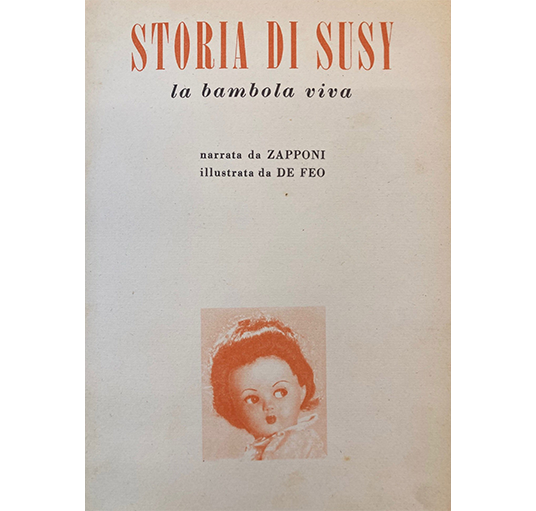
Imagination, humour and original illustrations are the essential ingredients of Storia di Susy: la bambola viva, an enchanting children’s book preserved in the Pirelli Foundation Library. Written by Bernardino Zapponi and published by Mondadori in 1951, the book celebrates the success of Susy, the rubber doll produced by Pirelli in the late 1940s. The tale opens with a peculiar request: the Venturas apply to the Ministry of Storks for permission to have a baby girl. Their wish is granted, but in a most unexpected way, when Susy—a doll—is brought to life by a bumbling fairy. Thus begins a long and eventful journey towards her future mother, filled with shipwrecks, kidnappings and surreal battles.
Susy is accompanied on this modern-day fairy-tale adventure by a colourful parade of eccentric and irresistible characters: Carlotta the stork, Professor Bargigli—a rooster and geographer—Speranza the fairy, and many others. Among the most whimsical scenes and inventions are toy mines from which Father Christmas draws his presents, tinned-fish fishing villages, talking loaves of bread, hospitals where the patients are the doctors, battles between Black and White chess pieces, and a Comic Book Land inhabited by gangsters and legendary Western heroes.
Zapponi, the celebrated screenwriter who worked with outstanding directors such as Federico Fellini, Dino Risi, and Dario Argento, writes a brisk and imaginative story that playfully weaves elements of classic fairy tales into a witty and original plot. De Feo’s charming illustrations, which enliven the pages, complete a work designed to delight children while also bringing a knowing smile to adult readers.
Storia di Susy, la bambola viva
Bernardino Zapponi, illustrations by De Feo
Arnoldo Mondadori Editore, 1951