

The fresh air of Adriano Olivetti
Seeing industry as a public service. Seeing enterprise as a conquest for all. In these complex times in which our economy and society are currently experiencing, concepts like this may appear, at the very least, anachronistic or unrealistic (dreamlike, even). In actual fact, however, the recovery of manufacturing, the best examples of such manufacturing, and a serious, pragmatic outlook on development may also come through concepts such as these. Fresh air to be shared with all. Air that is in tune with the times and yet not new. In fact, Adriano Olivetti had already sought to spread this air to many and to lend it special charm and depth, and a reborn Edizioni di Comunità have recently begun republishing all of his writings.
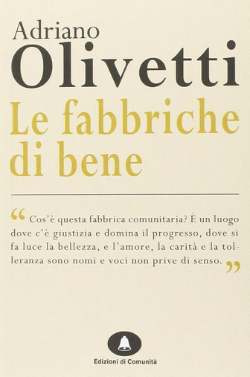
Le fabbriche del bene (literally: The factories of good), a book that can be read in a single sitting, is a collection of two of Olivetti’s most important works. The first is an overview of the “Community” project and Olivetti’s idea – rooted in the factory – of civil coexistence, while the second (Dovete conoscere i fini del vostro lavoro – literally: “You need to know the purpose of your work”) is a speech given in June 1945 to Olivetti workers immediately following Italy’s Liberation. In both, we find a wealth of ideas, concepts and suggestions that would appear today to be provocative and unique, the inspiration for modern forms of organisation and management that remain difficult to find in any complete sense.
“Any important company, because of its technical problems and the basic needs of its employees, results in constant conflicts of interest with the environment in which it operates,” Olivetti writes in the first section of the book, before adding, “Actually, the common good in industry is a complex function of: the direct, individual interests of those involved in the work; their indirect spiritual, social and solidarity-based interests; the interests of the surrounding environment, which draws its reason for being and for development from the progression of industry; and the interests of the immediately outlying territory.” All of this is by way of saying that the only possible solution for wellbeing and progress lies in “the balance between the forces behind the interests described”, and this is a conclusion that applies to this day and which, nonetheless, often seems far from the reality of our times.
The second part of this book is even more relevant to the factory, its culture and the work that is done there, and it opens with a testament to the presence of something that lies beyond a “rational examination” of the actions of a businessman, which require more than mere calculation to properly evaluate. Then comes the story of the factory during the war, which serves to lay some unusual (apparently for many, if not for Olivetti) groundwork for the factory of the future. To the question of what is to be done, Adriano Olivetti responds, “We will be led by spiritual values, as such values are eternal. Following these values, the tangibles will arise on their own, without having to go in search of them.”
In the wonderful introduction to this work, Gustavo Zagrebelsky is right when he says that Olivetti’s ideas may have “seemed out of this world”. In fact, Olivetti was, and is, “out of that world and today’s world, but he sought to represent entry into another world”.
Utopia, both then and now, but quite the breath of fresh air for everyone.
Le fabbriche del bene
Adriano Olivetti
Edizioni di Comunità, 2014
Seeing industry as a public service. Seeing enterprise as a conquest for all. In these complex times in which our economy and society are currently experiencing, concepts like this may appear, at the very least, anachronistic or unrealistic (dreamlike, even). In actual fact, however, the recovery of manufacturing, the best examples of such manufacturing, and a serious, pragmatic outlook on development may also come through concepts such as these. Fresh air to be shared with all. Air that is in tune with the times and yet not new. In fact, Adriano Olivetti had already sought to spread this air to many and to lend it special charm and depth, and a reborn Edizioni di Comunità have recently begun republishing all of his writings.
Le fabbriche del bene (literally: The factories of good), a book that can be read in a single sitting, is a collection of two of Olivetti’s most important works. The first is an overview of the “Community” project and Olivetti’s idea – rooted in the factory – of civil coexistence, while the second (Dovete conoscere i fini del vostro lavoro – literally: “You need to know the purpose of your work”) is a speech given in June 1945 to Olivetti workers immediately following Italy’s Liberation. In both, we find a wealth of ideas, concepts and suggestions that would appear today to be provocative and unique, the inspiration for modern forms of organisation and management that remain difficult to find in any complete sense.
“Any important company, because of its technical problems and the basic needs of its employees, results in constant conflicts of interest with the environment in which it operates,” Olivetti writes in the first section of the book, before adding, “Actually, the common good in industry is a complex function of: the direct, individual interests of those involved in the work; their indirect spiritual, social and solidarity-based interests; the interests of the surrounding environment, which draws its reason for being and for development from the progression of industry; and the interests of the immediately outlying territory.” All of this is by way of saying that the only possible solution for wellbeing and progress lies in “the balance between the forces behind the interests described”, and this is a conclusion that applies to this day and which, nonetheless, often seems far from the reality of our times.
The second part of this book is even more relevant to the factory, its culture and the work that is done there, and it opens with a testament to the presence of something that lies beyond a “rational examination” of the actions of a businessman, which require more than mere calculation to properly evaluate. Then comes the story of the factory during the war, which serves to lay some unusual (apparently for many, if not for Olivetti) groundwork for the factory of the future. To the question of what is to be done, Adriano Olivetti responds, “We will be led by spiritual values, as such values are eternal. Following these values, the tangibles will arise on their own, without having to go in search of them.”
In the wonderful introduction to this work, Gustavo Zagrebelsky is right when he says that Olivetti’s ideas may have “seemed out of this world”. In fact, Olivetti was, and is, “out of that world and today’s world, but he sought to represent entry into another world”.
Utopia, both then and now, but quite the breath of fresh air for everyone.
Le fabbriche del bene
Adriano Olivetti
Edizioni di Comunità, 2014