

Winter: Passion and Sport


The beautiful season of cold, to be enjoyed in safety and with pleasure, also becomes an opportunity for the company to share with its employess after working hours. In this article from our column “Pirelli, the winter season and sports”, we examine Pirelli’s welfare-driven vision of winter.
In the articles “Winter, a Season to Enjoy” and “Three Winter Tales”, we saw how the encounter between Pirelli and winter gave rise to product innovations and communication campaigns of great pioneering reach. Together, they transformed the cold months into a season to be experienced to the full, in a world of comfort and fun.
This story has a long timeline, beginning with Pirelli’s first hot-water bottles at the end of the nineteenth century and reaching all the way to the present day, with the launch of the Cinturato Winter 3 tyre and Pirelli’s role as Olympic and Paralympic Partner of the XXV Milano Cortina 2026 Winter Olympic Games. The 1920s saw the arrival of the Dopolavoro Aziendale Pirelli and the Sport Club Pirelli. These were early examples of corporate welfare, as it is termed today. Alongside initiatives in support of health, housing, education and family life, they formed one of the most ambitious and far-reaching programmes of their kind in Europe at the time.
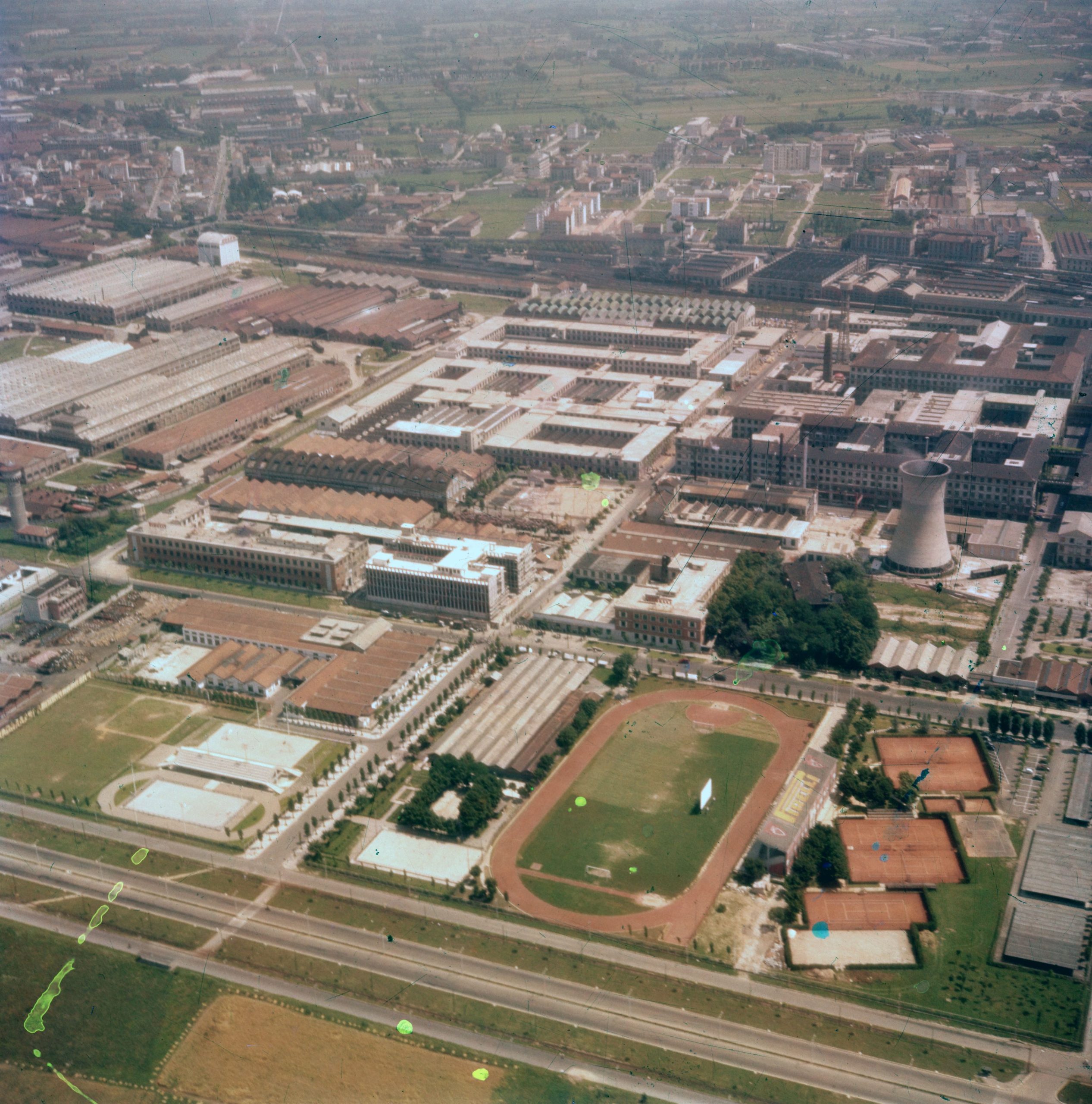
In 1922, as Pirelli proudly celebrated its fiftieth anniversary, one of the many events marking the occasion was the founding of the Sport Club Pirelli on 13 December. Sports fields and facilities were built on the other side of Viale Sarca, opposite the factory, in partnership with the historic sports association Pro Patria 1883. Over time, the complex was expanded with changing rooms, stands and modern infrastructure. Reserved for Pirelli employees in Bicocca, the multi-sports club offered the chance, after work, to train regularly, take part in competitions and tournaments, join trips and excursions, and ultimately receive official company recognition for commitment or excellence in a given discipline.
Over the years, the range of activities grew steadily, reaching 18 sections and more than 2,500 members in the 1970s. It is interesting to note that skiing and mountaineering were included from the very beginning, alongside football, tennis, basketball, fencing, athletics, bowls, cycling and motorcycle touring. Mountain sports and skiing were “warmly” encouraged not only for their physical benefits, but also for their ability to strengthen a shared sense of belonging within the company. Cesare Piantanida’s article Gita al Mottarone (“A Trip to Mottarone”), published in the grey-green pages of the Bollettino dello Sport Club Pirelli and preserved in our Historical Archive, tells the story of an excursion to the snowfields of Mottarone in what is now the province of Verbano-Cusio-Ossola on 8 and 9 December 1923. It paints a vivid picture of a community of colleagues devoted to skiing and the mountains – engineers, accountants, gentlemen and ladies alike – along with curious historical notes on the language and spelling of early ski culture (“…The skiators come speeding down the slope…”).
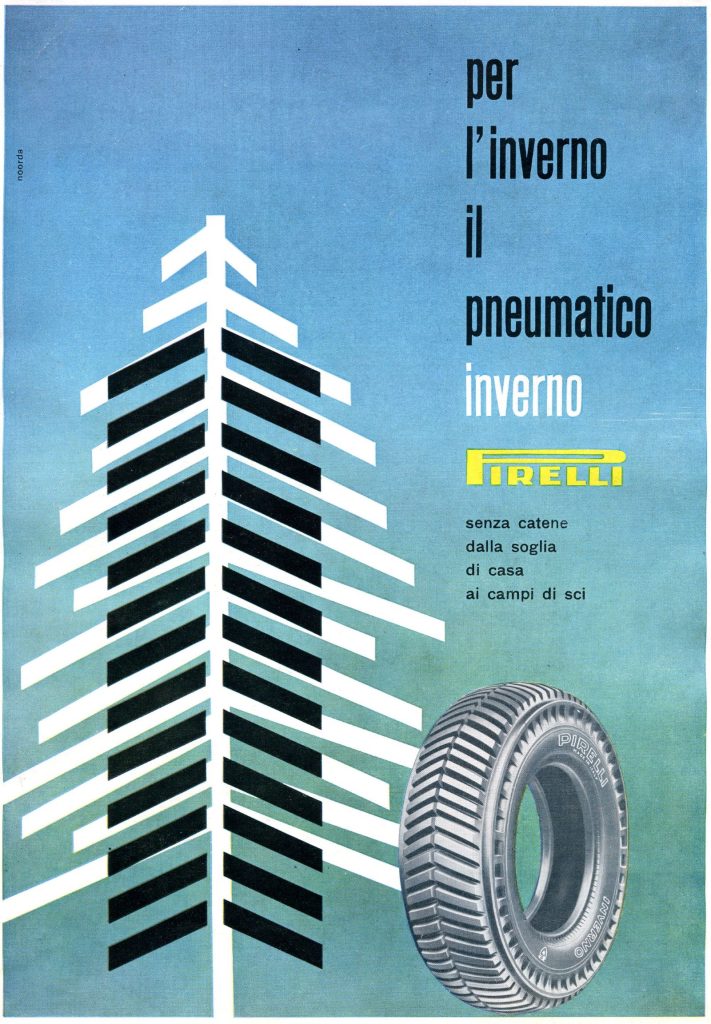
In his 1946 book La Pirelli. Vita di un’azienda industriale, President Alberto Pirelli wrote: “The Company has always encouraged and supported these activities: sporting competitions, alpine outings, cycling tours, fraternity, emulation, and team spirit.” With these words, he acknowledged sport as a core corporate value. The 1950s marked a veritable second renaissance for the Bicocca sports facilities and for the activities of the Sport Club Pirelli, particularly for its Skiing and Mountaineering section. This growth ran parallel to the production of a wide range of rubber products for skiers – jackets, boots, grips and baskets for ski poles, straps and bindings – as well as rubber soles, a flagship of the Miscellaneous Products sector, and the first winter tyre with a herringbone tread, aptly named Inverno.
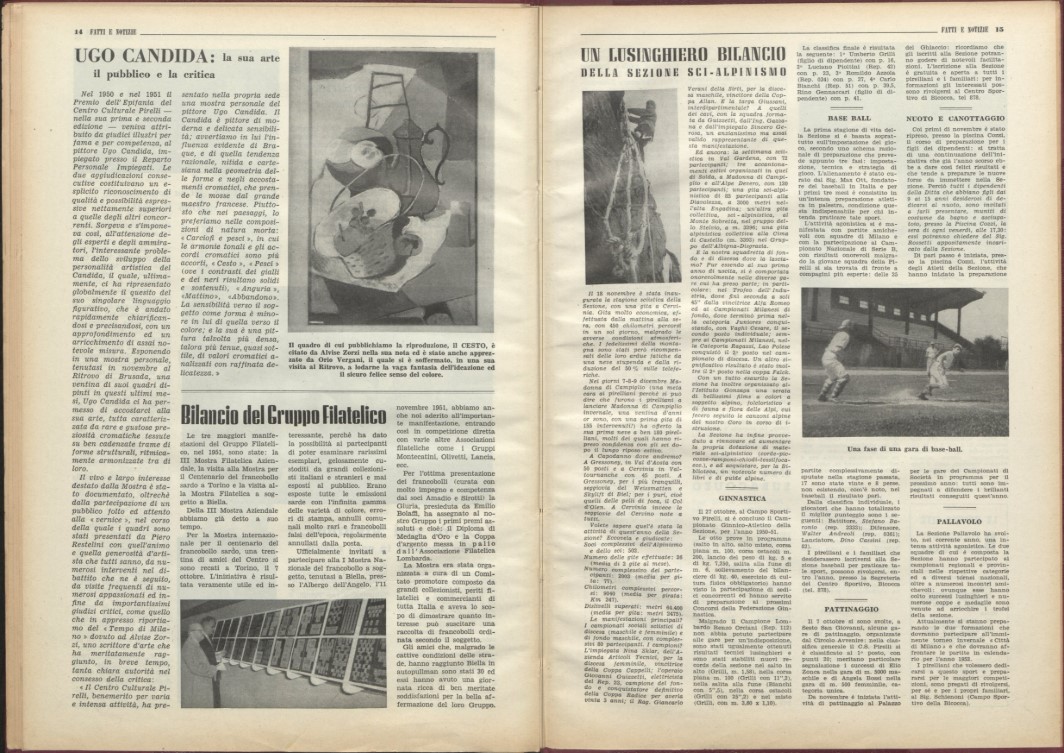
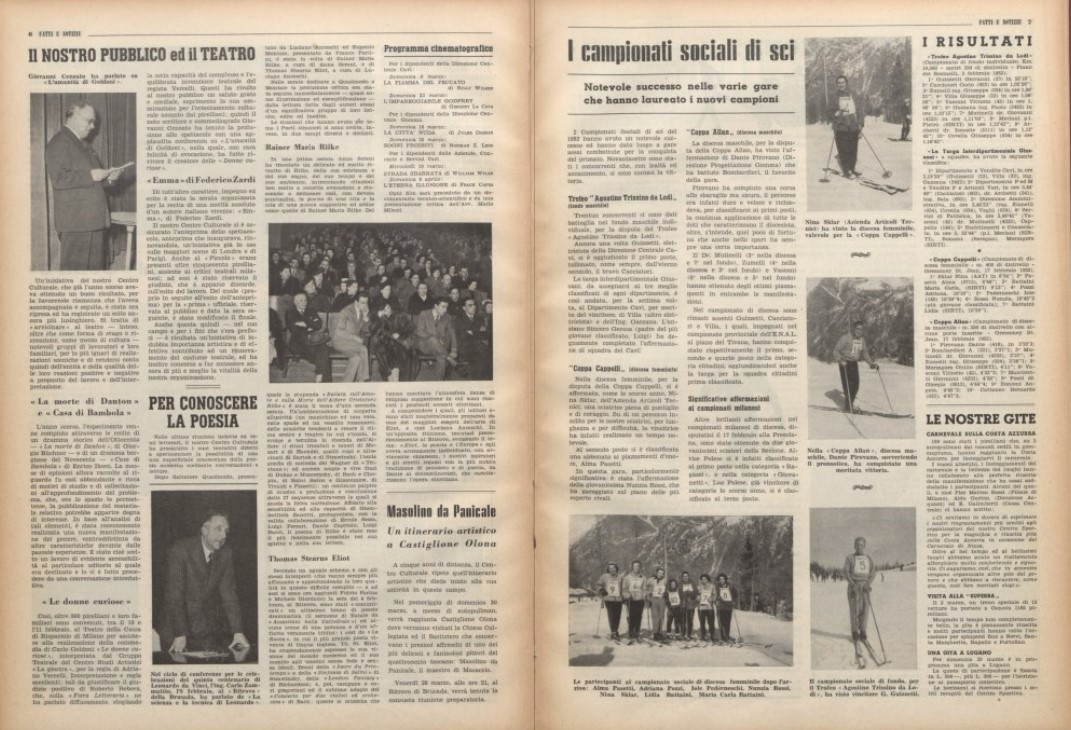
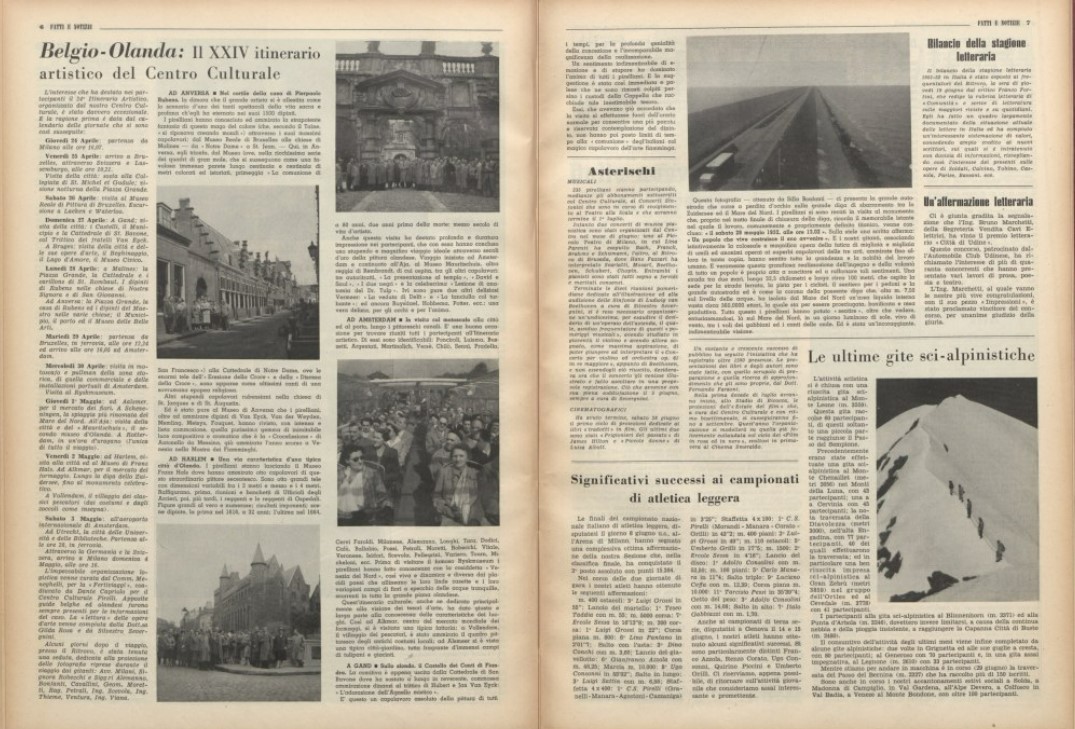
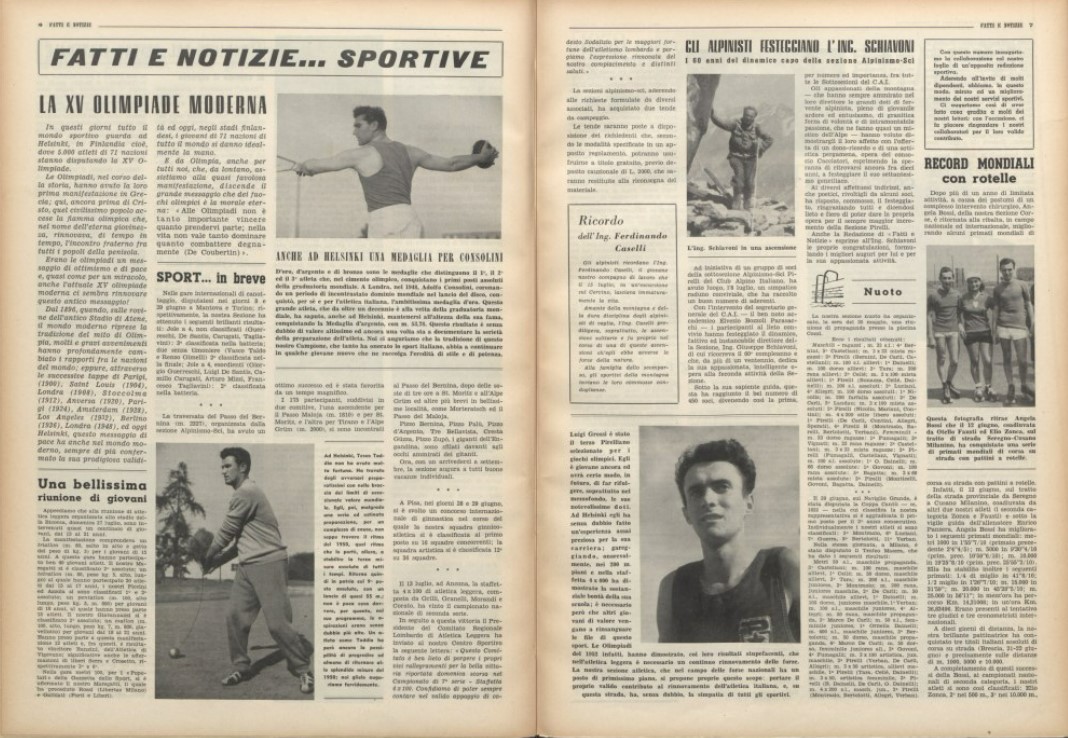
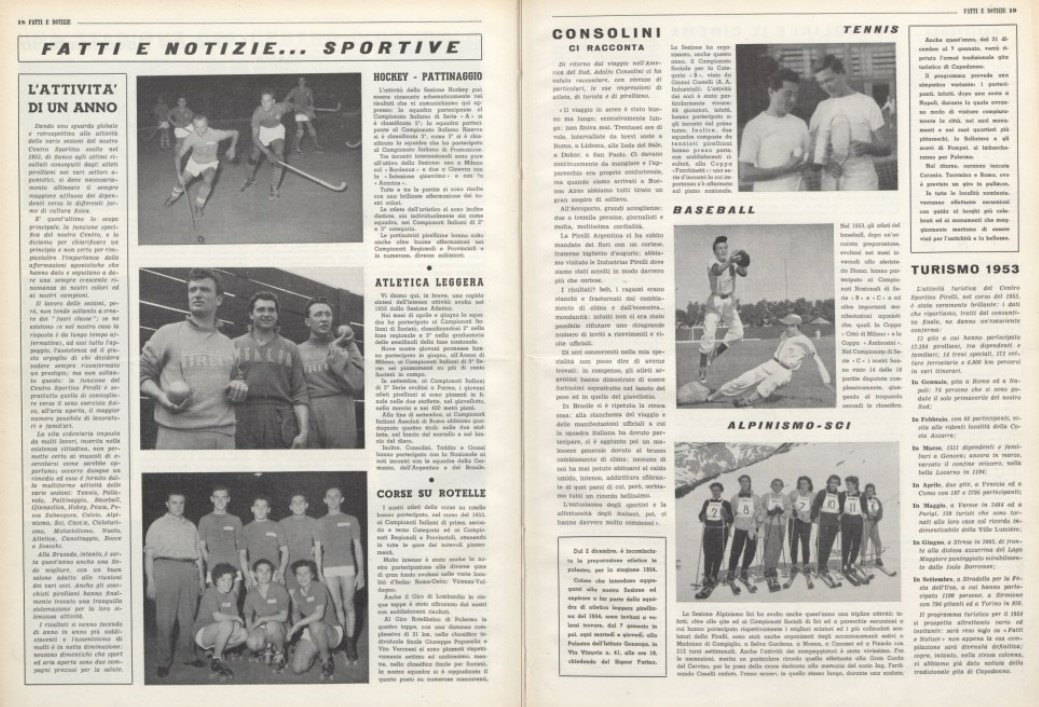
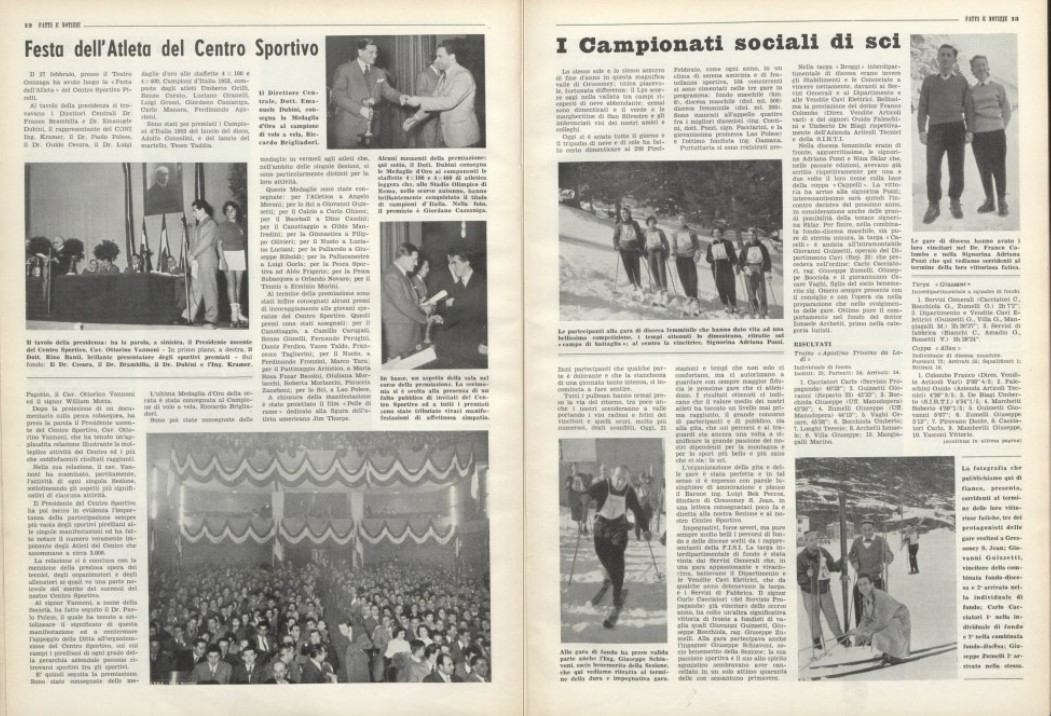
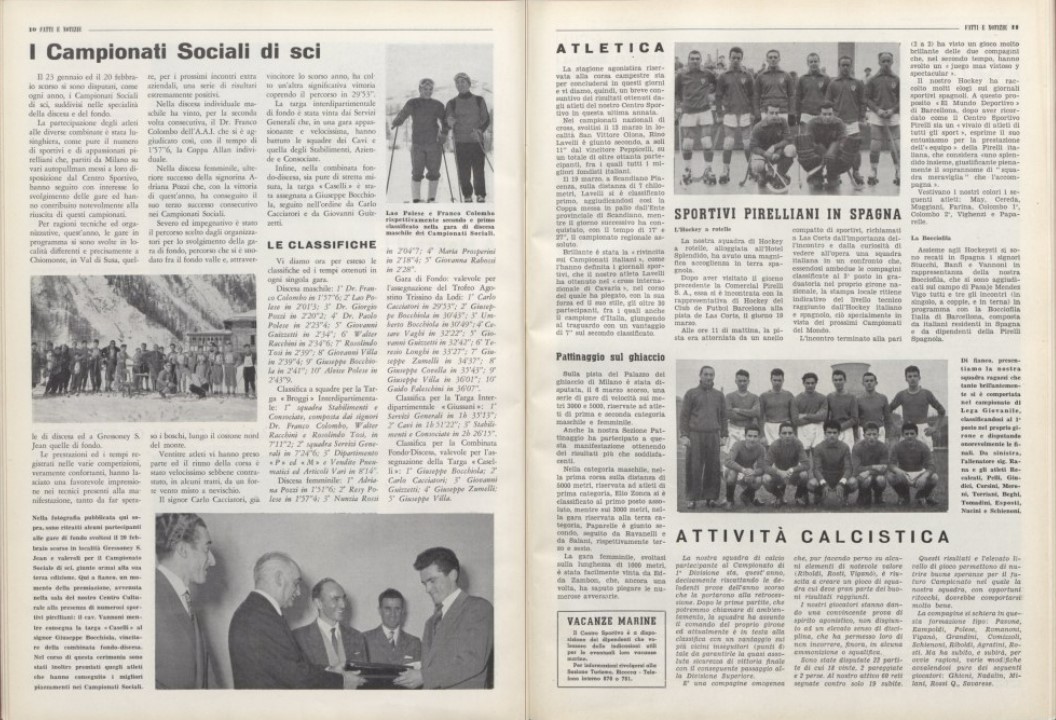
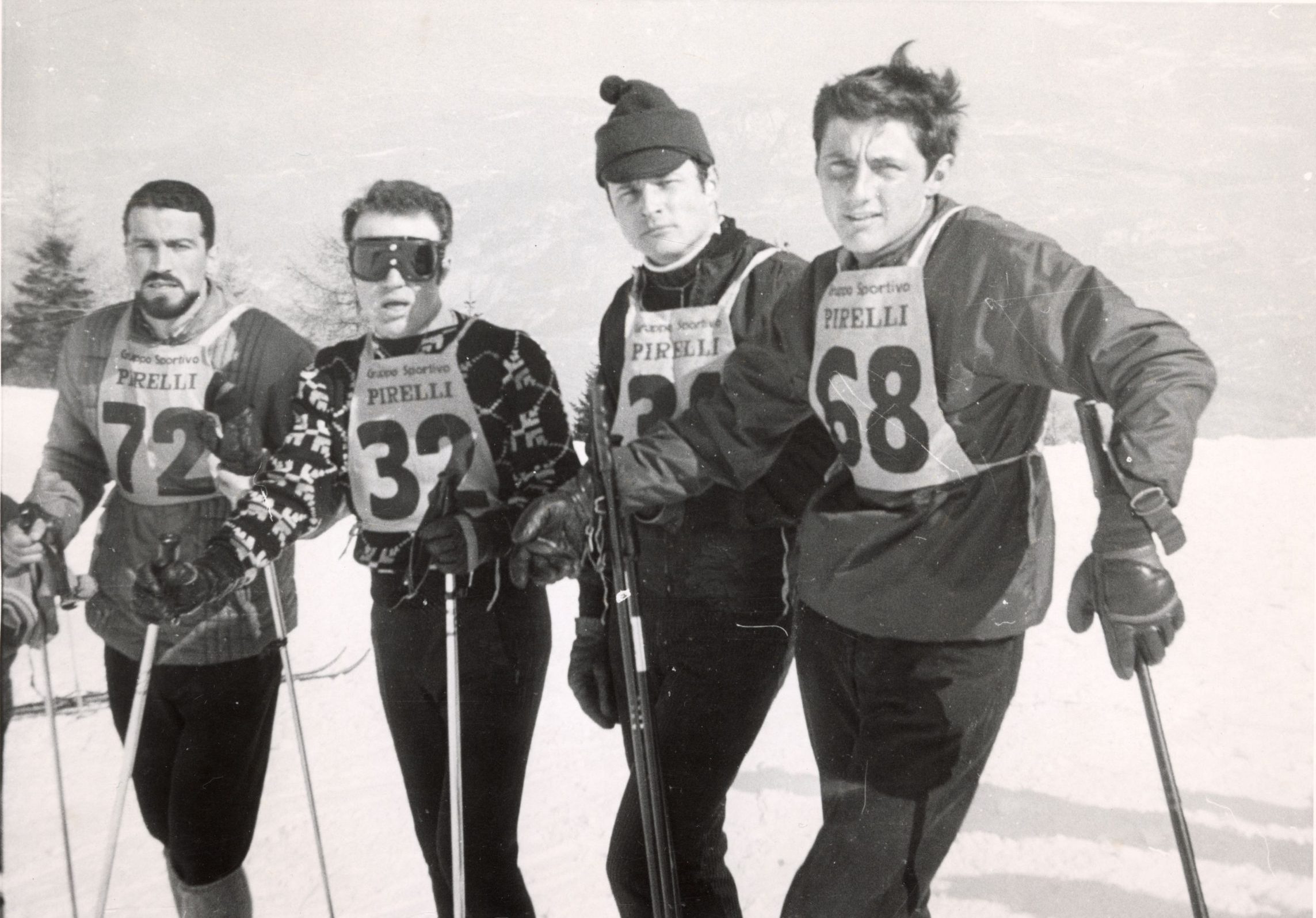
The events and achievements of the Sport Club Pirelli regularly featured in the company press. The monthly magazine Fatti e Notizie, the internal publication for Pirelli Group employees in Italy, remains the main source documenting the life of the Skiing and Mountaineering section, from excursions and climbs to races, championships and personal stories. In its very first issue in February 1950, alongside reports on monthly activities, it tells the story of the “noble act of altruism performed by CAI guide and ski instructor Jean Pellisier towards our colleague Alma Pasetti”. Skiing, rock training and mountaineering were on the programme for April 1950, with trips to Grignone, Marmolada, Corno Stella, Punta d’Arbola and Blindenhorn, as reported in Fatti e Notizie 1950, no. 3. The February–March period of 1951 included a skiing week in Val Gardena, the Sellaronda and the company downhill championships for men and women (Fatti e Notizie 1951, no. 3, while Fatti e Notizie 1952, no. 3 reports on the Trofeo dell’Industria, held at Alpe Devero on 8 March between the leading industries in Milan. The event included cross-country and men’s downhill races, with a women’s downhill as a supporting competition: “Our cross-country skiing team (Guizzetti, Cacciatori, Zumelli) cane first with 284 points, ahead of Alfa Romeo, C.G.E., AEM and others.” Fatti e Notizie 1951, no. 1 also presents a “highly positive balance sheet” of the Skiing and Mountaineering section’s activities in 1950: 30 outings and a total of 2,347 participants, a “record among the 32 company skiing and mountaineering sections affiliated with CAI Milano”.
From Fatti e Notizie 1952, no. 7 we learn that, with 450 members, the Pirelli Ski and Mountaineering section affiliated with CAI was the largest of all CAI subsections, thanks in particular to Engineer Giuseppe Schiavoni. Fatti e Notizie 1955, no. 4, on the other hand, reports on the interdepartmental trophies and rankings, mentioning teams such as the “Plants and subsidiaries”, “General services”, “Tyre and Miscellaneous Products Sales”, and others.
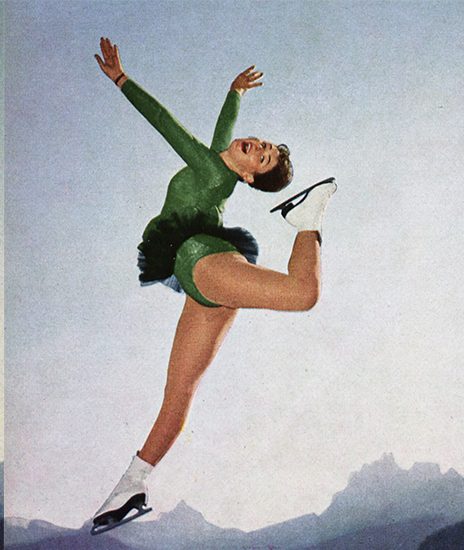
Ice skating also featured among the winter sports promoted by the Sport Club Pirelli. Fatti e Notizie 1956, no. 5 reviews the November 1955–April 1956 season, noting “a good number of gratifying performances and excellent results”. In competitive sports, and in speed skating in particular, the team took part in several provincial and regional contests, reaching the top spots in the Targa d’Argento trophy.
The passion for the mountains and skiing shown by Pirelli employees also found expression in the city, in auditoriums and libraries, through cultural events designed to promote knowledge of, and respect for, the mountain ecosystem. Fatti e Notizie 1951, no. 11 reports that “the Section organised an evening at the Istituto Gonzaga featuring beautiful colour films on alpine themes, folklore, and Alpine flora and fauna… and arranged for the purchase of a substantial number of books and alpine guides for the Library”.
A lot has changed in society since the days of the Sport Club Pirelli. The lifestyles of Pirelli employees evolved in the 1980s and corporate welfare entered a new phase. Commitment to sport, however, continued to grow, acquiring a global dimension through partnerships – particularly in snow sports – with the world of competitive winter games, from the Italian Winter Sports Federation to the Winter Olympic Games.
Milano-Cortina 2026 is now close at hand, with Pirelli employees taking centre stage as torchbearers, entrusted with carrying the Olympic flame as a symbol of the finest traditions and highest values of sport from the days of ancient Greece.