
Europe’s isolation and the conditions for regaining momentum on security and innovation


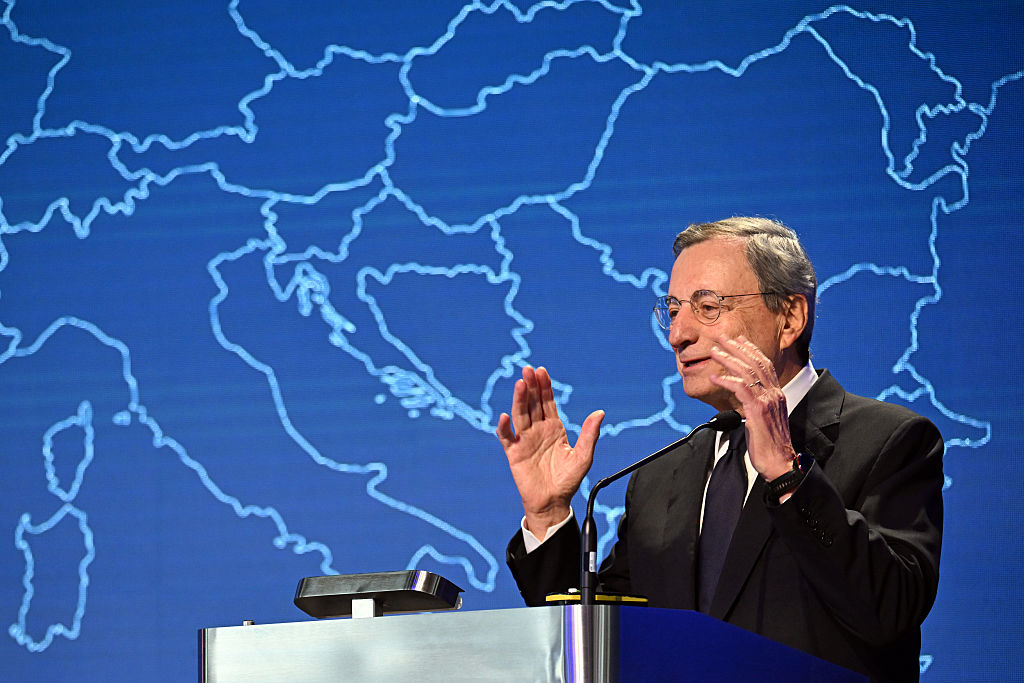
‘Loneliness does not stem from being alone, but from not being understood’, or, in other words, ‘from the inability to communicate the things that seem important to us’. Carl Gustav Jung’s observation comes to mind when rereading Mario Draghi’s words during his speech in Aachen on the occasion of receiving the Charlemagne Prize, one of Europe’s most prestigious awards. And they bear clear witness to the political situation in a Europe that is facing the collapse of the certainties that came with being an integral and secure part of a West built on the foundations of friendship, political and cultural harmony, and ties with the US. ‘For the first time, we are alone, together’.
“Alone, together’. This apparent oxymoron reveals the full gravity of a situation that touches on the key issues of current European politics: security, energy, new technologies, industrial policy and international relations. And it urgently calls for consistent political decisions.
In the solitude of his irony, Oscar Wilde could afford the bitter luxury of declaring that ‘the only possible company is one’s own’. A human condition that may have its advantages. A political condition, however, that is impossible.
‘Alone, together’ also has another meaning worth reflecting upon. The European Union is a home of diversity, where people have long been accustomed to exchange and dialogue. And in a world undergoing such rapid change, diversity ultimately becomes a source of strength to be harnessed.
Draghi is therefore right when, speaking once again from Aachen, before the throne that once belonged to Charlemagne, he urges Europe to finally take all the necessary steps to avoid being crushed in the vice-like grip of relations between Trump’s US and Xi’s China, both of which are tempted by a new G2 world order, having consigned the G7 and G8 to the dustbin of history.
His stark warning against isolation is a kind of echo, one imbued with far greater political significance, of that ‘whatever it takes’ with which, as President of the ECB, he saved the euro and thus the future of the EU economy from one of the most severe crises the single currency has ever faced. Draghi has entrusted this essay, with the bold, explicit title ‘ Compete or Disappear: Towards a New European Landscape’, to Rizzoli and it will be available in bookshops from the end of May.
The point is this: we must acknowledge that ‘a world that no longer exists is now a thing of the past’ (Marco Zatterin, La Stampa, 17 May). This refers to the world of bipolar equilibrium, the ‘NATO umbrella’ and the special Atlantic partnership of democracy, security and business. We must learn to navigate far more treacherous, dangerous and unknown waters.
Therefore, we must radically overhaul EU governance. This means saying goodbye to the constraints of unanimity and rigid bureaucracy, except on fundamental issues such as rights and freedoms, starting with economic rights and competition, and consequently, the single market that has finally been established. We should consider developing common policies and taking the lead with those countries that are ready to move forward in areas such as defence, technology, scientific research, training and industrial policy. This should start with a culture of ‘getting things done and doing them well’, as well as a high-quality industrial workforce with skills that rank among the best in the world, certainly far more capable than those in the US.
In short, Europe still has plenty of assets at its disposal with which to reclaim its position as a leading political and economic player. It is simply a matter of deciding to take on that role and moving away from sovereignty-driven policies and populism, as well as investing financial resources. But also those cultural, ethical and civic resources that can help forge a ‘European approach’ to artificial intelligence.
It is worth emphasising that Europe holds a leading position in these resources, as its history and current cultural landscape confirm. These resources can form a new, solid foundation for the revival of European civilisation and provide a point of reference for internationally significant public discourse and research, including political and social research.
Financial investment is key. Draghi urges at least 1.2 trillion euros of investment per year over a long period. The euro is a reliable currency and the EU has already proven that it is a trustworthy debtor.
The timing is not in our favour, however, as it is neither politically nor technologically convenient. However, there are universities, research centres and cutting-edge companies in major European cities whose collaboration in an effective industrial and cultural policy can promote growth, autonomy and, indeed, security.
Loneliness remains a risk. Good politics can provide solutions.
Another political dimension that can be leveraged is the relationships that the EU can build and strengthen independently of the G2 framework. The Mercosur agreements are a case in point, as are relations with Canada, Japan, South Korea and the Arab world.
In other words, the only way to resolve a political crisis is to make ambitious political decisions that look to the future. The decline of Europe is by no means inevitable.
(photo Getty Images)