


Artificial Intelligence built on mistakes and revolutions
A book explaining how we went from computers to AI, helping readers gain a deeper understanding of emerging technologies
When we understand new technologies, we are able to use them more effectively, avoid feeling overwhelmed and maintain control. While challenging, this task and goal are achievable. The task can be accomplished with the help of adequate knowledge tools, such as ‘Parlare agli algoritmi. Intelligenza artificiale: trent’anni di errori, scoperte e rivoluzioni’ (Talking to algorithms: thirty years of mistakes, discoveries and revolutions), a recently published book by Federico Neri.
There are three technological transformations to consider: first, the arrival of the computer; then, the internet; and now, artificial intelligence. This new technology is revolutionising the way we work and interact, and for the first time offers a glimpse into a future where machines may replace humans.
Neri guides readers along the path that has led much of humanity to its current technological state. This is a journey full of mistakes, but also of discoveries and revolutions, which can only be described with clarity and precision by those who have experienced much of it. In fact, the author is one of Italy’s pioneers in the application of AI to language. Having lived through thirty years of technological revolution as a first-hand witness, he is well placed to guide readers on a journey from the first symbolic rules of the nineties to modern Large Language Models, from university laboratories to secret meetings with intelligence services, and from the semantics of military patents to modern generative systems.
Neri’s book is not only an account of the evolution of algorithms; it is also a story of their creation, a book in which biography and technology are intertwined. There is one major difference compared to many other texts on the subject: in Neri’s work, science and technology are interwoven with emotions and humanity, the fears and hopes of the people behind every advance.
At a time when AI arouses both enthusiasm and legitimate fears, the insights of those who have ‘talked to algorithms’ for three decades can provide valuable guidance. They can help us to better understand artificial intelligence in all its aspects, from its technical foundations to its ethical implications. And that’s not all: Federico Neri’s book is also written in clear and often compelling language, which is another of its great strengths.
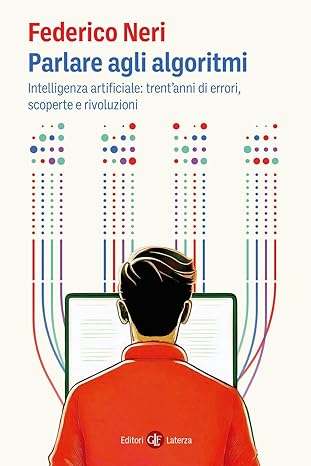
Parlare agli algoritmi. Intelligenza artificiale: trent’anni di errori, scoperte e rivoluzioni
Federico Neri
Laterza, 2026
A book explaining how we went from computers to AI, helping readers gain a deeper understanding of emerging technologies
When we understand new technologies, we are able to use them more effectively, avoid feeling overwhelmed and maintain control. While challenging, this task and goal are achievable. The task can be accomplished with the help of adequate knowledge tools, such as ‘Parlare agli algoritmi. Intelligenza artificiale: trent’anni di errori, scoperte e rivoluzioni’ (Talking to algorithms: thirty years of mistakes, discoveries and revolutions), a recently published book by Federico Neri.
There are three technological transformations to consider: first, the arrival of the computer; then, the internet; and now, artificial intelligence. This new technology is revolutionising the way we work and interact, and for the first time offers a glimpse into a future where machines may replace humans.
Neri guides readers along the path that has led much of humanity to its current technological state. This is a journey full of mistakes, but also of discoveries and revolutions, which can only be described with clarity and precision by those who have experienced much of it. In fact, the author is one of Italy’s pioneers in the application of AI to language. Having lived through thirty years of technological revolution as a first-hand witness, he is well placed to guide readers on a journey from the first symbolic rules of the nineties to modern Large Language Models, from university laboratories to secret meetings with intelligence services, and from the semantics of military patents to modern generative systems.
Neri’s book is not only an account of the evolution of algorithms; it is also a story of their creation, a book in which biography and technology are intertwined. There is one major difference compared to many other texts on the subject: in Neri’s work, science and technology are interwoven with emotions and humanity, the fears and hopes of the people behind every advance.
At a time when AI arouses both enthusiasm and legitimate fears, the insights of those who have ‘talked to algorithms’ for three decades can provide valuable guidance. They can help us to better understand artificial intelligence in all its aspects, from its technical foundations to its ethical implications. And that’s not all: Federico Neri’s book is also written in clear and often compelling language, which is another of its great strengths.
Parlare agli algoritmi. Intelligenza artificiale: trent’anni di errori, scoperte e rivoluzioni
Federico Neri
Laterza, 2026