


Cars and beyond
A just published book provides a historical and contemporary analysis of the automotive sector in Italy and Europe
Even if the path to achieving it is fraught with difficulties and pitfalls, transforming an industrial sector that has been crucial to the economy (and society) for decades is an important goal to pursue. Here, we are talking about the automotive sector, which has been the cornerstone of the European and Italian economies for decades, as well as certain regions more than others. It is now the paradigm of the economic crisis par excellence: the ‘perfect storm’. And it is precisely from the image of the ‘perfect storm’ that ‘Auto-distruzione. Crisi e trasformazione dell’industria dell’automobile’ (with the author employing a play on words in Italian, where auto means both self and car – Self/Car-destruction. Crisis and transformation of the automotive industry), a recently published book by Francesco Zirpoli, takes its cue.
Zirpoli discusses the state of the automotive industry in Italy and Europe in three stages. First, as mentioned above, he focuses on the decline of the industry in Europe before turning his attention to the situation in Italy and the history and current affairs of Fiat (now Stellantis). Finally, he considers how to overcome the crisis by combining the conditions and prospects of the supply chain, the environmental compatibility of new cars and the need for change to avoid extinction. This requires us to ‘broaden our horizons’ and find solutions beyond those attempted to date.
He debunks certain myths and highlights the benefits of what many today see as harmful, which is one of the book’s defining features. This is evident in his criticism of EU emissions regulations as ‘convenient narratives that only serve to protect vested interests’, and his suggestion that the ecological shift could in fact be the key to reviving the sector.
Zirpoli writes that the book is also an invitation ‘to move beyond a vision of industry focused on the car, and to highlight the importance of broader reflections on future mobility. Because it’s not just about building new factories or producing cleaner cars. We also need to imagine cities that are less dependent on private cars and more open to shared mobility solutions, such as public transport and car sharing. This is a change that will affect the daily lives of millions of people, from families wondering whether they can afford to buy a car, to factory workers fearing for their jobs, to young people aspiring to live in cleaner, more liveable cities.’
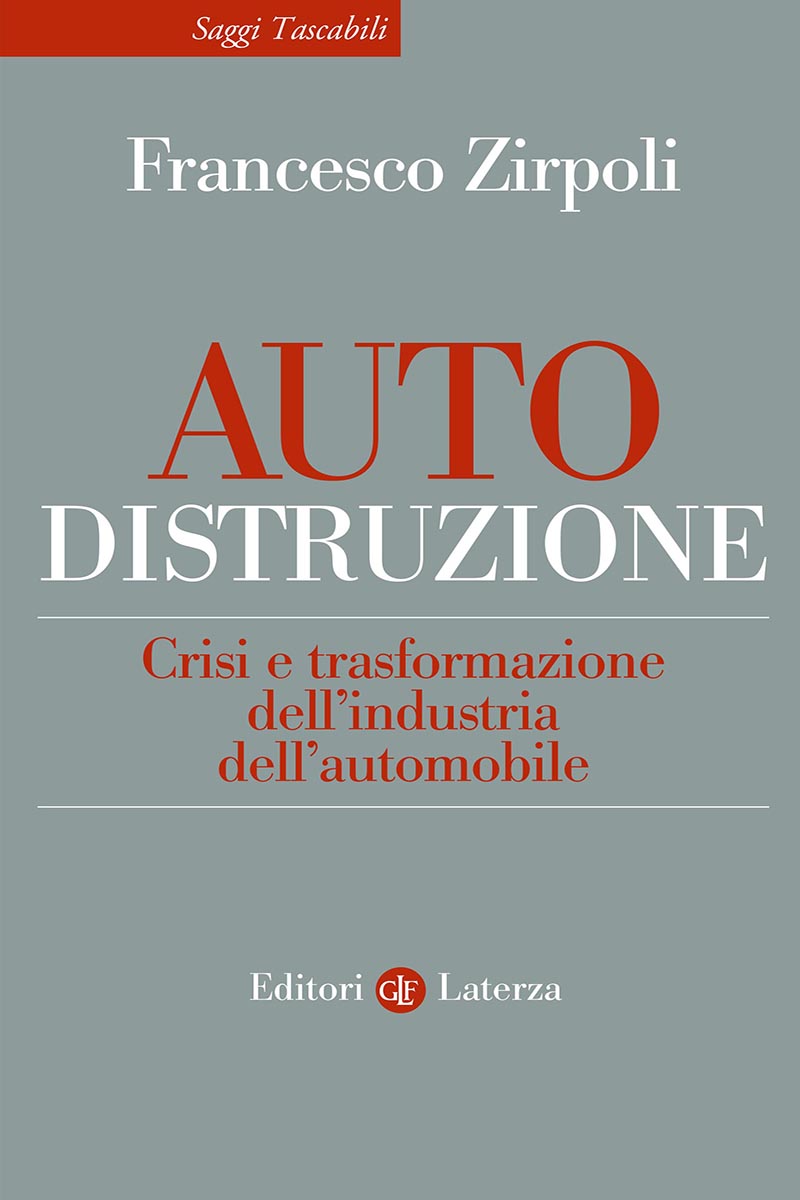
Auto-distruzione. Crisi e trasformazione dell’industria dell’automobile
Francesco Zirpoli
Laterza, 2026
A just published book provides a historical and contemporary analysis of the automotive sector in Italy and Europe
Even if the path to achieving it is fraught with difficulties and pitfalls, transforming an industrial sector that has been crucial to the economy (and society) for decades is an important goal to pursue. Here, we are talking about the automotive sector, which has been the cornerstone of the European and Italian economies for decades, as well as certain regions more than others. It is now the paradigm of the economic crisis par excellence: the ‘perfect storm’. And it is precisely from the image of the ‘perfect storm’ that ‘Auto-distruzione. Crisi e trasformazione dell’industria dell’automobile’ (with the author employing a play on words in Italian, where auto means both self and car – Self/Car-destruction. Crisis and transformation of the automotive industry), a recently published book by Francesco Zirpoli, takes its cue.
Zirpoli discusses the state of the automotive industry in Italy and Europe in three stages. First, as mentioned above, he focuses on the decline of the industry in Europe before turning his attention to the situation in Italy and the history and current affairs of Fiat (now Stellantis). Finally, he considers how to overcome the crisis by combining the conditions and prospects of the supply chain, the environmental compatibility of new cars and the need for change to avoid extinction. This requires us to ‘broaden our horizons’ and find solutions beyond those attempted to date.
He debunks certain myths and highlights the benefits of what many today see as harmful, which is one of the book’s defining features. This is evident in his criticism of EU emissions regulations as ‘convenient narratives that only serve to protect vested interests’, and his suggestion that the ecological shift could in fact be the key to reviving the sector.
Zirpoli writes that the book is also an invitation ‘to move beyond a vision of industry focused on the car, and to highlight the importance of broader reflections on future mobility. Because it’s not just about building new factories or producing cleaner cars. We also need to imagine cities that are less dependent on private cars and more open to shared mobility solutions, such as public transport and car sharing. This is a change that will affect the daily lives of millions of people, from families wondering whether they can afford to buy a car, to factory workers fearing for their jobs, to young people aspiring to live in cleaner, more liveable cities.’
Auto-distruzione. Crisi e trasformazione dell’industria dell’automobile
Francesco Zirpoli
Laterza, 2026