

From Programming to Artificial Intelligence
A newly published book helps us to understand the tools of innovation
Many manufacturing organisations (and, ultimately, most modern companies) seem to be experiencing innovation that outpaces innovation. It is not just a question of the pace at which research progresses, but also of the timetable for accepting and applying its results. As always, careful consideration is required to understand this phenomenon, which is also evident in the rapidly evolving field of Artificial Intelligence.
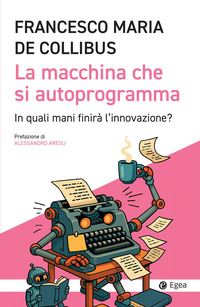
In his recently published book ‘La macchina che si autoprogramma. In quali mani finirà l’innovazione?’ (The self-programming machine: in whose hands will innovation end?), Francesco Maria De Collibus begins his reasoning from these considerations. Within the confines of a limited space, he attempts to clarify the relationship between two pivotal components of innovation: Artificial Intelligence and information technology.
According to De Collibus, it is Artificial Intelligence that is devouring software today. In just a few months, we have gone from a time when programming required years of study to a new reality where we only have to describe what we want in everyday language to see the code write itself. What might the outcome be? The reader is taken on a two-stage journey to learn about this technological transition. First, the focus is on what computers and programming are. Then, there is an in-depth look at the characteristics of Artificial Intelligence. De Collibus, a philosopher and computer scientist with extensive experience in information technology, touches on events in Silicon Valley and the activities of major companies such as GitHub Copilot, as well as emerging companies such as Cursor and Replit. The aim is to show not only how the role of programmers is changing, but also what it means to create technology today.
While the book does not provide solutions for every situation, it does provide tools to help readers better understand and respond to a series of questions whose answers must become part of our collective awareness. Questions on how to think about our time, how to think with totally new tools and how to make sense of the vast amount of information and suggestions offered every day.
La macchina che si autoprogramma. In quali mani finirà l’innovazione?
Francesco De Collibus
EGEA, 2025
A newly published book helps us to understand the tools of innovation
Many manufacturing organisations (and, ultimately, most modern companies) seem to be experiencing innovation that outpaces innovation. It is not just a question of the pace at which research progresses, but also of the timetable for accepting and applying its results. As always, careful consideration is required to understand this phenomenon, which is also evident in the rapidly evolving field of Artificial Intelligence.
In his recently published book ‘La macchina che si autoprogramma. In quali mani finirà l’innovazione?’ (The self-programming machine: in whose hands will innovation end?), Francesco Maria De Collibus begins his reasoning from these considerations. Within the confines of a limited space, he attempts to clarify the relationship between two pivotal components of innovation: Artificial Intelligence and information technology.
According to De Collibus, it is Artificial Intelligence that is devouring software today. In just a few months, we have gone from a time when programming required years of study to a new reality where we only have to describe what we want in everyday language to see the code write itself. What might the outcome be? The reader is taken on a two-stage journey to learn about this technological transition. First, the focus is on what computers and programming are. Then, there is an in-depth look at the characteristics of Artificial Intelligence. De Collibus, a philosopher and computer scientist with extensive experience in information technology, touches on events in Silicon Valley and the activities of major companies such as GitHub Copilot, as well as emerging companies such as Cursor and Replit. The aim is to show not only how the role of programmers is changing, but also what it means to create technology today.
While the book does not provide solutions for every situation, it does provide tools to help readers better understand and respond to a series of questions whose answers must become part of our collective awareness. Questions on how to think about our time, how to think with totally new tools and how to make sense of the vast amount of information and suggestions offered every day.
La macchina che si autoprogramma. In quali mani finirà l’innovazione?
Francesco De Collibus
EGEA, 2025