

The humanity of Industry 5.0
Multi-authored book published on the current situation regarding technology and the need to put people at the centre
The issue is not just technology. Rather, it is that technology necessarily requires other complex, innovative elements to be understood correctly in order to avoid one being overwhelmed. This is a condition common to all since the Industry 5.0 scenario became a reality, based on the idea of overcoming techno-centrism and putting people at the centre by combining innovation with sustainability, resilience, and social justice. But what does it mean to put people at the “centre” in the digital age? What is the emerging Industry 5.0 paradigm really all about?
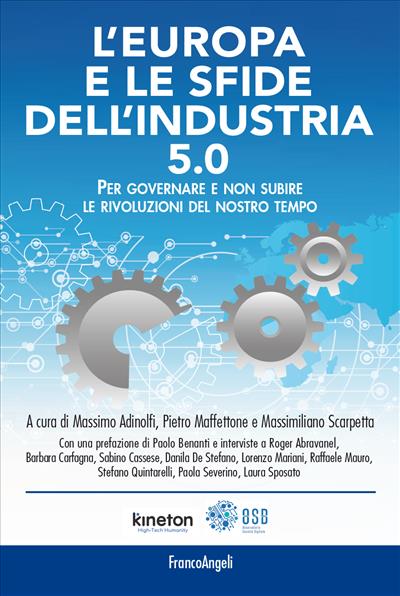
To understand more, read ‘L’Europa e le sfide dell’industria 5.0. Per governare e non subire le rivoluzioni del nostro tempo’ (Europe and the challenges of industry 5.0: How to govern without suffering the revolutions of our time), edited by Massimo Adinolfi, Pietro Maffettone and Massimiliano Scarpetta.
The book brings together a series of contributions offering multidisciplinary readings of the ethical, political and cultural implications of digital transformation. These readings span a range of disciplines, from philosophy and law to economics and geography, and investigate the impact of automation on work, democracy and rights. In addition to the editors, Paolo Benanti, Roger Abravanel, Barbara Carfagna, Sabino Cassese, Danila De Stefano, Lorenzo Mariani, Raffaele Mauro, Stefano Quintarelli, Paola Severino and Laura Sposato contributed to the work, each bringing their own vision and interpretation of Industry 5.0 to the multidisciplinary analysis, providing a more comprehensive understanding of the topic.
After explaining how the project that led to the book came about, the transition from Industry 4.0 to Industry 5.0 is addressed, as well as the evolution of industrial policy that accompanied this process. The book then goes on to explore some of the fundamental aspects of Industry 5.0, such as automation and the market, spatial and social organisation, and issues like labour relations and distributive justice. It concludes with a series of interviews, each offering a unique perspective on the subject. The book emphasises the need for inclusive public policies that can govern innovation without stifling its potential, while supporting a human-centred model of European development. Above all, Adinolfi, Maffettone and Scarpetta invite us to engage in an informed dialogue that enables us to govern, rather than suffer, the revolutions of our time.
L’Europa e le sfide dell’industria 5.0. Per governare e non subire le rivoluzioni del nostro tempo
Massimo Adinolfi, Pietro Maffettone, Massimiliano Scarpetta
Franco Angeli, 2026
Multi-authored book published on the current situation regarding technology and the need to put people at the centre
The issue is not just technology. Rather, it is that technology necessarily requires other complex, innovative elements to be understood correctly in order to avoid one being overwhelmed. This is a condition common to all since the Industry 5.0 scenario became a reality, based on the idea of overcoming techno-centrism and putting people at the centre by combining innovation with sustainability, resilience, and social justice. But what does it mean to put people at the “centre” in the digital age? What is the emerging Industry 5.0 paradigm really all about?
To understand more, read ‘L’Europa e le sfide dell’industria 5.0. Per governare e non subire le rivoluzioni del nostro tempo’ (Europe and the challenges of industry 5.0: How to govern without suffering the revolutions of our time), edited by Massimo Adinolfi, Pietro Maffettone and Massimiliano Scarpetta.
The book brings together a series of contributions offering multidisciplinary readings of the ethical, political and cultural implications of digital transformation. These readings span a range of disciplines, from philosophy and law to economics and geography, and investigate the impact of automation on work, democracy and rights. In addition to the editors, Paolo Benanti, Roger Abravanel, Barbara Carfagna, Sabino Cassese, Danila De Stefano, Lorenzo Mariani, Raffaele Mauro, Stefano Quintarelli, Paola Severino and Laura Sposato contributed to the work, each bringing their own vision and interpretation of Industry 5.0 to the multidisciplinary analysis, providing a more comprehensive understanding of the topic.
After explaining how the project that led to the book came about, the transition from Industry 4.0 to Industry 5.0 is addressed, as well as the evolution of industrial policy that accompanied this process. The book then goes on to explore some of the fundamental aspects of Industry 5.0, such as automation and the market, spatial and social organisation, and issues like labour relations and distributive justice. It concludes with a series of interviews, each offering a unique perspective on the subject. The book emphasises the need for inclusive public policies that can govern innovation without stifling its potential, while supporting a human-centred model of European development. Above all, Adinolfi, Maffettone and Scarpetta invite us to engage in an informed dialogue that enables us to govern, rather than suffer, the revolutions of our time.
L’Europa e le sfide dell’industria 5.0. Per governare e non subire le rivoluzioni del nostro tempo
Massimo Adinolfi, Pietro Maffettone, Massimiliano Scarpetta
Franco Angeli, 2026