

The Italian economy from 1945 to today: what lies behind us
A republished, updated, and expanded edition offers a valuable resource for understanding the present
Understanding what happened yesterday helps us to understand what is happening today and be better prepared for what will happen tomorrow. This is the meaning of history, and the result of paying attention to the origins of a present that is increasingly complex and seemingly inexplicable. Examining the past is a responsibility that everyone shares, and fulfilling this responsibility helps to develop a strong culture (including business culture). For this reason, it is important to have reliable sources of information, such as ‘Sviluppo e crisi dell’economia italiana. Dal 1945 ad oggi’ (Development and crisis of the Italian economy: From 1945 to today), a book written by Gioacchino Garofoli over two decades ago, which has now been updated and revised to be relevant to readers once again.
Spanning approximately 260 pages, Garofoli’s account of the history of the Italian economy from 1945 to the present day draws on his extensive experience as a researcher and teacher of economic policy. In a clearly structured way, he recounts the evolution of the economy, highlighting the problems that arose in various periods and the economic policy choices that were made, thus continuing an important tradition of Italian economic studies. He analyses the conditions of both the national and international contexts, in order to understand the role of both internal and external constraints, as well as the opportunities that have arisen.
The narrative begins with the years of economic reconstruction and the development model choices that characterised our country for at least twenty years. It then moves on to consider the years of the so-called ‘economic miracle’ (1953–1963) and the period of missed opportunities (1963–1970). It subsequently discusses the periods of great change in the 1970s (the oil crisis and the transition to flexible exchange rates) and in the 1980s (progressive integration into the European economy and the introduction of the European Monetary System), leading up to the decades that were strongly marked by the creation of the single European currency and the resulting deflationary policies in Italy and Europe. The final chapters examine the progressive economic stagnation that began with the introduction of austerity policies in Europe and culminated in the great economic and financial crisis of 2008. However, Garofoli points out that the Italian and European economies will not recover due to two additional crises and a fundamental misunderstanding of the root cause: insufficient domestic demand in Europe. The book concludes with two appendices: one providing interpretations of the country’s development, and the other dedicated to the territorial organisation of the national economic system.
Garofoli’s book is a great achievement in that it is written in simple yet not simplistic language, and is straightforward yet not oversimplified. This is why it can be read by anyone who wants to understand the economic choices made in the past, the issues currently facing us, and the opportunities that lie ahead.
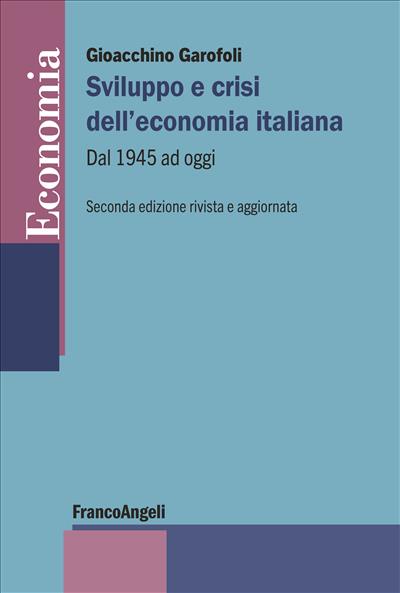
Sviluppo e crisi dell’economia italiana. Dal 1945 ad oggi
Gioacchino Garofoli
Franci Angeli, 2026
A republished, updated, and expanded edition offers a valuable resource for understanding the present
Understanding what happened yesterday helps us to understand what is happening today and be better prepared for what will happen tomorrow. This is the meaning of history, and the result of paying attention to the origins of a present that is increasingly complex and seemingly inexplicable. Examining the past is a responsibility that everyone shares, and fulfilling this responsibility helps to develop a strong culture (including business culture). For this reason, it is important to have reliable sources of information, such as ‘Sviluppo e crisi dell’economia italiana. Dal 1945 ad oggi’ (Development and crisis of the Italian economy: From 1945 to today), a book written by Gioacchino Garofoli over two decades ago, which has now been updated and revised to be relevant to readers once again.
Spanning approximately 260 pages, Garofoli’s account of the history of the Italian economy from 1945 to the present day draws on his extensive experience as a researcher and teacher of economic policy. In a clearly structured way, he recounts the evolution of the economy, highlighting the problems that arose in various periods and the economic policy choices that were made, thus continuing an important tradition of Italian economic studies. He analyses the conditions of both the national and international contexts, in order to understand the role of both internal and external constraints, as well as the opportunities that have arisen.
The narrative begins with the years of economic reconstruction and the development model choices that characterised our country for at least twenty years. It then moves on to consider the years of the so-called ‘economic miracle’ (1953–1963) and the period of missed opportunities (1963–1970). It subsequently discusses the periods of great change in the 1970s (the oil crisis and the transition to flexible exchange rates) and in the 1980s (progressive integration into the European economy and the introduction of the European Monetary System), leading up to the decades that were strongly marked by the creation of the single European currency and the resulting deflationary policies in Italy and Europe. The final chapters examine the progressive economic stagnation that began with the introduction of austerity policies in Europe and culminated in the great economic and financial crisis of 2008. However, Garofoli points out that the Italian and European economies will not recover due to two additional crises and a fundamental misunderstanding of the root cause: insufficient domestic demand in Europe. The book concludes with two appendices: one providing interpretations of the country’s development, and the other dedicated to the territorial organisation of the national economic system.
Garofoli’s book is a great achievement in that it is written in simple yet not simplistic language, and is straightforward yet not oversimplified. This is why it can be read by anyone who wants to understand the economic choices made in the past, the issues currently facing us, and the opportunities that lie ahead.
Sviluppo e crisi dell’economia italiana. Dal 1945 ad oggi
Gioacchino Garofoli
Franci Angeli, 2026