


Work and enterprise, transforming discontent into well-being
The malaise in manufacturing organisations and how to overcome it
Running a business in difficult and complex times. Balancing the books and valuing people. Tasks that many manufacturing organisations must address. Inescapable tasks involving not only ensuring the right production processes, but also paying the utmost attention to well-being and discontent within the company. The recently published book by Mauro Tomé and Paolo Umidon ‘Clinica del benessere organizzativo. Quali risposte al disagio sul lavoro’ (Organisational wellbeing clinic. The answers to discontent at work) may offer some insights.
The two authors start from a series of findings: the relationship between the individual and the organisation is increasingly complex; unstable markets, precariousness and insecurity in labour relations, excessive bureaucracy and cuts and reductions imposed by the need to ‘balance the books’ create fatigue and a precarious work-life balance. The crux of the questions arising from this situation is simple: how can effectiveness and efficiency be reconciled with valuing people?
In their response, the authors present theories and techniques alongside references to real cases of interventions in customer organisations. Their approach is based on an ambitious vision: addressing discontent is an opportunity not only to take care of people, but also to improve organisational efficiency and effectiveness. They explain that it is a matter of exercising a kind of ‘double gaze’, based on constant listening and valuing individuals, groups, and internal relationships. The topic is structured according to the outline provided by MODUS Società Benefit in several steps. After providing a general overview of the topic, they move on to the issue of family businesses between managerialisation and generational transition. They then consider the need to develop a true business culture and the need to facilitate change and innovation. Subsequently, the topics of the valuing of each individual within the organisation and the need to address organisational ‘malaise’ in order to promote well-being are addressed.
Tomé and Umidon’s book does not offer a universal solution to the challenges facing manufacturing organisations, but it certainly provides effective remedies for many of them.
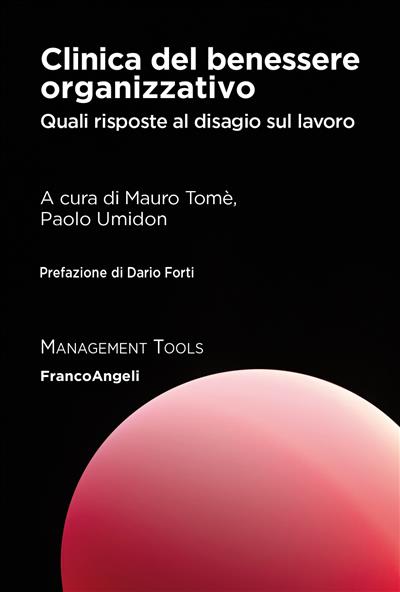
Clinica del benessere organizzativo. Quali risposte al disagio sul lavoro
Mauro Tomé, Paolo Umidon
Franco Angeli, 2025
The malaise in manufacturing organisations and how to overcome it
Running a business in difficult and complex times. Balancing the books and valuing people. Tasks that many manufacturing organisations must address. Inescapable tasks involving not only ensuring the right production processes, but also paying the utmost attention to well-being and discontent within the company. The recently published book by Mauro Tomé and Paolo Umidon ‘Clinica del benessere organizzativo. Quali risposte al disagio sul lavoro’ (Organisational wellbeing clinic. The answers to discontent at work) may offer some insights.
The two authors start from a series of findings: the relationship between the individual and the organisation is increasingly complex; unstable markets, precariousness and insecurity in labour relations, excessive bureaucracy and cuts and reductions imposed by the need to ‘balance the books’ create fatigue and a precarious work-life balance. The crux of the questions arising from this situation is simple: how can effectiveness and efficiency be reconciled with valuing people?
In their response, the authors present theories and techniques alongside references to real cases of interventions in customer organisations. Their approach is based on an ambitious vision: addressing discontent is an opportunity not only to take care of people, but also to improve organisational efficiency and effectiveness. They explain that it is a matter of exercising a kind of ‘double gaze’, based on constant listening and valuing individuals, groups, and internal relationships. The topic is structured according to the outline provided by MODUS Società Benefit in several steps. After providing a general overview of the topic, they move on to the issue of family businesses between managerialisation and generational transition. They then consider the need to develop a true business culture and the need to facilitate change and innovation. Subsequently, the topics of the valuing of each individual within the organisation and the need to address organisational ‘malaise’ in order to promote well-being are addressed.
Tomé and Umidon’s book does not offer a universal solution to the challenges facing manufacturing organisations, but it certainly provides effective remedies for many of them.
Clinica del benessere organizzativo. Quali risposte al disagio sul lavoro
Mauro Tomé, Paolo Umidon
Franco Angeli, 2025