


Different roads to business sustainability
A field survey of companies in Mantua
Since sustainability is interpreted on a company-by-company basis, taking organisational characteristics and particular production cultures into account, understanding the evolution of each case requires an understanding of theory. This is precisely what Alessandro Lai, Riccardo Stacchezzini, Francesca Rossignoli and Mariella Colantoni have achieved in Percorsi di Sostenibilità (Paths of sustainability), a collaborative book based on the results of a study conducted by a research group from the University of Verona’s Department of Management in the Mantua area, as part of the Mantova Sostiene il Futuro project, which is supported by a network of professional firms.
Through more than one hundred interviews, the research investigates how companies based in Mantua interpret and implement sustainability in its three dimensions – environmental, social, and governance – highlighting the associated challenges, progress, concerns, and delays. The book is divided into three sections: the research design; an in-depth examination of the different sustainability dimensions emerging from the survey; and an analysis of companies based on the results, classifying them into three groups: the ‘apprentices’, the ‘up-and-comers’ and the ‘pioneers’.
The survey reveals a clear pattern: while almost all companies recognise the importance of environmental issues, social and governance factors are often considered either ‘already satisfied’ or marginal. Some companies have embarked on structured, integrated paths, while others have declared intentions that are still lacking in tangible implementation. Group analysis reinforces this perception. However, after providing an overview of current practices, the book also offers insights into how companies are preparing for sustainability reporting. This is now almost obligatory due to advancing regulation and the need to gain legitimacy in the eyes of stakeholders.
Lai, Stacchezzini, Rossignoli and Colantoni’s work is an interesting read for anyone wanting to learn about businesses navigating changes in the social and economic landscape.
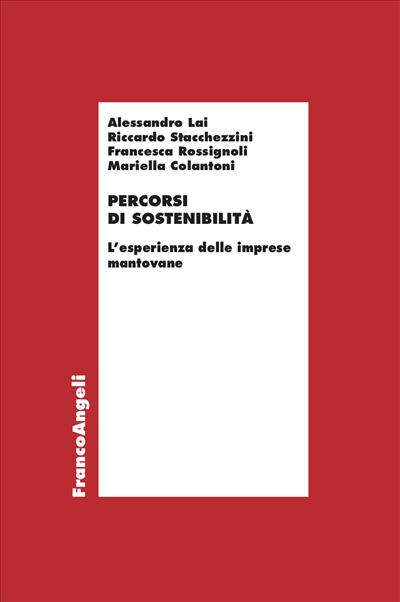
Percorsi di sostenibilità. L’esperienza delle imprese mantovane
Alessandro Lai, Riccardo Stacchezzini, Francesca Rossignoli, Mariella Colantoni (eds.)
Franco Angeli, 2025
A field survey of companies in Mantua
Since sustainability is interpreted on a company-by-company basis, taking organisational characteristics and particular production cultures into account, understanding the evolution of each case requires an understanding of theory. This is precisely what Alessandro Lai, Riccardo Stacchezzini, Francesca Rossignoli and Mariella Colantoni have achieved in Percorsi di Sostenibilità (Paths of sustainability), a collaborative book based on the results of a study conducted by a research group from the University of Verona’s Department of Management in the Mantua area, as part of the Mantova Sostiene il Futuro project, which is supported by a network of professional firms.
Through more than one hundred interviews, the research investigates how companies based in Mantua interpret and implement sustainability in its three dimensions – environmental, social, and governance – highlighting the associated challenges, progress, concerns, and delays. The book is divided into three sections: the research design; an in-depth examination of the different sustainability dimensions emerging from the survey; and an analysis of companies based on the results, classifying them into three groups: the ‘apprentices’, the ‘up-and-comers’ and the ‘pioneers’.
The survey reveals a clear pattern: while almost all companies recognise the importance of environmental issues, social and governance factors are often considered either ‘already satisfied’ or marginal. Some companies have embarked on structured, integrated paths, while others have declared intentions that are still lacking in tangible implementation. Group analysis reinforces this perception. However, after providing an overview of current practices, the book also offers insights into how companies are preparing for sustainability reporting. This is now almost obligatory due to advancing regulation and the need to gain legitimacy in the eyes of stakeholders.
Lai, Stacchezzini, Rossignoli and Colantoni’s work is an interesting read for anyone wanting to learn about businesses navigating changes in the social and economic landscape.
Percorsi di sostenibilità. L’esperienza delle imprese mantovane
Alessandro Lai, Riccardo Stacchezzini, Francesca Rossignoli, Mariella Colantoni (eds.)
Franco Angeli, 2025