


Stories of work, factories and offices
When literature does the talking for the culture of production
Human beings and work, offices and factories. Communities made of common labours and dreams, conflicts and hopes. A culture of production that becomes industrious reality, and a desire for well-being, and a rich subject matter. This has often, very often, been the case in the history of literature, as well as in literature today. It is important to occasionally visit (or revisit) some of the countless examples of stories of work and enterprise that literature is full of, perhaps to read them again or for the first time.
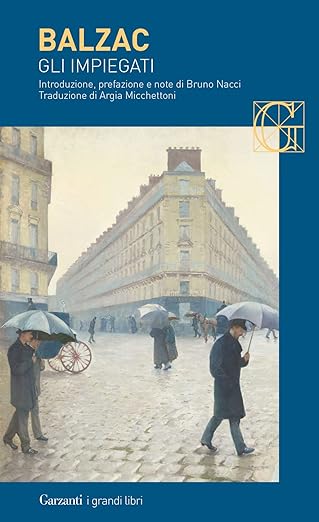
Thus, it is possible to read The Government Clerks (written by Honoré de Balzac in 1844, but still relevant and worth reading in some respects), which describes the office world of the time with merciless wit (a world that, in many respects, resembles that of today). Xavier Rabourdin, the protagonist, works in a ‘big room’, which could be referred to as an open-plan office today. Like the protagonists in Charles Dickens’ Hard Times, he fights every day to build a career, albeit in a very different environment. Hard Times describes factories and labour relations in the early days of the English Industrial Revolution in no uncertain terms. Dickens had experienced factory life, albeit briefly, and later became a parliamentary journalist. He combined the ability to tell with the ability to see, in no uncertain terms. Starting with the places and characters. ‘In Coketown,’ writes Dickens, ‘the piston of the steam-engine worked monotonously up and down (…). It contained several large streets all very like one another, and many small streets still more like one another, inhabited by people equally like one another, who all went in and out at the same hours, with the same sound upon the same pavements, to do the same work, and to whom every day was the same as yesterday and to-morrow, and every year the counterpart of the last and the next’.
The factory is depicted as a place of conflict (and possibly redemption), confrontation, as well as alienation. This is what happens to the protagonist of the 1925 novella The Train Has Whistled by Luigi Pirandello. The protagonist, Belluca, is an office worker who is mistreated by his colleagues and has a family that he feels he cannot connect with. Belluca eventually goes mad.
But are work and enterprise exclusively areas of drudgery and alienation? Clearly not, although these aspects have often been the focus of literature. One example is enough to refute the rule: Primo Levi, who, in his The Monkey Wrench, speaks of the toil of work and the factory, but also of its beauty. Levi — writer, chemist, man of letters and science, and witness to both the Holocaust and corporate work — tells of a particular aspect of human happiness in one of his most well-known passages. He writes, ‘If we can except those isolated and miraculous moments fate can bestow on a man, loving your work (unfortunately, the privilege of a few) represents the best, most concrete approximation of happiness on earth. But this is a truth that not many know’.
The Government Clerks
Honoré de Balzac
Garzanti, 1996
Hard Times
Charles Dickens
Feltrinelli, 2015
The train has whistled…
in, ‘Novella for a year. The lonely man’
Luigi Pirandello
Mondadori (various editions)
The Monkey Wrench
Primo Levi
Einaudi (various editions)
When literature does the talking for the culture of production
Human beings and work, offices and factories. Communities made of common labours and dreams, conflicts and hopes. A culture of production that becomes industrious reality, and a desire for well-being, and a rich subject matter. This has often, very often, been the case in the history of literature, as well as in literature today. It is important to occasionally visit (or revisit) some of the countless examples of stories of work and enterprise that literature is full of, perhaps to read them again or for the first time.
Thus, it is possible to read The Government Clerks (written by Honoré de Balzac in 1844, but still relevant and worth reading in some respects), which describes the office world of the time with merciless wit (a world that, in many respects, resembles that of today). Xavier Rabourdin, the protagonist, works in a ‘big room’, which could be referred to as an open-plan office today. Like the protagonists in Charles Dickens’ Hard Times, he fights every day to build a career, albeit in a very different environment. Hard Times describes factories and labour relations in the early days of the English Industrial Revolution in no uncertain terms. Dickens had experienced factory life, albeit briefly, and later became a parliamentary journalist. He combined the ability to tell with the ability to see, in no uncertain terms. Starting with the places and characters. ‘In Coketown,’ writes Dickens, ‘the piston of the steam-engine worked monotonously up and down (…). It contained several large streets all very like one another, and many small streets still more like one another, inhabited by people equally like one another, who all went in and out at the same hours, with the same sound upon the same pavements, to do the same work, and to whom every day was the same as yesterday and to-morrow, and every year the counterpart of the last and the next’.
The factory is depicted as a place of conflict (and possibly redemption), confrontation, as well as alienation. This is what happens to the protagonist of the 1925 novella The Train Has Whistled by Luigi Pirandello. The protagonist, Belluca, is an office worker who is mistreated by his colleagues and has a family that he feels he cannot connect with. Belluca eventually goes mad.
But are work and enterprise exclusively areas of drudgery and alienation? Clearly not, although these aspects have often been the focus of literature. One example is enough to refute the rule: Primo Levi, who, in his The Monkey Wrench, speaks of the toil of work and the factory, but also of its beauty. Levi — writer, chemist, man of letters and science, and witness to both the Holocaust and corporate work — tells of a particular aspect of human happiness in one of his most well-known passages. He writes, ‘If we can except those isolated and miraculous moments fate can bestow on a man, loving your work (unfortunately, the privilege of a few) represents the best, most concrete approximation of happiness on earth. But this is a truth that not many know’.
The Government Clerks
Honoré de Balzac
Garzanti, 1996
Hard Times
Charles Dickens
Feltrinelli, 2015
The train has whistled…
in, ‘Novella for a year. The lonely man’
Luigi Pirandello
Mondadori (various editions)
The Monkey Wrench
Primo Levi
Einaudi (various editions)