Access the Online Archive
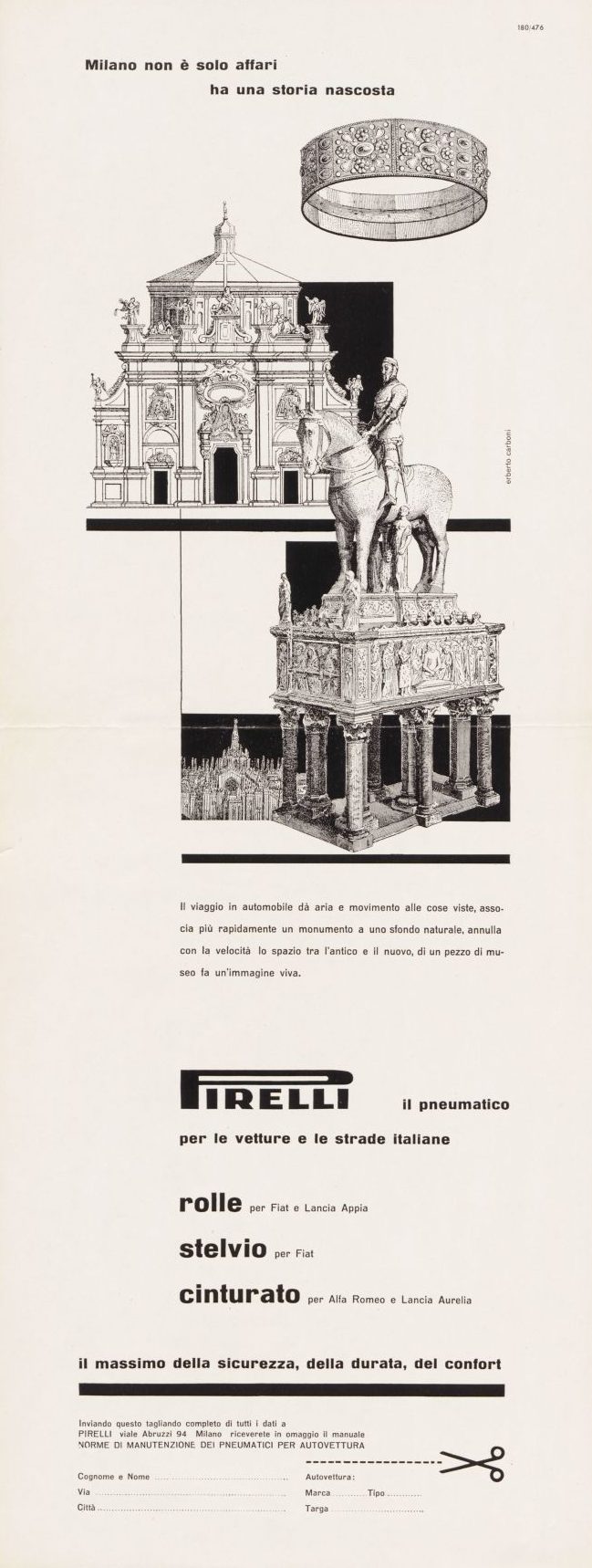
Search the Historical Archive of the Pirelli Foundation for sources and materials. Select the type of support you are interested in and write the keywords of your research.
    Select one of the following categories
  • Documents
  • Photographs
  • Drawings and posters
  • Audio-visuals
  • Publications and magazines
  • All
Help with your research
To request to view the materials in the Historical Archive and in the libraries of the Pirelli Foundation for study and research purposes and/or to find out how to request the use of materials for loans and exhibitions, please fill in the form below. You will receive an email confirming receipt of the request and you will be contacted.
Pirelli Foundation Educational Courses

Select the education level of the school
Back
Primary schools
Pirelli Foundation Educational Courses
Please fill in your details and the staff of Pirelli Foundation Educational will contact you to arrange the dates of the course.

I declare I have read  the privacy policy, and authorise the Pirelli Foundation to process my personal data in order to send communications, also by email, about initiatives/conferences organised by the Pirelli Foundation.

Back
Lower secondary school
Pirelli Foundation Educational Courses
Please fill in your details and the staff of Pirelli Foundation Educational will contact you to arrange the dates of the course.
Back
Upper secondary school
Pirelli Foundation Educational Courses
Please fill in your details and the staff of Pirelli Foundation Educational will contact you to arrange the dates of the course.
Back
University
Pirelli Foundation Educational Courses

Do you want to organize a training programme with your students? For information and reservations, write to universita@fondazionepirelli.org

Visit the Foundation
For information about the Foundation’s activities, guided tours and accessibility,
please call +39 0264423971 or fill in the form below, providing details of your request in the notes field.

Ready to Launch: “The Workshop of Ideas,” a New Pirelli Foundation Educational Programme

As the new school year approaches, Pirelli Foundation Educational is preparing to resume its education courses for primary and secondary schools. This year’s programme, entitled “The Workshop of Ideas”, invites students to engage with Pirelli’s business culture, helping them develop a deeper understanding of the world of work, which is one of people, processes and products, but especially one of thoughts and ideas.
The workshop has always been a unique space throughout the company’s history. It is a place where practical tasks are performed, demanding not only technical expertise but also creativity, intelligence, and passion. The new educational programme aims to enhance young people’s understanding of industrial production and the world of work in general, while also firing their imagination. By drawing on the vast collection of sketches, documents, photographs, and audio-visual materials in the Pirelli Historical Archive, students will be encouraged to think up and bring to life their own creative projects.
Sustainability, innovation and technological development, business history, and graphic and visual communication are just some of the subjects that will be covered in the free training workshops. The sessions will be held either in person at the Pirelli Foundation headquarters in Milan or live online.
A special focus will be placed on Pirelli’s historically close ties with sport in all its forms, highlighting the shared values that are found in both sport and business culture. Drawing on the content of The Sports Workshop, the Pirelli Foundation’s new publishing project, and on the newly curated exhibition on display on its premises, we will explore such themes such as teamwork, power and control, passion, and innovation. The workshops will also look at stories of champions, challenges, victories, and much more.
This year, there will be two opportunities to learn more about the content of the educational courses and how to sign up for them. You can choose between two online meetings, on 18 or 24 September, both starting at 5 p.m. To take part in the online presentation (via Microsoft Teams), click HERE. Registration is now open (booking required).

As the new school year approaches, Pirelli Foundation Educational is preparing to resume its education courses for primary and secondary schools. This year’s programme, entitled “The Workshop of Ideas”, invites students to engage with Pirelli’s business culture, helping them develop a deeper understanding of the world of work, which is one of people, processes and products, but especially one of thoughts and ideas.
The workshop has always been a unique space throughout the company’s history. It is a place where practical tasks are performed, demanding not only technical expertise but also creativity, intelligence, and passion. The new educational programme aims to enhance young people’s understanding of industrial production and the world of work in general, while also firing their imagination. By drawing on the vast collection of sketches, documents, photographs, and audio-visual materials in the Pirelli Historical Archive, students will be encouraged to think up and bring to life their own creative projects.
Sustainability, innovation and technological development, business history, and graphic and visual communication are just some of the subjects that will be covered in the free training workshops. The sessions will be held either in person at the Pirelli Foundation headquarters in Milan or live online.
A special focus will be placed on Pirelli’s historically close ties with sport in all its forms, highlighting the shared values that are found in both sport and business culture. Drawing on the content of The Sports Workshop, the Pirelli Foundation’s new publishing project, and on the newly curated exhibition on display on its premises, we will explore such themes such as teamwork, power and control, passion, and innovation. The workshops will also look at stories of champions, challenges, victories, and much more.
This year, there will be two opportunities to learn more about the content of the educational courses and how to sign up for them. You can choose between two online meetings, on 18 or 24 September, both starting at 5 p.m. To take part in the online presentation (via Microsoft Teams), click HERE. Registration is now open (booking required).

pordenonelegge… The Sports Workshop

The 25th edition of pordenonelegge, organised by Fondazione Pordenonelegge.it, opens today at the Teatro Verdi in Pordenone. Running from 18 to 22 September, the festival will feature over 600 Italian and international authors in more than 300 events across the Friuli-Venezia Giulia region.
This year’s guests include the Pulitzer Prize winner Richard Ford, the French philosopher Bernard-Henri Lévy, Enrico Brizzi with the long-awaited sequel to Jack Frusciante è uscita dal gruppo, Gianrico Carofiglio, Chiara Valerio, Donatella Di Pietrantonio, and Maurizio Maggiani.

The theme of sport will take centre stage in this edition, which will see the tennis champion Adriano Panatta in a conversation with the producer and director Domenico Procacci and the journalist Stefano Semeraro. There will also be a special event curated by Massimo Passeri and Antonio Bacci. Arrigo Sacchi, Federico Buffa and Fabrizio Gabrielli, Riccardo Pittis and Marino Bartoletti, among others, will all be taking part. As part of the pordenonelegge programme, on Friday 20 September at 9 p.m., the headquarters of Confindustria Alto Adriatico will host a discussion on our latest editorial project, The Sports Workshop, published in June by Marsilio Arte. This event, organised by the Pirelli Foundation, will feature Antonio Calabrò and Luigi Garlando, a writer and journalist for La Gazzetta dello Sport. Together, they will look at sport as a form of participation, involvement, community, and civic engagement. It will be a unmissable opportunity to reflect on the many facets and manifestations of sport, including what goes on behind the scenes and in the world beyond the performance.

The 25th edition of pordenonelegge, organised by Fondazione Pordenonelegge.it, opens today at the Teatro Verdi in Pordenone. Running from 18 to 22 September, the festival will feature over 600 Italian and international authors in more than 300 events across the Friuli-Venezia Giulia region.
This year’s guests include the Pulitzer Prize winner Richard Ford, the French philosopher Bernard-Henri Lévy, Enrico Brizzi with the long-awaited sequel to Jack Frusciante è uscita dal gruppo, Gianrico Carofiglio, Chiara Valerio, Donatella Di Pietrantonio, and Maurizio Maggiani.

The theme of sport will take centre stage in this edition, which will see the tennis champion Adriano Panatta in a conversation with the producer and director Domenico Procacci and the journalist Stefano Semeraro. There will also be a special event curated by Massimo Passeri and Antonio Bacci. Arrigo Sacchi, Federico Buffa and Fabrizio Gabrielli, Riccardo Pittis and Marino Bartoletti, among others, will all be taking part. As part of the pordenonelegge programme, on Friday 20 September at 9 p.m., the headquarters of Confindustria Alto Adriatico will host a discussion on our latest editorial project, The Sports Workshop, published in June by Marsilio Arte. This event, organised by the Pirelli Foundation, will feature Antonio Calabrò and Luigi Garlando, a writer and journalist for La Gazzetta dello Sport. Together, they will look at sport as a form of participation, involvement, community, and civic engagement. It will be a unmissable opportunity to reflect on the many facets and manifestations of sport, including what goes on behind the scenes and in the world beyond the performance.

What power with AI

A book recently published in Italy explores the relationships between the capabilities of Artificial Intelligence and its effects in the economy and society


Artificial Intelligence (AI) has established itself as the new boundary for the economy and business, as well as society – or so it would seem. However, the actual mechanisms for using AI and safeguarding ourselves from it and, above all, the extent of its effects, remain unclear. In attempting to answer these questions, it may be useful to read Power and Prediction. The Disruptive Economics of Artificial Intelligence, written by the trio of Ajay Agrawal, Joshua Gans and Avi Goldfarb and recently published in Italy.

The book takes its cue from an observation: AI has already had a significant impact on much of the economy – from finance and pharmaceuticals to the automotive, medical and manufacturing sectors, as well as world trade – but we are still only beginning to understand how to apply it effectively and appropriately. And, in the opinion of the three authors, this is especially true of economic forecasting, which AI should make more accurate, faster and better able to guide strategic decisions.
Our subject, then, is using AI to predict what will happen in the economy. The book explains how the two key ingredients in decision-making – prediction and judgment – are simultaneously processed by our minds, often without our realising it. The rise of AI is shifting the task of making predictions from humans to machines, relieving us of this cognitive load and increasing the speed and accuracy of decisions. Achieving such a leap forward, however, will involve redesigning a substantial set of systems and procedures. And this is the stage of the journey that provides the focal point for the book.

Agrawal, Gans and Goldfarb go on to take the reader through the rules and systems that need to be applied but, above all, they explore the topic of the power conferred on those able to use AI. Indeed, decision-making, as they note, confers power. And in the economy, power generates profits, while in society, power means control. All this will lead to a profound shake-up of economic and social structures. Companies will be able to exploit the opportunities that open up and will also have to protect their positions. Society will have to rethink how it is set up and people’s rights.

This book by Agrawal, Gans and Goldfarb – a useful and important volume – should be read carefully and critically by aware citizens and shrewd entrepreneurs alike.

Power and Prediction. The Disruptive Economics of Artificial Intelligence

Ajay Agrawal, Joshua Gans, Avi Goldfarb

Italian edition: Potere e previsione. L’economia dirompente dell’intelligenza artificiale, Franco Angeli, 2024

A book recently published in Italy explores the relationships between the capabilities of Artificial Intelligence and its effects in the economy and society


Artificial Intelligence (AI) has established itself as the new boundary for the economy and business, as well as society – or so it would seem. However, the actual mechanisms for using AI and safeguarding ourselves from it and, above all, the extent of its effects, remain unclear. In attempting to answer these questions, it may be useful to read Power and Prediction. The Disruptive Economics of Artificial Intelligence, written by the trio of Ajay Agrawal, Joshua Gans and Avi Goldfarb and recently published in Italy.

The book takes its cue from an observation: AI has already had a significant impact on much of the economy – from finance and pharmaceuticals to the automotive, medical and manufacturing sectors, as well as world trade – but we are still only beginning to understand how to apply it effectively and appropriately. And, in the opinion of the three authors, this is especially true of economic forecasting, which AI should make more accurate, faster and better able to guide strategic decisions.
Our subject, then, is using AI to predict what will happen in the economy. The book explains how the two key ingredients in decision-making – prediction and judgment – are simultaneously processed by our minds, often without our realising it. The rise of AI is shifting the task of making predictions from humans to machines, relieving us of this cognitive load and increasing the speed and accuracy of decisions. Achieving such a leap forward, however, will involve redesigning a substantial set of systems and procedures. And this is the stage of the journey that provides the focal point for the book.

Agrawal, Gans and Goldfarb go on to take the reader through the rules and systems that need to be applied but, above all, they explore the topic of the power conferred on those able to use AI. Indeed, decision-making, as they note, confers power. And in the economy, power generates profits, while in society, power means control. All this will lead to a profound shake-up of economic and social structures. Companies will be able to exploit the opportunities that open up and will also have to protect their positions. Society will have to rethink how it is set up and people’s rights.

This book by Agrawal, Gans and Goldfarb – a useful and important volume – should be read carefully and critically by aware citizens and shrewd entrepreneurs alike.

Power and Prediction. The Disruptive Economics of Artificial Intelligence

Ajay Agrawal, Joshua Gans, Avi Goldfarb

Italian edition: Potere e previsione. L’economia dirompente dell’intelligenza artificiale, Franco Angeli, 2024

An enterprise for the common good

A summary of the main features of the debate on new forms of economy and business

Identifying mistakes as a means to improve and setting wider goals for business other than simply utility (and profit) are topics that define a large part of the current debate on the purposes of economic activity. This is a discussion that often leads to constructive reasoning, but which needs periodic fine-tuning to prevent it getting lost amid digressions and misunderstandings. And this is the aim of Elena Beccalli’s contribution, which recently appeared in the magazine Nuova Rivista di Teologia Morale. Entitled “Oeconomicae et pecuniariae quaestiones” eThe economy of Francesco”: nuove prospettive di riflessione etica e di impegno culturale in ambito economico-finanziario [translation below], this useful summary of the topic takes as its starting point the unavoidable ethical dimension in economics and finance when viewed as human activities. Her intervention focuses firstly on the main errors which, in Beccalli’s view, are induced by “the utilitarian economic model that for decades has dominated economic theory and, consequently, operational practice”. Her research, therefore, makes the case for “the positive value of economic biodiversity and analyses the potential of social enterprise models in their various possible forms”. Finally, Beccalli explores the new role of finance “at the intersection with sustainability and in its positive incarnations such as microcredit and community banks”. The foundations for her reasoning are various ideas proposed in the Vatican document Oeconomicae et pecuniariae quaestiones and by the Economy of Francesco initiative.

Elena Beccalli’s work follows a simple structure: after an introduction that serves to frame the topic, she first retraces the features of the traditional economic paradigm before reimagining the concept of business according to criteria that differ from those usually applied (in a section that also touches on welfare and social enterprises); finally, she turns her attention to the relations between finance and the new economy.

In one of the most significant passages, Beccalli writes: “One cannot sacrifice one person’s good to improve the good of someone else or, in other words, an individual’s good cannot be enjoyed if it is not also enjoyed by others (each person’s interest is achieved together with that of others – that is, neither in opposition to nor regardless of others’ interest)”.

Oeconomicae et pecuniariae quaestiones e The economy of Francesco: nuove prospettive di riflessione etica e di impegno culturale in ambito economico-finanziario (“Oeconomicae et pecuniariae quaestiones” andThe Economy of Francesco”: New Perspectives of Ethical Reflection and Cultural Commitment in Economics and Finance)

Elena Beccalli

Nuova Rivista di Teologia Morale, 2024 n. 1

A summary of the main features of the debate on new forms of economy and business

Identifying mistakes as a means to improve and setting wider goals for business other than simply utility (and profit) are topics that define a large part of the current debate on the purposes of economic activity. This is a discussion that often leads to constructive reasoning, but which needs periodic fine-tuning to prevent it getting lost amid digressions and misunderstandings. And this is the aim of Elena Beccalli’s contribution, which recently appeared in the magazine Nuova Rivista di Teologia Morale. Entitled “Oeconomicae et pecuniariae quaestiones” eThe economy of Francesco”: nuove prospettive di riflessione etica e di impegno culturale in ambito economico-finanziario [translation below], this useful summary of the topic takes as its starting point the unavoidable ethical dimension in economics and finance when viewed as human activities. Her intervention focuses firstly on the main errors which, in Beccalli’s view, are induced by “the utilitarian economic model that for decades has dominated economic theory and, consequently, operational practice”. Her research, therefore, makes the case for “the positive value of economic biodiversity and analyses the potential of social enterprise models in their various possible forms”. Finally, Beccalli explores the new role of finance “at the intersection with sustainability and in its positive incarnations such as microcredit and community banks”. The foundations for her reasoning are various ideas proposed in the Vatican document Oeconomicae et pecuniariae quaestiones and by the Economy of Francesco initiative.

Elena Beccalli’s work follows a simple structure: after an introduction that serves to frame the topic, she first retraces the features of the traditional economic paradigm before reimagining the concept of business according to criteria that differ from those usually applied (in a section that also touches on welfare and social enterprises); finally, she turns her attention to the relations between finance and the new economy.

In one of the most significant passages, Beccalli writes: “One cannot sacrifice one person’s good to improve the good of someone else or, in other words, an individual’s good cannot be enjoyed if it is not also enjoyed by others (each person’s interest is achieved together with that of others – that is, neither in opposition to nor regardless of others’ interest)”.

Oeconomicae et pecuniariae quaestiones e The economy of Francesco: nuove prospettive di riflessione etica e di impegno culturale in ambito economico-finanziario (“Oeconomicae et pecuniariae quaestiones” andThe Economy of Francesco”: New Perspectives of Ethical Reflection and Cultural Commitment in Economics and Finance)

Elena Beccalli

Nuova Rivista di Teologia Morale, 2024 n. 1

Restoring trust in institutions and democracy: the challenge for a more open and competitive Europe

Confidence in public institutions is falling, not only when it comes to politics but also in the economy. This presents challenges for governments and markets, political parties, and social and cultural organisations, as well as schools and communities. It undermines our civil society. Moreover, and most worryingly, it severely impairs the connection between the younger generations and their future. It imperils the story we are writing and, crucially, it hinders our children and grandchildren from writing a more promising one.

This warning comes from the OECD in its recent report, “Trust Survey — 2024 Results: Building Trust in a Complex Policy Environment” (as reported in IlSole24ore, 5 September). The report observes that 44% of respondents across the 30 countries participating in the study (including Italy for the first time) express little or no trust in public institutions, exceeding the 39% who claim to have a sufficient level of trust. In the US, the situation is even worse, with a mere 23% “confident” respondents.

The institutions that garner the highest levels of trust are law enforcement agencies (62.9%) and the judicial system (54.1%). Political parties are at the bottom of the scale with a trust level of 23.4%. International, as well as regional and local administrations, command a trust level of just over 40%. Meanwhile, national governments and parliaments fall slightly below this mark. The data must, of course, be interpreted with meticulous attention to the nuances between different countries, as well as to their unique historical and political circumstances. Nonetheless, a fundamental truth persists: the “pact of trust” that forms the foundation of representative democracies, guiding the relationship between leaders and citizens and underpinning the delegation of representation, is increasingly showing signs of strain. This is indicative of a wider crisis within liberal democracy and the ‘social contract’ that sustains it, which is rooted in the principles of freedom and widespread prosperity. There is an urgent need for swift and effective solutions to counteract the rise of authoritarian regimes – the so-called “demokraturs”, and “illiberal democracies” that dominate the global landscape – that are competing with increasing ferocity and unscrupulousness.

The issue has a profound impact on Europe, as well as the United States. The early November vote for the White House will reveal the extent of the crisis in political and institutional trust, and what responses can emerge from a robust and established democracy that serves as a global benchmark. Italian President Sergio Mattarella is quite right in raising the issue of an “incomplete Europe” that “could collapse”, acknowledging the challenges that must be addressed, the reforms required (including for Italy to reduce its colossal public debt, which poses a threat to the nation’s stability and growth), and warding against the easy answers. Mattarella warns, “In the public consciousness, unfounded ideas are resurfacing that conjure up a future coloured by a longing for a past that has all too often brought tragedy upon us.” The Italian Constitution remains a steadfast guide, while Mattarella also calls on young people to “resist the allure of forgotten spectres that seek to return in new guises.”

More Europe”, is essentially Mattarella’s thesis. And a better Europe, one that is capable of implementing reforms, making joint investments, and taking long-term decisions. We must focus on defending and revitalising the legacy of states and EU institutions that have uniquely managed to hold together democracy, the market, and social welfare, as well as freedom and innovation, economic growth and inclusivity, individual enterprise and social justice. It is a delicate equilibrium, and one that is currently experiencing serious tremors due to the rapid and profound impacts of environmental crises and technological changes (with the increasing proliferation of fake news as an ever-growing concern). To strengthen and renew this balance, we must embark on a decisive rebuilding of trust.

The competitiveness report unveiled yesterday by Mario Draghi shows the crux of the matter, calling for radical changes. It cautions that if the EU can no longer provide “prosperity, equity, freedom, peace and democracy in a sustainable environment […] it will have lost its reason for being”. The report also highlights the need for substantial investments, equivalent to twice the scale of the Marshall Plan, in security, energy, defence, innovation (beginning with Artificial Intelligence), the environment, and education. It asserts that critical political decisions are imperative to maintain competitiveness with the United States and China.

The new EU Commission, under the leadership of Ursula von der Leyen, has established the cornerstones of its political agenda with the Draghi Report and the report presented in July by Enrico Letta on the development of a truly efficient Single Market. These foundational elements will enable the Commission to rebuild the fabric of trust and, consequently, foster sustainable development.

One summary well worth reviewing is Giovanni Maria Flick’s “A Pact for the Future — From Survival to Coexistence” [Un patto per il futuro – Dalla sopravvivenza alla convivenza], published by IlSole24Ore. Flick, an Italian former Minister of Justice and President of the Constitutional Court, deploys his far-sighted acumen to expound on the decisions that need to be made in both Brussels and Rome. His aim is to steer clear of the “presentism” trap, which is often exacerbated by the oversimplifications found on social media, and to embark on ambitious reforms. For Flick, the Constitution remains a crucial point of reference, and he emphasizes the importance of prioritizing the individual as a guiding principle, even when attempting to regulate technological advancements.

We must be wary of the seizure of power by technological oligarchies that are detached from the values and practices of liberal democracies, which are manipulative and fundamentally authoritarian in nature (“The logic of a robot is merely a mirror of its controller” or of the writer of its underlying algorithm). Therefore, decisions and reforms need to be implemented without overlooking the significance and beneficial aspects of new technologies, including Artificial Intelligence, within the framework of democratic values, the efficacy and accountability of public institutions, and the duties of economic and social stakeholders. It is, indeed, a question of confidence – and of revitalising a robust democracy.

(photo Getty Images)

Confidence in public institutions is falling, not only when it comes to politics but also in the economy. This presents challenges for governments and markets, political parties, and social and cultural organisations, as well as schools and communities. It undermines our civil society. Moreover, and most worryingly, it severely impairs the connection between the younger generations and their future. It imperils the story we are writing and, crucially, it hinders our children and grandchildren from writing a more promising one.

This warning comes from the OECD in its recent report, “Trust Survey — 2024 Results: Building Trust in a Complex Policy Environment” (as reported in IlSole24ore, 5 September). The report observes that 44% of respondents across the 30 countries participating in the study (including Italy for the first time) express little or no trust in public institutions, exceeding the 39% who claim to have a sufficient level of trust. In the US, the situation is even worse, with a mere 23% “confident” respondents.

The institutions that garner the highest levels of trust are law enforcement agencies (62.9%) and the judicial system (54.1%). Political parties are at the bottom of the scale with a trust level of 23.4%. International, as well as regional and local administrations, command a trust level of just over 40%. Meanwhile, national governments and parliaments fall slightly below this mark. The data must, of course, be interpreted with meticulous attention to the nuances between different countries, as well as to their unique historical and political circumstances. Nonetheless, a fundamental truth persists: the “pact of trust” that forms the foundation of representative democracies, guiding the relationship between leaders and citizens and underpinning the delegation of representation, is increasingly showing signs of strain. This is indicative of a wider crisis within liberal democracy and the ‘social contract’ that sustains it, which is rooted in the principles of freedom and widespread prosperity. There is an urgent need for swift and effective solutions to counteract the rise of authoritarian regimes – the so-called “demokraturs”, and “illiberal democracies” that dominate the global landscape – that are competing with increasing ferocity and unscrupulousness.

The issue has a profound impact on Europe, as well as the United States. The early November vote for the White House will reveal the extent of the crisis in political and institutional trust, and what responses can emerge from a robust and established democracy that serves as a global benchmark. Italian President Sergio Mattarella is quite right in raising the issue of an “incomplete Europe” that “could collapse”, acknowledging the challenges that must be addressed, the reforms required (including for Italy to reduce its colossal public debt, which poses a threat to the nation’s stability and growth), and warding against the easy answers. Mattarella warns, “In the public consciousness, unfounded ideas are resurfacing that conjure up a future coloured by a longing for a past that has all too often brought tragedy upon us.” The Italian Constitution remains a steadfast guide, while Mattarella also calls on young people to “resist the allure of forgotten spectres that seek to return in new guises.”

More Europe”, is essentially Mattarella’s thesis. And a better Europe, one that is capable of implementing reforms, making joint investments, and taking long-term decisions. We must focus on defending and revitalising the legacy of states and EU institutions that have uniquely managed to hold together democracy, the market, and social welfare, as well as freedom and innovation, economic growth and inclusivity, individual enterprise and social justice. It is a delicate equilibrium, and one that is currently experiencing serious tremors due to the rapid and profound impacts of environmental crises and technological changes (with the increasing proliferation of fake news as an ever-growing concern). To strengthen and renew this balance, we must embark on a decisive rebuilding of trust.

The competitiveness report unveiled yesterday by Mario Draghi shows the crux of the matter, calling for radical changes. It cautions that if the EU can no longer provide “prosperity, equity, freedom, peace and democracy in a sustainable environment […] it will have lost its reason for being”. The report also highlights the need for substantial investments, equivalent to twice the scale of the Marshall Plan, in security, energy, defence, innovation (beginning with Artificial Intelligence), the environment, and education. It asserts that critical political decisions are imperative to maintain competitiveness with the United States and China.

The new EU Commission, under the leadership of Ursula von der Leyen, has established the cornerstones of its political agenda with the Draghi Report and the report presented in July by Enrico Letta on the development of a truly efficient Single Market. These foundational elements will enable the Commission to rebuild the fabric of trust and, consequently, foster sustainable development.

One summary well worth reviewing is Giovanni Maria Flick’s “A Pact for the Future — From Survival to Coexistence” [Un patto per il futuro – Dalla sopravvivenza alla convivenza], published by IlSole24Ore. Flick, an Italian former Minister of Justice and President of the Constitutional Court, deploys his far-sighted acumen to expound on the decisions that need to be made in both Brussels and Rome. His aim is to steer clear of the “presentism” trap, which is often exacerbated by the oversimplifications found on social media, and to embark on ambitious reforms. For Flick, the Constitution remains a crucial point of reference, and he emphasizes the importance of prioritizing the individual as a guiding principle, even when attempting to regulate technological advancements.

We must be wary of the seizure of power by technological oligarchies that are detached from the values and practices of liberal democracies, which are manipulative and fundamentally authoritarian in nature (“The logic of a robot is merely a mirror of its controller” or of the writer of its underlying algorithm). Therefore, decisions and reforms need to be implemented without overlooking the significance and beneficial aspects of new technologies, including Artificial Intelligence, within the framework of democratic values, the efficacy and accountability of public institutions, and the duties of economic and social stakeholders. It is, indeed, a question of confidence – and of revitalising a robust democracy.

(photo Getty Images)

Premio Campiello 2024 Meet the Finalist Authors and Their Books

The announcement of the Campiello Prize 2024 winner is almost upon us. The prestigious award is once again supported by Pirelli, always a dedicated advocate for promoting reading initiatives. The Award Ceremony will take place on Saturday, 21 September, at the iconic Teatro La Fenice in Venice, and will be broadcast live on RAI 5.

As is now tradition, this year the five finalist authors will share insights into their books through a series of video interviews. These will appear daily on our website in the week leading up to the final. This will be a unique opportunity to get to know the top names in the 62nd edition of the Premio Campiello, as we await the announcement of the winner by the 300-strong Jury of readers.

Here is the full schedule of video releases:

Monday 16 September 2024: Michele Mari – Locus desperatus (Einaudi)

Tuesday 17 September 2024: Federica Manzon – Alma (Feltrinelli)

Wednesday 18 September 2024: Antonio Franchini – Il fuoco che ti porti dentro (Marsilio)

Thursday 19 September 2024: Vanni Santoni – Dilaga ovunque (Laterza)

Friday 20 September 2024: Emanuele Trevi – La casa del mago (Ponte alle Grazie)

Enjoy the show – and the read!

The announcement of the Campiello Prize 2024 winner is almost upon us. The prestigious award is once again supported by Pirelli, always a dedicated advocate for promoting reading initiatives. The Award Ceremony will take place on Saturday, 21 September, at the iconic Teatro La Fenice in Venice, and will be broadcast live on RAI 5.

As is now tradition, this year the five finalist authors will share insights into their books through a series of video interviews. These will appear daily on our website in the week leading up to the final. This will be a unique opportunity to get to know the top names in the 62nd edition of the Premio Campiello, as we await the announcement of the winner by the 300-strong Jury of readers.

Here is the full schedule of video releases:

Monday 16 September 2024: Michele Mari – Locus desperatus (Einaudi)

Tuesday 17 September 2024: Federica Manzon – Alma (Feltrinelli)

Wednesday 18 September 2024: Antonio Franchini – Il fuoco che ti porti dentro (Marsilio)

Thursday 19 September 2024: Vanni Santoni – Dilaga ovunque (Laterza)

Friday 20 September 2024: Emanuele Trevi – La casa del mago (Ponte alle Grazie)

Enjoy the show – and the read!

Multimedia

Video

Not just profits to make more profits

The diversity of a company’s goals enhances its competitiveness and efficiency

Profit and purpose: going beyond financial statements to something more profound, something that transcends them, remains at the forefront of the discussion over a corporation’s goals. Corporate reputation is on the line, as well as the organisation of production, the liveability of factories and offices, and ultimately, the very efficiency and competitiveness of production itself. However, reconciling profits with additional goals is a complex task.   This is the inspiration behind “Grow the Pie”, the most recent literary work by Alex Edmans, a Professor of Finance at London Business School and, more importantly, an expert in the routes a company can take towards fulfilling its role for the common good.

In response to the question of whether companies should prioritise profit or pursue a purpose, Edmans argues that these objectives are not mutually exclusive. On the contrary, he points out that companies with a focus on a purpose beyond profit consistently achieve superior economic performance in the long term. However, working towards this goal is not without its challenges.
In the book, Edmans outlines a practical approach for business leaders to genuinely fulfil their company’s purpose and to navigate past the barriers that often impede progress. He also guides investors in distinguishing between companies that engage in mere greenwashing and those that are sincerely driven by their purpose.  Furthermore, the author explores the role of citizens as workers, consumers and shareholders in reshaping businesses to be more aware of their multifaceted functions.

This gives rise to what can be termed “Pieconomics”, a distinct approach to economics wherein corporate profits are not enhanced at the expense of employees, customers, suppliers, the environment, the community, or governments, but rather by growing the “pie” as a whole. In other words, the range of benefits of any kind that a company produces for society boosts profits for investors much more significantly than merely attempting to secure a larger share for them. That is the message from Edmans, who, to reinforce his point, also draws on concrete examples, like that of Merck & Co, supplementing these with a meticulous analysis of extensive data and thorough research.

As ever, what Alex Edmans has proposed should not, though, be considered in isolation, but rather offers fresh insights for consideration. To gain a better understanding of the context in which businesses operate.

Grow the Pie

Alex Edmans

Franco Angeli, 2024

The diversity of a company’s goals enhances its competitiveness and efficiency

Profit and purpose: going beyond financial statements to something more profound, something that transcends them, remains at the forefront of the discussion over a corporation’s goals. Corporate reputation is on the line, as well as the organisation of production, the liveability of factories and offices, and ultimately, the very efficiency and competitiveness of production itself. However, reconciling profits with additional goals is a complex task.   This is the inspiration behind “Grow the Pie”, the most recent literary work by Alex Edmans, a Professor of Finance at London Business School and, more importantly, an expert in the routes a company can take towards fulfilling its role for the common good.

In response to the question of whether companies should prioritise profit or pursue a purpose, Edmans argues that these objectives are not mutually exclusive. On the contrary, he points out that companies with a focus on a purpose beyond profit consistently achieve superior economic performance in the long term. However, working towards this goal is not without its challenges.
In the book, Edmans outlines a practical approach for business leaders to genuinely fulfil their company’s purpose and to navigate past the barriers that often impede progress. He also guides investors in distinguishing between companies that engage in mere greenwashing and those that are sincerely driven by their purpose.  Furthermore, the author explores the role of citizens as workers, consumers and shareholders in reshaping businesses to be more aware of their multifaceted functions.

This gives rise to what can be termed “Pieconomics”, a distinct approach to economics wherein corporate profits are not enhanced at the expense of employees, customers, suppliers, the environment, the community, or governments, but rather by growing the “pie” as a whole. In other words, the range of benefits of any kind that a company produces for society boosts profits for investors much more significantly than merely attempting to secure a larger share for them. That is the message from Edmans, who, to reinforce his point, also draws on concrete examples, like that of Merck & Co, supplementing these with a meticulous analysis of extensive data and thorough research.

As ever, what Alex Edmans has proposed should not, though, be considered in isolation, but rather offers fresh insights for consideration. To gain a better understanding of the context in which businesses operate.

Grow the Pie

Alex Edmans

Franco Angeli, 2024

The essentials of economics

A speech by the Governor of the Bank of Italy offers valuable insights to enhance our understanding of the environment in which businesses operate

In economics, as well as in business, it is crucial to assess what is truly essential. This applies to economic and production decisions, markets, labour relations, production organisations and communities.   The Governor of the Bank of Italy, Fabio Panetta, recently delved into this multifaceted and intricate subject in his address at the 2024 Rimini Meeting.

Panetta took the opportunity to reflect on the importance of simplicity in economics and business, with a particular focus on the context of Europe, and subsequently, Italy. He begins by summarising the historical events that culminated in the formation of a united Europe, emphasising especially the aspiration to preserve peace on the continent – a condition that remains crucial even today.  He then recalls how Europe has provided an array of crucial advantages, not only in the strict economic sense but also in a wider social and human context.

However, Panetta adds that “[t]he European project is now facing both internal and external challenges that put its resilience and cohesion to the test.” The shifts occurring in the economy and the global landscape, including wars and trade relations, require a reassessment of the conditions for European unity and a revival of its foundational principles.

Panetta highlights a route forward, one that focuses on fortifying Europe and its foundational pillars: a journey where cohesion and growth are goals to be actively and resolutely chased, considering specific measures that the Governor deems important.

He looks at subjects such as demography and employment, as well as productivity and technology, which are the battlegrounds where Europe’s future will be determined, and within them, the concept of what is truly ‘essential’ comes back to the fore.

Even so, the Governor goes beyond merely asking what is essential for Europe and Italy. His message emphasises the importance of prudence and wisdom in managing public finances, as well as the need to enhance productivity, which in turn will lead to growth. The concept of an unassailable balance is put forward as the pivot point to secure a future for Europe.

The Governor of the Bank of Italy’s address offers a concise and valuable overview that is beneficial not only for business professionals but also for anyone seeking a deeper understanding of current economic and social developments.

45a edizione del Meeting per l’amicizia tra i popoli

Se non siamo alla ricerca dell’essenziale, allora cosa cerchiamo?

(45th Meeting for Friendship Among Peoples

If we are not after the essence, then what are we after?)

Speech by Fabio Panetta, Governor of the Bank of Italy

Rimini, 21 August 2024

A speech by the Governor of the Bank of Italy offers valuable insights to enhance our understanding of the environment in which businesses operate

In economics, as well as in business, it is crucial to assess what is truly essential. This applies to economic and production decisions, markets, labour relations, production organisations and communities.   The Governor of the Bank of Italy, Fabio Panetta, recently delved into this multifaceted and intricate subject in his address at the 2024 Rimini Meeting.

Panetta took the opportunity to reflect on the importance of simplicity in economics and business, with a particular focus on the context of Europe, and subsequently, Italy. He begins by summarising the historical events that culminated in the formation of a united Europe, emphasising especially the aspiration to preserve peace on the continent – a condition that remains crucial even today.  He then recalls how Europe has provided an array of crucial advantages, not only in the strict economic sense but also in a wider social and human context.

However, Panetta adds that “[t]he European project is now facing both internal and external challenges that put its resilience and cohesion to the test.” The shifts occurring in the economy and the global landscape, including wars and trade relations, require a reassessment of the conditions for European unity and a revival of its foundational principles.

Panetta highlights a route forward, one that focuses on fortifying Europe and its foundational pillars: a journey where cohesion and growth are goals to be actively and resolutely chased, considering specific measures that the Governor deems important.

He looks at subjects such as demography and employment, as well as productivity and technology, which are the battlegrounds where Europe’s future will be determined, and within them, the concept of what is truly ‘essential’ comes back to the fore.

Even so, the Governor goes beyond merely asking what is essential for Europe and Italy. His message emphasises the importance of prudence and wisdom in managing public finances, as well as the need to enhance productivity, which in turn will lead to growth. The concept of an unassailable balance is put forward as the pivot point to secure a future for Europe.

The Governor of the Bank of Italy’s address offers a concise and valuable overview that is beneficial not only for business professionals but also for anyone seeking a deeper understanding of current economic and social developments.

45a edizione del Meeting per l’amicizia tra i popoli

Se non siamo alla ricerca dell’essenziale, allora cosa cerchiamo?

(45th Meeting for Friendship Among Peoples

If we are not after the essence, then what are we after?)

Speech by Fabio Panetta, Governor of the Bank of Italy

Rimini, 21 August 2024

Cultural activity gives renewed impetus to Italian design and manufacturing, with businesses key to driving creativity and innovation in society

“Culture is the driving force behind Italian design and manufacturing” was the view that emerged from the Soft Power Forum held in Venice by the Soft Power Club, the association chaired by Francesco Rutelli. And the relationship between sustainable economic development, quality manufacturing and cultural dialogue is growing deeper. Remaining in Venice, on the occasion of the Venice Film Festival, Pietrangelo Buttafuoco, president of the Biennale, reiterated the fact that “cinema and culture grow GDP and stimulate the economy” (Il Sole 24 Ore, 27 August) while reminding us of the importance of “dialogue” between different cultural forms, the various artistic disciplines and areas of the economy.

Gianfelice Rocca, the new president of the Cini Foundation (also based in Venice) and one of the leading Italian entrepreneurs at a global level, likens the institution’s new course (steered partly also by Scientific Director Daniele Franco, former Minister of the Economy and Director General of the Bank of Italy) to that of a “lantern” that illuminates different areas and talks of it as a place for international dialogue to overcome the limits of contrasting positions between the “two cultures” – humanistic and scientific – and build bridges between the West, China, India and the Global South.

Culture and economy are intertwined. To find broadly effective ways out of the dramatic conflicts and bitter clashes that continue to rage, geopolitics needs new maps of knowledge. Relations between different and highly competitive markets require rules that stimulate genuine fair trade rather than aggressive free trade attitudes. But the technological evolution of the digital economy, the disruptive developments of Artificial Intelligence and the growing power of Big Tech, with its unwillingness to be constrained by rules (including antitrust rules), pose unprecedented and very complex cultural challenges to politics and civil societies. The freedom necessary for research and innovation must coexist with a responsibility for the consequences of choices, changes, radical transformations in consumption, habits, relationships and powers.

And indeed these are all cultural themes – this is about knowledge undergoing a metamorphosis. In addition to deposits of knowledge, above all we need some critical thinking on the “meaning” of knowledge itself. As Carlo Ossola, who has just been appointed by Italian Head of State Sergio Mattarella to the presidency of the Treccani Encyclopedia, also argues: “The foundation of Encyclopedias did not lie so much in extending aggregation or in conveying data, as in circumscribing what could be incorporated by our eyes, by memory, by reading, by memory, by an individual existence.” Contrast that with today, where, unfortunately, “in being transferred to a physically elusive place, more and more knowledge is becoming separated from itself” (Il Sole 24 Ore, 1 September). Instead, we must “go back to that critical lesson: the centre of humankind is the individual. A person’s dignity, their existence, which, unlike objects and digital memories, is unique and short.”

Here, then, is the search for meaning. And the cultural and ethical challenge for governments, knowledge institutions and, of course, businesses.

These are complex issues, which resist demagogic shortcuts, rhetorical approximations, superficial propaganda and the inclination to use factoids and purvey fake news, which are such increasing features of social media. It will be discussed in the coming days in Milan, at the Forum Cultura 2024 event organised by the Municipality with administrators, figures from public and private cultural organisations and businesses. Also on the agenda is a discussion of collaborating on “cultural infrastructure” (Corriere della Sera, 2 September). And this will continue to be discussed at all those events – ranging from literary festivals to award shows (Mantua, Pordenonelegge, the Campiello prize) – where talking about books will involve debating not only cultural issues, but also the new economic landscape and sustainable, environmental and social development.

The idea, seen from this very perspective, is attracting growing sensitivity and attention from the economic world, including from some of the most international and competitive companies associated with Italian design and manufacturing. They have a deep-rooted awareness that their role and responsibility as social and cultural actors goes far beyond traditional displays of patronage (although, in the absence of public funds, this remains a necessary means of supporting art and culture) and extends to fully investing in the relationship between competitive entrepreneurship and creativity.

Indeed, business culture should be considered as Culture with a capital C. Its impulse is to overcome the traditional construct of the “business and culture” hendiadys as a dialogue – albeit a significant one – between different fields, between doing and representing, between producing and narrating, between mechanics and philosophy or poetry. Instead, it insists on following a new semantic path, on radically modifying the course of the sentence by accustoming ourselves to saying “business is culture”, and doing so as part of the Soft Power framework which we talked about earlier in relation to Rutelli’s Forum and the Cini Foundation’s projects.

Culture is, in fact, science and technology, patents, the development of new materials, the evolution of industrial relations (those employment contracts that affect fundamental cultural and social aspects such as power relations and supervisory functions, personal dialectics, wages, corporate welfare and services, etc.). Culture is the languages of marketing and communication, which change behaviours and expectations. Culture is the processes of governance which define relationships between the company, shareholders, managers, employees and the vast world of stakeholders. Culture is reporting, planning tools and accountability. And culture is trade on open and well-regulated markets. Again, culture is a business’ choices of patronage in support of the creative and artistic processes of those who depict and build the wider personal and social imagination.

Business culture, in short, is a choral and polyphonic affair – an orchestral game. One that is in continuous progress.

Over time, businesses have undergone a radical transformation, setting aside cultures and methodologies belonging to the Taylorist era of mass production and economies of scale. Data driven and digital, they look to other organisational and governance cultures and know about other working times and methods of working, as well as ways of calculating productivity and efficiency. They feel a strong sense of responsibility for positive relationships with both their own people and all their stakeholders. And it is precisely this transformation that is giving rise to a new form of narration, a different, more pertinent representation of the company itself. In short, companies must learn to open up and be transparent; to be characterised, in the high-tech neo factories, as “thinking hands”. In short, to undergo a new era of production with obvious cultural connotations. To link “know-how” to “making things known” ever more effectively.

Innovation, therefore, is seen as a very broad path, especially now that we are entering into the heart of new challenges: the electric car and smart city mobility; digital factories; robots; high-tech simulators; nanotechnologies;  and Artificial Intelligence applied to research, production, consumption – to multiple aspects of the economy and our lives. These are all chapters in a story that is being lived and written today. A story that also requires of business culture a deep commitment to analysis and proposals for the new economic and social equilibrium. The market, welfare and democracy are themselves in tension. And science and knowledge are called upon to take up a new dimension of responsibility.

(photo Getty Images)

“Culture is the driving force behind Italian design and manufacturing” was the view that emerged from the Soft Power Forum held in Venice by the Soft Power Club, the association chaired by Francesco Rutelli. And the relationship between sustainable economic development, quality manufacturing and cultural dialogue is growing deeper. Remaining in Venice, on the occasion of the Venice Film Festival, Pietrangelo Buttafuoco, president of the Biennale, reiterated the fact that “cinema and culture grow GDP and stimulate the economy” (Il Sole 24 Ore, 27 August) while reminding us of the importance of “dialogue” between different cultural forms, the various artistic disciplines and areas of the economy.

Gianfelice Rocca, the new president of the Cini Foundation (also based in Venice) and one of the leading Italian entrepreneurs at a global level, likens the institution’s new course (steered partly also by Scientific Director Daniele Franco, former Minister of the Economy and Director General of the Bank of Italy) to that of a “lantern” that illuminates different areas and talks of it as a place for international dialogue to overcome the limits of contrasting positions between the “two cultures” – humanistic and scientific – and build bridges between the West, China, India and the Global South.

Culture and economy are intertwined. To find broadly effective ways out of the dramatic conflicts and bitter clashes that continue to rage, geopolitics needs new maps of knowledge. Relations between different and highly competitive markets require rules that stimulate genuine fair trade rather than aggressive free trade attitudes. But the technological evolution of the digital economy, the disruptive developments of Artificial Intelligence and the growing power of Big Tech, with its unwillingness to be constrained by rules (including antitrust rules), pose unprecedented and very complex cultural challenges to politics and civil societies. The freedom necessary for research and innovation must coexist with a responsibility for the consequences of choices, changes, radical transformations in consumption, habits, relationships and powers.

And indeed these are all cultural themes – this is about knowledge undergoing a metamorphosis. In addition to deposits of knowledge, above all we need some critical thinking on the “meaning” of knowledge itself. As Carlo Ossola, who has just been appointed by Italian Head of State Sergio Mattarella to the presidency of the Treccani Encyclopedia, also argues: “The foundation of Encyclopedias did not lie so much in extending aggregation or in conveying data, as in circumscribing what could be incorporated by our eyes, by memory, by reading, by memory, by an individual existence.” Contrast that with today, where, unfortunately, “in being transferred to a physically elusive place, more and more knowledge is becoming separated from itself” (Il Sole 24 Ore, 1 September). Instead, we must “go back to that critical lesson: the centre of humankind is the individual. A person’s dignity, their existence, which, unlike objects and digital memories, is unique and short.”

Here, then, is the search for meaning. And the cultural and ethical challenge for governments, knowledge institutions and, of course, businesses.

These are complex issues, which resist demagogic shortcuts, rhetorical approximations, superficial propaganda and the inclination to use factoids and purvey fake news, which are such increasing features of social media. It will be discussed in the coming days in Milan, at the Forum Cultura 2024 event organised by the Municipality with administrators, figures from public and private cultural organisations and businesses. Also on the agenda is a discussion of collaborating on “cultural infrastructure” (Corriere della Sera, 2 September). And this will continue to be discussed at all those events – ranging from literary festivals to award shows (Mantua, Pordenonelegge, the Campiello prize) – where talking about books will involve debating not only cultural issues, but also the new economic landscape and sustainable, environmental and social development.

The idea, seen from this very perspective, is attracting growing sensitivity and attention from the economic world, including from some of the most international and competitive companies associated with Italian design and manufacturing. They have a deep-rooted awareness that their role and responsibility as social and cultural actors goes far beyond traditional displays of patronage (although, in the absence of public funds, this remains a necessary means of supporting art and culture) and extends to fully investing in the relationship between competitive entrepreneurship and creativity.

Indeed, business culture should be considered as Culture with a capital C. Its impulse is to overcome the traditional construct of the “business and culture” hendiadys as a dialogue – albeit a significant one – between different fields, between doing and representing, between producing and narrating, between mechanics and philosophy or poetry. Instead, it insists on following a new semantic path, on radically modifying the course of the sentence by accustoming ourselves to saying “business is culture”, and doing so as part of the Soft Power framework which we talked about earlier in relation to Rutelli’s Forum and the Cini Foundation’s projects.

Culture is, in fact, science and technology, patents, the development of new materials, the evolution of industrial relations (those employment contracts that affect fundamental cultural and social aspects such as power relations and supervisory functions, personal dialectics, wages, corporate welfare and services, etc.). Culture is the languages of marketing and communication, which change behaviours and expectations. Culture is the processes of governance which define relationships between the company, shareholders, managers, employees and the vast world of stakeholders. Culture is reporting, planning tools and accountability. And culture is trade on open and well-regulated markets. Again, culture is a business’ choices of patronage in support of the creative and artistic processes of those who depict and build the wider personal and social imagination.

Business culture, in short, is a choral and polyphonic affair – an orchestral game. One that is in continuous progress.

Over time, businesses have undergone a radical transformation, setting aside cultures and methodologies belonging to the Taylorist era of mass production and economies of scale. Data driven and digital, they look to other organisational and governance cultures and know about other working times and methods of working, as well as ways of calculating productivity and efficiency. They feel a strong sense of responsibility for positive relationships with both their own people and all their stakeholders. And it is precisely this transformation that is giving rise to a new form of narration, a different, more pertinent representation of the company itself. In short, companies must learn to open up and be transparent; to be characterised, in the high-tech neo factories, as “thinking hands”. In short, to undergo a new era of production with obvious cultural connotations. To link “know-how” to “making things known” ever more effectively.

Innovation, therefore, is seen as a very broad path, especially now that we are entering into the heart of new challenges: the electric car and smart city mobility; digital factories; robots; high-tech simulators; nanotechnologies;  and Artificial Intelligence applied to research, production, consumption – to multiple aspects of the economy and our lives. These are all chapters in a story that is being lived and written today. A story that also requires of business culture a deep commitment to analysis and proposals for the new economic and social equilibrium. The market, welfare and democracy are themselves in tension. And science and knowledge are called upon to take up a new dimension of responsibility.

(photo Getty Images)

Sports and Exercises in Style: The Pirelli Foundation at Archivi Aperti 2024

We are pleased to announce our participation in Archivi Aperti (“Open Archives”) 2024, the annual event organised by Rete Fotografia. This gathering serves as a platform for dialogue and interaction between organisations committed to promoting and advancing photography. The 10th edition of Archivi Aperti, set to take place from 11 to 20 October 2024, will centre around the theme of “Photography and Publishing”. This theme invites reflection on the dissemination of photographic culture, highlighting the importance of specialist libraries and the various forms in which photography is published: from photographic catalogues and trade magazines to educational volumes, corporate house organs, and today’s world of digital editions.

Our contribution, Exercises in Style: Sports Photography and the Publishing World, from the Pirelli House Organs to The Sports Workshop, will examine the interplay between photography and publishing. It draws on images from the Pirelli Historical Archive, which were originally commissioned or acquired for company periodicals such as Pirelli magazine, Fatti e Notizie, and Vado e Torno. These images are now being used to illustrate the many different sporting arenas that feature in The Sports Workshop, the Pirelli Foundation’s latest publication. Visitors will be accompanied through the spaces of the Foundation’s new exhibition, and will learn about the process of bringing these photographic collections to life. The works, which were originally created for the company’s house organs, are now featured in a new book published by Marsilio Arte, available in bookstores since June.  The book examines the world of sport, viewing it as a realm of competition, knowledge, skill, and community. It goes behind the scenes, to the sites, workshops, and backstage areas of competitions, and the staging and storytelling of sports events, as well as the role of sports within corporate welfare initiatives, both past and present. The photographs from the Pirelli Historical Archive illustrate previously unpublished texts such as the story on martial arts by the writer Joe Lansdale, the essay by the historian Eva Cantarella on the ancient Greek Olympics, and an in-depth study by Giuseppe Di Piazza on the voices, sounds, and anthems of sport. The photographs also illustrate thematic fact sheets on the sports in which Pirelli has played a leading role throughout its history. This iconographic heritage, which started out in the publishing world and is returning to it once again, illustrates the enduring bond between Pirelli and the world of sport, which continues to this day.


Guided tours are scheduled for Friday, 18 October 2024, in two sessions (5 and 8.30pm). Admission is free, but reservations are required.

Please use the tool to make your booking.

Come and join us!

We are pleased to announce our participation in Archivi Aperti (“Open Archives”) 2024, the annual event organised by Rete Fotografia. This gathering serves as a platform for dialogue and interaction between organisations committed to promoting and advancing photography. The 10th edition of Archivi Aperti, set to take place from 11 to 20 October 2024, will centre around the theme of “Photography and Publishing”. This theme invites reflection on the dissemination of photographic culture, highlighting the importance of specialist libraries and the various forms in which photography is published: from photographic catalogues and trade magazines to educational volumes, corporate house organs, and today’s world of digital editions.

Our contribution, Exercises in Style: Sports Photography and the Publishing World, from the Pirelli House Organs to The Sports Workshop, will examine the interplay between photography and publishing. It draws on images from the Pirelli Historical Archive, which were originally commissioned or acquired for company periodicals such as Pirelli magazine, Fatti e Notizie, and Vado e Torno. These images are now being used to illustrate the many different sporting arenas that feature in The Sports Workshop, the Pirelli Foundation’s latest publication. Visitors will be accompanied through the spaces of the Foundation’s new exhibition, and will learn about the process of bringing these photographic collections to life. The works, which were originally created for the company’s house organs, are now featured in a new book published by Marsilio Arte, available in bookstores since June.  The book examines the world of sport, viewing it as a realm of competition, knowledge, skill, and community. It goes behind the scenes, to the sites, workshops, and backstage areas of competitions, and the staging and storytelling of sports events, as well as the role of sports within corporate welfare initiatives, both past and present. The photographs from the Pirelli Historical Archive illustrate previously unpublished texts such as the story on martial arts by the writer Joe Lansdale, the essay by the historian Eva Cantarella on the ancient Greek Olympics, and an in-depth study by Giuseppe Di Piazza on the voices, sounds, and anthems of sport. The photographs also illustrate thematic fact sheets on the sports in which Pirelli has played a leading role throughout its history. This iconographic heritage, which started out in the publishing world and is returning to it once again, illustrates the enduring bond between Pirelli and the world of sport, which continues to this day.


Guided tours are scheduled for Friday, 18 October 2024, in two sessions (5 and 8.30pm). Admission is free, but reservations are required.

Please use the tool to make your booking.

Come and join us!

Multimedia

Images