Access the Online Archive
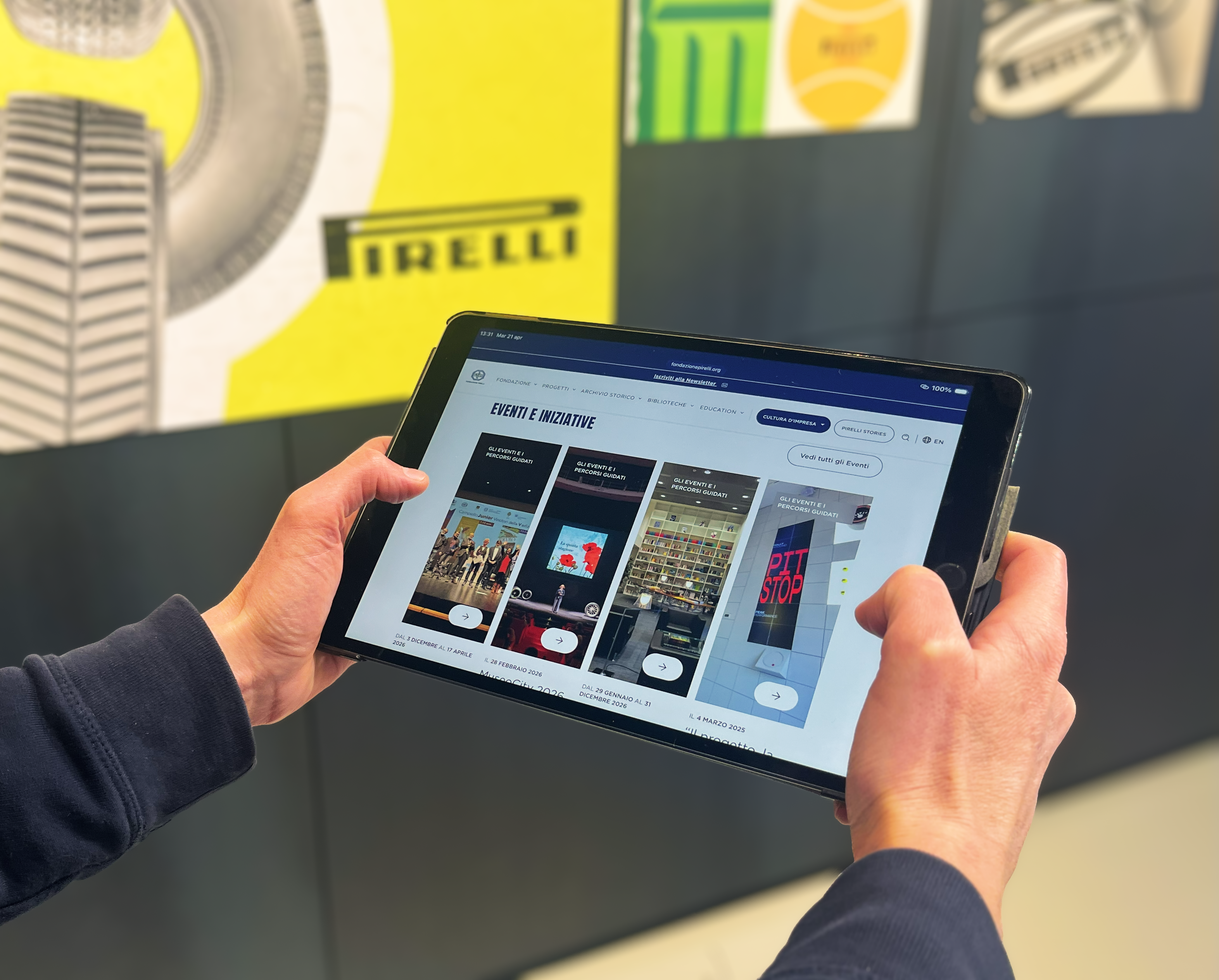
Search the Historical Archive of the Pirelli Foundation for sources and materials. Select the type of support you are interested in and write the keywords of your research.
    Select one of the following categories
  • Documents
  • Photographs
  • Drawings and posters
  • Audio-visuals
  • Publications and magazines
  • All
Help with your research
To request to view the materials in the Historical Archive and in the libraries of the Pirelli Foundation for study and research purposes and/or to find out how to request the use of materials for loans and exhibitions, please fill in the form below. You will receive an email confirming receipt of the request and you will be contacted.
Pirelli Foundation Educational Courses

Select the education level of the school
Back
Primary schools
Pirelli Foundation Educational Courses
Please fill in your details and the staff of Pirelli Foundation Educational will contact you to arrange the dates of the course.

I declare I have read  the privacy policy, and authorise the Pirelli Foundation to process my personal data in order to send communications, also by email, about initiatives/conferences organised by the Pirelli Foundation.

Back
Lower secondary school
Pirelli Foundation Educational Courses
Please fill in your details and the staff of Pirelli Foundation Educational will contact you to arrange the dates of the course.
Back
Upper secondary school
Pirelli Foundation Educational Courses
Please fill in your details and the staff of Pirelli Foundation Educational will contact you to arrange the dates of the course.
Back
University
Pirelli Foundation Educational Courses

Do you want to organize a training programme with your students? For information and reservations, write to universita@fondazionepirelli.org

Visit the Foundation
For information about the Foundation’s activities, guided tours and accessibility,
please call +39 0264423971 or fill in the form below, providing details of your request in the notes field.

In an ageing Italy, the political challenge lies in investing in the future and creating jobs for young people

Italy is an ageing country.  The average age is currently 48.7 years and is rising year on year. It is already the highest average age among EU countries (Eurostat data). At the same time, it is the country with the lowest birth rate, at 1.18%. According to Istat, just 370,000 children were born in 2024, which was 2.6% fewer than the previous year. In the first six months of 2025, there were 13,000 fewer births than in the same period in 2024.

And the crisis doesn’t end there. Young people are looking elsewhere for better working and living conditions. ‘In the last ten years, over 337,000 young Italians, including 120,000 graduates, have left the country,’ says Riccardo Di Stefano, Confindustria’s vice-president for Education and Open Innovation. Moreover, those who remain are neither valued nor afforded prospects for the future:  there are 1.3 million NEETs (Not in Education, Employment or Training) aged 15–29, representing 15.2% of their age group.

In short, we are experiencing an alarming ‘demographic winter’, characterised by an ageing population (life expectancy has risen to an average of 83.4 years) and falling birth rates.  To make matters worse, too large a proportion of the younger generation is being kept out of work and out of the ‘knowledge economy’.

The issue, which has been neglected for years, has finally come to the forefront of public discourse, with growing interest in demographic studies and journalistic investigations.  However, despite the availability of data, there are still no signs of political decisions being taken to address the related economic, social and cultural issues.

According to Istat, children will account for only 11.2% of the population by 2050.  This will lead to empty schools and unemployed teachers.  Over the next few years, there will also be a shortage of workers and entrepreneurs unless solid immigration policies are put in place.  Resources to pay for welfare, including pensions for the growing elderly population, will also decrease.

Demographics are a phenomenon of long-term trends. Even if the low birth rate were miraculously halted and reversed, it would take at least twenty years for today’s newborns to have an impact on the labour market. So, to address these issues, we need to make timely decisions and implement intelligent policy measures to deal with the interim situations.

But where? The trend towards low birth rates has psychological, economic and cultural roots.  These include the crisis of the traditional family and a change in values, with an increased focus on individual expectations rather than parental responsibilities and the sense of community. Other factors include the structures and trends of the labour market, which still marginalise many women, and the serious shortage of housing and services in large urban centres, including nurseries and full-time schools. And, above all, the loss of confidence in the future.

The key issue is a crisis of confidence. The ‘generational pact’ (the idea that our children will enjoy a better quality of life than us, so it’s worth investing in their education and creating opportunities for them) began to break down in Italy in the early 1980s due to the explosion of public debt. In short, the cost of the current generation’s well-being was passed on to the next generation. In all other Western countries, welfare maintenance, starting with pensions, was funded by debt passed on to children and grandchildren.

Tensions and generational divides have been exacerbated by international geopolitical tensions, environmental disasters, trade wars, growing social unrest, and the difficulty of maintaining the same quality of life as their parents.  Having children is no longer a priority.

Breaking this cycle is extremely difficult. Yet something urgent and forward-looking must be done to avoid resigning ourselves to a fate of decline and degradation, a loss of momentum for innovation, not only economic, but also social and cultural. This would represent a radical crisis of all that Europe and the West have built up over the course of the 20th century, especially in its second half:  the synthesis of liberal democracy, the market economy and welfare, that is, a balance between freedom, enterprise and the values of change and solidarity; progress and social cohesion.

So, we need to rethink politics, work and participation, and finally learn to link our long-term ambitions for change with the pragmatic reformism of good governance —

a difficult balance to strike. However, it is possible if we heed the words of one of the finest intellectuals of the 20th century, Ernst Cassirer:  ‘The great mission of the Utopia is to make room for the possible as opposed to a passive acquiescence in the present actual state of affairs.  It is symbolic thought which overcomes the natural inertia of man and endows him with a new ability, the ability constantly to reshape his human universe.’

Therefore, bearing in mind Cassirer’s thinking alongside that of Lewis Mumford, we should note the distinction (which readers of this blog will already be familiar with) between a ‘utopia of escape’, which is the desire to build castles in the air, and a ‘utopia of reconstruction’, which is the commitment to imagining and implementing ambitious change. However, we must also think practically about good politics here and now.

How? Rebuilding trust is a general goal (we discussed this in blogs on 6 May and 7 October). To give the new generations a sense of purpose and the prospect of change.  But in the meantime, make practical choices. We should make better use of the resources we have, namely women and young people, by guaranteeing them better access to the job market with career policies and incomes suited to their training, enabling them to transform their ambitions into enterprise and industriousness. We must change the cycle of Italy being abandoned by its most enterprising and active young people by offering growth opportunities and, at the same time, attracting new human resources from abroad, especially from the Mediterranean basin. We need to insist on education and bridge the knowledge and understanding gap (a third of Italians are ‘functionally illiterate’, meaning they cannot understand a written text of medium complexity or do basic maths). Finally, we have to commit adequate financial and intellectual resources to reintegrating a large portion of those NEETs we mentioned into civil coexistence and therefore responsible participation.

This is not a catalogue of good intentions, but rather an indication of the parts that make up a balanced plan for the development of Italy within Europe.  It is a list of points that must be translated into government choices, investments (EU funds must be used wisely) and commitments involving not only political decision-makers, but also economic and cultural actors.

It is a difficult challenge, of course, but a key step for economic growth and, above all, for social balance.

A ‘citizenship collaboration’, according to Confindustria, at the end of a conference in Ortigia on Open Innovation and training, precisely to ‘highlight talent, knowledge, technology and productivity’ (Il Sole24Ore, 24 and 25 October).  And The Young Entrepreneurs of Confindustria, chaired by Maria Anghileri, emphasise in their conferences the importance of opening up the company to new generations as a space in which to realise projects, ideas, ambitions and dreams. ‘The growing enterprise’ is their stated goal.  Enterprise as an economic actor and a social catalyst.

From this point of view, the political choice is clear:  the strategy we need is one of knowledge, innovation and training, particularly from an industrial policy perspective.

If our resources are limited, it is essential to invest in training our young people. This will enable them to reach their full potential.  In the meantime, we must work to reverse the cycle of fearful closure in social microcosms and falling birth rates.  We must invest in rebuilding trust and developing a positive vision for the future.

(photo Getty Images)

Italy is an ageing country.  The average age is currently 48.7 years and is rising year on year. It is already the highest average age among EU countries (Eurostat data). At the same time, it is the country with the lowest birth rate, at 1.18%. According to Istat, just 370,000 children were born in 2024, which was 2.6% fewer than the previous year. In the first six months of 2025, there were 13,000 fewer births than in the same period in 2024.

And the crisis doesn’t end there. Young people are looking elsewhere for better working and living conditions. ‘In the last ten years, over 337,000 young Italians, including 120,000 graduates, have left the country,’ says Riccardo Di Stefano, Confindustria’s vice-president for Education and Open Innovation. Moreover, those who remain are neither valued nor afforded prospects for the future:  there are 1.3 million NEETs (Not in Education, Employment or Training) aged 15–29, representing 15.2% of their age group.

In short, we are experiencing an alarming ‘demographic winter’, characterised by an ageing population (life expectancy has risen to an average of 83.4 years) and falling birth rates.  To make matters worse, too large a proportion of the younger generation is being kept out of work and out of the ‘knowledge economy’.

The issue, which has been neglected for years, has finally come to the forefront of public discourse, with growing interest in demographic studies and journalistic investigations.  However, despite the availability of data, there are still no signs of political decisions being taken to address the related economic, social and cultural issues.

According to Istat, children will account for only 11.2% of the population by 2050.  This will lead to empty schools and unemployed teachers.  Over the next few years, there will also be a shortage of workers and entrepreneurs unless solid immigration policies are put in place.  Resources to pay for welfare, including pensions for the growing elderly population, will also decrease.

Demographics are a phenomenon of long-term trends. Even if the low birth rate were miraculously halted and reversed, it would take at least twenty years for today’s newborns to have an impact on the labour market. So, to address these issues, we need to make timely decisions and implement intelligent policy measures to deal with the interim situations.

But where? The trend towards low birth rates has psychological, economic and cultural roots.  These include the crisis of the traditional family and a change in values, with an increased focus on individual expectations rather than parental responsibilities and the sense of community. Other factors include the structures and trends of the labour market, which still marginalise many women, and the serious shortage of housing and services in large urban centres, including nurseries and full-time schools. And, above all, the loss of confidence in the future.

The key issue is a crisis of confidence. The ‘generational pact’ (the idea that our children will enjoy a better quality of life than us, so it’s worth investing in their education and creating opportunities for them) began to break down in Italy in the early 1980s due to the explosion of public debt. In short, the cost of the current generation’s well-being was passed on to the next generation. In all other Western countries, welfare maintenance, starting with pensions, was funded by debt passed on to children and grandchildren.

Tensions and generational divides have been exacerbated by international geopolitical tensions, environmental disasters, trade wars, growing social unrest, and the difficulty of maintaining the same quality of life as their parents.  Having children is no longer a priority.

Breaking this cycle is extremely difficult. Yet something urgent and forward-looking must be done to avoid resigning ourselves to a fate of decline and degradation, a loss of momentum for innovation, not only economic, but also social and cultural. This would represent a radical crisis of all that Europe and the West have built up over the course of the 20th century, especially in its second half:  the synthesis of liberal democracy, the market economy and welfare, that is, a balance between freedom, enterprise and the values of change and solidarity; progress and social cohesion.

So, we need to rethink politics, work and participation, and finally learn to link our long-term ambitions for change with the pragmatic reformism of good governance —

a difficult balance to strike. However, it is possible if we heed the words of one of the finest intellectuals of the 20th century, Ernst Cassirer:  ‘The great mission of the Utopia is to make room for the possible as opposed to a passive acquiescence in the present actual state of affairs.  It is symbolic thought which overcomes the natural inertia of man and endows him with a new ability, the ability constantly to reshape his human universe.’

Therefore, bearing in mind Cassirer’s thinking alongside that of Lewis Mumford, we should note the distinction (which readers of this blog will already be familiar with) between a ‘utopia of escape’, which is the desire to build castles in the air, and a ‘utopia of reconstruction’, which is the commitment to imagining and implementing ambitious change. However, we must also think practically about good politics here and now.

How? Rebuilding trust is a general goal (we discussed this in blogs on 6 May and 7 October). To give the new generations a sense of purpose and the prospect of change.  But in the meantime, make practical choices. We should make better use of the resources we have, namely women and young people, by guaranteeing them better access to the job market with career policies and incomes suited to their training, enabling them to transform their ambitions into enterprise and industriousness. We must change the cycle of Italy being abandoned by its most enterprising and active young people by offering growth opportunities and, at the same time, attracting new human resources from abroad, especially from the Mediterranean basin. We need to insist on education and bridge the knowledge and understanding gap (a third of Italians are ‘functionally illiterate’, meaning they cannot understand a written text of medium complexity or do basic maths). Finally, we have to commit adequate financial and intellectual resources to reintegrating a large portion of those NEETs we mentioned into civil coexistence and therefore responsible participation.

This is not a catalogue of good intentions, but rather an indication of the parts that make up a balanced plan for the development of Italy within Europe.  It is a list of points that must be translated into government choices, investments (EU funds must be used wisely) and commitments involving not only political decision-makers, but also economic and cultural actors.

It is a difficult challenge, of course, but a key step for economic growth and, above all, for social balance.

A ‘citizenship collaboration’, according to Confindustria, at the end of a conference in Ortigia on Open Innovation and training, precisely to ‘highlight talent, knowledge, technology and productivity’ (Il Sole24Ore, 24 and 25 October).  And The Young Entrepreneurs of Confindustria, chaired by Maria Anghileri, emphasise in their conferences the importance of opening up the company to new generations as a space in which to realise projects, ideas, ambitions and dreams. ‘The growing enterprise’ is their stated goal.  Enterprise as an economic actor and a social catalyst.

From this point of view, the political choice is clear:  the strategy we need is one of knowledge, innovation and training, particularly from an industrial policy perspective.

If our resources are limited, it is essential to invest in training our young people. This will enable them to reach their full potential.  In the meantime, we must work to reverse the cycle of fearful closure in social microcosms and falling birth rates.  We must invest in rebuilding trust and developing a positive vision for the future.

(photo Getty Images)

Working in the digital and AI age

ADAPT’s analysis aims to make sense of a complex and ever-evolving topic

Working in the age of digitalisation and Artificial Intelligence, and post-pandemic, with tools that are significantly different from those of the past and are constantly changing, requires a different technological background and a renewal of the culture of work and production.  It takes a lot of reflection to understand how much the world of work and production is changing. With this in mind, it may be helpful to read ‘I nuovi paradigmi del lavoro tra digitalizzazione, intelligenza artificiale e metaverso.  Riflessioni di sistema’ (The new paradigms of work from digitalisation, artificial intelligence to the metaverse. System reflections), a piece of research by Roberta Caragnano which has recently been published in the ADAPT Labour Studies e-book series.

Caragnano explains that, ‘in recent years and particularly due to the acceleration imposed by the pandemic, the world of work has undergone radical transformation. This is due to (1) pressure from unprecedented technological innovations such as the spread of big data and the advent of artificial intelligence (AI) and (2) the Internet of Things (IoT). These innovations allow business processes to be automated, stimulating product and process innovations (3). They also generate changes in work models that impact the way work is performed.’ All of this has led to widespread and generalised change that continues to evolve. The research therefore starts with an introductory focus on the hybridisation of organisational models and seeks to investigate the elements and variables that influence the ‘extension’ and flexibility of organisations and the organisation of work. It also seeks to investigate the challenges affecting the rules of work itself, which are now totally immersed in ‘hybrid, automated and dematerialised’ scenarios.

Roberta Caragnano’s study begins with an in-depth analysis of organisational models and moves on to examine hybrid working and the emergence of AI and the metaverse. Ultimately, it concludes with the necessity of a ‘change in the rules’ and a new code of ethics in industrial relations.

This significant analytical effort constitutes a valuable foundation for a better understanding of the context in which the production system is evolving.


I nuovi paradigmi del lavoro tra digitalizzazione, intelligenza artificiale e metaverso. Riflessioni di sistema

Roberta Caragnano

ADAPT Labour studies e-Book series n. 108, 2025

ADAPT’s analysis aims to make sense of a complex and ever-evolving topic

Working in the age of digitalisation and Artificial Intelligence, and post-pandemic, with tools that are significantly different from those of the past and are constantly changing, requires a different technological background and a renewal of the culture of work and production.  It takes a lot of reflection to understand how much the world of work and production is changing. With this in mind, it may be helpful to read ‘I nuovi paradigmi del lavoro tra digitalizzazione, intelligenza artificiale e metaverso.  Riflessioni di sistema’ (The new paradigms of work from digitalisation, artificial intelligence to the metaverse. System reflections), a piece of research by Roberta Caragnano which has recently been published in the ADAPT Labour Studies e-book series.

Caragnano explains that, ‘in recent years and particularly due to the acceleration imposed by the pandemic, the world of work has undergone radical transformation. This is due to (1) pressure from unprecedented technological innovations such as the spread of big data and the advent of artificial intelligence (AI) and (2) the Internet of Things (IoT). These innovations allow business processes to be automated, stimulating product and process innovations (3). They also generate changes in work models that impact the way work is performed.’ All of this has led to widespread and generalised change that continues to evolve. The research therefore starts with an introductory focus on the hybridisation of organisational models and seeks to investigate the elements and variables that influence the ‘extension’ and flexibility of organisations and the organisation of work. It also seeks to investigate the challenges affecting the rules of work itself, which are now totally immersed in ‘hybrid, automated and dematerialised’ scenarios.

Roberta Caragnano’s study begins with an in-depth analysis of organisational models and moves on to examine hybrid working and the emergence of AI and the metaverse. Ultimately, it concludes with the necessity of a ‘change in the rules’ and a new code of ethics in industrial relations.

This significant analytical effort constitutes a valuable foundation for a better understanding of the context in which the production system is evolving.


I nuovi paradigmi del lavoro tra digitalizzazione, intelligenza artificiale e metaverso. Riflessioni di sistema

Roberta Caragnano

ADAPT Labour studies e-Book series n. 108, 2025

Beyond production

Carlo Galli’s latest book offers readers the tools they need to better understand the relationship between technology and humanity


Is it technophobia or technolatry (technology worship)?  Or is technology something separate from humans, or rather a tool that is entirely human and not artificial?  The path of technology is ambiguous and uncertain precisely because it is so inherently human. Critique of technology, both intellectual and political, contests its desire to dictate the entire future agenda. These are important issues, especially today, that affect not only those who care about where they are and where they are going, but also shrewd entrepreneurs, managers and cautious decision-makers. In this context, it is worth reading Carlo Galli’s ‘Tecnica’ (Technology), which attempts to answer a number of crucial questions.  Is technology in charge today, in the age of techno-capitalism?  And who needs it?  Is it for everyone, or just a select few?  Or are we serving technology? Is technology a challenge to human domination of the world, or an indispensable resource for achieving it?

Starting from the observation that technology has never been and is never neutral, but has always been intertwined with human history, Galli seeks and finds the answers (or at least provides the reader with the tools to arrive at the correct answers themselves). Technology is ambiguous by definition and has a dual nature: it is an instrument of freedom and domination, in its ability to relieve us from toil and need; and it simultaneously creates imbalance, conflict and division. It is never just the ‘pure production’ of something, but carries within it the element of decision and consequently of power.

Galli guides the reader through four stages:  the development of the concept; the history of technology, from flint to silicon; the relationship between technology and philosophy; and the status of new digital techniques, up to artificial intelligence.

Avoiding both mythical glorification and apocalyptic condemnation of technology, this book analyses its creation as an interweaving of knowledge and will, as the root of inequalities and transformations, and as a necessity that conceals choices and interests. It is precisely in this intersection of compulsion and freedom that the space for political action opens up, which must be characterised by balance and wisdom.

Tecnica

Carlo Galli

il Mulino, 2025

Carlo Galli’s latest book offers readers the tools they need to better understand the relationship between technology and humanity


Is it technophobia or technolatry (technology worship)?  Or is technology something separate from humans, or rather a tool that is entirely human and not artificial?  The path of technology is ambiguous and uncertain precisely because it is so inherently human. Critique of technology, both intellectual and political, contests its desire to dictate the entire future agenda. These are important issues, especially today, that affect not only those who care about where they are and where they are going, but also shrewd entrepreneurs, managers and cautious decision-makers. In this context, it is worth reading Carlo Galli’s ‘Tecnica’ (Technology), which attempts to answer a number of crucial questions.  Is technology in charge today, in the age of techno-capitalism?  And who needs it?  Is it for everyone, or just a select few?  Or are we serving technology? Is technology a challenge to human domination of the world, or an indispensable resource for achieving it?

Starting from the observation that technology has never been and is never neutral, but has always been intertwined with human history, Galli seeks and finds the answers (or at least provides the reader with the tools to arrive at the correct answers themselves). Technology is ambiguous by definition and has a dual nature: it is an instrument of freedom and domination, in its ability to relieve us from toil and need; and it simultaneously creates imbalance, conflict and division. It is never just the ‘pure production’ of something, but carries within it the element of decision and consequently of power.

Galli guides the reader through four stages:  the development of the concept; the history of technology, from flint to silicon; the relationship between technology and philosophy; and the status of new digital techniques, up to artificial intelligence.

Avoiding both mythical glorification and apocalyptic condemnation of technology, this book analyses its creation as an interweaving of knowledge and will, as the root of inequalities and transformations, and as a necessity that conceals choices and interests. It is precisely in this intersection of compulsion and freedom that the space for political action opens up, which must be characterised by balance and wisdom.

Tecnica

Carlo Galli

il Mulino, 2025

A return to good books in our ‘Winter of the Spirit’, to forge new paths of knowledge and freedom

‘Where is the wisdom we have lost in knowledge? Where is the knowledge we have lost in information?’ The questions posed by Thomas Stearns Eliot in the verses of The Rock (a poetic work staged in London in 1934) are extremely relevant, particularly in a challenging period when we are once again confronted with the cultural and moral decline of a ‘wasteland’, a desolate place.

The loss of wisdom and the fear of the unknown are constant themes in Western thought. Throughout the twentieth century, we witnessed the questioning of ethical and scientific certainties that were once considered immovable. Theories such as the theory of relativity, quantum physics with its ‘uncertainty principle’, and psychoanalysis with its exploration of the unconscious have overturned traditional forms and harmonies, as have representations of reality through music, figurative art, literature, and theatre. A storm of innovations has shaken philosophy, history, the economy and civil society. We descended into the ‘heart of darkness’ that Joseph Conrad first glimpsed in 1899 (later be transformed into a cinematic masterpiece by Francis Ford Coppola in his 1979 film Apocalypse Now).

The twentieth century was an age of uncertainty.  Yet in its latter half, we caught a glimpse of the beauty of a long season of prosperity and progress, an illusion of the ‘best of all possible worlds’, with democracy, the free market, welfare, dynamic innovation and an ever-improving quality of life.

However, uncertainties and fears remain (it is worth revisiting Giacomo Leopardi‘s ironic reflections on ‘magnificent and progressive fortunes’). And today, at the dramatic beginning of the millennium, as the lights of the 20th century dim and give way to the darkness of armed conflicts and geopolitical and economic upheavals, we are here to critically consider the mistake of believing in the ‘end of history’, the limits of Western expansionism, and the need to address the new environmental, war and interest-related problems that plague our controversial humanity.

This is why we should heed Eliot’s words. Without succumbing to nostalgia for lost wisdom, we must try to understand how to restore knowledge to its rightful place and defend ourselves from the ongoing degradation of information, which is undermined by a ‘media jam’ of fake news, post-truth manipulations, and ‘factoids’ that are passed off on social media as facts. These ‘factoids’ are in a position to upset and overwhelm the well-informed public opinion that is indispensable to democracy.

Therefore, we need more knowledge:  an increasingly sophisticated, critical knowledge. We need an original relationship between humanistic and scientific knowledge in order to understand, guide and govern the processes set in motion by artificial intelligence, which is occupying an ever-increasing amount of space in the economy, in society and in our lives. This involves both positive innovations (in health, research and industry, for example) and the disturbing implications (the political, social and moral consequences of the domination of big tech, with its structures of concentrated power and lack of adequate democratic control).

But, what kind of knowledge? The very culture of the twentieth century, which we mentioned earlier, may prove useful. It is a culture based on a sense of limits and the need for critical thinking and methodological doubt, resulting in a sense of responsibility.  It is a culture that must be put to the test in the face of the new frontiers of thought and science.

We need to invest in education, training and depth of thought again.  And so, we need to pick up our books once again.

‘Not all our books will perish’, wistfully wished the emperor Hadrian in the brilliant pages of Marguerite Yourcenar‘s Memoirs of Hadrian. And he undertakes to read them, to have them written, to save them, aware that ‘Founding libraries is like building public barns, piling up stock to tackle a winter of the spirit that, as several clues reveal, I fear will soon be here.’ A winter of the spirit that defines our daily lives.

Books focus on stories of travel and critical thoughts, the knowledge of pain and the power of hope, the deepest doubts and the most intense illuminations. As Stéphane Mallarmé, a ‘man of books’, knew:  ‘Everything in the world exists in order to end up as a book.’

This means books and libraries (public and private, in homes, schools, businesses and places of social gathering, such as hospitals,  as we discussed in a blog post on 12 May), literary, scientific and philosophical festivals, reading groups and events such as Pordenonelegge (with 160,000 visitors, see the  blog post of 22 September) and ‘Ioleggoperché’ (organised by the Publishers’ Association and supported by Pirelli to donate books to schools), as well as Book City, both scheduled for November. Everything happens in the world of books . It is an essential world.

In a ‘provocative’ letter sent to Corriere della Sera, Marina Berlusconi, president of Italy’s largest publishing house, Mondadori, offers comforting words of wisdom.  ‘In this era of “Move fast and break things”, Zuckerberg’s motto, what if we were to rediscover the slow but constructive power of good old books? Books have always been effective antibodies against barbarism and totalitarianism, but today they also serve a new purpose as antibodies against the stifling of thought imposed by smartphones — true instruments of resistance against digital standardisation.’ To ‘continue listening to the voices of freedom and democracy’.

However, the problem is that much less is being read in Italy these days. Avid readers (those who read at least 12 books per year) account for just 6.4% of the population. The proportion of people who read a book in the last year has decreased (from 74% in 2023 to 73% in 2024). The time spent reading has also fallen, with people now reading for just 2 hours and 47 minutes a week compared to 3 hours and 22 minutes in 2022. This includes reading any kind of book, including cheap novelty books or cookery books.

It is therefore essential to start educating people again about the pleasure of reading and the value of reading good books, starting from the earliest years of compulsory education. And while a well-designed law to promote books and reading is necessary, much more is needed: a solid, far-sighted cultural and civil battle that transcends all of society and involves not only politics and culture, but also the economy, businesses, schools, the ‘third sector’ and social organisations. Because a book represents knowledge, beauty, fantasy, pleasure, freedom, quality of life and autonomy of thought. It fosters a sense of responsibility, the construction of an open and dialogue-driven identity, and acts as a catalyst for a better, more fulfilling human condition.

A return to books is also essential to recover and strengthen the intellectual and moral resources necessary to deal with another growing phenomenon in these restless and disheartening times:  the crisis of democracy and the crumbling of public opinion. The literature on the subject is limitless. In fact, faced with so much theoretical analysis, historical reconstruction and proposals for programmes, it is clear that something has gone wrong if we are still speaking of a ‘crisis’.  So, it would be worthwhile to revisit a key text:  It is by Hans Kelsen, one of the most important liberal jurists of the 20th century, and is taken from his essay General Theory of Law and the State (published in Italy in 1952):  ‘In a democracy, the will of the community is always formed through continuous discussion between the majority and the minority, and through the free examination of arguments for and against a given regulation of a subject. This discussion should take place not only in parliament, but also in political meetings, newspapers, books, and other means of disseminating public opinion. A democracy without public opinion is a contradiction in terms. Where freedom of thought, speech, the press and religion are guaranteed, public opinion can arise and democracy coincides with political liberalism, although not necessarily with economic liberalism.’

So, once again, we are faced with the need for knowledge and the centrality of public opinion.  The ‘discourse theory’, as Jürgen Habermas would argue, meaning capable of ‘public speech’, or critical discourse.

(Photo Getty Images)

‘Where is the wisdom we have lost in knowledge? Where is the knowledge we have lost in information?’ The questions posed by Thomas Stearns Eliot in the verses of The Rock (a poetic work staged in London in 1934) are extremely relevant, particularly in a challenging period when we are once again confronted with the cultural and moral decline of a ‘wasteland’, a desolate place.

The loss of wisdom and the fear of the unknown are constant themes in Western thought. Throughout the twentieth century, we witnessed the questioning of ethical and scientific certainties that were once considered immovable. Theories such as the theory of relativity, quantum physics with its ‘uncertainty principle’, and psychoanalysis with its exploration of the unconscious have overturned traditional forms and harmonies, as have representations of reality through music, figurative art, literature, and theatre. A storm of innovations has shaken philosophy, history, the economy and civil society. We descended into the ‘heart of darkness’ that Joseph Conrad first glimpsed in 1899 (later be transformed into a cinematic masterpiece by Francis Ford Coppola in his 1979 film Apocalypse Now).

The twentieth century was an age of uncertainty.  Yet in its latter half, we caught a glimpse of the beauty of a long season of prosperity and progress, an illusion of the ‘best of all possible worlds’, with democracy, the free market, welfare, dynamic innovation and an ever-improving quality of life.

However, uncertainties and fears remain (it is worth revisiting Giacomo Leopardi‘s ironic reflections on ‘magnificent and progressive fortunes’). And today, at the dramatic beginning of the millennium, as the lights of the 20th century dim and give way to the darkness of armed conflicts and geopolitical and economic upheavals, we are here to critically consider the mistake of believing in the ‘end of history’, the limits of Western expansionism, and the need to address the new environmental, war and interest-related problems that plague our controversial humanity.

This is why we should heed Eliot’s words. Without succumbing to nostalgia for lost wisdom, we must try to understand how to restore knowledge to its rightful place and defend ourselves from the ongoing degradation of information, which is undermined by a ‘media jam’ of fake news, post-truth manipulations, and ‘factoids’ that are passed off on social media as facts. These ‘factoids’ are in a position to upset and overwhelm the well-informed public opinion that is indispensable to democracy.

Therefore, we need more knowledge:  an increasingly sophisticated, critical knowledge. We need an original relationship between humanistic and scientific knowledge in order to understand, guide and govern the processes set in motion by artificial intelligence, which is occupying an ever-increasing amount of space in the economy, in society and in our lives. This involves both positive innovations (in health, research and industry, for example) and the disturbing implications (the political, social and moral consequences of the domination of big tech, with its structures of concentrated power and lack of adequate democratic control).

But, what kind of knowledge? The very culture of the twentieth century, which we mentioned earlier, may prove useful. It is a culture based on a sense of limits and the need for critical thinking and methodological doubt, resulting in a sense of responsibility.  It is a culture that must be put to the test in the face of the new frontiers of thought and science.

We need to invest in education, training and depth of thought again.  And so, we need to pick up our books once again.

‘Not all our books will perish’, wistfully wished the emperor Hadrian in the brilliant pages of Marguerite Yourcenar‘s Memoirs of Hadrian. And he undertakes to read them, to have them written, to save them, aware that ‘Founding libraries is like building public barns, piling up stock to tackle a winter of the spirit that, as several clues reveal, I fear will soon be here.’ A winter of the spirit that defines our daily lives.

Books focus on stories of travel and critical thoughts, the knowledge of pain and the power of hope, the deepest doubts and the most intense illuminations. As Stéphane Mallarmé, a ‘man of books’, knew:  ‘Everything in the world exists in order to end up as a book.’

This means books and libraries (public and private, in homes, schools, businesses and places of social gathering, such as hospitals,  as we discussed in a blog post on 12 May), literary, scientific and philosophical festivals, reading groups and events such as Pordenonelegge (with 160,000 visitors, see the  blog post of 22 September) and ‘Ioleggoperché’ (organised by the Publishers’ Association and supported by Pirelli to donate books to schools), as well as Book City, both scheduled for November. Everything happens in the world of books . It is an essential world.

In a ‘provocative’ letter sent to Corriere della Sera, Marina Berlusconi, president of Italy’s largest publishing house, Mondadori, offers comforting words of wisdom.  ‘In this era of “Move fast and break things”, Zuckerberg’s motto, what if we were to rediscover the slow but constructive power of good old books? Books have always been effective antibodies against barbarism and totalitarianism, but today they also serve a new purpose as antibodies against the stifling of thought imposed by smartphones — true instruments of resistance against digital standardisation.’ To ‘continue listening to the voices of freedom and democracy’.

However, the problem is that much less is being read in Italy these days. Avid readers (those who read at least 12 books per year) account for just 6.4% of the population. The proportion of people who read a book in the last year has decreased (from 74% in 2023 to 73% in 2024). The time spent reading has also fallen, with people now reading for just 2 hours and 47 minutes a week compared to 3 hours and 22 minutes in 2022. This includes reading any kind of book, including cheap novelty books or cookery books.

It is therefore essential to start educating people again about the pleasure of reading and the value of reading good books, starting from the earliest years of compulsory education. And while a well-designed law to promote books and reading is necessary, much more is needed: a solid, far-sighted cultural and civil battle that transcends all of society and involves not only politics and culture, but also the economy, businesses, schools, the ‘third sector’ and social organisations. Because a book represents knowledge, beauty, fantasy, pleasure, freedom, quality of life and autonomy of thought. It fosters a sense of responsibility, the construction of an open and dialogue-driven identity, and acts as a catalyst for a better, more fulfilling human condition.

A return to books is also essential to recover and strengthen the intellectual and moral resources necessary to deal with another growing phenomenon in these restless and disheartening times:  the crisis of democracy and the crumbling of public opinion. The literature on the subject is limitless. In fact, faced with so much theoretical analysis, historical reconstruction and proposals for programmes, it is clear that something has gone wrong if we are still speaking of a ‘crisis’.  So, it would be worthwhile to revisit a key text:  It is by Hans Kelsen, one of the most important liberal jurists of the 20th century, and is taken from his essay General Theory of Law and the State (published in Italy in 1952):  ‘In a democracy, the will of the community is always formed through continuous discussion between the majority and the minority, and through the free examination of arguments for and against a given regulation of a subject. This discussion should take place not only in parliament, but also in political meetings, newspapers, books, and other means of disseminating public opinion. A democracy without public opinion is a contradiction in terms. Where freedom of thought, speech, the press and religion are guaranteed, public opinion can arise and democracy coincides with political liberalism, although not necessarily with economic liberalism.’

So, once again, we are faced with the need for knowledge and the centrality of public opinion.  The ‘discourse theory’, as Jürgen Habermas would argue, meaning capable of ‘public speech’, or critical discourse.

(Photo Getty Images)

Transforming diversity into competitiveness through cultural intelligence

The ability to embrace different cultures in the workplace as a business resource

Cultural intelligence (CQ) is a useful tool for growing a business in new and complex contexts, such as those we find ourselves in today. In such contexts, diversity is almost the norm and can truly make a difference. These ideas form the basis of Said Toumi’s recently defended doctoral thesis in administrative sciences at the University of Québec, titled ‘The impact of cultural intelligence on work performance: Evidence from the Arab world’, starts with the observation that literature on cultural intelligence (CQ) and its impact on intercultural management in international professional settings is gaining increasing interest in academic and professional circles. But what is cultural intelligence? CQ can be understood as an individual’s ability to work effectively in different cultural contexts. In other words, turning diversity into a strength for growth rather than an obstacle.

Said Toumi’s research aims to enrich our understanding of this concept by studying the impact of cultural intelligence (CQ) and informal networks within multinational organisations, with a particular focus on expats and inter-organisational relationships in the Arab world.

The work consists of three chapters, each of which addresses a different aspect of this complex topic. The first chapter provides an overview of studies on the impact of cultural intelligence on expats up to December 2024, while identifying the main directions for future research. The second chapter examines ‘Wasta’, an informal inter-organisational network prevalent in the Arab world, and its effect on satisfaction and performance in B2B relationships in the Maghreb region. Finally, the third chapter explores the impact of CQ on informal networks, with a particular focus on the supervisor-subordinate relationship in intercultural organisational contexts.

Toumi’s work is valuable because it provides insight into a topic that is not well understood or widely applied in most companies.

The impact of cultural intelligence on work performance: Evidence from the Arab world

Said Toumi

Thesis, Doctorat en sciences de l’administration, Université Lava, Quebec, 2025

The ability to embrace different cultures in the workplace as a business resource

Cultural intelligence (CQ) is a useful tool for growing a business in new and complex contexts, such as those we find ourselves in today. In such contexts, diversity is almost the norm and can truly make a difference. These ideas form the basis of Said Toumi’s recently defended doctoral thesis in administrative sciences at the University of Québec, titled ‘The impact of cultural intelligence on work performance: Evidence from the Arab world’, starts with the observation that literature on cultural intelligence (CQ) and its impact on intercultural management in international professional settings is gaining increasing interest in academic and professional circles. But what is cultural intelligence? CQ can be understood as an individual’s ability to work effectively in different cultural contexts. In other words, turning diversity into a strength for growth rather than an obstacle.

Said Toumi’s research aims to enrich our understanding of this concept by studying the impact of cultural intelligence (CQ) and informal networks within multinational organisations, with a particular focus on expats and inter-organisational relationships in the Arab world.

The work consists of three chapters, each of which addresses a different aspect of this complex topic. The first chapter provides an overview of studies on the impact of cultural intelligence on expats up to December 2024, while identifying the main directions for future research. The second chapter examines ‘Wasta’, an informal inter-organisational network prevalent in the Arab world, and its effect on satisfaction and performance in B2B relationships in the Maghreb region. Finally, the third chapter explores the impact of CQ on informal networks, with a particular focus on the supervisor-subordinate relationship in intercultural organisational contexts.

Toumi’s work is valuable because it provides insight into a topic that is not well understood or widely applied in most companies.

The impact of cultural intelligence on work performance: Evidence from the Arab world

Said Toumi

Thesis, Doctorat en sciences de l’administration, Université Lava, Quebec, 2025

From the highs to the lows, Italy’s economic history

A contemporary guide to better navigate the events that the country has experienced and is continuing to experience

The advice is familiar:  by understanding the past you can live better in the present and prepare more effectively for the future. This is also true in complex and volatile times such as these, for everyone, including businesses. This sage advice can be put into practice by reading Emanuele Felice’s latest literary offering. Felice, who teaches Economic History at IULM University in Milan, has updated his book ‘Ascesa e declino. Una storia dell’economia italiana’ (Rise and fall: A history of the Italian economy), first published ten years ago. This new edition is an opportunity to understand the fundamental milestones of the country’s recent and distant history. It is a story of alternating periods of prosperity and decline that few other countries have experienced. After its economic and social successes following World War II, Italy now seems to be trapped in decades of stagnation. Felice attempts to answer one question:  how could such a decline have occurred? The reasons are numerous and can be found in the political and institutional systems, the role of the elite, and the decisions — or lack of decisions — that have had a profound influence on development trajectories.

In this new, updated and expanded edition of his book, Felice provides a critical analysis of the dynamics that have shaped Italian history. He provides the necessary detail while placing the entire narrative in ‘a millenary perspective’, as the first chapter puts it, before outlining liberal Italy, the twenty-year period and the war. He then moves on to ‘the golden age’, as another chapter describes it, before ending with the era of globalisation and today’s decline.

Emanuele Felice’s book is an essential read for anyone seeking to understand the roots of Italy’s successes and failures, and to reflect on its future prospects.

Ascesa e declino. Una storia dell’economia italiana

Emanuele Felice

il Mulino, 2025

A contemporary guide to better navigate the events that the country has experienced and is continuing to experience

The advice is familiar:  by understanding the past you can live better in the present and prepare more effectively for the future. This is also true in complex and volatile times such as these, for everyone, including businesses. This sage advice can be put into practice by reading Emanuele Felice’s latest literary offering. Felice, who teaches Economic History at IULM University in Milan, has updated his book ‘Ascesa e declino. Una storia dell’economia italiana’ (Rise and fall: A history of the Italian economy), first published ten years ago. This new edition is an opportunity to understand the fundamental milestones of the country’s recent and distant history. It is a story of alternating periods of prosperity and decline that few other countries have experienced. After its economic and social successes following World War II, Italy now seems to be trapped in decades of stagnation. Felice attempts to answer one question:  how could such a decline have occurred? The reasons are numerous and can be found in the political and institutional systems, the role of the elite, and the decisions — or lack of decisions — that have had a profound influence on development trajectories.

In this new, updated and expanded edition of his book, Felice provides a critical analysis of the dynamics that have shaped Italian history. He provides the necessary detail while placing the entire narrative in ‘a millenary perspective’, as the first chapter puts it, before outlining liberal Italy, the twenty-year period and the war. He then moves on to ‘the golden age’, as another chapter describes it, before ending with the era of globalisation and today’s decline.

Emanuele Felice’s book is an essential read for anyone seeking to understand the roots of Italy’s successes and failures, and to reflect on its future prospects.

Ascesa e declino. Una storia dell’economia italiana

Emanuele Felice

il Mulino, 2025

The importance of knowledge in the age AI: Journalism put to the test against fake news that distorts democracy and society

‘If the photo didn’t turn out well, it means you weren’t close enough.’  said Robert Capa, one of the greatest photojournalists of the 20th century. He never shied away from risk in his work. During the Spanish Civil War, and on D-Day in Normandy in June 1944.  He was also on the ground in the Arab-Israeli War of 1948.  And in Indochina in 1954.  It was there, in the province of Thai Binh, that he got too close to a mine.  He was 41 years old. His colleague and partner, Gerda Taro, was 26.

She was run over by a tank on the outskirts of Madrid in July 1937.

They had lived their lives to tell the story.  To bear witness. To make people understand.  Through an image, a piece of writing or a TV shot.  Journalism is a job. But it is also a lifestyle choice.  One that sometimes comes at the terrible price of death.

As Capa said, it’s about being ‘close enough’. Close to the objective truth that reporting, analysis and investigation allow us to see and portray.

These words were echoed at the end of September during the opening ceremony for the winners of ‘Il Premiolino’, one of Italy’s oldest journalism awards. Founded in 1960 by Enzo Biagi, Indro Montanelli, Orio Vergani and other prominent figures in the daily newspaper industry, the ceremony took place at the Piccolo Teatro in Milan. Meanwhile, an actress’s voice, off-screen, recalled the names of Mauro De Mauro, Mario Francese, Mauro Rostagno, Pippo Fava and Giancarlo Siani — journalists who wrote about the mafia’s involvement in crime, business and power. Also mentioned were Carlo Casalegno and Walter Tobagi, who were committed to uncovering the horrors of terrorism in the 1970s, as well as Maria Grazia Cutuli in Afghanistan, Ilaria Alpi and Miran Hrovatin in Mogadishu, and Anna Politkovskaya in Russia.  And many others from Europe and around the world.

The evening was dedicated to them, and saw the honouring of ‘good journalism, a diligent and rigorous interpreter of truth, civilisation, humanity, and the sense of democracy’. Remembering, also, the reporters who died in Gaza, just a few days ago. And Victoria Roshchyna, another exemplary and courageous woman, in Ukraine.

All these names, ‘read aloud with solidarity and respect, dramatically express the meaning and value of the journalism profession.’ It is a profession with strong moral and civic connotations, ‘fitting for those women and men who love freedom and responsibility.  However, it is ill-suited to ‘cynics’, as that extraordinary master, Ryszard Kapuściński, taught us’.

This ceremony commemorates the dead in a way that goes beyond mere remembrance.  One that values the words spoken and written in newspapers, online, on the radio and on television year after year. It acknowledges the past, present and future, emphasising that good information is fundamental to our civil and democratic coexistence and our commitment to future generations.

The Premiolino jury (chaired by Chiara Beria di Argentine and supported by Pirelli), this year recognised Paolo Giordano (Corriere della Sera), Anna Zafesova (La Stampa), Luigi Manconi (la Repubblica), Siegmund Ginzberg (Il Foglio), Thomas Mackinson (Il Fatto Quotidiano), Sabrina Giannini (Rai3). The Pirelli Prize for Schools went to Gianna Fregonara and Orsola Riva (Corriere della Sera).  The awards recognised the wide range of issues covered and the constant provision of evidence of cultural and social value during such a difficult and controversial period.

The fact is that these are not easy times for journalists. They are undermined by the general loss of credibility that has affected the elite, intellectuals, scientists and competent individuals for far too long (the overwhelming expansion of social media on the internet has helped to spread the misconception that ‘my ignorance is worth as much as your knowledge’). The media system is being affected by radical technological and cultural transformations, for which there are no editorial or political responses capable of meeting the challenge yet. Maligned by political and economic powers that detest criticism and prefer to cultivate fake news and post-truths. They are considered marginal by a widespread public opinion that does not view information as a fundamental community asset and relies on factoids instead of engaging with facts, data and truth, including when they are uncomfortable or inconvenient for a social group, interest group or corporation.

As with all crises, those in the worlds of culture, science and information must also take responsibility. One thing is clear, however:  without quality information, the world would be an even worse, more unjust and unbalanced place,  and democracy, the market economy, welfare and social solidarity systems, and all the knowledge mechanisms that affect quality of life, work and relationships would suffer.

In recent days, during a speech in Tallinn, Estonia, the President of the Republic, Sergio Mattarella, who has always been keenly aware of the issues relating to democracy, as well as the relationships between powers and cultures that form the basis of participation and citizenship, recalled that ‘the challenges posed by artificial intelligence are complex, but democracies cannot afford to be left behind… It is up to us to create an AI that protects our citizens and our values without undermining them’.

This is a key point: ‘Technology and security are closely interconnected issues that are increasingly central to our democratic communities’ insists Mattarella. ‘We are witnessing an increasing use of AI for disinformation purposes, as well as to influence public opinion, through the unscrupulous use of user profiling on social media and the equally unscrupulous dissemination of fake news.’

Therefore, ‘binding global standards’ are needed to govern the processes set in motion by AI, and there must be widespread awareness of both the opportunities and risks related to new technologies.

The antidote? Invest in knowledge, the humanities and the sciences, and foster a deeper sense of responsibility within public opinion. This may be difficult to achieve, but it is essential to try with conviction.

These are issues that were also central to Pope Leo’s reflections. ‘Free information is a pillar that supports the construction of our societies and, for this reason, we are called upon to defend and guarantee it,’ he said in recent days in a message to Minds, the association of leading press agencies. To combat ‘junk information’, we need ‘competence, courage and a sense of ethics’:  journalists can ‘act as a bulwark against those who, through the ancient art of lying, seek to create divisions in order to rule by dividing;  a bastion of civilisation against the quicksand of approximation and post-truth’.

Journalism, Pope Leo insists, ‘is not a crime’.  And we must thank ‘the reporters who put themselves at risk so that people can understand how things really are’.

The Pope asked journalists to ‘free communication from the cognitive pollution that corrupts it; from unfair competition; and from the degradation of clickbait.’  In short, ‘we are not destined to live in a world where truth is indistinguishable from fiction.’  In his view, ‘algorithms generate content and data at a speed and in a dimension that has never been seen before, but who governs them? Artificial intelligence is changing the way we inform ourselves and communicate, but who is driving it and for what purposes?’ W must ensure that technology does not replace man, and that the information and algorithms that govern it today are not in the hands of a few.’

Fortunately, these issues are receiving increasing attention from journalists and publishers, as was evident from the recent debate on the evolution of the media at the Il Sole 24 Ore conference. Two of the keynote speeches illustrate this well.  The first was delivered by Agnese Pini, editor-in-chief of QN/La Nazione, Il Resto del Carlino and Il Giorno, who said: ‘Information is the third channel between power and citizens. If this filter is removed, power speaks directly to citizens in a vertical manner, and a fundamental guarantee for democracy is lost.’ There is, in fact, a perverse relationship between the spread of social media and the collapse in reading rates from 2011-2012 to the present day.  And we must face the challenge of improving knowledge processes and good information.

Giuseppe De Bellis, the editorial director of SkyTG24, adds,  ‘In the vast landscape of information, which is often inaccurate, overly sensationalised, and verging on misinformation, all publications with a historical legacy that operate in the digital ecosystem through websites and social media must encourage consumers and readers to visit their platforms by focusing on authority and credibility.’

In short, the challenge of acquiring knowledge and good information is difficult, but not insurmountable.

There is an interesting opportunity for reflection in the coming year, a year of symbolic anniversaries for the world of newspapers:  the 159th anniversary of the founding of the Corriere della Sera, the 70th anniversary of Il Giorno, and the 50th anniversary of la Repubblica. Another notable and unfortunate anniversary is the closure of Il Mondo, the weekly magazine edited by Mario Pannunzio, on 8 March 1966. It was a training ground for solid, high-quality journalism, but above all it fostered an intense civic, secular, liberal and socially sensitive outlook.

Occasions such as this are sometimes at risk of celebratory rhetoric and nostalgic reminiscence. This time, it would be worthwhile for the worlds of information, politics, economics and culture to take advantage of the opportunity to think seriously, deeply and impartially about the essential relationship between journalism and democracy; the need to improve levels of information and knowledge; and the shift in publishing from an economic enterprise to a strong, deep-rooted civic endeavour.

As Carlo Levi taught us, words are like stones:  indispensable for strengthening the buildings of our freedoms.

(photo Ippi Studio)

‘If the photo didn’t turn out well, it means you weren’t close enough.’  said Robert Capa, one of the greatest photojournalists of the 20th century. He never shied away from risk in his work. During the Spanish Civil War, and on D-Day in Normandy in June 1944.  He was also on the ground in the Arab-Israeli War of 1948.  And in Indochina in 1954.  It was there, in the province of Thai Binh, that he got too close to a mine.  He was 41 years old. His colleague and partner, Gerda Taro, was 26.

She was run over by a tank on the outskirts of Madrid in July 1937.

They had lived their lives to tell the story.  To bear witness. To make people understand.  Through an image, a piece of writing or a TV shot.  Journalism is a job. But it is also a lifestyle choice.  One that sometimes comes at the terrible price of death.

As Capa said, it’s about being ‘close enough’. Close to the objective truth that reporting, analysis and investigation allow us to see and portray.

These words were echoed at the end of September during the opening ceremony for the winners of ‘Il Premiolino’, one of Italy’s oldest journalism awards. Founded in 1960 by Enzo Biagi, Indro Montanelli, Orio Vergani and other prominent figures in the daily newspaper industry, the ceremony took place at the Piccolo Teatro in Milan. Meanwhile, an actress’s voice, off-screen, recalled the names of Mauro De Mauro, Mario Francese, Mauro Rostagno, Pippo Fava and Giancarlo Siani — journalists who wrote about the mafia’s involvement in crime, business and power. Also mentioned were Carlo Casalegno and Walter Tobagi, who were committed to uncovering the horrors of terrorism in the 1970s, as well as Maria Grazia Cutuli in Afghanistan, Ilaria Alpi and Miran Hrovatin in Mogadishu, and Anna Politkovskaya in Russia.  And many others from Europe and around the world.

The evening was dedicated to them, and saw the honouring of ‘good journalism, a diligent and rigorous interpreter of truth, civilisation, humanity, and the sense of democracy’. Remembering, also, the reporters who died in Gaza, just a few days ago. And Victoria Roshchyna, another exemplary and courageous woman, in Ukraine.

All these names, ‘read aloud with solidarity and respect, dramatically express the meaning and value of the journalism profession.’ It is a profession with strong moral and civic connotations, ‘fitting for those women and men who love freedom and responsibility.  However, it is ill-suited to ‘cynics’, as that extraordinary master, Ryszard Kapuściński, taught us’.

This ceremony commemorates the dead in a way that goes beyond mere remembrance.  One that values the words spoken and written in newspapers, online, on the radio and on television year after year. It acknowledges the past, present and future, emphasising that good information is fundamental to our civil and democratic coexistence and our commitment to future generations.

The Premiolino jury (chaired by Chiara Beria di Argentine and supported by Pirelli), this year recognised Paolo Giordano (Corriere della Sera), Anna Zafesova (La Stampa), Luigi Manconi (la Repubblica), Siegmund Ginzberg (Il Foglio), Thomas Mackinson (Il Fatto Quotidiano), Sabrina Giannini (Rai3). The Pirelli Prize for Schools went to Gianna Fregonara and Orsola Riva (Corriere della Sera).  The awards recognised the wide range of issues covered and the constant provision of evidence of cultural and social value during such a difficult and controversial period.

The fact is that these are not easy times for journalists. They are undermined by the general loss of credibility that has affected the elite, intellectuals, scientists and competent individuals for far too long (the overwhelming expansion of social media on the internet has helped to spread the misconception that ‘my ignorance is worth as much as your knowledge’). The media system is being affected by radical technological and cultural transformations, for which there are no editorial or political responses capable of meeting the challenge yet. Maligned by political and economic powers that detest criticism and prefer to cultivate fake news and post-truths. They are considered marginal by a widespread public opinion that does not view information as a fundamental community asset and relies on factoids instead of engaging with facts, data and truth, including when they are uncomfortable or inconvenient for a social group, interest group or corporation.

As with all crises, those in the worlds of culture, science and information must also take responsibility. One thing is clear, however:  without quality information, the world would be an even worse, more unjust and unbalanced place,  and democracy, the market economy, welfare and social solidarity systems, and all the knowledge mechanisms that affect quality of life, work and relationships would suffer.

In recent days, during a speech in Tallinn, Estonia, the President of the Republic, Sergio Mattarella, who has always been keenly aware of the issues relating to democracy, as well as the relationships between powers and cultures that form the basis of participation and citizenship, recalled that ‘the challenges posed by artificial intelligence are complex, but democracies cannot afford to be left behind… It is up to us to create an AI that protects our citizens and our values without undermining them’.

This is a key point: ‘Technology and security are closely interconnected issues that are increasingly central to our democratic communities’ insists Mattarella. ‘We are witnessing an increasing use of AI for disinformation purposes, as well as to influence public opinion, through the unscrupulous use of user profiling on social media and the equally unscrupulous dissemination of fake news.’

Therefore, ‘binding global standards’ are needed to govern the processes set in motion by AI, and there must be widespread awareness of both the opportunities and risks related to new technologies.

The antidote? Invest in knowledge, the humanities and the sciences, and foster a deeper sense of responsibility within public opinion. This may be difficult to achieve, but it is essential to try with conviction.

These are issues that were also central to Pope Leo’s reflections. ‘Free information is a pillar that supports the construction of our societies and, for this reason, we are called upon to defend and guarantee it,’ he said in recent days in a message to Minds, the association of leading press agencies. To combat ‘junk information’, we need ‘competence, courage and a sense of ethics’:  journalists can ‘act as a bulwark against those who, through the ancient art of lying, seek to create divisions in order to rule by dividing;  a bastion of civilisation against the quicksand of approximation and post-truth’.

Journalism, Pope Leo insists, ‘is not a crime’.  And we must thank ‘the reporters who put themselves at risk so that people can understand how things really are’.

The Pope asked journalists to ‘free communication from the cognitive pollution that corrupts it; from unfair competition; and from the degradation of clickbait.’  In short, ‘we are not destined to live in a world where truth is indistinguishable from fiction.’  In his view, ‘algorithms generate content and data at a speed and in a dimension that has never been seen before, but who governs them? Artificial intelligence is changing the way we inform ourselves and communicate, but who is driving it and for what purposes?’ W must ensure that technology does not replace man, and that the information and algorithms that govern it today are not in the hands of a few.’

Fortunately, these issues are receiving increasing attention from journalists and publishers, as was evident from the recent debate on the evolution of the media at the Il Sole 24 Ore conference. Two of the keynote speeches illustrate this well.  The first was delivered by Agnese Pini, editor-in-chief of QN/La Nazione, Il Resto del Carlino and Il Giorno, who said: ‘Information is the third channel between power and citizens. If this filter is removed, power speaks directly to citizens in a vertical manner, and a fundamental guarantee for democracy is lost.’ There is, in fact, a perverse relationship between the spread of social media and the collapse in reading rates from 2011-2012 to the present day.  And we must face the challenge of improving knowledge processes and good information.

Giuseppe De Bellis, the editorial director of SkyTG24, adds,  ‘In the vast landscape of information, which is often inaccurate, overly sensationalised, and verging on misinformation, all publications with a historical legacy that operate in the digital ecosystem through websites and social media must encourage consumers and readers to visit their platforms by focusing on authority and credibility.’

In short, the challenge of acquiring knowledge and good information is difficult, but not insurmountable.

There is an interesting opportunity for reflection in the coming year, a year of symbolic anniversaries for the world of newspapers:  the 159th anniversary of the founding of the Corriere della Sera, the 70th anniversary of Il Giorno, and the 50th anniversary of la Repubblica. Another notable and unfortunate anniversary is the closure of Il Mondo, the weekly magazine edited by Mario Pannunzio, on 8 March 1966. It was a training ground for solid, high-quality journalism, but above all it fostered an intense civic, secular, liberal and socially sensitive outlook.

Occasions such as this are sometimes at risk of celebratory rhetoric and nostalgic reminiscence. This time, it would be worthwhile for the worlds of information, politics, economics and culture to take advantage of the opportunity to think seriously, deeply and impartially about the essential relationship between journalism and democracy; the need to improve levels of information and knowledge; and the shift in publishing from an economic enterprise to a strong, deep-rooted civic endeavour.

As Carlo Levi taught us, words are like stones:  indispensable for strengthening the buildings of our freedoms.

(photo Ippi Studio)

Global business and global working

International mobility of human resources as a tool to help companies grow

International business culture moves with the mobility of people.  In an increasingly interconnected world of work, companies often need to send or attract managers and technicians from abroad, often at short notice. This can turn work into an opportunity for collaboration and vice versa. This is the theme of ‘Talenti internazionali. Strategie e strumenti di global mobility’ (International talent. Global mobility strategies and tools), written by Andrea Benigni and intended for companies grappling with the international mobility of personnel for various reasons. However, a closer look reveals that this can actually be a strategic lever for the competitiveness of production organisations.

How? Benigni attempts to answer the question by looking at how production culture and business organisation interact.  Alongside traditional engagement formulas, new solutions have been introduced, such as international smart working, now making global mobility accessible even to smaller companies. However, not everything is as simple as it seems,  because, as the book explains, the management of expats, particularly managers and technical staff, is still an area that is often overlooked or approached in a fragmented way, despite having significant economic, organisational and management impacts.
The book was therefore written to raise awareness and provide those involved in human resources and business internationalisation with a clear, practical and accessible guide on how to link the choice of organisational structure to the company’s objectives. Readers are guided along a structured path that covers all the key aspects of employee mobility: from organisational models and remuneration policies for foreign countries to fiscal neutrality, social security, legal planning and the evaluation of expat performance. The text uses direct language and a series of examples to explain everything.

Andrea Benigni’s book is not a universal guide to business organisation, but it effectively addresses a point that could become crucial for many businesses.

Talenti internazionali. Strategie e strumenti di global mobility

Andrea Benigni

Franco Angeli, 2025

International mobility of human resources as a tool to help companies grow

International business culture moves with the mobility of people.  In an increasingly interconnected world of work, companies often need to send or attract managers and technicians from abroad, often at short notice. This can turn work into an opportunity for collaboration and vice versa. This is the theme of ‘Talenti internazionali. Strategie e strumenti di global mobility’ (International talent. Global mobility strategies and tools), written by Andrea Benigni and intended for companies grappling with the international mobility of personnel for various reasons. However, a closer look reveals that this can actually be a strategic lever for the competitiveness of production organisations.

How? Benigni attempts to answer the question by looking at how production culture and business organisation interact.  Alongside traditional engagement formulas, new solutions have been introduced, such as international smart working, now making global mobility accessible even to smaller companies. However, not everything is as simple as it seems,  because, as the book explains, the management of expats, particularly managers and technical staff, is still an area that is often overlooked or approached in a fragmented way, despite having significant economic, organisational and management impacts.
The book was therefore written to raise awareness and provide those involved in human resources and business internationalisation with a clear, practical and accessible guide on how to link the choice of organisational structure to the company’s objectives. Readers are guided along a structured path that covers all the key aspects of employee mobility: from organisational models and remuneration policies for foreign countries to fiscal neutrality, social security, legal planning and the evaluation of expat performance. The text uses direct language and a series of examples to explain everything.

Andrea Benigni’s book is not a universal guide to business organisation, but it effectively addresses a point that could become crucial for many businesses.

Talenti internazionali. Strategie e strumenti di global mobility

Andrea Benigni

Franco Angeli, 2025

‘Spiritual Intelligence’ to grow corporate culture

Examining business management and ethics as tools for navigating the complexities of the present day 

The combination of ethics and business management is a time-honoured topic of interest that needs to be studied and put into practice.  It is important to remember that ethics should not be confused with corporate do-gooding, which is harmful to everyone.  Instead, it is the people who embody ethics and are the real driving force behind the company. With this in mind, you may be interested in reading Ethical Leadership and Spiritual Intelligence in Corporate Communication:  A Strategic Imperative for Sustainable Business Culture by Odunayo Kolawole Kayode, which has just been published by the Department of Information Technology Services at Gateway ICT Polytechnic in Nigeria.

The research is based on the observation that the business environment is now complex, characterised as it is by rapid technological advances, globalisation, socio-political instability, and a renewed emphasis on ethics and human values. And volatility certainly seems to be the watchword of this era. This is a context in which corporate communications can play a crucial role in shaping and communicating organisational identity, stakeholder trust and sustainable business practices. However, as noted, this ultimately comes down to the people in charge.

The research aims to explore how ethical leadership and spiritual intelligence can be used as fundamental tools to improve corporate communication and address contemporary challenges. But what is ethical leadership?  For Odunayo Kolawole Kayode, it is a business management approach based on integrity, fairness and responsibility. It is capable of promoting a transparent organisational culture that prioritises ethical behaviour and engagement. Rather than having anything to do with the transcendental, the research outlines a kind of ‘spiritual intelligence’ consisting of the ability to navigate complex moral scenarios, demonstrate empathy, and align corporate practices with deeper human values. In addition to the theory, three company case studies are highlighted: Microsoft, The Body Shop, and Unilever. These are analysed in depth to examine the behaviour of three managers.

The findings explain how leaders who embody both ethical and spiritual qualities are better equipped to foster open communication, resolve conflict, manage diversity, and drive ethical decision-making. The close relationship between ethical leadership and ‘spiritual intelligence’ helps create a virtuous system involving corporate organisation, communication, and business results in the marketplace.

Ethical Leadership and Spiritual Intelligence in Corporate Communication: A Strategic Imperative for Sustainable Business Culture

Odunayo Kolawole Kayode

Edumania-An International Multidisciplinary Journal, 2025, Vol. 03, Issue 03, 145-149

Examining business management and ethics as tools for navigating the complexities of the present day 

The combination of ethics and business management is a time-honoured topic of interest that needs to be studied and put into practice.  It is important to remember that ethics should not be confused with corporate do-gooding, which is harmful to everyone.  Instead, it is the people who embody ethics and are the real driving force behind the company. With this in mind, you may be interested in reading Ethical Leadership and Spiritual Intelligence in Corporate Communication:  A Strategic Imperative for Sustainable Business Culture by Odunayo Kolawole Kayode, which has just been published by the Department of Information Technology Services at Gateway ICT Polytechnic in Nigeria.

The research is based on the observation that the business environment is now complex, characterised as it is by rapid technological advances, globalisation, socio-political instability, and a renewed emphasis on ethics and human values. And volatility certainly seems to be the watchword of this era. This is a context in which corporate communications can play a crucial role in shaping and communicating organisational identity, stakeholder trust and sustainable business practices. However, as noted, this ultimately comes down to the people in charge.

The research aims to explore how ethical leadership and spiritual intelligence can be used as fundamental tools to improve corporate communication and address contemporary challenges. But what is ethical leadership?  For Odunayo Kolawole Kayode, it is a business management approach based on integrity, fairness and responsibility. It is capable of promoting a transparent organisational culture that prioritises ethical behaviour and engagement. Rather than having anything to do with the transcendental, the research outlines a kind of ‘spiritual intelligence’ consisting of the ability to navigate complex moral scenarios, demonstrate empathy, and align corporate practices with deeper human values. In addition to the theory, three company case studies are highlighted: Microsoft, The Body Shop, and Unilever. These are analysed in depth to examine the behaviour of three managers.

The findings explain how leaders who embody both ethical and spiritual qualities are better equipped to foster open communication, resolve conflict, manage diversity, and drive ethical decision-making. The close relationship between ethical leadership and ‘spiritual intelligence’ helps create a virtuous system involving corporate organisation, communication, and business results in the marketplace.

Ethical Leadership and Spiritual Intelligence in Corporate Communication: A Strategic Imperative for Sustainable Business Culture

Odunayo Kolawole Kayode

Edumania-An International Multidisciplinary Journal, 2025, Vol. 03, Issue 03, 145-149

Italy is having a crisis of confidence, caught between electoral apathy, tax inequities and poor levels of education and culture

Let us take a closer look at Italian society during this controversial period of uncertainty and widespread lack of confidence, amid growing fears of crisis, war, and severe economic and social unrest. We can do this by looking at some illustrative data: the number of voters versus non-voters; taxpayers versus tax evaders (often guilty and irresponsible); those with secure job prospects versus those who leave, ‘vote with their feet’ and seek better living conditions and professions elsewhere (almost 200,000 Italians emigrated in 2024, 20% more than the previous year, and many of them had a degree).

‘Il Foglio’ (3 October) runs the headline ‘Disaffection for politics’ alongside a full-page article by Sabino Cassese, one of our foremost scholars of political institutions and movements, who reasons that the behaviour of the electoral body manifests ‘distrust and disinterest’. According to Cassese, ‘in Italy, it is not only voter turnout that is declining, but also “invisible participation”, which means information and discussion’. This refers to the participation of a public opinion capable of critical discourse and thus of well-informed judgement in political and social processes, as set out by Jürgen Habermas in his theory of consensus building in liberal democracy.

Recent data on voter turnout for the regional elections in Marche (50.01%) last week and in Calabria yesterday (43%) confirm the long-standing trend of an average voter turnout of just over 50%.  This percentage has been commonplace in other Western democracies for some time, but it nevertheless indicates a significant weakness in the relationship between politics and the public, who increasingly feel like mere ‘residents’, rather than ‘citizens’ — responsible participants in a cohesive and aware community.

Where does the mistrust of politics and disenchantment with the idea that political forces, whether in government or opposition, can improve quality of life and address major issues such as employment, income, security, health and education — in short, the prospect of a better future — come from?

What would be very useful is a ‘forum’ of critical and self-critical reflection, able to suggest measures to encourage abstainers to vote. The hope is that someone will begin a serious and sincere debate, and, above all, be willing to listen to citizens.

There is a second set of data to be considered, concerning taxation. 43% of Italians do not pay IRPEF (personal income tax) because they have no income or do not declare it, and 12% pay just €26 per year.  The result is that the tax burden falls on 45% of Italians. A closer look at the numbers reveals further imbalance:  76.8% of the entire IRPEF is paid by around 11.6 million taxpayers (out of the 42 million who file tax returns and the 33.5 million actual taxpayers, i.e. who pay at least €1).

The data (relating to the 2024 tax return and so to 2023) is provided by Itinerari Previdenziali, with the support of Cida (the association of company directors). These figures confirm a situation that has clear for years and has become increasingly intolerable over time:  the entire burden of income taxes, with which the schooling, security, health and public services of all citizens are funded, falls on the middle and upper-middle classes, employees and that minority of productive and professional self-employed individuals who comply with tax laws. ‘Pensioners, employees and large companies — those are the people who pay the taxes,’ summarises La Stampa on 6 October.

In its complexity of income and expenditure (taxes and public spending), taxation is a fundamental part of the citizenship pact and the link between people and the state. The persistence, and indeed worsening, of imbalances between taxpayers and non-taxpayers, and between law-abiding citizens and tax evaders, undermines that pact. It erodes trust and undermines the foundations of civil coexistence and democracy. This is another essential topic for reflection, especially in a season of ‘democracy’s discontent’ (the title of Michael J. Sandel‘s excellent book, a professor at Harvard, which we discussed in last week’s blog), and in light of the need to reinvigorate democratic politics, which is under attack from authoritarian and populist tendencies.

And so the third set of data concerns cultural depth.  One in three Italians is a ‘functional illiterate’, unable to understand a written text of even minimal complexity or cope with simple mathematical operations.  We have been at the bottom of the rankings of the most industrialised countries for a decade. We also perform poorly in other rankings related to investment in education and scientific research, the number of university graduates, and reading habits.

Ignorance, a lack of understanding of general and professional issues, and a distance from cultural factors are causes of other divisions in community spirit and self-perception as citizens.

In short, there is a link between the collapse of political participation, unease over tax inequities, functional illiteracy, and low cultural quality.  Everything contributes to the decline of civilisation. And thus, to the crisis in our ability to address the major issues of public life consciously, starting with the creation of opportunities for more balanced economic and social development, and real improvements in working and living conditions.

A possible solution? Invest massively in knowledge, using public and private resources. Focus on schools. On disseminating and reading books, and on active and critical participation in cultural activities. Focus on the powerful concept of the connection between responsible freedom and our understanding of the phenomena that influence our daily lives and the shaping of our future.

‘Più libri più liberi’ (‘More books, more freedom’) was the slogan of a successful reading initiative and book fair for small and medium-sized publishers a few years ago. Books are, of course, a metaphor for knowledge — critical knowledge that can lead to an improved human condition and a better way of thinking about the future.

Photo Getty Images

Let us take a closer look at Italian society during this controversial period of uncertainty and widespread lack of confidence, amid growing fears of crisis, war, and severe economic and social unrest. We can do this by looking at some illustrative data: the number of voters versus non-voters; taxpayers versus tax evaders (often guilty and irresponsible); those with secure job prospects versus those who leave, ‘vote with their feet’ and seek better living conditions and professions elsewhere (almost 200,000 Italians emigrated in 2024, 20% more than the previous year, and many of them had a degree).

‘Il Foglio’ (3 October) runs the headline ‘Disaffection for politics’ alongside a full-page article by Sabino Cassese, one of our foremost scholars of political institutions and movements, who reasons that the behaviour of the electoral body manifests ‘distrust and disinterest’. According to Cassese, ‘in Italy, it is not only voter turnout that is declining, but also “invisible participation”, which means information and discussion’. This refers to the participation of a public opinion capable of critical discourse and thus of well-informed judgement in political and social processes, as set out by Jürgen Habermas in his theory of consensus building in liberal democracy.

Recent data on voter turnout for the regional elections in Marche (50.01%) last week and in Calabria yesterday (43%) confirm the long-standing trend of an average voter turnout of just over 50%.  This percentage has been commonplace in other Western democracies for some time, but it nevertheless indicates a significant weakness in the relationship between politics and the public, who increasingly feel like mere ‘residents’, rather than ‘citizens’ — responsible participants in a cohesive and aware community.

Where does the mistrust of politics and disenchantment with the idea that political forces, whether in government or opposition, can improve quality of life and address major issues such as employment, income, security, health and education — in short, the prospect of a better future — come from?

What would be very useful is a ‘forum’ of critical and self-critical reflection, able to suggest measures to encourage abstainers to vote. The hope is that someone will begin a serious and sincere debate, and, above all, be willing to listen to citizens.

There is a second set of data to be considered, concerning taxation. 43% of Italians do not pay IRPEF (personal income tax) because they have no income or do not declare it, and 12% pay just €26 per year.  The result is that the tax burden falls on 45% of Italians. A closer look at the numbers reveals further imbalance:  76.8% of the entire IRPEF is paid by around 11.6 million taxpayers (out of the 42 million who file tax returns and the 33.5 million actual taxpayers, i.e. who pay at least €1).

The data (relating to the 2024 tax return and so to 2023) is provided by Itinerari Previdenziali, with the support of Cida (the association of company directors). These figures confirm a situation that has clear for years and has become increasingly intolerable over time:  the entire burden of income taxes, with which the schooling, security, health and public services of all citizens are funded, falls on the middle and upper-middle classes, employees and that minority of productive and professional self-employed individuals who comply with tax laws. ‘Pensioners, employees and large companies — those are the people who pay the taxes,’ summarises La Stampa on 6 October.

In its complexity of income and expenditure (taxes and public spending), taxation is a fundamental part of the citizenship pact and the link between people and the state. The persistence, and indeed worsening, of imbalances between taxpayers and non-taxpayers, and between law-abiding citizens and tax evaders, undermines that pact. It erodes trust and undermines the foundations of civil coexistence and democracy. This is another essential topic for reflection, especially in a season of ‘democracy’s discontent’ (the title of Michael J. Sandel‘s excellent book, a professor at Harvard, which we discussed in last week’s blog), and in light of the need to reinvigorate democratic politics, which is under attack from authoritarian and populist tendencies.

And so the third set of data concerns cultural depth.  One in three Italians is a ‘functional illiterate’, unable to understand a written text of even minimal complexity or cope with simple mathematical operations.  We have been at the bottom of the rankings of the most industrialised countries for a decade. We also perform poorly in other rankings related to investment in education and scientific research, the number of university graduates, and reading habits.

Ignorance, a lack of understanding of general and professional issues, and a distance from cultural factors are causes of other divisions in community spirit and self-perception as citizens.

In short, there is a link between the collapse of political participation, unease over tax inequities, functional illiteracy, and low cultural quality.  Everything contributes to the decline of civilisation. And thus, to the crisis in our ability to address the major issues of public life consciously, starting with the creation of opportunities for more balanced economic and social development, and real improvements in working and living conditions.

A possible solution? Invest massively in knowledge, using public and private resources. Focus on schools. On disseminating and reading books, and on active and critical participation in cultural activities. Focus on the powerful concept of the connection between responsible freedom and our understanding of the phenomena that influence our daily lives and the shaping of our future.

‘Più libri più liberi’ (‘More books, more freedom’) was the slogan of a successful reading initiative and book fair for small and medium-sized publishers a few years ago. Books are, of course, a metaphor for knowledge — critical knowledge that can lead to an improved human condition and a better way of thinking about the future.

Photo Getty Images