Access the Online Archive
Search the Historical Archive of the Pirelli Foundation for sources and materials. Select the type of support you are interested in and write the keywords of your research.
    Select one of the following categories
  • Documents
  • Photographs
  • Drawings and posters
  • Audio-visuals
  • Publications and magazines
  • All
Help with your research
To request to view the materials in the Historical Archive and in the libraries of the Pirelli Foundation for study and research purposes and/or to find out how to request the use of materials for loans and exhibitions, please fill in the form below. You will receive an email confirming receipt of the request and you will be contacted.
Pirelli Foundation Educational Courses

Select the education level of the school
Back
Primary schools
Pirelli Foundation Educational Courses
Please fill in your details and the staff of Pirelli Foundation Educational will contact you to arrange the dates of the course.

I declare I have read  the privacy policy, and authorise the Pirelli Foundation to process my personal data in order to send communications, also by email, about initiatives/conferences organised by the Pirelli Foundation.

Back
Lower secondary school
Pirelli Foundation Educational Courses
Please fill in your details and the staff of Pirelli Foundation Educational will contact you to arrange the dates of the course.
Back
Upper secondary school
Pirelli Foundation Educational Courses
Please fill in your details and the staff of Pirelli Foundation Educational will contact you to arrange the dates of the course.
Back
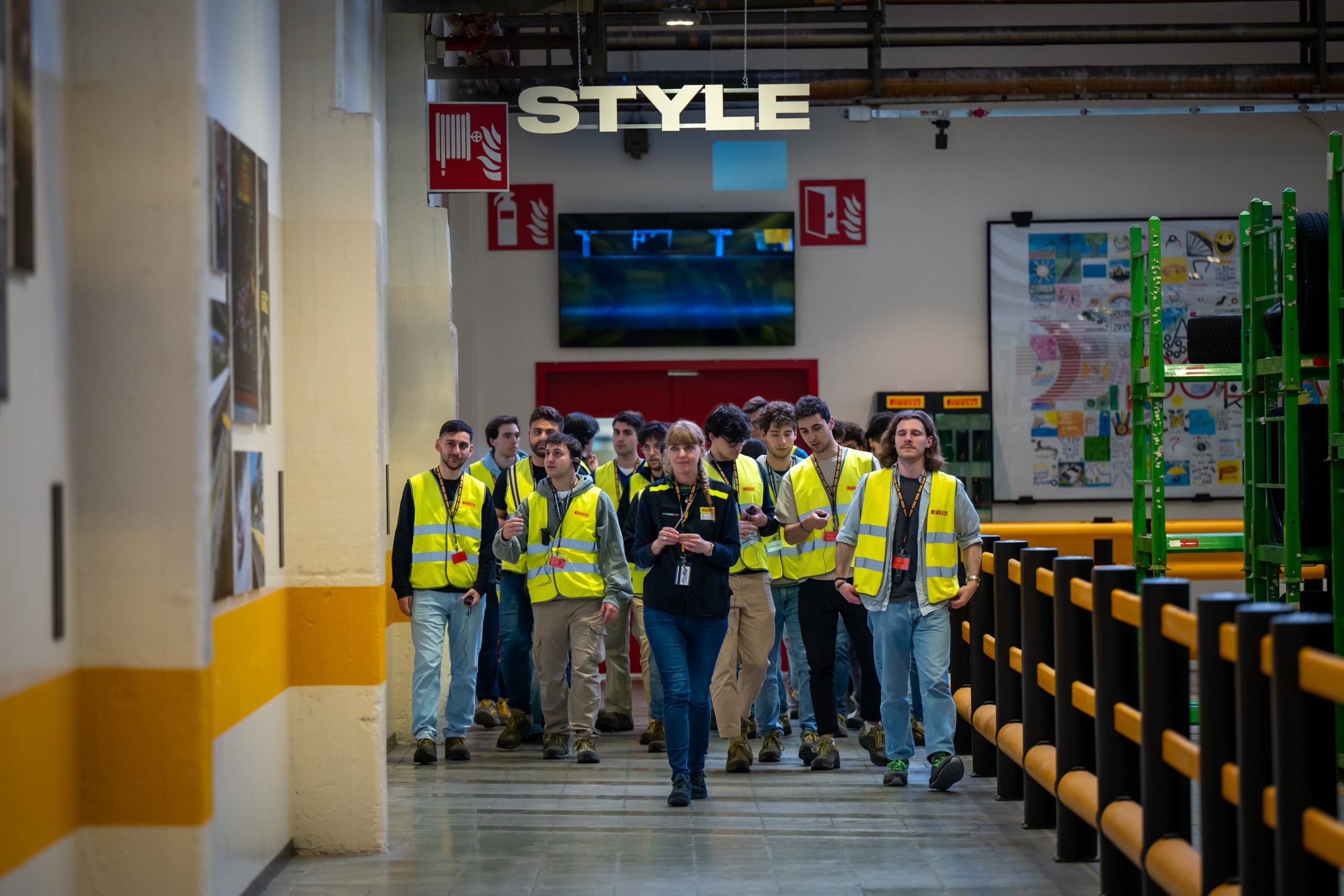
University
Pirelli Foundation Educational Courses

Do you want to organize a training programme with your students? For information and reservations, write to universita@fondazionepirelli.org

Visit the Foundation
For information about the Foundation’s activities, guided tours and accessibility,
please call +39 0264423971 or fill in the form below, providing details of your request in the notes field.

A company that leaves its mark

Pirelli and Milan share a deep-rooted, lasting bond. One that has shaped everything from street names to architecture and sporting venues. A new chapter in “Pirelli, a City and a Vision” opens the doors to our Historical Archive, which is home to more than four kilometres of records

Some companies imprint themselves not only on the physical landscape but also on that of the imagination. Pirelli is one of them. Founded in Milan in 1872, with its first factory in Via Ponte Seveso (now Via Fabio Filzi), the company rapidly expanded abroad, all while maintaining its deep-rooted connection with the city where it was born. This bond has led to a history unlike any other, as we see even in the names it has adopted.

In the first article of this series, “Pirelli, a City and a Vision”, we saw how the company’s connection with Milan quickly became a defining feature. From the inclusion of “Milano” in the firm’s name to its early products—the first registered trademark in 1888, the first Italian cable-laying vessel Città di Milano, and the Tipo Milano bicycle tyres launched in 1894—the name echoed across Pirelli’s identity. “Milano” appeared consistently in the company’s catalogues, price lists and marketing materials, reinforcing this intimate connection.

As the company grew, its factories, product lines, workforce and community relationships multiplied. “Pirelli” became a well-known and prestigious name. It acquired iconic status, to the point that, in Milan, it became synonymous with the city itself.

Let us start with a railway station, a place of fundamental importance to Milan and its twentieth-century industrial growth. Inaugurated in 1914, Greco station stood between the municipalities of Greco Milanese and Gorla Primo (later Gorlaprecotto), which were incorporated into the municipality of Milan in 1923. It served the surrounding industrial complexes in that part of the city—Breda (later Ansaldo), Manifattura Tabacchi, CIWL and Pirelli—connecting them to the wider world. “An event breaks Bicocca out of its doldrums. A train loaded to the brim chugs into Greco. Raw rubber from Genoa! And possibly coal and other raw materials. Finally!” — so reads scene 21 of Questa è la nostra città (This is Our City), a screenplay written by Alberto Moravia in 1947 at Pirelli’s request, to celebrate the company’s 75th anniversary. It has been published for the first time this year by Bompiani. In 1957, the Milano Greco station was renamed Milano Greco Pirelli in tribute to the company’s nearby factories, which by then had occupied a significant part of the Bicocca district.

Next we come to a skyscraper—not the first in Milan, as the city had already begun to climb skyward in the 1920s with the first buildings to be known as “skyscrapers”. On 12 July 1956, however, the cornerstone was officially laid for the Pirelli Tower, the Group’s new headquarters, built on the site of the historic Brusada buildings, remnants of the original plant that had survived the 1943 bombings. Designed by Gio Ponti and Giuseppe Valtolina, with input from Pierluigi Nervi and Arturo Danusso, the tower was completed in 1960 and was acclaimed in the international press as an exceptional work both for its engineering and for its aesthetic innovation. The 127-metre, 31-storey Pirelli Tower is a soaring, elegant structure of reinforced concrete. It features a broad central body that narrows to delicate edges that almost close. It was the tallest reinforced concrete building in Europe and the third tallest in the world and displays an extraordinary and elegant rationality. Its facade is a continuous glass window in aluminium and glass covering 9,500 square metres, which during the day reflects “the movements of the sky”, making the Pirellone stand out against the Milan skyline. The Tower remained the property of Pirelli until 1978, when it was sold to the Lombardy Region, but its name remained among the symbols and icons of “The City that Rises”, retaining the record for height in the Milanese capital until 2010.

Pirelli’s name is also etched into two of Milan’s most iconic sporting venues, both of which have made international history: one in the world of football, the other in cycling. A sports enthusiast and the eldest son of the company’s founder, Piero Pirelli helped to establish the Milan Football Club in 1899, later serving as its president from 1909 to 1929. In 1926, he also contributed to the construction of the San Siro stadium. His life was one of business and social activities but also of a great passion for sport.

In 1935, the semi-covered Vigorelli Velodrome was inaugurated, taking the place of the then outdated Corso Sempione track, which had been demolished in 1928. Championed by Pirelli and Giuseppe Vigorelli—a former track cyclist, industrialist and member of the Pirelli sales team—the new velodrome quickly earned a reputation as a veritable temple of Italian and international cycling. It was here, on 7 November 1942, that Fausto Coppi set his legendary world hour record: 45,798 km. During its golden era, from 1949 to 1957, under the guidance of the cycling great Alfredo Binda, the Vigorelli also hosted the Gran Premio Pirelli. This competition brought together young cycling enthusiasts from across the country, who competed in regional heats culminating in the grand finale on the revered Milan track—the “temple” of cycling.

Pirelli and Milan: a name etched into the very fabric of the city.

Pirelli and Milan share a deep-rooted, lasting bond. One that has shaped everything from street names to architecture and sporting venues. A new chapter in “Pirelli, a City and a Vision” opens the doors to our Historical Archive, which is home to more than four kilometres of records

Some companies imprint themselves not only on the physical landscape but also on that of the imagination. Pirelli is one of them. Founded in Milan in 1872, with its first factory in Via Ponte Seveso (now Via Fabio Filzi), the company rapidly expanded abroad, all while maintaining its deep-rooted connection with the city where it was born. This bond has led to a history unlike any other, as we see even in the names it has adopted.

In the first article of this series, “Pirelli, a City and a Vision”, we saw how the company’s connection with Milan quickly became a defining feature. From the inclusion of “Milano” in the firm’s name to its early products—the first registered trademark in 1888, the first Italian cable-laying vessel Città di Milano, and the Tipo Milano bicycle tyres launched in 1894—the name echoed across Pirelli’s identity. “Milano” appeared consistently in the company’s catalogues, price lists and marketing materials, reinforcing this intimate connection.

As the company grew, its factories, product lines, workforce and community relationships multiplied. “Pirelli” became a well-known and prestigious name. It acquired iconic status, to the point that, in Milan, it became synonymous with the city itself.

Let us start with a railway station, a place of fundamental importance to Milan and its twentieth-century industrial growth. Inaugurated in 1914, Greco station stood between the municipalities of Greco Milanese and Gorla Primo (later Gorlaprecotto), which were incorporated into the municipality of Milan in 1923. It served the surrounding industrial complexes in that part of the city—Breda (later Ansaldo), Manifattura Tabacchi, CIWL and Pirelli—connecting them to the wider world. “An event breaks Bicocca out of its doldrums. A train loaded to the brim chugs into Greco. Raw rubber from Genoa! And possibly coal and other raw materials. Finally!” — so reads scene 21 of Questa è la nostra città (This is Our City), a screenplay written by Alberto Moravia in 1947 at Pirelli’s request, to celebrate the company’s 75th anniversary. It has been published for the first time this year by Bompiani. In 1957, the Milano Greco station was renamed Milano Greco Pirelli in tribute to the company’s nearby factories, which by then had occupied a significant part of the Bicocca district.

Next we come to a skyscraper—not the first in Milan, as the city had already begun to climb skyward in the 1920s with the first buildings to be known as “skyscrapers”. On 12 July 1956, however, the cornerstone was officially laid for the Pirelli Tower, the Group’s new headquarters, built on the site of the historic Brusada buildings, remnants of the original plant that had survived the 1943 bombings. Designed by Gio Ponti and Giuseppe Valtolina, with input from Pierluigi Nervi and Arturo Danusso, the tower was completed in 1960 and was acclaimed in the international press as an exceptional work both for its engineering and for its aesthetic innovation. The 127-metre, 31-storey Pirelli Tower is a soaring, elegant structure of reinforced concrete. It features a broad central body that narrows to delicate edges that almost close. It was the tallest reinforced concrete building in Europe and the third tallest in the world and displays an extraordinary and elegant rationality. Its facade is a continuous glass window in aluminium and glass covering 9,500 square metres, which during the day reflects “the movements of the sky”, making the Pirellone stand out against the Milan skyline. The Tower remained the property of Pirelli until 1978, when it was sold to the Lombardy Region, but its name remained among the symbols and icons of “The City that Rises”, retaining the record for height in the Milanese capital until 2010.

Pirelli’s name is also etched into two of Milan’s most iconic sporting venues, both of which have made international history: one in the world of football, the other in cycling. A sports enthusiast and the eldest son of the company’s founder, Piero Pirelli helped to establish the Milan Football Club in 1899, later serving as its president from 1909 to 1929. In 1926, he also contributed to the construction of the San Siro stadium. His life was one of business and social activities but also of a great passion for sport.

In 1935, the semi-covered Vigorelli Velodrome was inaugurated, taking the place of the then outdated Corso Sempione track, which had been demolished in 1928. Championed by Pirelli and Giuseppe Vigorelli—a former track cyclist, industrialist and member of the Pirelli sales team—the new velodrome quickly earned a reputation as a veritable temple of Italian and international cycling. It was here, on 7 November 1942, that Fausto Coppi set his legendary world hour record: 45,798 km. During its golden era, from 1949 to 1957, under the guidance of the cycling great Alfredo Binda, the Vigorelli also hosted the Gran Premio Pirelli. This competition brought together young cycling enthusiasts from across the country, who competed in regional heats culminating in the grand finale on the revered Milan track—the “temple” of cycling.

Pirelli and Milan: a name etched into the very fabric of the city.

Multimedia

Images

“Tazio Nuvolari el conductor de la emoción”. On Display in Barcelona

Tazio Nuvolari el conductor de la emoción – ”Tazio Nuvolari: Driver of Emotion” – is the title of the exhibition opening today and running until 18 October at the Casa degli Italiani in Barcelona, in collaboration with Scuderia Nuvolari Italia. A true campionissimo on both two and four wheels, Nuvolari conquered the roads and circuits of three continents during a career spanning three decades – from the 1920s to the 1940s – securing his place in motor-racing history and in the popular imagination. The Barcelona exhibition shines a light on a lesser-known side of Nuvolari: his passion for photography. On view is a selection of 300 images from an archive of over 2,500 photographs taken by Nuvolari himself, catalogued, digitised, and first exhibited in Mantua in 2009. Shot mainly between 1936 and the early years of the Second World War with a Zeiss Contax II 24×36 mm camera, these photographs reveal the Mantuan driver’s remarkable technical skill and keen curiosity. They take us on a journey through his public and private life: his family, friends, travels, and of course the racing world – seen not through the eyes of a star, but through the lens of a reporter.

The Barcelona exhibition pays tribute not only to Nuvolari the photographer, but also to Nuvolari the driver, with photographs recording his triumphs on both car and motorcycle circuits, with a special emphasis on his ties to Barcelona and Catalonia. The Grand Prix organised by Penya Rhin in Vilafranca in 1923 marked Nuvolari’s international debut at the wheel of a Chiribiri. Unknown at the time and with no results of note, he nonetheless left a strong impression on the Barcelona public. A decade later Nuvolari returned as a champion to the Penya Rhin Grands Prix at Montjuïc from 1933 to 1936, the year he achieved one of his finest victories at the wheel of an Alfa Romeo Scuderia Ferrari, fitted with Pirelli Stella Bianca tyres.

At the heart of this section of the exhibition is an original Stella Bianca tyre from the 1930s, which – together with materials from the Pirelli Historical Archive – bears witness to the close bond between Nuvolari and Pirelli. Captured by Federico Patellani, the Mantua-born champion was chosen for the cover of the very first issue of Pirelli magazine, which also carried an article about him by Orio Vergani. In 1954, a year after Nuvolari’s death, Vergani wrote a moving tribute in the magazine.

A striking photograph from Documents on the History of Pirelli industries shows the Ferrari team at the European Hill Climb Championships on 29 June 1930: in the foreground we see Luigi Arcangeli, Tazio Nuvolari and Enzo Ferrari sitting on an Alfa Romeo P2, also fitted with Stella Bianca tyres. The Alfa Romeo–Pirelli partnership, which came about as soon as the “Quadrifoglio” was born, reached its height in the 1930s thanks in part to the creation of Scuderia Ferrari. This ushered in an era of great victories – led above all by Nuvolari, from the Mille Miglia (1930) to the Targa Florio (1930 and 1932), and the Grands Prix of Monaco, France, Italy (1932) and Germany (1935). This bond with Ferrari can also be seen in other photographs from our Archive: the Scuderia Ferrari luncheon in 1930, the group portrait with the cyclist Costante Girardengo, and the image of Nuvolari, Ferrari and Mario Umberto Borzacchini holding out their hands in a pledge of loyalty to Scuderia Ferrari on 22 January 1933. This authentic album of memories retraces the extraordinary personal and sporting life of one of the greatest champions of all time.

Tazio Nuvolari el conductor de la emoción – ”Tazio Nuvolari: Driver of Emotion” – is the title of the exhibition opening today and running until 18 October at the Casa degli Italiani in Barcelona, in collaboration with Scuderia Nuvolari Italia. A true campionissimo on both two and four wheels, Nuvolari conquered the roads and circuits of three continents during a career spanning three decades – from the 1920s to the 1940s – securing his place in motor-racing history and in the popular imagination. The Barcelona exhibition shines a light on a lesser-known side of Nuvolari: his passion for photography. On view is a selection of 300 images from an archive of over 2,500 photographs taken by Nuvolari himself, catalogued, digitised, and first exhibited in Mantua in 2009. Shot mainly between 1936 and the early years of the Second World War with a Zeiss Contax II 24×36 mm camera, these photographs reveal the Mantuan driver’s remarkable technical skill and keen curiosity. They take us on a journey through his public and private life: his family, friends, travels, and of course the racing world – seen not through the eyes of a star, but through the lens of a reporter.

The Barcelona exhibition pays tribute not only to Nuvolari the photographer, but also to Nuvolari the driver, with photographs recording his triumphs on both car and motorcycle circuits, with a special emphasis on his ties to Barcelona and Catalonia. The Grand Prix organised by Penya Rhin in Vilafranca in 1923 marked Nuvolari’s international debut at the wheel of a Chiribiri. Unknown at the time and with no results of note, he nonetheless left a strong impression on the Barcelona public. A decade later Nuvolari returned as a champion to the Penya Rhin Grands Prix at Montjuïc from 1933 to 1936, the year he achieved one of his finest victories at the wheel of an Alfa Romeo Scuderia Ferrari, fitted with Pirelli Stella Bianca tyres.

At the heart of this section of the exhibition is an original Stella Bianca tyre from the 1930s, which – together with materials from the Pirelli Historical Archive – bears witness to the close bond between Nuvolari and Pirelli. Captured by Federico Patellani, the Mantua-born champion was chosen for the cover of the very first issue of Pirelli magazine, which also carried an article about him by Orio Vergani. In 1954, a year after Nuvolari’s death, Vergani wrote a moving tribute in the magazine.

A striking photograph from Documents on the History of Pirelli industries shows the Ferrari team at the European Hill Climb Championships on 29 June 1930: in the foreground we see Luigi Arcangeli, Tazio Nuvolari and Enzo Ferrari sitting on an Alfa Romeo P2, also fitted with Stella Bianca tyres. The Alfa Romeo–Pirelli partnership, which came about as soon as the “Quadrifoglio” was born, reached its height in the 1930s thanks in part to the creation of Scuderia Ferrari. This ushered in an era of great victories – led above all by Nuvolari, from the Mille Miglia (1930) to the Targa Florio (1930 and 1932), and the Grands Prix of Monaco, France, Italy (1932) and Germany (1935). This bond with Ferrari can also be seen in other photographs from our Archive: the Scuderia Ferrari luncheon in 1930, the group portrait with the cyclist Costante Girardengo, and the image of Nuvolari, Ferrari and Mario Umberto Borzacchini holding out their hands in a pledge of loyalty to Scuderia Ferrari on 22 January 1933. This authentic album of memories retraces the extraordinary personal and sporting life of one of the greatest champions of all time.

Multimedia

Images

Ethics as an indispensable factor in the economy

The President of the ABI delivers a speech that lucidly summarises some key principles to be followed


Ethics and economics are two parts of the same argument, and are also factors to be taken into account in business. This is necessary for a culture of production that is attentive to both profit and how it is achieved. These ideas formed the basis of a recent speech by Antonio Patuelli, President of the Italian Banking Association (ABI). ‘Ethics and Economics’ is a lucid analysis of the principles that should underpin every successful business and guide every individual in the modern economic system.

Profit not in opposition with morality, therefore. Patuelli explains that ‘the moral dimension of economics and finance enables economic efficiency and the promotion of sustainable, solidarity-based development as inseparable goals’. A ‘base’ that supports economics and finance as ‘sources of wealth creation, not ends in themselves, but means and instruments for increasing development, progress and civilisation’. Above all, not just principles. Patuelli goes on to emphasise that, in ‘economics and finance, everything that is morally correct is aimed at the overall development and solidarity of the individual and society, which can only be achieved in a market economy with social awareness. In such an economy, private initiative enjoys wide constitutional guarantees, and the market is free and competitive, supervised by independent authorities’.

Then there is the enterprise, the organisation of production par excellence. The President of the ABI then takes up Pope John Paul II’s 1991 encyclical Centesimus Annus, which examined contemporary political and economic issues, emphasising: ‘The enterprise cannot be regarded only as a corporation; it is also a community of people.  Therefore, it is necessary to assess welfare using criteria broader than GDP, taking into account parameters such as security, health, the growth of “human capital”, and the quality of social life and work.’

And next to enterprise is the ‘precept’ par excellence of today:  sustainability, seen as an alternative to short-termism and everything that does not consider future consequences. ‘Sustainability,’ Patuelli emphasises, ‘is a long-term view and an alternative to choices based on polling that mainly analyses the consequences of phenomena.’ This speech by the President of the Italian Banking Association is certainly worth a read.

Etica ed Economia

Antonio Patuelli

The Italian Banking Association – LINK University, 24 September 2025

The President of the ABI delivers a speech that lucidly summarises some key principles to be followed


Ethics and economics are two parts of the same argument, and are also factors to be taken into account in business. This is necessary for a culture of production that is attentive to both profit and how it is achieved. These ideas formed the basis of a recent speech by Antonio Patuelli, President of the Italian Banking Association (ABI). ‘Ethics and Economics’ is a lucid analysis of the principles that should underpin every successful business and guide every individual in the modern economic system.

Profit not in opposition with morality, therefore. Patuelli explains that ‘the moral dimension of economics and finance enables economic efficiency and the promotion of sustainable, solidarity-based development as inseparable goals’. A ‘base’ that supports economics and finance as ‘sources of wealth creation, not ends in themselves, but means and instruments for increasing development, progress and civilisation’. Above all, not just principles. Patuelli goes on to emphasise that, in ‘economics and finance, everything that is morally correct is aimed at the overall development and solidarity of the individual and society, which can only be achieved in a market economy with social awareness. In such an economy, private initiative enjoys wide constitutional guarantees, and the market is free and competitive, supervised by independent authorities’.

Then there is the enterprise, the organisation of production par excellence. The President of the ABI then takes up Pope John Paul II’s 1991 encyclical Centesimus Annus, which examined contemporary political and economic issues, emphasising: ‘The enterprise cannot be regarded only as a corporation; it is also a community of people.  Therefore, it is necessary to assess welfare using criteria broader than GDP, taking into account parameters such as security, health, the growth of “human capital”, and the quality of social life and work.’

And next to enterprise is the ‘precept’ par excellence of today:  sustainability, seen as an alternative to short-termism and everything that does not consider future consequences. ‘Sustainability,’ Patuelli emphasises, ‘is a long-term view and an alternative to choices based on polling that mainly analyses the consequences of phenomena.’ This speech by the President of the Italian Banking Association is certainly worth a read.

Etica ed Economia

Antonio Patuelli

The Italian Banking Association – LINK University, 24 September 2025

Back to school with Alexander the Great

A book dedicated to the concept of the leader outlines a management method that traces its origins back to history and extends to the present day


Learning from the ancients to become more modern. This advice can be applied to everyone and everything, including prudent business management. It’s not about looking at the past indiscriminately; it’s about rediscovering experiences and methods that can still be useful and relevant today. This is what Gianfranco Di Pietro (a philosopher) and Andrea Lipparini (a business strategy expert) have achieved in their recently published book, ‘Il coraggio e la visione. Alessandro Magno e la leadership generativa’ (Courage and vision: Alexander the Great and generative leadership), which, as the title suggests, is about the life of Alexander the Great.

The two authors begin with a question. What can Alexander the Great teach today’s leaders? While the answer is clearly plenty, the details must be explained carefully. On the one hand, he is an example of courage, charisma, strategic skills and an extraordinary ability to inspire others to achieve remarkable things. On the other hand, however, at a certain point in the story, his success begins to crumble, difficulties become apparent, and his ability to stop and go back in order to avoid losing everything emerges. The book conveys all of this, offering a modern interpretation of Alexander the Great’s experience.

After an initial section on the general characteristics of leadership, illustrated with the example of Enzo Ferrari, the book moves on to tell the story of Alexander the Great from historical and managerial perspectives. Finally, everything comes together in the final chapter, ‘Leaders of our desires.  Traces of generative leadership’, which outlines a new approach to leadership inspired by Alexander the Great’s experiences in nine steps.

When read with a modern perspective, Di Pietro and Lipparini’s book offers practical insights for today’s organisational leaders. It addresses questions such as how to build trust, foster consensus and maintain a shared vision during periods of profound change. It also highlights common mistakes, such as leadership that centres on the hero rather than the collective cause and a lack of recognition of an ideal felt by all. The true ‘going above and beyond’, the two authors make clear, even for those who run a business, lies in recognising one’s own limits, not accepting them, but overcoming them.

Il coraggio e la visione. Alessandro Magno e la leadership generativa

Gianfranco Di Pietro, Andrea Lipparini

Il Mulino, 2025

A book dedicated to the concept of the leader outlines a management method that traces its origins back to history and extends to the present day


Learning from the ancients to become more modern. This advice can be applied to everyone and everything, including prudent business management. It’s not about looking at the past indiscriminately; it’s about rediscovering experiences and methods that can still be useful and relevant today. This is what Gianfranco Di Pietro (a philosopher) and Andrea Lipparini (a business strategy expert) have achieved in their recently published book, ‘Il coraggio e la visione. Alessandro Magno e la leadership generativa’ (Courage and vision: Alexander the Great and generative leadership), which, as the title suggests, is about the life of Alexander the Great.

The two authors begin with a question. What can Alexander the Great teach today’s leaders? While the answer is clearly plenty, the details must be explained carefully. On the one hand, he is an example of courage, charisma, strategic skills and an extraordinary ability to inspire others to achieve remarkable things. On the other hand, however, at a certain point in the story, his success begins to crumble, difficulties become apparent, and his ability to stop and go back in order to avoid losing everything emerges. The book conveys all of this, offering a modern interpretation of Alexander the Great’s experience.

After an initial section on the general characteristics of leadership, illustrated with the example of Enzo Ferrari, the book moves on to tell the story of Alexander the Great from historical and managerial perspectives. Finally, everything comes together in the final chapter, ‘Leaders of our desires.  Traces of generative leadership’, which outlines a new approach to leadership inspired by Alexander the Great’s experiences in nine steps.

When read with a modern perspective, Di Pietro and Lipparini’s book offers practical insights for today’s organisational leaders. It addresses questions such as how to build trust, foster consensus and maintain a shared vision during periods of profound change. It also highlights common mistakes, such as leadership that centres on the hero rather than the collective cause and a lack of recognition of an ideal felt by all. The true ‘going above and beyond’, the two authors make clear, even for those who run a business, lies in recognising one’s own limits, not accepting them, but overcoming them.

Il coraggio e la visione. Alessandro Magno e la leadership generativa

Gianfranco Di Pietro, Andrea Lipparini

Il Mulino, 2025

Europe needs to invest in security, but it also needs to revisit the works of Mann, Unamuno and Balzac

This Europe, so fragile, caught between a humiliating Trump administration in the US, a Russia under Putin that keeps it under threat of war, and a China under Xi JinPing that flatters it as a trade partner, but a second-class one…This Europe, so full of culture and tradition and yet uncertain and lost on the relevance of its values… This Europe, which has nurtured a vocabulary of grand words, yet all too often speaks with the wooden tongue of mediocre bureaucracy. How can we revive this Europe that has lost hope and forgotten how to dream?

We must go back to our roots and, drawing on our memory, rethink the reality of our democracy and plan a better, more solid future. With the courage and shrewdness of one who moves and engages in battles, both political and cultural, including in partibus infidelium (in the lands of the unbelievers).

Altiero Spinelli and Eugenio Colorni were just over thirty years old, and Ernesto Rossi just over forty, when they wrote the ‘Ventotene Manifesto’ in the harsh conditions of island confinement during the darkest period of fascist and Nazi domination of Europe. This manifesto was to become the cornerstone of European rebirth. And it was just after the horrors of World War II, when Thomas Mann published Moniti all’Europa, an anthology of political and civic essays in which he attempted to rebuild a sense of civilisation that would inspire a new era of coexistence and democracy.

So, it is precisely now, in these uncertain and dramatic times, as we walk on the edge of a precipice, along the narrow and slippery ridge that separates peace from war, (the President of the Republic, Sergio Mattarella, is right to evoke the spectre of 1914 as a danger to be avoided) that we must return to the foundations of our European identity. We must reread good books such as the ‘Manifesto’ and the works of Mann, and reflect on ‘words that make you live’ (Paul Éluard‘s inspiration in 1944, as previously mentioned in our blog post from 8 March).

Words such as: ‘You will win because you have brute force in abundance, but you will not convince.  To convince, you need to persuade, and to persuade, you need something you lack:  reason and justice in the struggle.’ These are the words of Miguel de Unamuno, a philosopher and writer, rector of the University of Salamanca, when, in 1936, he addressed a hostile audience of Falangists — the extreme right-wing supporters of General Francisco Franco — who were on the verge of winning the Spanish Civil War.

But is Europe convincing today? Can it convince its citizens of the importance and necessity of defending and reviving its values in the face of pitfalls posed by powerful and overbearing adversaries?

The fracture of the strong idea of the ‘West’ and ‘democracy’, alongside the new direction of government in the White House, has profoundly undermined confidence in the stability and future of an alliance that has been characterised by a shared commitment to democracy, freedom, and mutual interests, shaping the course of contemporary history from 1945 to the present day. Authoritarian systems and ‘illiberal democracies’ are finding easy acceptance in growing sectors of European public opinion, thanks to the polluting capabilities of social media and disinformation as an act of ‘hybrid warfare’, and under the illusion of easy and irresponsible shortcuts. This is a difficult, dangerous situation. As La Stampa (23 September) summarises: ‘Trump divides, Putin threatens: the double trap for Europe’.

Unfortunately, this crisis has deep roots. For some time now, we have been confronted with the phenomenon of ‘democracy’s discontent’, as described in the intriguing book of the same name by Michael J. Sandel (Feltrinelli), who teaches government theory at Harvard. He argues that we are living through a ‘dangerous political moment’ due to the mistakes made by Western democracies in uncritically embracing ‘finance-driven globalisation’, which has had negative consequences for workers and the middle classes — the social and cultural groups that form the backbone of liberal democracy. However, all is not lost: ‘In order to breathe new life into democracy, we must reconfigure the economy and empower citizens to take an active role in public life.’

It should be a ‘just’ economy that is also circular, sustainable and cohesive. It should combine productivity and social inclusion, as well as competitiveness and solidarity. The ideas of John Maynard Keynes and his most recent followers are back in the news, with Federico Caffè — Mario Draghi’s university teacher — calling for a Europe that is not marginal or submissive, but a key player in history. A ‘civil’ economy, also taking up the ideas of those who, from Naples (Antonio Genovesi, civil economy theorist) to Milan (the ‘good government’ analysed and proposed by the Verri brothers), in the most fertile and far-sighted period of the Enlightenment, attempted to put forward original ideas for political reforms and economic development.

And the Enlightenment is one of the finest achievements of European culture. It is an extraordinary and highly relevant lesson in civilisation that should never be forgotten. Cardinal of Turin Roberto Repole warns, ‘Today, Europe is experiencing a certain spiritual secularisation, but it has also betrayed the basic insight of the Enlightenment: that freedom entails assuming an ethical responsibility’ (La Stampa, 24 September). He argues, ‘We took the 20th-century acquisitions of peace, welfare and health for granted.  We have passed on the memory of wars, but we no longer feel the need to reflect on the roots of peace that stemmed from the ethical consciousness of previous generations. We risk losing what we have because we have neglected to maintain it; we have not considered that peace and prosperity are not definitive, but a dynamic process.’ The Illuminists were aware of this, of the primacy of reason and its possible crisis, which remains to be answered. Even Leonardo Sciascia, the contemporary writer who was most aware of this lesson, knew this well. The title of his last book, published by Bompiani in 1989, was ‘For a Future Memory’: a synthesis of the duties of literature as creative work and civic responsibility. However, he added the warning, ‘If memory has a future’.

Enlightenment is the culture of yesterday reflected in today. So, looking to the future, what does Europe need to say today?

We are the only region in the world that is still capable of combining liberal democracy, a market economy and welfare in an extraordinary and original way. In other words, we embody freedom, economic and social innovation, and solidarity. This is a complex system of strong values and sophisticated governance and civic coexistence amidst diversity. And it is an area in which we must persist, even through courageous reforms, both institutional — such as ending unanimity for decisions by the 27 EU countries, a trend which is already underway anyway — and political, such as  common investments and efficient, effective public spending on security, sustainable development and knowledge.

We must do it quickly and we must do it well. It is also vital to raise awareness among Europeans of the choices to be made and their consequences, and to encourage them to consider the values involved.

Reconstruct a convincing, persuasive narrative of Europe’s values, strengths and necessity. As a democracy, a paradigm of balanced development and a destiny. Persuade, as Unamuno said, and as the best European politicians (from the ‘founding fathers’ to Kohl, Delors and Mitterrand) have done until now. And revive cultures and rules as an alternative to the primacy of force, which denies civilisation and relations inspired by the rule of law.

How? Here is another point to consider in relation to the crisis: the language of Europe. Certainly not the bureaucratic, cold, distant and complicated language of verbose treaties and obscure regulations. Nor the long-winded, formal and icy language of the EU Constitution, which was approved by the European Parliament in 2004 but never came into force as it was not ratified by some member states. This constitution has an enormous 448 articles, which is even more than the 139 articles (plus 18 articles of ‘transitional and final provisions’) of the Italian constitution, the 146 articles of the German constitution, and the 89 articles (plus a preamble) of the French constitution.

If anything, the language of literature and art. As Antonio Spadaro explains in la Repubblica (24 September), ‘Europe is a great novel.  Beyond treaties, which are insufficient, it must be experienced as an epic narrative, following in the footsteps of Mann, Musil, Balzac, Flaubert, Cervantes, and contemporary novelists such as Javier Cercas’, as well as poets, philosophers, and historians who have depicted its controversies and connections throughout history. Because ‘telling the story like this, like a novel, also means going through the conflicts and  making us experience them, rather than denying them; inhabiting contradictions rather than evading them; remembering the wounds rather than concealing them, and thus beginning to heal them; and  not erasing the clash, but going through it’.

Europe as life and destiny, an awareness of roots and a vision of the future. Not as a region to impose authoritarian thinking, which is too violent and infinitely poor, compared to the rich complexity of our history, which deserves to have a future.

A project demonstrating courageous political choices, firmness when confronting our necessary ally, the US, and effective management of those who detest Europe and all it stands for — economically, spiritually, culturally and morally — can help reacquaint citizens and, perhaps more importantly, new generations with Europe.

A Europe we can trust: strengthening what is already there. This is confirmed by the 2025 European Sentiment Compass, which was drawn up in cooperation with the European Council on Foreign Relations and cited by two European scholars, André Wilkens and Paweł Zerka, in Il Foglio on 26 September. The study argues that European sentiment has been strengthened and shaped by the pandemic, as Europe tackled the crisis and its aftermath with a spirit of cooperation in terms of vaccines and health responses, as well as economic and planning intelligence, with Next Generation EU funding. This was then reinforced by concrete and active solidarity in response to Russia’s attack on Ukraine. And trust in the EU is also at its highest since 2007: ‘In almost all Member States, the majority of citizens feel connected to Europe, identify as EU citizens, and are optimistic about the Union’s future. More and more people see Europe as not only an economic project, but also a community of security and shared destiny.’

Even if media reports and widespread political stances seem to suggest otherwise. It is necessary to investigate and understand this better, but certainly, decisive action is needed to build, rebuild or strengthen trust. The challenge is political, especially today, when it comes to security.  But it is also, and above all, cultural, ethical and civil.  And on these fronts, Europe still has good cards to play.

Photo Getty Images

This Europe, so fragile, caught between a humiliating Trump administration in the US, a Russia under Putin that keeps it under threat of war, and a China under Xi JinPing that flatters it as a trade partner, but a second-class one…This Europe, so full of culture and tradition and yet uncertain and lost on the relevance of its values… This Europe, which has nurtured a vocabulary of grand words, yet all too often speaks with the wooden tongue of mediocre bureaucracy. How can we revive this Europe that has lost hope and forgotten how to dream?

We must go back to our roots and, drawing on our memory, rethink the reality of our democracy and plan a better, more solid future. With the courage and shrewdness of one who moves and engages in battles, both political and cultural, including in partibus infidelium (in the lands of the unbelievers).

Altiero Spinelli and Eugenio Colorni were just over thirty years old, and Ernesto Rossi just over forty, when they wrote the ‘Ventotene Manifesto’ in the harsh conditions of island confinement during the darkest period of fascist and Nazi domination of Europe. This manifesto was to become the cornerstone of European rebirth. And it was just after the horrors of World War II, when Thomas Mann published Moniti all’Europa, an anthology of political and civic essays in which he attempted to rebuild a sense of civilisation that would inspire a new era of coexistence and democracy.

So, it is precisely now, in these uncertain and dramatic times, as we walk on the edge of a precipice, along the narrow and slippery ridge that separates peace from war, (the President of the Republic, Sergio Mattarella, is right to evoke the spectre of 1914 as a danger to be avoided) that we must return to the foundations of our European identity. We must reread good books such as the ‘Manifesto’ and the works of Mann, and reflect on ‘words that make you live’ (Paul Éluard‘s inspiration in 1944, as previously mentioned in our blog post from 8 March).

Words such as: ‘You will win because you have brute force in abundance, but you will not convince.  To convince, you need to persuade, and to persuade, you need something you lack:  reason and justice in the struggle.’ These are the words of Miguel de Unamuno, a philosopher and writer, rector of the University of Salamanca, when, in 1936, he addressed a hostile audience of Falangists — the extreme right-wing supporters of General Francisco Franco — who were on the verge of winning the Spanish Civil War.

But is Europe convincing today? Can it convince its citizens of the importance and necessity of defending and reviving its values in the face of pitfalls posed by powerful and overbearing adversaries?

The fracture of the strong idea of the ‘West’ and ‘democracy’, alongside the new direction of government in the White House, has profoundly undermined confidence in the stability and future of an alliance that has been characterised by a shared commitment to democracy, freedom, and mutual interests, shaping the course of contemporary history from 1945 to the present day. Authoritarian systems and ‘illiberal democracies’ are finding easy acceptance in growing sectors of European public opinion, thanks to the polluting capabilities of social media and disinformation as an act of ‘hybrid warfare’, and under the illusion of easy and irresponsible shortcuts. This is a difficult, dangerous situation. As La Stampa (23 September) summarises: ‘Trump divides, Putin threatens: the double trap for Europe’.

Unfortunately, this crisis has deep roots. For some time now, we have been confronted with the phenomenon of ‘democracy’s discontent’, as described in the intriguing book of the same name by Michael J. Sandel (Feltrinelli), who teaches government theory at Harvard. He argues that we are living through a ‘dangerous political moment’ due to the mistakes made by Western democracies in uncritically embracing ‘finance-driven globalisation’, which has had negative consequences for workers and the middle classes — the social and cultural groups that form the backbone of liberal democracy. However, all is not lost: ‘In order to breathe new life into democracy, we must reconfigure the economy and empower citizens to take an active role in public life.’

It should be a ‘just’ economy that is also circular, sustainable and cohesive. It should combine productivity and social inclusion, as well as competitiveness and solidarity. The ideas of John Maynard Keynes and his most recent followers are back in the news, with Federico Caffè — Mario Draghi’s university teacher — calling for a Europe that is not marginal or submissive, but a key player in history. A ‘civil’ economy, also taking up the ideas of those who, from Naples (Antonio Genovesi, civil economy theorist) to Milan (the ‘good government’ analysed and proposed by the Verri brothers), in the most fertile and far-sighted period of the Enlightenment, attempted to put forward original ideas for political reforms and economic development.

And the Enlightenment is one of the finest achievements of European culture. It is an extraordinary and highly relevant lesson in civilisation that should never be forgotten. Cardinal of Turin Roberto Repole warns, ‘Today, Europe is experiencing a certain spiritual secularisation, but it has also betrayed the basic insight of the Enlightenment: that freedom entails assuming an ethical responsibility’ (La Stampa, 24 September). He argues, ‘We took the 20th-century acquisitions of peace, welfare and health for granted.  We have passed on the memory of wars, but we no longer feel the need to reflect on the roots of peace that stemmed from the ethical consciousness of previous generations. We risk losing what we have because we have neglected to maintain it; we have not considered that peace and prosperity are not definitive, but a dynamic process.’ The Illuminists were aware of this, of the primacy of reason and its possible crisis, which remains to be answered. Even Leonardo Sciascia, the contemporary writer who was most aware of this lesson, knew this well. The title of his last book, published by Bompiani in 1989, was ‘For a Future Memory’: a synthesis of the duties of literature as creative work and civic responsibility. However, he added the warning, ‘If memory has a future’.

Enlightenment is the culture of yesterday reflected in today. So, looking to the future, what does Europe need to say today?

We are the only region in the world that is still capable of combining liberal democracy, a market economy and welfare in an extraordinary and original way. In other words, we embody freedom, economic and social innovation, and solidarity. This is a complex system of strong values and sophisticated governance and civic coexistence amidst diversity. And it is an area in which we must persist, even through courageous reforms, both institutional — such as ending unanimity for decisions by the 27 EU countries, a trend which is already underway anyway — and political, such as  common investments and efficient, effective public spending on security, sustainable development and knowledge.

We must do it quickly and we must do it well. It is also vital to raise awareness among Europeans of the choices to be made and their consequences, and to encourage them to consider the values involved.

Reconstruct a convincing, persuasive narrative of Europe’s values, strengths and necessity. As a democracy, a paradigm of balanced development and a destiny. Persuade, as Unamuno said, and as the best European politicians (from the ‘founding fathers’ to Kohl, Delors and Mitterrand) have done until now. And revive cultures and rules as an alternative to the primacy of force, which denies civilisation and relations inspired by the rule of law.

How? Here is another point to consider in relation to the crisis: the language of Europe. Certainly not the bureaucratic, cold, distant and complicated language of verbose treaties and obscure regulations. Nor the long-winded, formal and icy language of the EU Constitution, which was approved by the European Parliament in 2004 but never came into force as it was not ratified by some member states. This constitution has an enormous 448 articles, which is even more than the 139 articles (plus 18 articles of ‘transitional and final provisions’) of the Italian constitution, the 146 articles of the German constitution, and the 89 articles (plus a preamble) of the French constitution.

If anything, the language of literature and art. As Antonio Spadaro explains in la Repubblica (24 September), ‘Europe is a great novel.  Beyond treaties, which are insufficient, it must be experienced as an epic narrative, following in the footsteps of Mann, Musil, Balzac, Flaubert, Cervantes, and contemporary novelists such as Javier Cercas’, as well as poets, philosophers, and historians who have depicted its controversies and connections throughout history. Because ‘telling the story like this, like a novel, also means going through the conflicts and  making us experience them, rather than denying them; inhabiting contradictions rather than evading them; remembering the wounds rather than concealing them, and thus beginning to heal them; and  not erasing the clash, but going through it’.

Europe as life and destiny, an awareness of roots and a vision of the future. Not as a region to impose authoritarian thinking, which is too violent and infinitely poor, compared to the rich complexity of our history, which deserves to have a future.

A project demonstrating courageous political choices, firmness when confronting our necessary ally, the US, and effective management of those who detest Europe and all it stands for — economically, spiritually, culturally and morally — can help reacquaint citizens and, perhaps more importantly, new generations with Europe.

A Europe we can trust: strengthening what is already there. This is confirmed by the 2025 European Sentiment Compass, which was drawn up in cooperation with the European Council on Foreign Relations and cited by two European scholars, André Wilkens and Paweł Zerka, in Il Foglio on 26 September. The study argues that European sentiment has been strengthened and shaped by the pandemic, as Europe tackled the crisis and its aftermath with a spirit of cooperation in terms of vaccines and health responses, as well as economic and planning intelligence, with Next Generation EU funding. This was then reinforced by concrete and active solidarity in response to Russia’s attack on Ukraine. And trust in the EU is also at its highest since 2007: ‘In almost all Member States, the majority of citizens feel connected to Europe, identify as EU citizens, and are optimistic about the Union’s future. More and more people see Europe as not only an economic project, but also a community of security and shared destiny.’

Even if media reports and widespread political stances seem to suggest otherwise. It is necessary to investigate and understand this better, but certainly, decisive action is needed to build, rebuild or strengthen trust. The challenge is political, especially today, when it comes to security.  But it is also, and above all, cultural, ethical and civil.  And on these fronts, Europe still has good cards to play.

Photo Getty Images

The Pirelli Foundation at Archivi Aperti 2025: Discovering Postwar Milan Through Photography and Creativity

For the 11th edition of Archivi Aperti (“Open Archives”), the event promoted by Rete Fotografia to highlight photographic heritage, the Pirelli Foundation is organising an educational workshop for secondary school students on 23 October 2025. This initiative follows the theme proposed for the 2025 edition, “Resistant Photography: The Role of Images in Historical Narration.” Through a national conference, guided tours, public talks, and workshops for schools, the programme will examine how photography acts as a powerful means for constructing, reconstructing, and consolidating memory.

The workshop takes participants on a historical and visual journey, weaving together archival photographs and other documentary sources. The students will be led on a symbolic exploration of a vast postwar factory to observe and interpret the transformations of the industrial world: its roles, faces, and the dynamics of labour. At the same time, they will be invited to wander, as it were, through the streets of Milan, a city that in those years was undergoing profound changes, driven by an energetic push towards modernity and progress.

The Pirelli Foundation holds a photographic archive comprising thousands of images from the nineteenth century to the present day. These of pictures document not only the growth of a great company, but also the sweeping social, economic, and cultural changes in Italy, particularly in the crucial postwar years of reconstruction and the economic boom. The photographs reveal a nation in transformation. They capture scenes of daily life, workplaces, and building sites for the infrastructure of the future, alongside rapidly changing cityscapes, factories and public buildings, the faces of both male and female machine operators, bicycles and cars in the streets, and luminous advertising signs.

Taking inspiration from archive photographs and the screenplay Questa è la nostra città (“This is Our City”)—commissioned in 1947 from Alberto Moravia and Roberto Rossellini to mark Pirelli’s 75th anniversary—the students will be invited to create and write a scene of their own, set in post-war Milan. This creative exercise, weaving together visual and literary sources, will give rise to a new narrative that revisits, with fresh eyes, factory life during the years of reconstruction.

Schools wishing to take part may write to scuole@fondazionepirelli.org

For the 11th edition of Archivi Aperti (“Open Archives”), the event promoted by Rete Fotografia to highlight photographic heritage, the Pirelli Foundation is organising an educational workshop for secondary school students on 23 October 2025. This initiative follows the theme proposed for the 2025 edition, “Resistant Photography: The Role of Images in Historical Narration.” Through a national conference, guided tours, public talks, and workshops for schools, the programme will examine how photography acts as a powerful means for constructing, reconstructing, and consolidating memory.

The workshop takes participants on a historical and visual journey, weaving together archival photographs and other documentary sources. The students will be led on a symbolic exploration of a vast postwar factory to observe and interpret the transformations of the industrial world: its roles, faces, and the dynamics of labour. At the same time, they will be invited to wander, as it were, through the streets of Milan, a city that in those years was undergoing profound changes, driven by an energetic push towards modernity and progress.

The Pirelli Foundation holds a photographic archive comprising thousands of images from the nineteenth century to the present day. These of pictures document not only the growth of a great company, but also the sweeping social, economic, and cultural changes in Italy, particularly in the crucial postwar years of reconstruction and the economic boom. The photographs reveal a nation in transformation. They capture scenes of daily life, workplaces, and building sites for the infrastructure of the future, alongside rapidly changing cityscapes, factories and public buildings, the faces of both male and female machine operators, bicycles and cars in the streets, and luminous advertising signs.

Taking inspiration from archive photographs and the screenplay Questa è la nostra città (“This is Our City”)—commissioned in 1947 from Alberto Moravia and Roberto Rossellini to mark Pirelli’s 75th anniversary—the students will be invited to create and write a scene of their own, set in post-war Milan. This creative exercise, weaving together visual and literary sources, will give rise to a new narrative that revisits, with fresh eyes, factory life during the years of reconstruction.

Schools wishing to take part may write to scuole@fondazionepirelli.org

Multimedia

Images

Business diplomacy

A Lectio magistralis (master’s lecture) on the ability of companies to be positive actors in the economy and society


Businesses can play an important role in terms of political relations and the common good. It’s not just about sound accounts and product quality; it’s also about playing an important role in social relations, local areas and politics in general.  This is a highly important issue that needs to be properly understood. One way to gain a better understanding is to read the Lectio magistralis delivered by Simone Bemporad at the University of Trieste last May.

In his lecture, ‘L’impatto delle aziende sulle relazioni politiche e sul bene comune’ (The impact of companies on political relations and the common good), Bemporad lucidly addressed the topic, drawing on his experience as a journalist and businessman. In his own words, over the years, this experience has led him to work in ‘key institutions and companies that have always shown a vocation for innovation and the future.’ The Lectio aims to highlight three key aspects of Bemporad’s worldview: the economy, social relations, and politics. Firstly, the fact that ‘considering the trajectories of private business interests separate from those of public interest is a view already surpassed by reality, and attempting to divide them will not help achieve either one or the other.’ Secondly, ‘businesses play a bridging role between distant places, with forces and means that almost no government can rival. It is essential for governments to collaborate with businesses, particularly through a highly competent diplomatic network, in order to manage relations between countries.’ Finally, that ‘corporate communication and advocacy are essential elements for modern interconnected economies. Indeed, to paraphrase Keynes’s words about economic theories, they are more powerful than is commonly believed.’

With great clarity, Bemporad addresses the topic and helps listeners (or readers) to understand the realities of relationships that often remain hidden from view, yet which can be decisive for the future of entire social and economic systems. He achieves this by drawing on his experience as both a journalist and a successful businessman.  ‘Companies,’ writes Bemporad in one of the pivotal passages, ‘can contribute to more informed diplomatic and political decisions by sharing the extensive knowledge they generate through their activities, offering a unique and innovative perspective.’


L’impatto delle aziende sulle relazioni politiche e sul bene comune. Lectio magistralis by Simone Bemporad

Simone Bemporad

Lectio Magistralis, University of Trieste, 30 May 2025, on the occasion of the awarding of the Honoris Causa Degree

A Lectio magistralis (master’s lecture) on the ability of companies to be positive actors in the economy and society


Businesses can play an important role in terms of political relations and the common good. It’s not just about sound accounts and product quality; it’s also about playing an important role in social relations, local areas and politics in general.  This is a highly important issue that needs to be properly understood. One way to gain a better understanding is to read the Lectio magistralis delivered by Simone Bemporad at the University of Trieste last May.

In his lecture, ‘L’impatto delle aziende sulle relazioni politiche e sul bene comune’ (The impact of companies on political relations and the common good), Bemporad lucidly addressed the topic, drawing on his experience as a journalist and businessman. In his own words, over the years, this experience has led him to work in ‘key institutions and companies that have always shown a vocation for innovation and the future.’ The Lectio aims to highlight three key aspects of Bemporad’s worldview: the economy, social relations, and politics. Firstly, the fact that ‘considering the trajectories of private business interests separate from those of public interest is a view already surpassed by reality, and attempting to divide them will not help achieve either one or the other.’ Secondly, ‘businesses play a bridging role between distant places, with forces and means that almost no government can rival. It is essential for governments to collaborate with businesses, particularly through a highly competent diplomatic network, in order to manage relations between countries.’ Finally, that ‘corporate communication and advocacy are essential elements for modern interconnected economies. Indeed, to paraphrase Keynes’s words about economic theories, they are more powerful than is commonly believed.’

With great clarity, Bemporad addresses the topic and helps listeners (or readers) to understand the realities of relationships that often remain hidden from view, yet which can be decisive for the future of entire social and economic systems. He achieves this by drawing on his experience as both a journalist and a successful businessman.  ‘Companies,’ writes Bemporad in one of the pivotal passages, ‘can contribute to more informed diplomatic and political decisions by sharing the extensive knowledge they generate through their activities, offering a unique and innovative perspective.’


L’impatto delle aziende sulle relazioni politiche e sul bene comune. Lectio magistralis by Simone Bemporad

Simone Bemporad

Lectio Magistralis, University of Trieste, 30 May 2025, on the occasion of the awarding of the Honoris Causa Degree

Places, humanity and businesses

Geography as an important tool for understanding social and economic evolution

The meaning, history, role and culture of a company’s production depend not only on the people behind it, but also on its location.   Geography is therefore an important factor for businesses, as it is for all other human endeavours, even today in the digital age where relationships are increasingly dematerialised. Studying geography from this perspective is therefore an important step in understanding social and economic activities, as Marco Percoco attempts to demonstrate his recently published book, ‘Il potere dei luoghi. La rivincita della geografia per capire la società’ (The power of places. The revenge of geography to understand society).

Percoco views geography not as a mere map, but as an intricate network of economic, social, and human relationships that influence the development of places. The book explores how geography can have a profound influence on growth trajectories, from migration and urban sprawl to health and the environment. Percoco uses stories and case studies to bridge the gap between theory and reality, taking us from the Val d’Agri to the Walser communities of Monte Rosa and from the malaria that struck Fausto Coppi to migrations from southern to northern Italy. The author demonstrates that space is not merely a container, but an active element that influences economic and social opportunities.

Therefore, geographical space, but also historical and social space. Percoco argues that history teaches us that territorial gaps are not simply reduced by moving people, but by understanding local specificities. Real cases are again used to illustrate this point, from the social capital of communities such as Arcidosso, to the consequences of extractive resource exploitation, and the impact of transport infrastructure on migration dynamics. Marco Percoco’s book thus takes on the features of a journey, revealing how development depends on enhancing the resources of each territory — human, natural, or institutional. However, ‘Il potere dei luoghi’ also represents another breakthrough: an innovative interpretation of contemporary inequalities that encourages us to look beyond geographical boundaries and imagine new growth and welfare strategies for all. Among many important passages, readers should note this one towards the end of the book: ‘Managing an area economically no longer means only creating new jobs with an effective industrial policy. A modern vision must be accompanied by strategic management of resources, from human capital to entrepreneurial and natural capital.’


Il potere dei luoghi. La rivincita della geografia per capire la società

Marco Percoco

EGEA, 2025

Geography as an important tool for understanding social and economic evolution

The meaning, history, role and culture of a company’s production depend not only on the people behind it, but also on its location.   Geography is therefore an important factor for businesses, as it is for all other human endeavours, even today in the digital age where relationships are increasingly dematerialised. Studying geography from this perspective is therefore an important step in understanding social and economic activities, as Marco Percoco attempts to demonstrate his recently published book, ‘Il potere dei luoghi. La rivincita della geografia per capire la società’ (The power of places. The revenge of geography to understand society).

Percoco views geography not as a mere map, but as an intricate network of economic, social, and human relationships that influence the development of places. The book explores how geography can have a profound influence on growth trajectories, from migration and urban sprawl to health and the environment. Percoco uses stories and case studies to bridge the gap between theory and reality, taking us from the Val d’Agri to the Walser communities of Monte Rosa and from the malaria that struck Fausto Coppi to migrations from southern to northern Italy. The author demonstrates that space is not merely a container, but an active element that influences economic and social opportunities.

Therefore, geographical space, but also historical and social space. Percoco argues that history teaches us that territorial gaps are not simply reduced by moving people, but by understanding local specificities. Real cases are again used to illustrate this point, from the social capital of communities such as Arcidosso, to the consequences of extractive resource exploitation, and the impact of transport infrastructure on migration dynamics. Marco Percoco’s book thus takes on the features of a journey, revealing how development depends on enhancing the resources of each territory — human, natural, or institutional. However, ‘Il potere dei luoghi’ also represents another breakthrough: an innovative interpretation of contemporary inequalities that encourages us to look beyond geographical boundaries and imagine new growth and welfare strategies for all. Among many important passages, readers should note this one towards the end of the book: ‘Managing an area economically no longer means only creating new jobs with an effective industrial policy. A modern vision must be accompanied by strategic management of resources, from human capital to entrepreneurial and natural capital.’


Il potere dei luoghi. La rivincita della geografia per capire la società

Marco Percoco

EGEA, 2025

Pordenonelegge, ‘the miracle of a city that becomes a book’, thanks to the connection between industry and culture

Like fishermen of ideas and words, to be used as the ingredients in delicious conversations and civil relations. Looking at this year’s posters for Pordenonelegge, the festival of good books and cultured and civilised encounters, light-hearted and curious thoughts come to mind:  there is a hook that, instead of catching a fish, lifts the corner of a yellow page to reveal the blue and starry edge of the European flag. And the exemplary slogan: ‘amoleggere’, meaning I love reading, adds even greater significance to this ‘Book and Freedom Festival’.

Yellow is the symbolic colour of Pordenonelegge, an initiative now in its 26th edition. In mid-September, it becomes a must-attend event for writers, readers and cultural figures, as well as young people, who come from all over Italy and abroad to listen to, read, discuss and understand that world of stories and ideas which, at times, seems doomed to decay and decline. Yet here, in the beautiful historic centre and in the yellow-decorated squares, it displays not only robust resilience, but also unexpected vitality. Its sights are now set on another ambitious goal: Pordenone as Italian Capital of Culture in 2027.

What are the roots of this industrial and cultural phenomenon? And what does it tell us about the prospects for the future of productive Italy, and that is, all things considered, of an Italy that has an extraordinary driving force in its history and its destiny in Europe?

This book festival is dedicated to Europe, fully aware of its limitations but also of the need to strengthen and develop (entrepreneurs from the north-east of Italy, including Friuli, are well aware of this through experience and culture). It was the determination of businessmen and businesswomen that led to the first edition in 2000 (a symbolic change of century and millennium). As Enzo Sellerio, with his profound, ironic and critical knowledge of books and ideas, would have said, ‘We are astonished’.

The initiative came from the Chamber of Commerce, which was chaired by Augusto Antonucci at the time.  Business associations provided significant support, including Confindustria, Confcommercio, Coldiretti, Confcooperative and Confartigianato. This was a book festival firmly rooted in the economic world and the forces of production, and local and regional politics followed.

Over time, this entrepreneurial spirit has grown stronger. For years, its most dynamic exponent has been Michelangelo Agrusti: a former DC parliamentarian, entrepreneur in the shipbuilding sector and president of Confindustria Alto Adriatico, which brings together companies in Pordenone, Gorizia and Trieste, as well as the Pordenonelegge Foundation. Industry and culture with a solid social and civil conscience.

The intentions were clear from the beginning: to attract the attention of the media, the publishing world, and the public to the city, enhancing the cultural, historical, and landscape riches of an area until then known primarily as a manufacturing hub. The aim was therefore to ‘help institutions, entrepreneurs, economic operators and citizens to broaden and deepen their knowledge, and to stimulate dialogue with intellectuals, publishers, authors and prominent national and international figures in literary, artistic and cultural fields’.

Over time, it has grown, and an average of 120,000 visitors per year have been recorded over the last few years. There has also been a strong economic return:  for every public euro invested, 10.24 euros benefit the local area (according to research by Bocconi University).

Agrusti argues: ‘Amoleggere this year is a declaration of interest in the present moment and in understanding its complexity.  Readers can not only inform themselves, but can also critically explore the issues with the knowledge that comes from understanding.’ And ‘this year too the miracle of the city becoming a book has been repeated.’

For this reason, Pordenonelegge is a festival conceived ‘on the threshold of history, an active observatory of contemporary reality.’ The special dedication to Europe ‘emphasises the institution that we all greatly need in our current historical and geopolitical context.  This institution is tasked with overcoming the risks of structural decline and the challenges of the existential crisis envisaged by the Draghi Report.’

Therefore, Europe is obliged to strengthen ‘its role as a point of reference for the founding values underlying the Treaties:  justice, democracy, freedom, the rule of law and respect for human rights. These are principles that the third millennium is calling into question in many parts of the world.’ The festival opened with a meeting with Shirin Ebadi, the Iranian writer and Nobel Peace Prize winner, and closed with Beethoven’s Ode to Joy.

Industry and culture, as we said, but also, more importantly, an industry that creates culture. And, better yet, ‘industry is culture’ if culture encompasses not only literature and art, theatre and music, but also science, technology, industrial or design patents, new high-tech products, artificial intelligence algorithms, innovative employment contracts for social relations, sustainable logistics organisation, and positive relationships between industry and the environment.

The importance of ‘material culture’, a concept dear to French historians of the Annales school, is also evident here in Friulian territory.

It was a peasant region in the post-war period, poor but industrious. It was marked by emigration to the strong industrial areas of Lombardy and the automotive region of Piedmont, but the people had a strong sense of pride in their roots, and among those who remained there was a widespread culture of work, cooperation and solidarity. During the boom years, the industry experienced a period of growth, beginning with the production of ‘white goods’ (household appliances, such as Zanussi and Electrolux), followed by light metalworking, woodworking, furniture production, textile machinery, and ceramics. More recently, shipbuilding and its sophisticated production chain have emerged.

The story of these transformations can be found in the concise yet comprehensive book Laboratorio Pordenone, written by Giuseppe Lupo, a historian who specialises in the relationship between literature and industry. He is the recent winner of the Friuli Venezia Giulia Literary Prize. ‘The economic miracle was not confined to Milan or Turin alone.  In fact, it was the peripheral areas that underwent the transition to modern civilisation in a less traumatic way than the big cities. In Pordenone, for example, the traditional way of life has never completely disappeared.  North-eastern Italy built its economic fortune on this mixture of industry and countryside, centuries-old customs and entrepreneurial daring — let’s call it an almost Calvinist mystique of work — helping to shape the figure of the metalmezzadro.’

The metalmezzadro was a common sight: half farmer and half metal worker. They were also frequently found in industrial plants across southern Italy, from Melfi to Termini Imerese.  However, there were some differences.  In southern Italian companies, harvest seasons (wheat, olives, grapes, etc.) coincided with peaks in factory absenteeism, whereas in the north-east there was a more harmonious balance of working periods.

In fact, Lupo writes that in Pordenone, ‘the old world continued to resist even in the presence of the new. The peasant soul — the one that spoke in dialect and felt rooted in the land — never fully succumbed to the advance of modernity. It was almost as if it were secretly resisting (or taking revenge on) the danger that modernity would homogenise everything, both in black-and-white Pordenone in the 1960s and in recent decades, when the demand for labour prompted Confindustria to devise a strategy to control the movement of individuals or families to the city and integrate them into the productive workforce.’

Lupo insists that,  ‘in the absence of cultural institutions, companies have had to act as drivers of development by promoting initiatives related to books, reading, art, cinema and theatre,  and this is how the Pordenonelegge festival came to be, one of the most important literary events in Italy.’ Why? ‘No material well-being can be achieved without culture, and this city uniquely expresses the relationship between business and the local area, even during a delicate phase such as the transition to Industry 4.0.’

Confirmation can be found in the Technology Hub, which is designed to incubate new businesses. It provides support in the form of technical skills and financial resources for the digital and environmental transition. It operates without bureaucratic rigidity and has a solid understanding of productivity. Another notable initiative is the Lef (or ‘Lean Experience Factory’), which was inaugurated in 2011 on the outskirts of Pordenone. Agrusti is its president. Lupo explains ‘It is a factory-school of sorts, or rather an experiential training centre that teaches how to optimise production processes.  Rather than being a model factory, it is a factory modeller because it works with the relevant parties to determine the most effective production model for specific industrial processes.  In short, it is an educational workshop, halfway between a practical factory and a conceptual one, and it applies to the Lef, but could work for the entire Pordenone system.’

Here it is again: the virtuous synthesis of ‘business is culture’.  The culture of know-how and of sharing knowledge. Pordenonelegge, with its ‘Festival of Books and Freedom’, is a fundamental tool for this.

(foto: Cozzarin)

Like fishermen of ideas and words, to be used as the ingredients in delicious conversations and civil relations. Looking at this year’s posters for Pordenonelegge, the festival of good books and cultured and civilised encounters, light-hearted and curious thoughts come to mind:  there is a hook that, instead of catching a fish, lifts the corner of a yellow page to reveal the blue and starry edge of the European flag. And the exemplary slogan: ‘amoleggere’, meaning I love reading, adds even greater significance to this ‘Book and Freedom Festival’.

Yellow is the symbolic colour of Pordenonelegge, an initiative now in its 26th edition. In mid-September, it becomes a must-attend event for writers, readers and cultural figures, as well as young people, who come from all over Italy and abroad to listen to, read, discuss and understand that world of stories and ideas which, at times, seems doomed to decay and decline. Yet here, in the beautiful historic centre and in the yellow-decorated squares, it displays not only robust resilience, but also unexpected vitality. Its sights are now set on another ambitious goal: Pordenone as Italian Capital of Culture in 2027.

What are the roots of this industrial and cultural phenomenon? And what does it tell us about the prospects for the future of productive Italy, and that is, all things considered, of an Italy that has an extraordinary driving force in its history and its destiny in Europe?

This book festival is dedicated to Europe, fully aware of its limitations but also of the need to strengthen and develop (entrepreneurs from the north-east of Italy, including Friuli, are well aware of this through experience and culture). It was the determination of businessmen and businesswomen that led to the first edition in 2000 (a symbolic change of century and millennium). As Enzo Sellerio, with his profound, ironic and critical knowledge of books and ideas, would have said, ‘We are astonished’.

The initiative came from the Chamber of Commerce, which was chaired by Augusto Antonucci at the time.  Business associations provided significant support, including Confindustria, Confcommercio, Coldiretti, Confcooperative and Confartigianato. This was a book festival firmly rooted in the economic world and the forces of production, and local and regional politics followed.

Over time, this entrepreneurial spirit has grown stronger. For years, its most dynamic exponent has been Michelangelo Agrusti: a former DC parliamentarian, entrepreneur in the shipbuilding sector and president of Confindustria Alto Adriatico, which brings together companies in Pordenone, Gorizia and Trieste, as well as the Pordenonelegge Foundation. Industry and culture with a solid social and civil conscience.

The intentions were clear from the beginning: to attract the attention of the media, the publishing world, and the public to the city, enhancing the cultural, historical, and landscape riches of an area until then known primarily as a manufacturing hub. The aim was therefore to ‘help institutions, entrepreneurs, economic operators and citizens to broaden and deepen their knowledge, and to stimulate dialogue with intellectuals, publishers, authors and prominent national and international figures in literary, artistic and cultural fields’.

Over time, it has grown, and an average of 120,000 visitors per year have been recorded over the last few years. There has also been a strong economic return:  for every public euro invested, 10.24 euros benefit the local area (according to research by Bocconi University).

Agrusti argues: ‘Amoleggere this year is a declaration of interest in the present moment and in understanding its complexity.  Readers can not only inform themselves, but can also critically explore the issues with the knowledge that comes from understanding.’ And ‘this year too the miracle of the city becoming a book has been repeated.’

For this reason, Pordenonelegge is a festival conceived ‘on the threshold of history, an active observatory of contemporary reality.’ The special dedication to Europe ‘emphasises the institution that we all greatly need in our current historical and geopolitical context.  This institution is tasked with overcoming the risks of structural decline and the challenges of the existential crisis envisaged by the Draghi Report.’

Therefore, Europe is obliged to strengthen ‘its role as a point of reference for the founding values underlying the Treaties:  justice, democracy, freedom, the rule of law and respect for human rights. These are principles that the third millennium is calling into question in many parts of the world.’ The festival opened with a meeting with Shirin Ebadi, the Iranian writer and Nobel Peace Prize winner, and closed with Beethoven’s Ode to Joy.

Industry and culture, as we said, but also, more importantly, an industry that creates culture. And, better yet, ‘industry is culture’ if culture encompasses not only literature and art, theatre and music, but also science, technology, industrial or design patents, new high-tech products, artificial intelligence algorithms, innovative employment contracts for social relations, sustainable logistics organisation, and positive relationships between industry and the environment.

The importance of ‘material culture’, a concept dear to French historians of the Annales school, is also evident here in Friulian territory.

It was a peasant region in the post-war period, poor but industrious. It was marked by emigration to the strong industrial areas of Lombardy and the automotive region of Piedmont, but the people had a strong sense of pride in their roots, and among those who remained there was a widespread culture of work, cooperation and solidarity. During the boom years, the industry experienced a period of growth, beginning with the production of ‘white goods’ (household appliances, such as Zanussi and Electrolux), followed by light metalworking, woodworking, furniture production, textile machinery, and ceramics. More recently, shipbuilding and its sophisticated production chain have emerged.

The story of these transformations can be found in the concise yet comprehensive book Laboratorio Pordenone, written by Giuseppe Lupo, a historian who specialises in the relationship between literature and industry. He is the recent winner of the Friuli Venezia Giulia Literary Prize. ‘The economic miracle was not confined to Milan or Turin alone.  In fact, it was the peripheral areas that underwent the transition to modern civilisation in a less traumatic way than the big cities. In Pordenone, for example, the traditional way of life has never completely disappeared.  North-eastern Italy built its economic fortune on this mixture of industry and countryside, centuries-old customs and entrepreneurial daring — let’s call it an almost Calvinist mystique of work — helping to shape the figure of the metalmezzadro.’

The metalmezzadro was a common sight: half farmer and half metal worker. They were also frequently found in industrial plants across southern Italy, from Melfi to Termini Imerese.  However, there were some differences.  In southern Italian companies, harvest seasons (wheat, olives, grapes, etc.) coincided with peaks in factory absenteeism, whereas in the north-east there was a more harmonious balance of working periods.

In fact, Lupo writes that in Pordenone, ‘the old world continued to resist even in the presence of the new. The peasant soul — the one that spoke in dialect and felt rooted in the land — never fully succumbed to the advance of modernity. It was almost as if it were secretly resisting (or taking revenge on) the danger that modernity would homogenise everything, both in black-and-white Pordenone in the 1960s and in recent decades, when the demand for labour prompted Confindustria to devise a strategy to control the movement of individuals or families to the city and integrate them into the productive workforce.’

Lupo insists that,  ‘in the absence of cultural institutions, companies have had to act as drivers of development by promoting initiatives related to books, reading, art, cinema and theatre,  and this is how the Pordenonelegge festival came to be, one of the most important literary events in Italy.’ Why? ‘No material well-being can be achieved without culture, and this city uniquely expresses the relationship between business and the local area, even during a delicate phase such as the transition to Industry 4.0.’

Confirmation can be found in the Technology Hub, which is designed to incubate new businesses. It provides support in the form of technical skills and financial resources for the digital and environmental transition. It operates without bureaucratic rigidity and has a solid understanding of productivity. Another notable initiative is the Lef (or ‘Lean Experience Factory’), which was inaugurated in 2011 on the outskirts of Pordenone. Agrusti is its president. Lupo explains ‘It is a factory-school of sorts, or rather an experiential training centre that teaches how to optimise production processes.  Rather than being a model factory, it is a factory modeller because it works with the relevant parties to determine the most effective production model for specific industrial processes.  In short, it is an educational workshop, halfway between a practical factory and a conceptual one, and it applies to the Lef, but could work for the entire Pordenone system.’

Here it is again: the virtuous synthesis of ‘business is culture’.  The culture of know-how and of sharing knowledge. Pordenonelegge, with its ‘Festival of Books and Freedom’, is a fundamental tool for this.

(foto: Cozzarin)

“The City Within the City” and Leopoldo Pirelli’s Vision

The Bicocca Project, one of Milan’s most significant urban planning ventures at the close of the millennium, was championed by Leopoldo Pirelli, president of Pirelli from 1965 to 1996. It is now being commemorated in a special way one hundred years after its founding

Pirelli and Milan share a bond that cannot be broken. We explored it in our study “Pirelli, a City and a Vision”, tracing its many expressions: its origins in Via Ponte Seveso shaped its identity and its products, and even their names. The images of the city provided a stage for its visual communication. From the post-war years to the 1960s, Pirelli’s cultural production entered into dialogue with that of Milan itself. The company also created signs that left their mark on both space and history—not only through place names but also on the map of the city’s most iconic landmarks. Among these was the Pirelli Tower, inaugurated in 1960. Designed by Gio Ponti, it redefined modern architecture and transformed Milan’s skyline. Then came the Bicocca Project one of the largest redevelopments in an area of Milan, which placed the city at the centre of international debate on industrial transformation. It was conceived by Leopoldo Pirelli together with the City of Milan, the Province of Milan, and the Lombardy Region.

In 1985 the Bicocca plants were gradually decommissioned. This moment was captured in Gabriele Basilico’s photographs and in the director Silvio Soldini’s documentary La fabbrica sospesa, commissioned by Pirelli. That same year, the company launched an international competition by invitation for the transformation of its industrial areas, linking them to the city and creating an integrated, multifunctional technology hub. The letter sent to twenty of the world’s top architecture and urban planning firms bore the subject line: “Bicocca Project: Invitation to develop the theme of the future urban and architectural layout of an area located to the north of Milan, owned by Pirelli and known as Bicocca.”

After a second round of judging, on 7 July 1988 Leopoldo Pirelli declared Gregotti Associati’s project to be the winner. “Comincia da Bicocca la Milano del XXI secolo” (“21st-Century Milan Begins in Bicocca”) was the title in Fatti e Notizie, the Pirelli Group’s Italian staff magazine. It reported on the presentation of the final phase to regional, provincial, and city authorities and published an interview with the architect Vittorio Gregotti.

The future of cities had long been a prime topic in Pirelli magazine during the 1950s and 1960s. Here, architects and town planners entered into a fascinating debate about the growth of urban settlements, as we explored in our article “Pirelli and the City of the Future“.

And “future” was the key word in the introduction that Leopoldo Pirelli wrote for Progetto Bicocca, published by Electa in 1986, which compiled all the submissions to the international competition for the “Integrated Technological Hub” on Pirelli’s Bicocca area. The publication is now preserved in the Pirelli Historical Archive, curated by the Pirelli Foundation. “We asked the designers who took part in the competition to redevelop a vast urban area, anticipating future needs that today we can at best guess at and catch sight of. We invited them to plan a city development based on new technologies, research, and an advanced services sector, while we entrepreneurs are still grappling with the problems of industrial society, large concentrations of workers (and, conversely, pockets of unemployment), as well as mass production. This is precisely why we turned to scholars of cities and urban cultures: for their ability to read into the future of humanity through the evolution of its habitat, from a perspective different from that of the economist, entrepreneur, or sociologist.”

Gregotti Associati went on to design the master plan for the entire district and most of its buildings, combining the restoration of existing structures with new constructions: university facilities, public and private research centres, multinational headquarters, residential and office complexes, services, leisure spaces, and shopping areas, all interwoven with public green spaces and infrastructure. It also housed Pirelli’s headquarters, with its administration and research and development centre—its “head,” as Leopoldo Pirelli called it. This was taken up in the documentary Leopoldo Pirelli—Industrial Dedication and Civil Culture, produced by the Pirelli Foundation in 2017, ten years after his death.

From “product factories” to “factories of ideas and knowledge,” the Bicocca Project extends across 676,000 square metres, making it one of the largest urban renewal initiatives in Europe over the past thirty years. It introduced a new concept of modern urban planning and territorial regeneration.

It was a new take on the idea of a “city within a city,” as Leopoldo Pirelli described it. In presenting the invitation to the competition, he wrote: “I don’t think it can be considered rhetorical to say that this is a cultural and social contribution that Pirelli wishes to offer to the city of Milan, convinced, as it has always been, that economic progress cannot ignore these two fundamental aspects of civic life.”

The Bicocca Project, one of Milan’s most significant urban planning ventures at the close of the millennium, was championed by Leopoldo Pirelli, president of Pirelli from 1965 to 1996. It is now being commemorated in a special way one hundred years after its founding

Pirelli and Milan share a bond that cannot be broken. We explored it in our study “Pirelli, a City and a Vision”, tracing its many expressions: its origins in Via Ponte Seveso shaped its identity and its products, and even their names. The images of the city provided a stage for its visual communication. From the post-war years to the 1960s, Pirelli’s cultural production entered into dialogue with that of Milan itself. The company also created signs that left their mark on both space and history—not only through place names but also on the map of the city’s most iconic landmarks. Among these was the Pirelli Tower, inaugurated in 1960. Designed by Gio Ponti, it redefined modern architecture and transformed Milan’s skyline. Then came the Bicocca Project one of the largest redevelopments in an area of Milan, which placed the city at the centre of international debate on industrial transformation. It was conceived by Leopoldo Pirelli together with the City of Milan, the Province of Milan, and the Lombardy Region.

In 1985 the Bicocca plants were gradually decommissioned. This moment was captured in Gabriele Basilico’s photographs and in the director Silvio Soldini’s documentary La fabbrica sospesa, commissioned by Pirelli. That same year, the company launched an international competition by invitation for the transformation of its industrial areas, linking them to the city and creating an integrated, multifunctional technology hub. The letter sent to twenty of the world’s top architecture and urban planning firms bore the subject line: “Bicocca Project: Invitation to develop the theme of the future urban and architectural layout of an area located to the north of Milan, owned by Pirelli and known as Bicocca.”

After a second round of judging, on 7 July 1988 Leopoldo Pirelli declared Gregotti Associati’s project to be the winner. “Comincia da Bicocca la Milano del XXI secolo” (“21st-Century Milan Begins in Bicocca”) was the title in Fatti e Notizie, the Pirelli Group’s Italian staff magazine. It reported on the presentation of the final phase to regional, provincial, and city authorities and published an interview with the architect Vittorio Gregotti.

The future of cities had long been a prime topic in Pirelli magazine during the 1950s and 1960s. Here, architects and town planners entered into a fascinating debate about the growth of urban settlements, as we explored in our article “Pirelli and the City of the Future“.

And “future” was the key word in the introduction that Leopoldo Pirelli wrote for Progetto Bicocca, published by Electa in 1986, which compiled all the submissions to the international competition for the “Integrated Technological Hub” on Pirelli’s Bicocca area. The publication is now preserved in the Pirelli Historical Archive, curated by the Pirelli Foundation. “We asked the designers who took part in the competition to redevelop a vast urban area, anticipating future needs that today we can at best guess at and catch sight of. We invited them to plan a city development based on new technologies, research, and an advanced services sector, while we entrepreneurs are still grappling with the problems of industrial society, large concentrations of workers (and, conversely, pockets of unemployment), as well as mass production. This is precisely why we turned to scholars of cities and urban cultures: for their ability to read into the future of humanity through the evolution of its habitat, from a perspective different from that of the economist, entrepreneur, or sociologist.”

Gregotti Associati went on to design the master plan for the entire district and most of its buildings, combining the restoration of existing structures with new constructions: university facilities, public and private research centres, multinational headquarters, residential and office complexes, services, leisure spaces, and shopping areas, all interwoven with public green spaces and infrastructure. It also housed Pirelli’s headquarters, with its administration and research and development centre—its “head,” as Leopoldo Pirelli called it. This was taken up in the documentary Leopoldo Pirelli—Industrial Dedication and Civil Culture, produced by the Pirelli Foundation in 2017, ten years after his death.

From “product factories” to “factories of ideas and knowledge,” the Bicocca Project extends across 676,000 square metres, making it one of the largest urban renewal initiatives in Europe over the past thirty years. It introduced a new concept of modern urban planning and territorial regeneration.

It was a new take on the idea of a “city within a city,” as Leopoldo Pirelli described it. In presenting the invitation to the competition, he wrote: “I don’t think it can be considered rhetorical to say that this is a cultural and social contribution that Pirelli wishes to offer to the city of Milan, convinced, as it has always been, that economic progress cannot ignore these two fundamental aspects of civic life.”

Multimedia

Images