

Knowledge requires work, research and effort. One must learn to do difficult things well


Pablo Picasso liked to play on the irony of the paradox, saying, ‘Genius is eight hours’ work a day’. Ernest Hemingway said, ‘There is nothing to writing. All you do is sit down at a typewriter and bleed’. Cultural work is commitment and hard work, a thirst for knowledge, rigorous research, creativity and a sense of responsibility.
Faced with images of protests filling the squares and streets of cities in France, Spain and Italy for several days now, certain reflections arise regarding the importance of work values and our attitude towards demands from younger generations. To move beyond the justified condemnation of the violence harming the vast majority of young men and women demonstrating against the difficulties of living, studying and building a better future, we must listen to the reasons put forward by younger generations. Following St Augustine’s lesson: ‘Anger and courage are the two children of hope: anger at seeing how things are, and courage to see how they could be’. And the guidance of Sergio Mattarella, the President of the Republic: ‘We must take the discontent of young people seriously and not view them with indifference or petty condescension. We need greater social cohesion’ (as discussed in last week’s blog).
How can this be achieved, and what long-term solutions can be implemented beyond the propaganda that unfortunately characterises much of the public discourse?
As always, it may be useful to look through one’s own bookshelf, or to draw on the archive of thoughts and words available online, to read or re-read some reflections by people whose profession involves working with the delicate mechanisms of knowledge and storytelling, bearing in mind Roland Barthes’s statement that ‘to quote is already to rewrite’. After all, we only quote what we know, but we must still seek it out to discover new meanings: culture is both memory and effort. Even so, AI can now simplify and speed up this process, provided we know how to ask the right questions.
Let us therefore return to Italo Calvino: ‘The devil today is vagueness. By “devil”, I mean irredeemable negativity from which no good can come. In vague discourse, generalisations and imprecision of thought and language, especially when accompanied by self-assurance and petulance, we can recognise the devil as the enemy of clarity within ourselves and in our relationships with others, as the personification of mystification and self-deception.
To be even clearer and more incisive, he writes, ‘I mean the vague, not the complicated. When things are not simple or clear, demanding clarity and simplification at all costs is superficial, and it is precisely this demand that forces discourse to become generalised, that is, deceitful. On the other hand, the effort to think and express oneself with the greatest possible precision, particularly when faced with the most complex issues, is the only honest and useful approach.’ (The Uses of Literature: Essays).
Calvino was a strict, inquisitive and creative man. An intellectual, he was aware of the need to forge new paths of knowledge by bridging the humanities and science. He was also aware of his responsibility to never succumb to the rhetoric of success, but rather to commit to delving deeper. He said, ‘Focus only on difficult things that have been perfectly accomplished; be wary of easy ways, laziness, slapdash attitudes. Bet on precision.’ Because in order to appropriately perform intellectual work we need ‘not to abandon our job as scholars, but widen it, engage a larger audience, if one has something to say that might be of interest to that audience. This requires the ability to reinvent oneself without betraying one’s job’ (a quote by Sabino Cassese, a great jurist and a wise civil servant).
We should do difficult things the proper way, then, just as Gianni Rodari, another 20th-century master in literature and life, advocated: ‘It’s difficult, doing difficult things: talking to deaf people, showing a rose to a blind person. Children, learn how to do difficult things: offer your hand to blind people, sing for deaf people, free the slaves who believe to be free.’
Among the difficult issues today are the lack of jobs, particularly for younger generations, many of whom continue to leave the labour market; wages and salaries that often fail to compensate for the loss of purchasing power caused by rising inflation; and the new professional roles offered by the rapid and sweeping developments of the digital economy. Other issues include how to boost the productivity of the Italian economy and how to rethink the welfare system in light of changes to the nature of work, contracts and industrial relations (not only pensions and social care, but also training throughout one’s working life). All these processes require long-term investment in knowledge, first and foremost.
‘Knowledge that matters’ is the official motto of Bocconi University in Milan, reflecting its commitment to producing and disseminating research with a tangible impact on society and the world of work. As Francesco Billari, the Rector of Bocconi University, points out in his valuable book ‘Hyperdiversity: The Revolutions that Have Changed the Way We Live Together’ (Sellerio), he argues against populist policies that exploit the creation of scapegoats, often blaming the most vulnerable: young people, the elderly, mass schools and universities, women and the policies that protect them, and foreigners and their descendants.
Instead, we need to value diversity as a source of richness and creative complexity, and embrace inclusion rather than envisaging closed societies that marginalise and exclude. This is difficult, certainly, but essential, and brings us back to the crux of knowledge and of work. Here is another passage to reflect upon: ‘If we exclude those prodigious, isolated moments that fate may bestow upon us, loving one’s work (which unfortunately is the privilege of a few) represents the best, most concrete approximation of happiness on earth.’ These are the words of Primo Levi in The Monkey’s Wrench, a metalworker’s elegy by a crane builder. A broader conception of the relationship between work and wages. If anything, it is a vision of work as a channel for personal growth, dignity, participation and initiative; a synthesis of rights and duties; and citizenship, as our Constitution itself states right from Article 1, and as millions of people learned in Italy’s economic boom factories and through the choices made to emerge from the many crises we have endured. Through hard work, creativity, culture and a sense of responsibility.
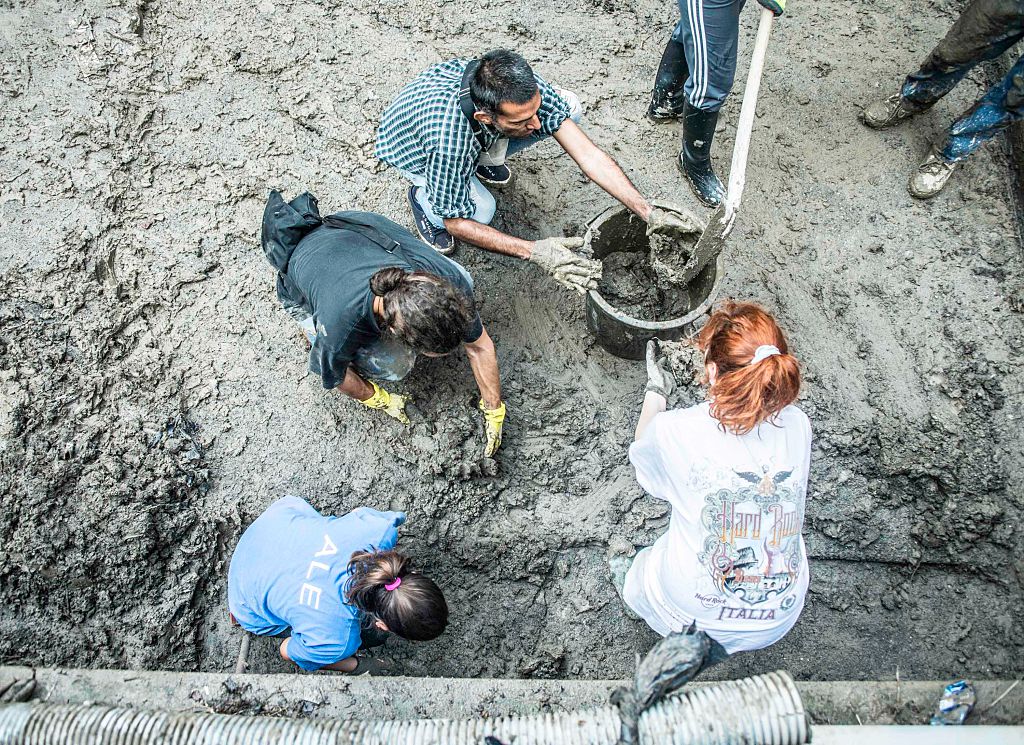
(photo Getty Images)