


Beyond production
Carlo Galli’s latest book offers readers the tools they need to better understand the relationship between technology and humanity
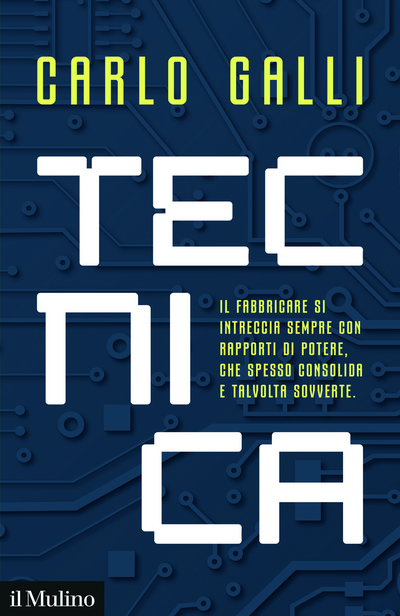
Is it technophobia or technolatry (technology worship)? Or is technology something separate from humans, or rather a tool that is entirely human and not artificial? The path of technology is ambiguous and uncertain precisely because it is so inherently human. Critique of technology, both intellectual and political, contests its desire to dictate the entire future agenda. These are important issues, especially today, that affect not only those who care about where they are and where they are going, but also shrewd entrepreneurs, managers and cautious decision-makers. In this context, it is worth reading Carlo Galli’s ‘Tecnica’ (Technology), which attempts to answer a number of crucial questions. Is technology in charge today, in the age of techno-capitalism? And who needs it? Is it for everyone, or just a select few? Or are we serving technology? Is technology a challenge to human domination of the world, or an indispensable resource for achieving it?
Starting from the observation that technology has never been and is never neutral, but has always been intertwined with human history, Galli seeks and finds the answers (or at least provides the reader with the tools to arrive at the correct answers themselves). Technology is ambiguous by definition and has a dual nature: it is an instrument of freedom and domination, in its ability to relieve us from toil and need; and it simultaneously creates imbalance, conflict and division. It is never just the ‘pure production’ of something, but carries within it the element of decision and consequently of power.
Galli guides the reader through four stages: the development of the concept; the history of technology, from flint to silicon; the relationship between technology and philosophy; and the status of new digital techniques, up to artificial intelligence.
Avoiding both mythical glorification and apocalyptic condemnation of technology, this book analyses its creation as an interweaving of knowledge and will, as the root of inequalities and transformations, and as a necessity that conceals choices and interests. It is precisely in this intersection of compulsion and freedom that the space for political action opens up, which must be characterised by balance and wisdom.
Tecnica
Carlo Galli
il Mulino, 2025
Carlo Galli’s latest book offers readers the tools they need to better understand the relationship between technology and humanity
Is it technophobia or technolatry (technology worship)? Or is technology something separate from humans, or rather a tool that is entirely human and not artificial? The path of technology is ambiguous and uncertain precisely because it is so inherently human. Critique of technology, both intellectual and political, contests its desire to dictate the entire future agenda. These are important issues, especially today, that affect not only those who care about where they are and where they are going, but also shrewd entrepreneurs, managers and cautious decision-makers. In this context, it is worth reading Carlo Galli’s ‘Tecnica’ (Technology), which attempts to answer a number of crucial questions. Is technology in charge today, in the age of techno-capitalism? And who needs it? Is it for everyone, or just a select few? Or are we serving technology? Is technology a challenge to human domination of the world, or an indispensable resource for achieving it?
Starting from the observation that technology has never been and is never neutral, but has always been intertwined with human history, Galli seeks and finds the answers (or at least provides the reader with the tools to arrive at the correct answers themselves). Technology is ambiguous by definition and has a dual nature: it is an instrument of freedom and domination, in its ability to relieve us from toil and need; and it simultaneously creates imbalance, conflict and division. It is never just the ‘pure production’ of something, but carries within it the element of decision and consequently of power.
Galli guides the reader through four stages: the development of the concept; the history of technology, from flint to silicon; the relationship between technology and philosophy; and the status of new digital techniques, up to artificial intelligence.
Avoiding both mythical glorification and apocalyptic condemnation of technology, this book analyses its creation as an interweaving of knowledge and will, as the root of inequalities and transformations, and as a necessity that conceals choices and interests. It is precisely in this intersection of compulsion and freedom that the space for political action opens up, which must be characterised by balance and wisdom.
Tecnica
Carlo Galli
il Mulino, 2025