Access the Online Archive
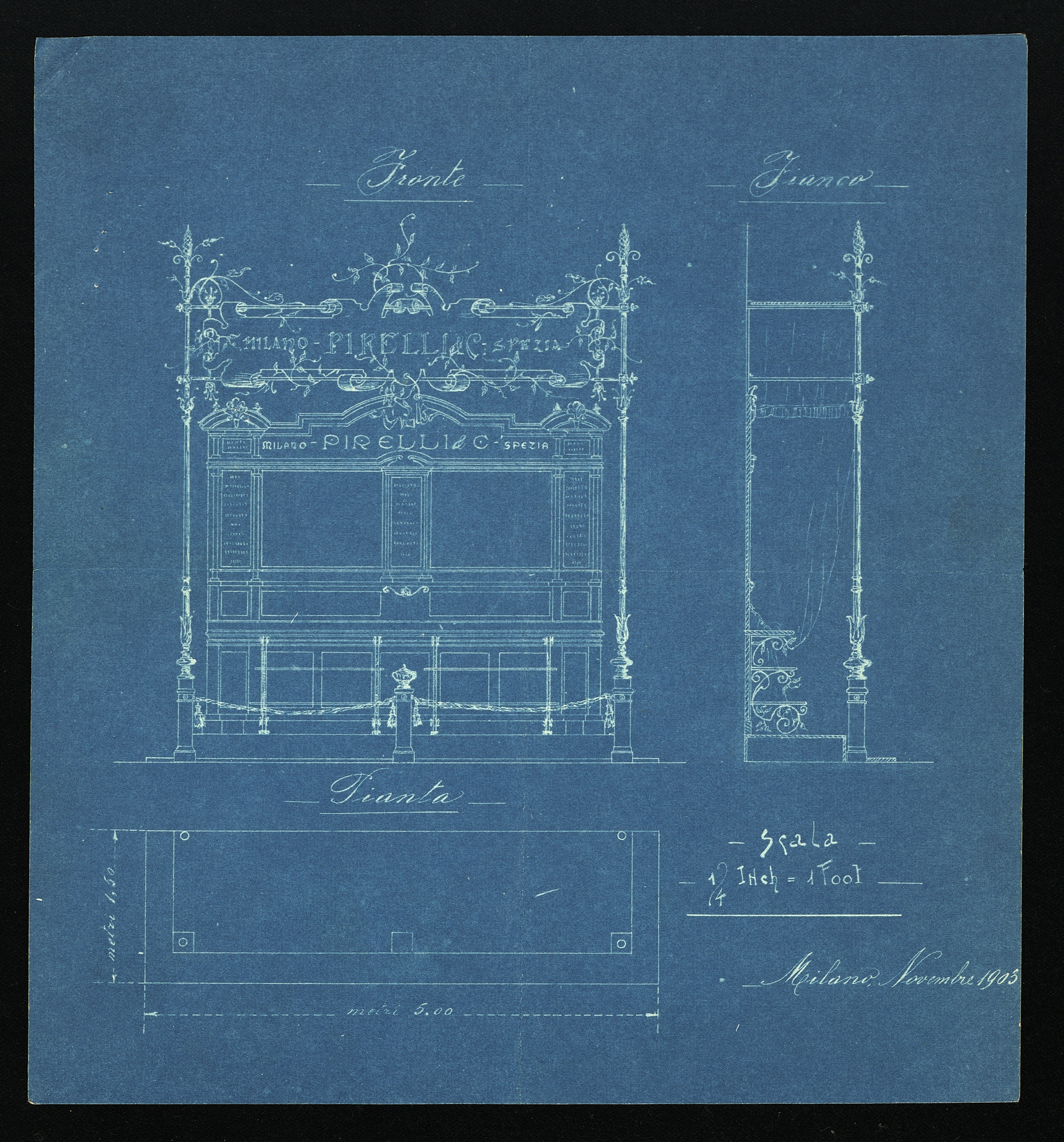
Search the Historical Archive of the Pirelli Foundation for sources and materials. Select the type of support you are interested in and write the keywords of your research.
    Select one of the following categories
  • Documents
  • Photographs
  • Drawings and posters
  • Audio-visuals
  • Publications and magazines
  • All
Help with your research
To request to view the materials in the Historical Archive and in the libraries of the Pirelli Foundation for study and research purposes and/or to find out how to request the use of materials for loans and exhibitions, please fill in the form below. You will receive an email confirming receipt of the request and you will be contacted.
Pirelli Foundation Educational Courses

Select the education level of the school
Back
Primary schools
Pirelli Foundation Educational Courses
Please fill in your details and the staff of Pirelli Foundation Educational will contact you to arrange the dates of the course.

I declare I have read  the privacy policy, and authorise the Pirelli Foundation to process my personal data in order to send communications, also by email, about initiatives/conferences organised by the Pirelli Foundation.

Back
Lower secondary school
Pirelli Foundation Educational Courses
Please fill in your details and the staff of Pirelli Foundation Educational will contact you to arrange the dates of the course.
Back
Upper secondary school
Pirelli Foundation Educational Courses
Please fill in your details and the staff of Pirelli Foundation Educational will contact you to arrange the dates of the course.
Back
University
Pirelli Foundation Educational Courses

Do you want to organize a training programme with your students? For information and reservations, write to universita@fondazionepirelli.org

Visit the Foundation
For information about the Foundation’s activities, guided tours and accessibility,
please call +39 0264423971 or fill in the form below, providing details of your request in the notes field.

Energy, risks and development needs

The CEO of the Bank of Italy discusses ongoing changes and the “energy trilemma”


Plans and prospects need to be revisited quickly, following the same approach that steers the way in which individuals or groups act. This is what we are encouraged to do, lately, and is what everyone basically already does (or should do) – without, of course, compromising one’s own principles (including corporate ones), but undoubtedly revisiting, enhancing, developing them. This is why reading “Transizione climatica, finanza e regole prudenziali” (“Climate transition, finance and prudential rules”), the contribution made by Luigi Federico Signorini (CEO of the Bank of Italy and president of IVASS) at the 17th AIFIRM (Italian association of financial industry risk managers) Convention, held on 3 March, proves very useful.

Signorini takes into consideration a particular aspect of our everyday life – the energy aspect, that is, the climate transition – although his observations kind of apply to all spheres involving our current social actions.

“This meeting is taking place over a difficult period”, the speaker tells us, “The appalling events of this past week oblige us to reconsider certain essential junctures within our individual and collective behaviour. Such as our energy strategies – not a top priority perhaps, but still a significant one – with current events highlighting their political and safety, as well as environmental, implications.”

Signorini goes on to analyse the theme assigned to him, pondering over the so-called “energy trilemma”, and then continues to discuss the “role played by finance and by financial brokers within the energy transition”, along with the “management of related risks”. Next, in his role as president of IVASS, he scrutinises the issue of climate (and catastrophe) risks and their related insurance possibilities, followed by an in-depth exploration concerning the sphere of finance and how it might, in some way, be affected by both climate and energy changes (swayed in their turn by shifting international politics and power relationships), and finally, as CEO of the Bank of Italy, he concludes by making a point related to banks, insurance companies and data reliability.

Signorini makes us understand how the need to ensure a positive and prudent management of production and energy usage is, nowadays, a question of technology, politics and culture.

His analysis indubitably makes for a useful read, and has the merit of interlinking topics that are interwoven in real life, too, though not everyone clearly realises the implications this might have.

Transizione climatica, finanza e regole prudenziali (“Climate transition, finance and prudential rules”)

Contribution by Luigi Federico Signorini, CEO of the Bank of Italy and president of IVASS, 17th AIFIRM Convention Il trend inarrestabile dell’economia digitale e ESG: il pensiero dei banchieri, dei CRO e della Vigilanza (The unstoppable trend of the digital economy and ESG: the thinking of bankers, CRO and Supervision)

3 March 2022

The CEO of the Bank of Italy discusses ongoing changes and the “energy trilemma”


Plans and prospects need to be revisited quickly, following the same approach that steers the way in which individuals or groups act. This is what we are encouraged to do, lately, and is what everyone basically already does (or should do) – without, of course, compromising one’s own principles (including corporate ones), but undoubtedly revisiting, enhancing, developing them. This is why reading “Transizione climatica, finanza e regole prudenziali” (“Climate transition, finance and prudential rules”), the contribution made by Luigi Federico Signorini (CEO of the Bank of Italy and president of IVASS) at the 17th AIFIRM (Italian association of financial industry risk managers) Convention, held on 3 March, proves very useful.

Signorini takes into consideration a particular aspect of our everyday life – the energy aspect, that is, the climate transition – although his observations kind of apply to all spheres involving our current social actions.

“This meeting is taking place over a difficult period”, the speaker tells us, “The appalling events of this past week oblige us to reconsider certain essential junctures within our individual and collective behaviour. Such as our energy strategies – not a top priority perhaps, but still a significant one – with current events highlighting their political and safety, as well as environmental, implications.”

Signorini goes on to analyse the theme assigned to him, pondering over the so-called “energy trilemma”, and then continues to discuss the “role played by finance and by financial brokers within the energy transition”, along with the “management of related risks”. Next, in his role as president of IVASS, he scrutinises the issue of climate (and catastrophe) risks and their related insurance possibilities, followed by an in-depth exploration concerning the sphere of finance and how it might, in some way, be affected by both climate and energy changes (swayed in their turn by shifting international politics and power relationships), and finally, as CEO of the Bank of Italy, he concludes by making a point related to banks, insurance companies and data reliability.

Signorini makes us understand how the need to ensure a positive and prudent management of production and energy usage is, nowadays, a question of technology, politics and culture.

His analysis indubitably makes for a useful read, and has the merit of interlinking topics that are interwoven in real life, too, though not everyone clearly realises the implications this might have.

Transizione climatica, finanza e regole prudenziali (“Climate transition, finance and prudential rules”)

Contribution by Luigi Federico Signorini, CEO of the Bank of Italy and president of IVASS, 17th AIFIRM Convention Il trend inarrestabile dell’economia digitale e ESG: il pensiero dei banchieri, dei CRO e della Vigilanza (The unstoppable trend of the digital economy and ESG: the thinking of bankers, CRO and Supervision)

3 March 2022

A new “spirit” to better our planet

The latest book by W.D. Nordhaus (winner of the 2018 Nobel Prize), now translated into Italian, describes a new plausible path towards safeguarding the environment and the economy

Smart and thoughtful change – this is what we need to tackle global warming, pandemics, overpopulation, climate disasters, and international political crises. To achieve all this, we also require a comprehensive and “revolutionary” approach, which could lead us to rethink economic efficiency, sustainability, politics, profit, finance and companies’ corporate responsibility. A complex knot of issues that William D. Nordhaus – winner of the Nobel Prize in Economics in 2018 and Sterling Professor of Economics at the School of the Environment at Yale University – attempts to untangle in his The Spirit of Green, recently published as Spirito Green in Italy.

The book describes a compelling and promising path we could follow in order to manage looming threats without sacrificing economic wealth or increasing disparities.

Nordhaus, drawing upon his experience as an economist, offers a concise analysis on the theme, starting from its fundamentals and commenting on what has been happening; he goes on to discuss “sustainability in a perilous world”, and then explores possible suitable policies to embark on a different path than our current one (as well as outlining a kind of Green New Deal). The author subsequently situates this potential new approach within the concrete framework of individual social structures: profit, fiscal matters, corporate externality and social and ethical aspects, finance and social corporate responsibility – all of which become as many steps on the path suggested by Nordhaus, who concludes the book by emphasising the need for “climate agreements for the protection of the planet.”

Nordhaus’s work paints a hopeful picture: together, we can safeguard the environment and make our economy thrive once more. A work to be read attentively and, indeed, with a positive spirit (despite everything).

Spirito Green (original title: The spirit of green)

William D. Nordhaus

Il Mulino, 2022

The latest book by W.D. Nordhaus (winner of the 2018 Nobel Prize), now translated into Italian, describes a new plausible path towards safeguarding the environment and the economy

Smart and thoughtful change – this is what we need to tackle global warming, pandemics, overpopulation, climate disasters, and international political crises. To achieve all this, we also require a comprehensive and “revolutionary” approach, which could lead us to rethink economic efficiency, sustainability, politics, profit, finance and companies’ corporate responsibility. A complex knot of issues that William D. Nordhaus – winner of the Nobel Prize in Economics in 2018 and Sterling Professor of Economics at the School of the Environment at Yale University – attempts to untangle in his The Spirit of Green, recently published as Spirito Green in Italy.

The book describes a compelling and promising path we could follow in order to manage looming threats without sacrificing economic wealth or increasing disparities.

Nordhaus, drawing upon his experience as an economist, offers a concise analysis on the theme, starting from its fundamentals and commenting on what has been happening; he goes on to discuss “sustainability in a perilous world”, and then explores possible suitable policies to embark on a different path than our current one (as well as outlining a kind of Green New Deal). The author subsequently situates this potential new approach within the concrete framework of individual social structures: profit, fiscal matters, corporate externality and social and ethical aspects, finance and social corporate responsibility – all of which become as many steps on the path suggested by Nordhaus, who concludes the book by emphasising the need for “climate agreements for the protection of the planet.”

Nordhaus’s work paints a hopeful picture: together, we can safeguard the environment and make our economy thrive once more. A work to be read attentively and, indeed, with a positive spirit (despite everything).

Spirito Green (original title: The spirit of green)

William D. Nordhaus

Il Mulino, 2022

One young person out of four is out of employment or education: a social and political crisis that needs to be tackled

Employment and young people in Italy. A world full of disparities and increasingly disintegrating expectations, and, as such, a serious threat to the development opportunities of the entire country. Moreover, a threat that not only concerns the economy but, more in general, the entire social system and, of course, the quality itself of Italian democracy. There’s a strong link between political involvement, a sense of social civic responsibility and employment (as indicated in the first article of the Italian Constitution) and this issue has remained unchallenged far too long.

To better understand it, let’s consider two factors: a figure of three millions and a percentage of 40%.

There are three million young people (3,047,000 to be precise) who are neither studying, working or training – they’re referred to as NEET, an acronym that means exactly that: “Not in education, employment or training. As a percentage, it amounts to 25% of young people aged 15 to 34 years, the highest average in the EU, even worse than Greece, Bulgaria, Spain and Romania. A “lost generation”, to quote a worrisome phrase by Prime Minister Mario Draghi.

Whereas 40% is the percentage of the jobs that companies would like to fill, but for which they can’t find staff that’s appropriately skilled or could promptly get a suitable qualification.

In summary, one young person out of four is out of school and employment at a time when companies are getting nervous about losing opportunities for general economic growth. In summary, these young people are left at home, disheartened, while companies don’t know who to employ. A troubling paradox.

Which young people comprise the NEET group? According to the ISTAT, OECD and Eurostat data included in the “NEET Working” report – a plan for the development and professional guidance for inactive young people, implemented by the Ministry of Youth Affairs in collaboration with the Ministry of Labour – 1.7 million out of over three million young people are women (amounting to a third of the European NEET rate – an astonishingly dismal record). Many quit studying after obtaining their secondary school diploma. Most live in Southern Italy: in Sicily, where the NEET rate amounts to 30% for young people aged 15 to 24 years; in the Calabria region, where it amounts to 28.4%; and in the Campania region, where it amounts to 27.3%.

Going into more detail, about one out of those three million is unemployed (but looking for a job), while the inactive category (unemployed but not looking for a job) comprises the remaining two million. A dramatic landscape now exacerbated by the crisis brought on by the pandemic, by the recession, and by the impact of rising energy and raw material prices, as well as the deceleration of the growth rate due to the war in Ukraine.

Thus, over the medium term, can a country like Italy, trying to establish a so-called “knowledge economy”, resign itself to disregard what amounts to a quarter of the next generation – and an even higher percentage, in terms of women – along the way, through ignorance and inaction (or precarious work, illegal and undeclared)? No, of course not. Not only because the perpetuation of such blatant disparities deeply unbalances the social system (causing frustration, resentment, and a sense of alienation with respect to the interests and values of the whole country, as reports by CENSIS, the Italian socio-economic research centre, have been showing for years), but also because enterprises – the drivers of development – are lacking indispensable human resources.

This is indeed confirmed by the percentage of unfulfilled roles we mentioned above: 40%. There is a lack of sophisticated skills concerning professions related to technological innovation and digital economy (engineers, mathematicians, computer scientists, statisticians, physicists, chemists, data analysts and cyber security experts, neuroscientists and technicians from the complex sphere of life sciences), but also a scarceness of intermediate technicians in the mechanic, mechatronic and chemical industries, as well as in the whole construction sector.

How to address this? The choices made until now proved to be unsuccessful, from the introduction of a “citizenship income” (welfare allowance dependant on income and citizenship) as a first step towards becoming employed to early retirement for elderly people, under the delusion that the new generation would fill their shoes; from training programmes (managed by regional authorities and extremely inadequate with respect to concrete employment needs) to European initiatives called Youth Guarantee actuated into “GOL” (Guaranteed employability) projects.

It’s time to change direction and channel resources from the PNRR (the Italian recovery and resilience plan) following the indications of the EU’s Next Generation Recovery Plan, reiterating the importance of quality training, the ratio between education and work, the enhancement of standard and higher technical colleges.

Leaving aside more specific measures, however, what’s needed is a more general political and cultural commitment, so as to teach our dispirited and discouraged young women and men the value of education and knowledge, through feasible and useful training programmes – a veritable civic battle involving cultural, entertainment and sports figures, influencers and testimonials the younger generations can rely to.

Italy is a country experiencing an alarming, growing demographic crisis, it’s getting older and it’s decaying (“in 50 years, in Italy, we’ll have 12 million less people”, predicted ISTAT in November 2021) – more reason to act and stop neglecting a quarter of today’s young people, leaving them stranded without study or employment skills. This social crisis needs a more effective and faster response, as well as a strong government taking responsibility for it. Italian President Mattarella has, in several occasions, spelled this out very clearly. It’s now the turn of the government, of Parliament, and of political forces to make some concrete decisions and implement appropriate measures, and inspire a sense of social willpower and passion for a better future.

photo: Getty Images

Employment and young people in Italy. A world full of disparities and increasingly disintegrating expectations, and, as such, a serious threat to the development opportunities of the entire country. Moreover, a threat that not only concerns the economy but, more in general, the entire social system and, of course, the quality itself of Italian democracy. There’s a strong link between political involvement, a sense of social civic responsibility and employment (as indicated in the first article of the Italian Constitution) and this issue has remained unchallenged far too long.

To better understand it, let’s consider two factors: a figure of three millions and a percentage of 40%.

There are three million young people (3,047,000 to be precise) who are neither studying, working or training – they’re referred to as NEET, an acronym that means exactly that: “Not in education, employment or training. As a percentage, it amounts to 25% of young people aged 15 to 34 years, the highest average in the EU, even worse than Greece, Bulgaria, Spain and Romania. A “lost generation”, to quote a worrisome phrase by Prime Minister Mario Draghi.

Whereas 40% is the percentage of the jobs that companies would like to fill, but for which they can’t find staff that’s appropriately skilled or could promptly get a suitable qualification.

In summary, one young person out of four is out of school and employment at a time when companies are getting nervous about losing opportunities for general economic growth. In summary, these young people are left at home, disheartened, while companies don’t know who to employ. A troubling paradox.

Which young people comprise the NEET group? According to the ISTAT, OECD and Eurostat data included in the “NEET Working” report – a plan for the development and professional guidance for inactive young people, implemented by the Ministry of Youth Affairs in collaboration with the Ministry of Labour – 1.7 million out of over three million young people are women (amounting to a third of the European NEET rate – an astonishingly dismal record). Many quit studying after obtaining their secondary school diploma. Most live in Southern Italy: in Sicily, where the NEET rate amounts to 30% for young people aged 15 to 24 years; in the Calabria region, where it amounts to 28.4%; and in the Campania region, where it amounts to 27.3%.

Going into more detail, about one out of those three million is unemployed (but looking for a job), while the inactive category (unemployed but not looking for a job) comprises the remaining two million. A dramatic landscape now exacerbated by the crisis brought on by the pandemic, by the recession, and by the impact of rising energy and raw material prices, as well as the deceleration of the growth rate due to the war in Ukraine.

Thus, over the medium term, can a country like Italy, trying to establish a so-called “knowledge economy”, resign itself to disregard what amounts to a quarter of the next generation – and an even higher percentage, in terms of women – along the way, through ignorance and inaction (or precarious work, illegal and undeclared)? No, of course not. Not only because the perpetuation of such blatant disparities deeply unbalances the social system (causing frustration, resentment, and a sense of alienation with respect to the interests and values of the whole country, as reports by CENSIS, the Italian socio-economic research centre, have been showing for years), but also because enterprises – the drivers of development – are lacking indispensable human resources.

This is indeed confirmed by the percentage of unfulfilled roles we mentioned above: 40%. There is a lack of sophisticated skills concerning professions related to technological innovation and digital economy (engineers, mathematicians, computer scientists, statisticians, physicists, chemists, data analysts and cyber security experts, neuroscientists and technicians from the complex sphere of life sciences), but also a scarceness of intermediate technicians in the mechanic, mechatronic and chemical industries, as well as in the whole construction sector.

How to address this? The choices made until now proved to be unsuccessful, from the introduction of a “citizenship income” (welfare allowance dependant on income and citizenship) as a first step towards becoming employed to early retirement for elderly people, under the delusion that the new generation would fill their shoes; from training programmes (managed by regional authorities and extremely inadequate with respect to concrete employment needs) to European initiatives called Youth Guarantee actuated into “GOL” (Guaranteed employability) projects.

It’s time to change direction and channel resources from the PNRR (the Italian recovery and resilience plan) following the indications of the EU’s Next Generation Recovery Plan, reiterating the importance of quality training, the ratio between education and work, the enhancement of standard and higher technical colleges.

Leaving aside more specific measures, however, what’s needed is a more general political and cultural commitment, so as to teach our dispirited and discouraged young women and men the value of education and knowledge, through feasible and useful training programmes – a veritable civic battle involving cultural, entertainment and sports figures, influencers and testimonials the younger generations can rely to.

Italy is a country experiencing an alarming, growing demographic crisis, it’s getting older and it’s decaying (“in 50 years, in Italy, we’ll have 12 million less people”, predicted ISTAT in November 2021) – more reason to act and stop neglecting a quarter of today’s young people, leaving them stranded without study or employment skills. This social crisis needs a more effective and faster response, as well as a strong government taking responsibility for it. Italian President Mattarella has, in several occasions, spelled this out very clearly. It’s now the turn of the government, of Parliament, and of political forces to make some concrete decisions and implement appropriate measures, and inspire a sense of social willpower and passion for a better future.

photo: Getty Images

Business in the Feminine

Female workers, sports champions, writers, journalists, designers. And many more. The history of Pirelli is closely intertwined with a whole feminine world to be read, interpreted, and imagined. Company registers, features, personnel files, photographs, articles: the archive tells the story of a company that is also a story of women. Rosa Navoni was the first woman to be taken on at Pirelli, in the factory in Via Ponte Seveso in Milan. In 1873, aged just 15, she became a worker in the “playground balls” department. Her name appears in the company register, and her face appears in the volume that celebrated the fiftieth anniversary of the Group in 1922. There is also a First Lady in the typically male-dominated world of motor racing: Maria Teresa de Filippis, a countess born in Naples in 1926, became a champion racing driver. In a photo in our archive, we see her preparing for the 1949 Stella Alpina race in a Taraschi Urania Sport, powered by BMW and fitted with Pirelli Stella Bianca tyres. Women and words: the writers whose contributions appeared in Pirelli magazine between the 1950s and the 1970s, included Fernanda Pivano, who in 1953 helped many readers discover the world of American literature, from Francis Scott Fitzgerald to John Steinbeck. Gianna Manzini, who explicitly describes “Donne al mare“ – women by the sea “who feel their power in an absolute manner, who are free, and heedless of their daily fights, as well as of their daily victories”. Then there is Camilla Cederna, who invented puns for “Un viaggio ma“ – “A journey but…” to be driven on Cinturato tyres, and Lietta Tornabuoni, who interviewed Pasolini at his home in Rome: “Even if he hadn’t be driven by curiosity, and by the joy of playing and showing off, he could still have been an actor: playing the part of a poet or possibly a symbolic apparition (Destiny, Death, or something like that) in a French film of 1937.”

During those same years, internationally renowned designers such as Lora Lamm, Jeanne Michot Grignani, Christiane Beylier and Christa Tschopp all helped create a graphic style like no other in the history of visual communication. They created advertising campaigns for trend-setting raincoats, drawing women riding bicycles, Vespa scooters and Lambrettas with Pirelli tyres, and they reinvented the logo by experimenting with new shapes for the Long P. A logo that, for a century and a half, has brought together stories of work and talent, resourcefulness and creativity. Stories in the feminine, too.

Female workers, sports champions, writers, journalists, designers. And many more. The history of Pirelli is closely intertwined with a whole feminine world to be read, interpreted, and imagined. Company registers, features, personnel files, photographs, articles: the archive tells the story of a company that is also a story of women. Rosa Navoni was the first woman to be taken on at Pirelli, in the factory in Via Ponte Seveso in Milan. In 1873, aged just 15, she became a worker in the “playground balls” department. Her name appears in the company register, and her face appears in the volume that celebrated the fiftieth anniversary of the Group in 1922. There is also a First Lady in the typically male-dominated world of motor racing: Maria Teresa de Filippis, a countess born in Naples in 1926, became a champion racing driver. In a photo in our archive, we see her preparing for the 1949 Stella Alpina race in a Taraschi Urania Sport, powered by BMW and fitted with Pirelli Stella Bianca tyres. Women and words: the writers whose contributions appeared in Pirelli magazine between the 1950s and the 1970s, included Fernanda Pivano, who in 1953 helped many readers discover the world of American literature, from Francis Scott Fitzgerald to John Steinbeck. Gianna Manzini, who explicitly describes “Donne al mare“ – women by the sea “who feel their power in an absolute manner, who are free, and heedless of their daily fights, as well as of their daily victories”. Then there is Camilla Cederna, who invented puns for “Un viaggio ma“ – “A journey but…” to be driven on Cinturato tyres, and Lietta Tornabuoni, who interviewed Pasolini at his home in Rome: “Even if he hadn’t be driven by curiosity, and by the joy of playing and showing off, he could still have been an actor: playing the part of a poet or possibly a symbolic apparition (Destiny, Death, or something like that) in a French film of 1937.”

During those same years, internationally renowned designers such as Lora Lamm, Jeanne Michot Grignani, Christiane Beylier and Christa Tschopp all helped create a graphic style like no other in the history of visual communication. They created advertising campaigns for trend-setting raincoats, drawing women riding bicycles, Vespa scooters and Lambrettas with Pirelli tyres, and they reinvented the logo by experimenting with new shapes for the Long P. A logo that, for a century and a half, has brought together stories of work and talent, resourcefulness and creativity. Stories in the feminine, too.

The manifold moods of Milan, among fashion, science and fears – and crime fiction can help us figure them out

What’s the mood like in Milan, nowadays? Changeable but nonetheless intense, compelling, troubling.

A supportive mood, inspired by Ukraine, invaded by the Russian army – blue and yellow patches appearing in the squares and on monuments, political and cultural declarations, an air-raid siren to signal the show is about to begin at Andrée Rush Shammah’s Teatro Parenti theatre to emphasise the sympathy we, here in front of a stage, feel for the Ukrainian people who are holding out despite the bombings.

A scientific mood, thanks to the inauguration of the first experimental laboratories at the Human Technopole, boasting five incredibly sophisticated microscopes that allow for the sequencing of a hundred DNA strands simultaneously in 48 hours: science and research, health as a key public good and awareness of what’s needed to improve the quality of life.

A reminiscing mood, due to the 30th anniversary of the “mani pulite” (“clean hands”) operation and its criminal investigations of bribery, giving rise to a profusion of books and conferences, as well as critical and self-deprecating stories, although widespread corruption continues to shame decent administrators, companies and citizens.

A violent mood, with children’s gangs that, coming from the outskirts and outlying neighbourhoods, rampage through “a Milan that sparkles”, causing brawls, robberies, stabbings. Marginalisation, unrest, social recrimination, a frenzied desire for quick cash to be spent on disposable goods. “Nightlife under police watch to stop complaints” proclaim the headlines of Milan’s major newspapers, acknowledging the exasperation of those who live on the besieged streets and squares of the city centre.

A fashionable mood, with catwalks, models, stylish window displays in the Quadrilatero upscale shopping area, black Mercedes cars and chauffeurs, not a chance to find a place to eat or sleep if you haven’t booked it weeks ago. All it’s glamour, with some recognition here and there of the difficult times we’re experiencing (no music at the Armani fashion show).

An innovative mood yearning for long-term changes, such as old neighbourhoods being revived (like the NoLo – North of Loreto – one, in the north-east area between Viale Monza, Via Padova and Via Greco, which we discussed in our blog post from two weeks ago) and new trendy settlements in the south-west area surrounding the Fondazione Prada, nicknamed Pradate, with its contemporary art and luxurious feel.

Then again, metropolises are just like that: changeable, multifaceted, their complex nature embodying their beauty, their wealth, their perdition.

“Milan is the only place that comprises all of Italy’s merits and faults”, pronounces Gianni Biondillo, urban architect by profession, author of crime novels by passion, leafing through the pages of his latest book, recently published by Guanda, entitled I cani del barrio (The neighbourhood dogs). The story sees our beloved hero, inspector Ferraro, investigating the attempted murder of an entrepreneur described as “ethical, much courted by politicians, who built his fortune fighting the mafia and organised crime”. The inquiry begins in the Quarto Oggiaro area, where the author grew up, and then meanders towards Viale Padova (NoLo, once again…), Corvetto, Rogoredo. Neighbourhoods whose roots are steeped into difficult social settings and that are still undergoing anthropological and social transformation. Actually, “inspector Ferraro is not the protagonist of my books – Milan is. Everyone thinks I write crime fiction, but it’s just my way to do some city planning, I write essays that interpret the city.”

What it all boils down to is that one of the best ways to try and understand and narrate Milan is to rely on its literature, such as its crime, or noir, fiction. According to Alessandro Robecchi, the creator (for Sellerio publishing) of Carlo Monterossi, author of trash TV programmes and detective by accident, “Milan is small, locations and sections of society lie side by side. For instance, in the San Siro neighbourhood, within an area 200 metre wide, you will find both a footballer’s mansion and the destitute casbah that’s arisen in Piazza Selinunte. Pockets of hardship emerge in the so-called residential areas: it’s such discrepancies, existing so close to each other, that make narrating Milan a pleasure.”

Thus, the choice made by the Corriere della Sera for the cover story of the latest edition of its culture supplement “La Lettura” (“Reading”), appears particularly shrewd and appropriate. It’s about “Milan’s crime fiction”, its roots going back to the books of Giorgio Scerbanenco (it’s worth noting, considered recent events, that he was of Ukrainian origin and changed his name, Vladimir Scerbanenko, so as not to feel alienated in his adopted city), and it looks at stories, settings and literary styles by authors such as Biondillo and Robecchi, mentioned above, as well as Luca Crovi, Gian Andrea Cerone, Enrico Vanzina, Hans Tuzzi, Andrea G. Pinketts, Rosa Teruzzi and many others.

Tuzzi explains that “Milan has always been an experimental lab where decisions affecting the whole of Italy can be tried out first. This trait, as well as its abrupt accelerations, makes it an emblematic city and the most modern and European among Italian cities, also in terms of crime. Its hoard of wealth and money causes shadows and social conflict, and these are all contradictions that suit the crime genre as conceived by André Gide and Carlo Emilio Gadda – stories that represent our times precisely because they revolve around very specific crimes.”

Milan as a paradigm, then, in these restless, tense, controversial times – yet, this could well be the reason why it makes for interesting living, as well as writing.

What’s the mood like in Milan, nowadays? Changeable but nonetheless intense, compelling, troubling.

A supportive mood, inspired by Ukraine, invaded by the Russian army – blue and yellow patches appearing in the squares and on monuments, political and cultural declarations, an air-raid siren to signal the show is about to begin at Andrée Rush Shammah’s Teatro Parenti theatre to emphasise the sympathy we, here in front of a stage, feel for the Ukrainian people who are holding out despite the bombings.

A scientific mood, thanks to the inauguration of the first experimental laboratories at the Human Technopole, boasting five incredibly sophisticated microscopes that allow for the sequencing of a hundred DNA strands simultaneously in 48 hours: science and research, health as a key public good and awareness of what’s needed to improve the quality of life.

A reminiscing mood, due to the 30th anniversary of the “mani pulite” (“clean hands”) operation and its criminal investigations of bribery, giving rise to a profusion of books and conferences, as well as critical and self-deprecating stories, although widespread corruption continues to shame decent administrators, companies and citizens.

A violent mood, with children’s gangs that, coming from the outskirts and outlying neighbourhoods, rampage through “a Milan that sparkles”, causing brawls, robberies, stabbings. Marginalisation, unrest, social recrimination, a frenzied desire for quick cash to be spent on disposable goods. “Nightlife under police watch to stop complaints” proclaim the headlines of Milan’s major newspapers, acknowledging the exasperation of those who live on the besieged streets and squares of the city centre.

A fashionable mood, with catwalks, models, stylish window displays in the Quadrilatero upscale shopping area, black Mercedes cars and chauffeurs, not a chance to find a place to eat or sleep if you haven’t booked it weeks ago. All it’s glamour, with some recognition here and there of the difficult times we’re experiencing (no music at the Armani fashion show).

An innovative mood yearning for long-term changes, such as old neighbourhoods being revived (like the NoLo – North of Loreto – one, in the north-east area between Viale Monza, Via Padova and Via Greco, which we discussed in our blog post from two weeks ago) and new trendy settlements in the south-west area surrounding the Fondazione Prada, nicknamed Pradate, with its contemporary art and luxurious feel.

Then again, metropolises are just like that: changeable, multifaceted, their complex nature embodying their beauty, their wealth, their perdition.

“Milan is the only place that comprises all of Italy’s merits and faults”, pronounces Gianni Biondillo, urban architect by profession, author of crime novels by passion, leafing through the pages of his latest book, recently published by Guanda, entitled I cani del barrio (The neighbourhood dogs). The story sees our beloved hero, inspector Ferraro, investigating the attempted murder of an entrepreneur described as “ethical, much courted by politicians, who built his fortune fighting the mafia and organised crime”. The inquiry begins in the Quarto Oggiaro area, where the author grew up, and then meanders towards Viale Padova (NoLo, once again…), Corvetto, Rogoredo. Neighbourhoods whose roots are steeped into difficult social settings and that are still undergoing anthropological and social transformation. Actually, “inspector Ferraro is not the protagonist of my books – Milan is. Everyone thinks I write crime fiction, but it’s just my way to do some city planning, I write essays that interpret the city.”

What it all boils down to is that one of the best ways to try and understand and narrate Milan is to rely on its literature, such as its crime, or noir, fiction. According to Alessandro Robecchi, the creator (for Sellerio publishing) of Carlo Monterossi, author of trash TV programmes and detective by accident, “Milan is small, locations and sections of society lie side by side. For instance, in the San Siro neighbourhood, within an area 200 metre wide, you will find both a footballer’s mansion and the destitute casbah that’s arisen in Piazza Selinunte. Pockets of hardship emerge in the so-called residential areas: it’s such discrepancies, existing so close to each other, that make narrating Milan a pleasure.”

Thus, the choice made by the Corriere della Sera for the cover story of the latest edition of its culture supplement “La Lettura” (“Reading”), appears particularly shrewd and appropriate. It’s about “Milan’s crime fiction”, its roots going back to the books of Giorgio Scerbanenco (it’s worth noting, considered recent events, that he was of Ukrainian origin and changed his name, Vladimir Scerbanenko, so as not to feel alienated in his adopted city), and it looks at stories, settings and literary styles by authors such as Biondillo and Robecchi, mentioned above, as well as Luca Crovi, Gian Andrea Cerone, Enrico Vanzina, Hans Tuzzi, Andrea G. Pinketts, Rosa Teruzzi and many others.

Tuzzi explains that “Milan has always been an experimental lab where decisions affecting the whole of Italy can be tried out first. This trait, as well as its abrupt accelerations, makes it an emblematic city and the most modern and European among Italian cities, also in terms of crime. Its hoard of wealth and money causes shadows and social conflict, and these are all contradictions that suit the crime genre as conceived by André Gide and Carlo Emilio Gadda – stories that represent our times precisely because they revolve around very specific crimes.”

Milan as a paradigm, then, in these restless, tense, controversial times – yet, this could well be the reason why it makes for interesting living, as well as writing.

Defending the best corporate Italian spirit

A recently published essay explores the technical and legal aspects of Made in Italy goods

Corporate culture in good quality manufacturing needs to be defended, as well as appreciated. It is a matter of rights and creativity, and, indeed, designers should become well acquainted with this topic. This is the theme around which Valentina Barella’s essay revolves, published on the journal Osservatorio del diritto civile e commerciale (Civil and corporate law watchdog).
Entitled “La creatività della moda in Italia e negli Stati Uniti: necessità di un nuovo approccio di tutela” (“Fashion creativity in Italy and in the United States: the need for a new safeguarding approach”), the essay tackles the legal rights related to fashion, describing the many instances of counterfeit goods, copies, imitations and other threats to creative outputs. The goal is to compare the legal protection offered in Italy (under European laws) – looking at diverse and at times overlapping disciplines such as trademark law, patent law, copyright law and design rights – with the protection offered in the United States, where no design rights have been laid down.
Indeed, at the heart of the matter lies the sharp difference between the two types of protection available in Europe, which depend on whether a design has been registered or not. In other words, if Europe offers two forms of protection, contingent on design registration or lack thereof, in the United States protection derives from the trademark’s developed identity and the feasibility of a physical and conceptual separation of creative from functional aspects – a challenging condition to prove in order to benefit from copyright protection. Due to the difficulties involved in this rather uncertain and unclear requirement, the goal is, ultimately, to identify alternative forms of protection and to consider the crucial role of social media, which have become the new battlefields on which these rights are fought out. Valentina Barella emphasises how important it is to be able to rely on a global system that can affect complex digital platforms and as such can overcome territorial issues without undermining the critical role undertaken by Antitrust Authorities. Thus, when defending creativity, the focus lies on the vital link between creativity itself and the places where it is explicitly expressed.
Barella’s essay certainly embodies some technical and legal aspects that are not easy to handle, but has the merit of shining a bright light on a too often neglected facet of corporate culture that daily contributes to the promotion of the best Italian manufacturing worldwide.

“La creatività della moda in Italia e negli Stati Uniti: necessità di un nuovo approccio di tutela” (“Fashion creativity in Italy and in the United States: the need for a new safeguarding approach”)
Valentina Barella
Osservatorio del diritto civile e commerciale, 2/2021, pp. 321-346

https://www.rivisteweb.it/doi/10.4478/103098

A recently published essay explores the technical and legal aspects of Made in Italy goods

Corporate culture in good quality manufacturing needs to be defended, as well as appreciated. It is a matter of rights and creativity, and, indeed, designers should become well acquainted with this topic. This is the theme around which Valentina Barella’s essay revolves, published on the journal Osservatorio del diritto civile e commerciale (Civil and corporate law watchdog).
Entitled “La creatività della moda in Italia e negli Stati Uniti: necessità di un nuovo approccio di tutela” (“Fashion creativity in Italy and in the United States: the need for a new safeguarding approach”), the essay tackles the legal rights related to fashion, describing the many instances of counterfeit goods, copies, imitations and other threats to creative outputs. The goal is to compare the legal protection offered in Italy (under European laws) – looking at diverse and at times overlapping disciplines such as trademark law, patent law, copyright law and design rights – with the protection offered in the United States, where no design rights have been laid down.
Indeed, at the heart of the matter lies the sharp difference between the two types of protection available in Europe, which depend on whether a design has been registered or not. In other words, if Europe offers two forms of protection, contingent on design registration or lack thereof, in the United States protection derives from the trademark’s developed identity and the feasibility of a physical and conceptual separation of creative from functional aspects – a challenging condition to prove in order to benefit from copyright protection. Due to the difficulties involved in this rather uncertain and unclear requirement, the goal is, ultimately, to identify alternative forms of protection and to consider the crucial role of social media, which have become the new battlefields on which these rights are fought out. Valentina Barella emphasises how important it is to be able to rely on a global system that can affect complex digital platforms and as such can overcome territorial issues without undermining the critical role undertaken by Antitrust Authorities. Thus, when defending creativity, the focus lies on the vital link between creativity itself and the places where it is explicitly expressed.
Barella’s essay certainly embodies some technical and legal aspects that are not easy to handle, but has the merit of shining a bright light on a too often neglected facet of corporate culture that daily contributes to the promotion of the best Italian manufacturing worldwide.

“La creatività della moda in Italia e negli Stati Uniti: necessità di un nuovo approccio di tutela” (“Fashion creativity in Italy and in the United States: the need for a new safeguarding approach”)
Valentina Barella
Osservatorio del diritto civile e commerciale, 2/2021, pp. 321-346

https://www.rivisteweb.it/doi/10.4478/103098

Good finance and good corporate cultures

The key aspects of ethics, enterprise and finance summarised in a collaboratively written book

Economy and finance confronted with ethics and concern for others – an encounter that needs to be constructive in nature and that must be guided with great attention. Attention that can be heightened by reading Etica ed educazione finanziaria (Ethics and financial education), an excellent collection curated by Paolo Moro and Mario Pomini, who have assembled contributions by economists and legal experts which apply an interdisciplinary approach and linear presentation to some recent perspectives developed within the spheres of scientific research and teaching practice. Indeed, the work’s emphasis – significant and not to be neglected – is precisely on those links between ethics and financial education, and, in fact, the entire book is based on the argument surrounding the central role that financial education, also understood as civic education, has nowadays.

Thus, some major themes of the day are explored in detail: consumer ethics and the “merit” of debt, ethical and legal aspects in the provision of investment services, the financial culture of small and medium businesses and of banks – also in terms of sustainability – and how speculative investment is structured within the financial system. This work also includes a timely and up-to-date view on fintech education, with a legal and economic analysis on algorithmic market trading and the thorny issue of investing in crypto assets.

Hence, the book outlines the necessity for a “financial culture” that is still struggling to make its way in Italy and that could actually and legitimately accompany precisely that good corporate culture now seen as an essential part of economy and society, though still in need of constant attention.

In just under 200 pages, Moro and Pomini (full professor of Philosophy of Law the former and associate professor of Political Economy the latter, both at the University of Padua), provide a kind of clever handbook useful to find one’s way along the circuitous paths connecting ethics to finance, and among the proper relationships that constitute a major part of society and financial structures.

Etica ed educazione finanziaria (Ethics and financial education)

Paolo MoroMario Pomini (curated by)

Francio Angeli, 2022

The key aspects of ethics, enterprise and finance summarised in a collaboratively written book

Economy and finance confronted with ethics and concern for others – an encounter that needs to be constructive in nature and that must be guided with great attention. Attention that can be heightened by reading Etica ed educazione finanziaria (Ethics and financial education), an excellent collection curated by Paolo Moro and Mario Pomini, who have assembled contributions by economists and legal experts which apply an interdisciplinary approach and linear presentation to some recent perspectives developed within the spheres of scientific research and teaching practice. Indeed, the work’s emphasis – significant and not to be neglected – is precisely on those links between ethics and financial education, and, in fact, the entire book is based on the argument surrounding the central role that financial education, also understood as civic education, has nowadays.

Thus, some major themes of the day are explored in detail: consumer ethics and the “merit” of debt, ethical and legal aspects in the provision of investment services, the financial culture of small and medium businesses and of banks – also in terms of sustainability – and how speculative investment is structured within the financial system. This work also includes a timely and up-to-date view on fintech education, with a legal and economic analysis on algorithmic market trading and the thorny issue of investing in crypto assets.

Hence, the book outlines the necessity for a “financial culture” that is still struggling to make its way in Italy and that could actually and legitimately accompany precisely that good corporate culture now seen as an essential part of economy and society, though still in need of constant attention.

In just under 200 pages, Moro and Pomini (full professor of Philosophy of Law the former and associate professor of Political Economy the latter, both at the University of Padua), provide a kind of clever handbook useful to find one’s way along the circuitous paths connecting ethics to finance, and among the proper relationships that constitute a major part of society and financial structures.

Etica ed educazione finanziaria (Ethics and financial education)

Paolo MoroMario Pomini (curated by)

Francio Angeli, 2022

On Stage at the Piccolo Teatro in Milan: Past, Present and Future in 150 Years of Business

“Our idea was to travel together through history, with our eyes firmly on the future. For the past 150 years, Pirelli has been able to anticipate change thanks to the robustness of its corporate culture and its ability always to be a protagonist in the present. This means we can now move forward with a brand that is well established the world over. We believe it is important for us to share this story with our city, with our country and with all those people and communities around the world that we deal with every day. Our thanks go to all the 30,000 people at Pirelli who piece together our story every day”. This was how Marco Tronchetti Provera commented on the show that on 28 January launched the celebrations for the 150th anniversary of the company of which he is Executive Vice President & CEO. The event, anchored by Ilaria D’Amico on the stage of the Piccolo Teatro, brought testimonies, voices and images from the company archive, presenting a history of industry, culture, lifestyle, technology and passion, all of which began on 28 January 1872. Ferruccio De Bortoli, Stefano Domenicali, Paolo Mieli, Renzo Piano, Alberto Pirelli, Ferruccio Resta, and Annamaria Testa, as well as Tronchetti Provera himself, retraced the most significant moments of the story. A century and a half that has been lived by Pirelli in the way that has become its distinguishing feature: in its international dimension and in its factories, in its bond with culture and artists, the creativity of its communication, its presence in sport and motorsport, and its constant striving for innovation and technological advances.

A journey through the past, present and future of the Italian company that pioneered the rubber industry, closely entwined with the story of a family, a city and a nation.

Event

“Our idea was to travel together through history, with our eyes firmly on the future. For the past 150 years, Pirelli has been able to anticipate change thanks to the robustness of its corporate culture and its ability always to be a protagonist in the present. This means we can now move forward with a brand that is well established the world over. We believe it is important for us to share this story with our city, with our country and with all those people and communities around the world that we deal with every day. Our thanks go to all the 30,000 people at Pirelli who piece together our story every day”. This was how Marco Tronchetti Provera commented on the show that on 28 January launched the celebrations for the 150th anniversary of the company of which he is Executive Vice President & CEO. The event, anchored by Ilaria D’Amico on the stage of the Piccolo Teatro, brought testimonies, voices and images from the company archive, presenting a history of industry, culture, lifestyle, technology and passion, all of which began on 28 January 1872. Ferruccio De Bortoli, Stefano Domenicali, Paolo Mieli, Renzo Piano, Alberto Pirelli, Ferruccio Resta, and Annamaria Testa, as well as Tronchetti Provera himself, retraced the most significant moments of the story. A century and a half that has been lived by Pirelli in the way that has become its distinguishing feature: in its international dimension and in its factories, in its bond with culture and artists, the creativity of its communication, its presence in sport and motorsport, and its constant striving for innovation and technological advances.

A journey through the past, present and future of the Italian company that pioneered the rubber industry, closely entwined with the story of a family, a city and a nation.

Event

The Foundation’s New Look with ‘Character’

Our site gets a makeover to celebrate the company’s 150th anniversary

Making Pirelli’s corporate culture known to the world means always using the latest digital tools, starting with our site, which now has great new content as well as new ways to make it even more user-friendly and intuitive.

There are digital hubs to support editorial projects, ranging from cantodellafabbrica.org to rivistapirelli.org, through to the celebrations for the Pirelli Tower on 60grattacielo.org and the new platform devoted to the company’s 150th anniversary, at www.pirellibuildsthefuture.org. There are new features such as “Stories from the World of Pirelli”, new podcasts, and a new, constantly updated section devoted to the intense training activities put on by our Foundation.

If, by any chance, you’ve landed on the fondazionepirelli.org site in the past few days, you will surely have noticed that something has changed, But what exactly is it? Let’s find out together.

There’s a new “style”, with a new font for the titles of the articles and for the various sections. A new “focus on” menu, giving you direct access to all the digital platforms available. A section devoted entirely to podcasts. The section devoted to the Historical Archive has been expanded with a new way of accessing documents: browsing by theme. A new page will also give you access to the virtual tours offered by the Foundation. A new virtual tour of the Bicocca degli Arcimboldi will soon be online, showing the extraordinary Renaissance building at the heart of our Headquarters. The latest features also include an updated chatbot and a restyling of the rivistapirelli.org website.

Now we’ll let you enjoy your browse… See you for the next new features!

Our site gets a makeover to celebrate the company’s 150th anniversary

Making Pirelli’s corporate culture known to the world means always using the latest digital tools, starting with our site, which now has great new content as well as new ways to make it even more user-friendly and intuitive.

There are digital hubs to support editorial projects, ranging from cantodellafabbrica.org to rivistapirelli.org, through to the celebrations for the Pirelli Tower on 60grattacielo.org and the new platform devoted to the company’s 150th anniversary, at www.pirellibuildsthefuture.org. There are new features such as “Stories from the World of Pirelli”, new podcasts, and a new, constantly updated section devoted to the intense training activities put on by our Foundation.

If, by any chance, you’ve landed on the fondazionepirelli.org site in the past few days, you will surely have noticed that something has changed, But what exactly is it? Let’s find out together.

There’s a new “style”, with a new font for the titles of the articles and for the various sections. A new “focus on” menu, giving you direct access to all the digital platforms available. A section devoted entirely to podcasts. The section devoted to the Historical Archive has been expanded with a new way of accessing documents: browsing by theme. A new page will also give you access to the virtual tours offered by the Foundation. A new virtual tour of the Bicocca degli Arcimboldi will soon be online, showing the extraordinary Renaissance building at the heart of our Headquarters. The latest features also include an updated chatbot and a restyling of the rivistapirelli.org website.

Now we’ll let you enjoy your browse… See you for the next new features!

PIRELLI BUILDS THE FUTURE, 150 YEARS OF BUSINESS HISTORY NOW ONLINE

www.pirellibuildsthefuture.org, the new Pirelli Foundation website devoted to the company’s 150th anniversary is online. This digital platform is divided into five sections, where you will find content and detailed information about this important milestone.

“Through Time” is a timeline that, as the title suggests, takes us through the history of Pirelli from 1872 to the present day. The journey is divided into twenty-year periods, focusing in particular on the technological innovations and on the challenges that the company has faced in the first 150 years of its existence. Next to this timeline is a brief history of the world, with the most important events that have taken place in a century and a half of global history.

“The Exhibition”: the new exhibition at the Pirelli Foundation retraces the company’s progress in research and experimentation, from past memories to future scenarios. From the technical know-how that has its roots in the challenging world of racing (“From Track to Road”) to the activities and projects to promote the company’s heritage (“Industrial Humanism and Corporate Culture”), by way of the new materials on display in the spaces devoted to the Historical Archive (“Let’s Look Inside”). And the exhibition could not be without multimedia installations that examine the theme of the virtual tyre and its evolution over time, with a look at what the future will bring.

“The Book”: here we have a preview of the publishing project Thinking Ahead (due for release in spring 2022), which highlights the leading role played by the company in the scientific and technical advances made in terms of processes and products. The book contains contributions from representatives of the institutions, including Maria Cristina Messa, Minister of University and Research, Ferruccio Resta and Guido Saracco, the rectors of the Politecnico Universities of Milan and Turin, and great Italian and international authors, such as Ian McEwan, Geoff Mulgan and David Weinberger, as well as leading lights from the world of art and culture, such as Renzo Piano and Salvatore Accardo.

“Visions”: the photographer Carlo Furgeri Gilbert goes into the heart of Pirelli’s Research & Development laboratories to record the transformation affecting raw materials and prototype tests for the creation of increasingly safe, sustainable tyres. The end result is a photo shoot and a video.

But more is on its way, so stay in touch with us to find out what’s next.

www.pirellibuildsthefuture.org, the new Pirelli Foundation website devoted to the company’s 150th anniversary is online. This digital platform is divided into five sections, where you will find content and detailed information about this important milestone.

“Through Time” is a timeline that, as the title suggests, takes us through the history of Pirelli from 1872 to the present day. The journey is divided into twenty-year periods, focusing in particular on the technological innovations and on the challenges that the company has faced in the first 150 years of its existence. Next to this timeline is a brief history of the world, with the most important events that have taken place in a century and a half of global history.

“The Exhibition”: the new exhibition at the Pirelli Foundation retraces the company’s progress in research and experimentation, from past memories to future scenarios. From the technical know-how that has its roots in the challenging world of racing (“From Track to Road”) to the activities and projects to promote the company’s heritage (“Industrial Humanism and Corporate Culture”), by way of the new materials on display in the spaces devoted to the Historical Archive (“Let’s Look Inside”). And the exhibition could not be without multimedia installations that examine the theme of the virtual tyre and its evolution over time, with a look at what the future will bring.

“The Book”: here we have a preview of the publishing project Thinking Ahead (due for release in spring 2022), which highlights the leading role played by the company in the scientific and technical advances made in terms of processes and products. The book contains contributions from representatives of the institutions, including Maria Cristina Messa, Minister of University and Research, Ferruccio Resta and Guido Saracco, the rectors of the Politecnico Universities of Milan and Turin, and great Italian and international authors, such as Ian McEwan, Geoff Mulgan and David Weinberger, as well as leading lights from the world of art and culture, such as Renzo Piano and Salvatore Accardo.

“Visions”: the photographer Carlo Furgeri Gilbert goes into the heart of Pirelli’s Research & Development laboratories to record the transformation affecting raw materials and prototype tests for the creation of increasingly safe, sustainable tyres. The end result is a photo shoot and a video.

But more is on its way, so stay in touch with us to find out what’s next.