Help with your research

To request to view the materials in the Historical Archive and in the libraries of the Pirelli Foundation for study and research purposes and/or to find out how to request the use of materials for loans and exhibitions, please fill in the form below. You will receive an email confirming receipt of the request and you will be contacted.

Pirelli Foundation Educational Courses

Select the education level of the school

Visit the Foundation

For information about the Foundation's activities, guided tours and accessibility, please call +39 0264423971 or fill in the form below, providing details of your request in the notes field.

Raphael’s young scribe and the need for critical culture in the face of the myth of Narcissus

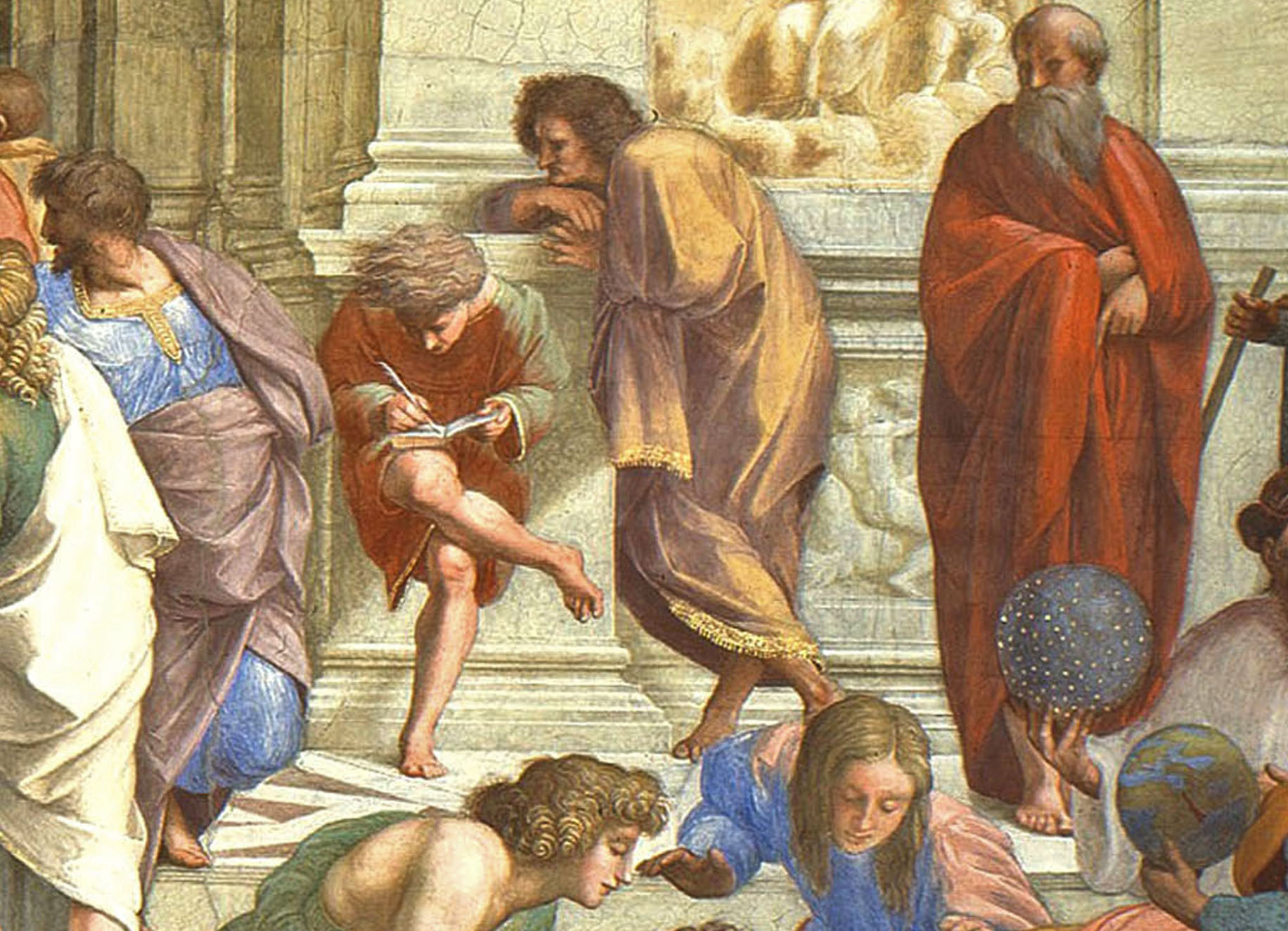
A rushing wind ruffles his hair.  But it does not disturb his concentration.  He stands leaning against the wall with his legs crossed to improve his balance.  He writes with his face bent over the notebook resting above his knee, holding the pen firmly to give the words and perhaps the drawings all the attention they deserve.

He is little more than a boy: a student, a young man in the court, an aspiring artist or scientist.  And he seems heedless of the world around him.  Yet what surrounds him is a solemn world:  philosophers, mathematicians and scientists; a convergence of knowledge; a metaphor for wisdom; with man at the centre.

This is ‘The School of Athens’, the great fresco painted by Raphael in the early 16th century in the Stanza della Segnatura, one of the four Vatican Rooms inside the Apostolic Palaces (the preparatory cartoon, as fascinating as the finest examples of creative processes, adorns one of the most important rooms in the Ambrosiana in Milan). It is a masterpiece of the Renaissance and a symbol of a world rooted in great classical culture, thus enabling it to offer a vision of a future rooted in beauty and reason. A ‘temple of Philosophy’, to quote an idea of Marsilio Ficino, a wise interpreter of Humanism.

In the centre, at the top of a wide staircase, are Aristotle and Plato, surrounded by disciples, both real and imagined, intent on discussing astronomy, geometry, celestial spaces and the whirlwind of ideas. Among those present are Zeno, Epicurus, Euclid and perhaps Archimedes,  as well as two contemporary figures of the time. Michelangelo, somewhat separated from the group, is pensive and distracted by the drawing he is sketching. He is solitary and shadowy, as he was in life, a master annoyed by his contemporaries and his own pupils. And Raphael, who, almost in profile and from above, takes pleasure in such a gathering of intellects (he himself is therefore a ‘master’ in that gathering). There is conflict between the artists, but they also represent different conceptions of life and art, between torment and the sublime.

And what about that nervous boy writing in the wind?  Nothing is known about him. Neither Vasari nor other critics and historians have ever posed the question of who he was or why a breath of wind crept through his hair.

However, things are ever-changing. That scribe boy, taken from Raphael’s fresco, now takes centre stage on the two covers, one in yellow-red and the other in blue-violet, of ‘Use Your Illusion’, the double album released by Guns N’ Roses in September 1991. Among other tracks (such as the famous ‘Don’t cry’ and ‘Live and let die’) the album features one of the most intense versions of ‘Knockin’ on Heaven’s Door’, the poignant song written by Bob Dylan in 1973 for the soundtrack of Sam Peckinpah’s Pat Garrett and Billy the Kid, an elegy to the death of Sheriff Baker — a good man and far from the stereotypical Western hero. Like so many of us, he was overwhelmed by history, knowing how to make good use of his illusions, and as the sun of life set, he knocked on the gates of Paradise, seeking peace — precisely the peace that our uncertain and controversial times do not seem to grant us.  Despite the humanistic promises of the wise domain of knowledge and the subsequent enlightenment hopes of the triumph of reason, that Raphael boy brought back to life by Guns N’ Roses speaks to us today, as then, of restlessness and a never-ending need for signs to translate and appease it: of paintings and wise words.

The interplay between Renaissance painting and contemporary stadium rock emerged from a conversation with Ugo Loeser, the astute banker CEO of Arca Fondi. The occasion was the presentation of Patrizia Fontana‘s insightful book, Dai forma al tuo talento (Embrace your talent) (Franco Angeli Editore), which discusses the challenges and aspirations of a new generation searching for fulfilment, both personal and professional.

A survey carried out by ‘Talent in Motion’ between January and February 2025 among 1,600 young adults (aged 20 to 30, 86% of whom had a university degree) showed that 80% of respondents were afraid of failure and of disappointing themselves and others. Almost all of them considered ‘success’ to be ‘important’ (85%), yet 75% were afraid of ‘making the wrong career choices’, and 78% confessed that they didn’t know which path to take in the current context of job uncertainty. Furthermore, 76% reported feeling anxious in the face of competition.

This generation is experiencing a dramatic crisis of confidence. They are in a constant state of acute concern about the disturbing interplay between general geopolitical and economic tensions, and a lack of confidence in their own abilities and the good use of their ‘talent’.

This level of uncertainty undermines the possibility of building a future, the sense of community and the very foundations of the market economy and liberal democracy, and it demands answers.

From this perspective, Patrizia Fontana’s use of the word ‘talent’ is reminiscent of the Gospel parable of the same name. In the parable, a master entrusts his wealth to his servants before going on a journey. He distributes different amounts to each servant based on their abilities. Upon his return, he assesses their stewardship, rewarding those who invested wisely and increased their talents, and rebuking the one who hid his out of fear. If that talent is not only understood in a narrow monetary sense, then the parable’s reference takes on an even broader cultural and ethical scope. It points to the personal and social qualities that can be employed to overcome fears and thus strengthen the common good and ‘public goods’.

How? As well as looking inward, it is necessary to learn to evaluate the contexts in which one’s choices will fit and the conditions in which one will be operating. Study history, geography, politics, economics, social situations, and changes in the scientific and technological landscape well. In times of such radical, rapid and sweeping changes to market structures and, more broadly, socio-economic balances, it is necessary to adopt a flexible and unprejudiced attitude in order to study and adapt to new developments. Skills are needed, of course. But above all, you need a robust and ambitious inclination towards knowledge, the basis of which is knowing how to ask questions. As good teachers suggest, one must ‘learn to learn’.

In short, we must contribute to the creation of new cognitive maps by following the clear path indicated by the leaders of corporate culture for some time now.  We must value a ‘polytechnic culture’ that links humanistic and scientific knowledge, the sense of beauty deeply rooted in Italian culture, and the inclination towards originality, resourcefulness, and innovation. We must also recognise the importance of historical awareness and the ability to think of ‘stories for the future’. However, when insisting on the ‘future of memory’, we must be mindful of Leonardo Sciascia’s warning in his collection of essays ‘To Future Memory (If Memory Has a Future…)’.

A lesson in ‘industrial humanism’, indeed. It is precisely the structure of these algorithms and the construction of these now widespread artificial intelligence mechanisms that tells us we need a multidisciplinary approach involving cyberscience, physics, mathematics, statistics, engineering, sociology, philosophy, psychology, economics and law to understand their meaning and value, and to govern their dynamics and consequences.

This is a critical culture, therefore, as a horizon of knowledge and as an ethical standpoint, and it is precisely with the new generations that we must insist on this. With the young people who continue to ask our parents’ and grandparents’ generations questions about meaning and value construction.

We have an obligation to try to provide answers that inspire confidence in the future. This is also to avoid falling into the trap of Narcissus, a negative myth and symbol of death (the character drowns in his fatal admiration of his reflection in the water), and nihilism — the complete opposite of the widespread need for creativity, community, and why not, competitiveness (which, let us remember, comes from the Latin ‘cum’ and ‘petere’, meaning ‘moving together towards a shared horizon’). We must also avoid becoming prey to real technological solitude, where one engages in dialogue with AI for feedback without realising that one is not facing ‘the gaze of the other’ with which to construct one’s own, albeit problematic, identity, but rather the manipulation of a deceptive mirror.

And so we return to the restlessness and redemptive writing of Raphael’s boy, a representation of each one of us and our honest and sincere attempts to shape our destiny, still letting the wind ruffle his hair and his ideas. Remembering Bob Dylan again, ‘Blowin’ in the Wind’, indeed.

(photo: Getty Images)
Raphael’s young scribe and the need for critical culture in the face of the myth of Narcissus

A rushing wind ruffles his hair.  But it does not disturb his concentration.  He stands leaning against the wall with his legs crossed to improve his balance.  He writes with his face bent over the notebook resting above his knee, holding the pen firmly to give the words and perhaps the drawings all the attention they deserve.

He is little more than a boy: a student, a young man in the court, an aspiring artist or scientist.  And he seems heedless of the world around him.  Yet what surrounds him is a solemn world:  philosophers, mathematicians and scientists; a convergence of knowledge; a metaphor for wisdom; with man at the centre.

This is ‘The School of Athens’, the great fresco painted by Raphael in the early 16th century in the Stanza della Segnatura, one of the four Vatican Rooms inside the Apostolic Palaces (the preparatory cartoon, as fascinating as the finest examples of creative processes, adorns one of the most important rooms in the Ambrosiana in Milan). It is a masterpiece of the Renaissance and a symbol of a world rooted in great classical culture, thus enabling it to offer a vision of a future rooted in beauty and reason. A ‘temple of Philosophy’, to quote an idea of Marsilio Ficino, a wise interpreter of Humanism.

In the centre, at the top of a wide staircase, are Aristotle and Plato, surrounded by disciples, both real and imagined, intent on discussing astronomy, geometry, celestial spaces and the whirlwind of ideas. Among those present are Zeno, Epicurus, Euclid and perhaps Archimedes,  as well as two contemporary figures of the time. Michelangelo, somewhat separated from the group, is pensive and distracted by the drawing he is sketching. He is solitary and shadowy, as he was in life, a master annoyed by his contemporaries and his own pupils. And Raphael, who, almost in profile and from above, takes pleasure in such a gathering of intellects (he himself is therefore a ‘master’ in that gathering). There is conflict between the artists, but they also represent different conceptions of life and art, between torment and the sublime.

And what about that nervous boy writing in the wind?  Nothing is known about him. Neither Vasari nor other critics and historians have ever posed the question of who he was or why a breath of wind crept through his hair.

However, things are ever-changing. That scribe boy, taken from Raphael’s fresco, now takes centre stage on the two covers, one in yellow-red and the other in blue-violet, of ‘Use Your Illusion’, the double album released by Guns N’ Roses in September 1991. Among other tracks (such as the famous ‘Don’t cry’ and ‘Live and let die’) the album features one of the most intense versions of ‘Knockin’ on Heaven’s Door’, the poignant song written by Bob Dylan in 1973 for the soundtrack of Sam Peckinpah’s Pat Garrett and Billy the Kid, an elegy to the death of Sheriff Baker — a good man and far from the stereotypical Western hero. Like so many of us, he was overwhelmed by history, knowing how to make good use of his illusions, and as the sun of life set, he knocked on the gates of Paradise, seeking peace — precisely the peace that our uncertain and controversial times do not seem to grant us.  Despite the humanistic promises of the wise domain of knowledge and the subsequent enlightenment hopes of the triumph of reason, that Raphael boy brought back to life by Guns N’ Roses speaks to us today, as then, of restlessness and a never-ending need for signs to translate and appease it: of paintings and wise words.

The interplay between Renaissance painting and contemporary stadium rock emerged from a conversation with Ugo Loeser, the astute banker CEO of Arca Fondi. The occasion was the presentation of Patrizia Fontana‘s insightful book, Dai forma al tuo talento (Embrace your talent) (Franco Angeli Editore), which discusses the challenges and aspirations of a new generation searching for fulfilment, both personal and professional.

A survey carried out by ‘Talent in Motion’ between January and February 2025 among 1,600 young adults (aged 20 to 30, 86% of whom had a university degree) showed that 80% of respondents were afraid of failure and of disappointing themselves and others. Almost all of them considered ‘success’ to be ‘important’ (85%), yet 75% were afraid of ‘making the wrong career choices’, and 78% confessed that they didn’t know which path to take in the current context of job uncertainty. Furthermore, 76% reported feeling anxious in the face of competition.

This generation is experiencing a dramatic crisis of confidence. They are in a constant state of acute concern about the disturbing interplay between general geopolitical and economic tensions, and a lack of confidence in their own abilities and the good use of their ‘talent’.

This level of uncertainty undermines the possibility of building a future, the sense of community and the very foundations of the market economy and liberal democracy, and it demands answers.

From this perspective, Patrizia Fontana’s use of the word ‘talent’ is reminiscent of the Gospel parable of the same name. In the parable, a master entrusts his wealth to his servants before going on a journey. He distributes different amounts to each servant based on their abilities. Upon his return, he assesses their stewardship, rewarding those who invested wisely and increased their talents, and rebuking the one who hid his out of fear. If that talent is not only understood in a narrow monetary sense, then the parable’s reference takes on an even broader cultural and ethical scope. It points to the personal and social qualities that can be employed to overcome fears and thus strengthen the common good and ‘public goods’.

How? As well as looking inward, it is necessary to learn to evaluate the contexts in which one’s choices will fit and the conditions in which one will be operating. Study history, geography, politics, economics, social situations, and changes in the scientific and technological landscape well. In times of such radical, rapid and sweeping changes to market structures and, more broadly, socio-economic balances, it is necessary to adopt a flexible and unprejudiced attitude in order to study and adapt to new developments. Skills are needed, of course. But above all, you need a robust and ambitious inclination towards knowledge, the basis of which is knowing how to ask questions. As good teachers suggest, one must ‘learn to learn’.

In short, we must contribute to the creation of new cognitive maps by following the clear path indicated by the leaders of corporate culture for some time now.  We must value a ‘polytechnic culture’ that links humanistic and scientific knowledge, the sense of beauty deeply rooted in Italian culture, and the inclination towards originality, resourcefulness, and innovation. We must also recognise the importance of historical awareness and the ability to think of ‘stories for the future’. However, when insisting on the ‘future of memory’, we must be mindful of Leonardo Sciascia’s warning in his collection of essays ‘To Future Memory (If Memory Has a Future…)’.

A lesson in ‘industrial humanism’, indeed. It is precisely the structure of these algorithms and the construction of these now widespread artificial intelligence mechanisms that tells us we need a multidisciplinary approach involving cyberscience, physics, mathematics, statistics, engineering, sociology, philosophy, psychology, economics and law to understand their meaning and value, and to govern their dynamics and consequences.

This is a critical culture, therefore, as a horizon of knowledge and as an ethical standpoint, and it is precisely with the new generations that we must insist on this. With the young people who continue to ask our parents’ and grandparents’ generations questions about meaning and value construction.

We have an obligation to try to provide answers that inspire confidence in the future. This is also to avoid falling into the trap of Narcissus, a negative myth and symbol of death (the character drowns in his fatal admiration of his reflection in the water), and nihilism — the complete opposite of the widespread need for creativity, community, and why not, competitiveness (which, let us remember, comes from the Latin ‘cum’ and ‘petere’, meaning ‘moving together towards a shared horizon’). We must also avoid becoming prey to real technological solitude, where one engages in dialogue with AI for feedback without realising that one is not facing ‘the gaze of the other’ with which to construct one’s own, albeit problematic, identity, but rather the manipulation of a deceptive mirror.

And so we return to the restlessness and redemptive writing of Raphael’s boy, a representation of each one of us and our honest and sincere attempts to shape our destiny, still letting the wind ruffle his hair and his ideas. Remembering Bob Dylan again, ‘Blowin’ in the Wind’, indeed.

(photo: Getty Images)

Brand, image and corporate content

Image and content are fundamental factors in the relationship between brand and production organisation.

Above all, a brand’s image should inspire confidence and provide reassurance. The relationships between brands and business success are often very close and complex. They also highlight a specific element of the production culture, which is communicated directly to the consumer. Roberto De Luca’s book ‘Brand e sostenibilità. Il ruolo degli intangibles nelle determinazioni quantitative d’azienda (Brand and Sustainability. The role of intangibles in quantitative business determinations) just published in open access, takes a closer look at these relationships.

The book begins with the observation that an increasing number of companies recognise that, in today’s competitive environment, the brand associated with their products or services is one of their key strengths. It is also a matter of choices and the time available to make them (something that applies to both individuals and organisations). In other words, when faced with complexity, one increasingly seeks simplicity.  Including in our choices. This is why brands that simplify consumer and business decisions, reduce perceived risk and define expectations are so valuable.

The book aims to explore the main issues of how to measure the financial value of brands and their influence from a business economics perspective. It achieves this by analysing a wide range of literature on the subject, particularly with regard to the evolution of brands, brand equity and its role over the years, problems associated with brand valuation, and the most commonly used valuation techniques. It also considers the influence of brands and how investments can be used to build them within markets.

De Luca’s book is a toolbox of sorts, providing a collection of research literature results that allow for a more conscious and shrewd approach to corporate branding.

Brand e sostenibilità. Il ruolo degli intangibles nelle determinazioni quantitative d’azienda

Roberto De Luca

Economics Research, Department of Business Sciences – Management and Information Systems of the University of Salerno, Franco Angeli open access, 2025

Brand, image and corporate content

Image and content are fundamental factors in the relationship between brand and production organisation.

Above all, a brand’s image should inspire confidence and provide reassurance. The relationships between brands and business success are often very close and complex. They also highlight a specific element of the production culture, which is communicated directly to the consumer. Roberto De Luca’s book ‘Brand e sostenibilità. Il ruolo degli intangibles nelle determinazioni quantitative d’azienda (Brand and Sustainability. The role of intangibles in quantitative business determinations) just published in open access, takes a closer look at these relationships.

The book begins with the observation that an increasing number of companies recognise that, in today’s competitive environment, the brand associated with their products or services is one of their key strengths. It is also a matter of choices and the time available to make them (something that applies to both individuals and organisations). In other words, when faced with complexity, one increasingly seeks simplicity.  Including in our choices. This is why brands that simplify consumer and business decisions, reduce perceived risk and define expectations are so valuable.

The book aims to explore the main issues of how to measure the financial value of brands and their influence from a business economics perspective. It achieves this by analysing a wide range of literature on the subject, particularly with regard to the evolution of brands, brand equity and its role over the years, problems associated with brand valuation, and the most commonly used valuation techniques. It also considers the influence of brands and how investments can be used to build them within markets.

De Luca’s book is a toolbox of sorts, providing a collection of research literature results that allow for a more conscious and shrewd approach to corporate branding.

Brand e sostenibilità. Il ruolo degli intangibles nelle determinazioni quantitative d’azienda

Roberto De Luca

Economics Research, Department of Business Sciences – Management and Information Systems of the University of Salerno, Franco Angeli open access, 2025

What is driving the digital transition?

A study by the Bank of Italy provides an analysis of the reasons behind the adoption of cloud computing and artificial intelligence (AI) by Italian companies

New technologies present a challenge to companies that need to adopt them.  It is an important challenge that could determine the future of many manufacturing organisations. Therefore, it is extremely important to understand the conditions that enable companies to adopt innovative technology. This is particularly true of advanced digital technologies, which are transforming the organisation and performance of enterprises. As yet, however, there has been little comprehensive research into the adoption of these technologies. To gain a real understanding, careful and analytical studies are needed. ‘Embracing the digital transition: the adoption of cloud computing and AI by Italian firms’ goes some way towards addressing this. The research, carried out within the Bank of Italy and based on data from the Institute’s corporate surveys, evaluates the uptake of cloud computing and artificial intelligence (AI) among Italian companies.

The key numbers that emerge from the research are clear. By early 2024, over 50% of companies employing at least 20 people had adopted cloud services, with little variation across industries. This suggests that cloud technology is becoming standard infrastructure. In contrast, AI adoption remains more limited, rising from 4% in 2020 to 13% in 2024, and is still often an experimental step within enterprises or adopted for specific activities. So what drives adoption or pushes a company away from AI? According to the research, the adoption of AI is strongly related to company size, export activity and innovation capacity,  while managerial quality and prior digital investments also influence uptake. It appears to be a question of management and technical culture. However, the Bank of Italy’s research goes further, also investigating expectations regarding generative AI. It is noted that these expectations point to the transformation of labour rather than its displacement. According to the researchers, the analysis reveals that the adoption of digital technology has a positive correlation with achieved and expected employment growth.

Embracing the digital transition: the adoption of cloud computing and AI by Italian firms

Lorenzo Bencivelli, Sara Formai, Elena Mattevi, Tullia Padellini

Bank of Italy, Occasional Papers (Questioni di economia e finanza), No. 946 – June 2025

What is driving the digital transition?

A study by the Bank of Italy provides an analysis of the reasons behind the adoption of cloud computing and artificial intelligence (AI) by Italian companies

New technologies present a challenge to companies that need to adopt them.  It is an important challenge that could determine the future of many manufacturing organisations. Therefore, it is extremely important to understand the conditions that enable companies to adopt innovative technology. This is particularly true of advanced digital technologies, which are transforming the organisation and performance of enterprises. As yet, however, there has been little comprehensive research into the adoption of these technologies. To gain a real understanding, careful and analytical studies are needed. ‘Embracing the digital transition: the adoption of cloud computing and AI by Italian firms’ goes some way towards addressing this. The research, carried out within the Bank of Italy and based on data from the Institute’s corporate surveys, evaluates the uptake of cloud computing and artificial intelligence (AI) among Italian companies.

The key numbers that emerge from the research are clear. By early 2024, over 50% of companies employing at least 20 people had adopted cloud services, with little variation across industries. This suggests that cloud technology is becoming standard infrastructure. In contrast, AI adoption remains more limited, rising from 4% in 2020 to 13% in 2024, and is still often an experimental step within enterprises or adopted for specific activities. So what drives adoption or pushes a company away from AI? According to the research, the adoption of AI is strongly related to company size, export activity and innovation capacity,  while managerial quality and prior digital investments also influence uptake. It appears to be a question of management and technical culture. However, the Bank of Italy’s research goes further, also investigating expectations regarding generative AI. It is noted that these expectations point to the transformation of labour rather than its displacement. According to the researchers, the analysis reveals that the adoption of digital technology has a positive correlation with achieved and expected employment growth.

Embracing the digital transition: the adoption of cloud computing and AI by Italian firms

Lorenzo Bencivelli, Sara Formai, Elena Mattevi, Tullia Padellini

Bank of Italy, Occasional Papers (Questioni di economia e finanza), No. 946 – June 2025

Skilled labour, higher wages and innovation: the solutions to prevent our young people from taking flight

Italy is ageing. We are having fewer and fewer children. And year by year, increasingly more of our young are leaving, especially those with high qualifications and a drive to succeed. This impoverishes the country: fewer young people means less work, fewer companies, less gross domestic product and lower productivity, as well as less passion for innovation, less social cohesion and a more fragile civic spirit linked to community values. Does this mean Italy is in decline? Not yet. But the risks are high.

These are the considerations that spring to mind when reading recent economic and demographic data which confirms long-known trends that, at times, are becoming increasingly alarming. Unfortunately, despite the progress that has been made, this issue still does not form a central part of public and political discourse, except in terms of rhetoric about caring for future generations.
What does the data say? ISTAT has confirmed that a quarter of the Italian population (58,934,000 as of 1 January 2025) is over 65 years old, with 4,591,000 people being over 80 years old (an increase of 50,000 since 2024). Life expectancy at birth is now 81.4 years for men and 85.5 years for women, which is almost five months longer than in 2023. Births continue to decline, with only 370,000 new births in 2024 and the fertility rate falling to 1.18 children per woman — one of the lowest rates in Europe.

Another very concerning statistic is that 97,000 young graduates have left the country in search of better job and life opportunities in the last ten years. And this average figure tends to worsen over time. In 2023 alone, there were 21,000 (21% more than the previous year). Almost one hundred thousand graduates have disappeared from our labour market. They were educated in our schools and gained sophisticated, in-depth knowledge at our universities, several of which are now among the best in the world. The Milan Polytechnic has just entered the top 100. Now, these talented young people are working for other countries, production systems and societies. This is a waste, which is even more serious at a time when the main competitive advantage is precisely the ‘knowledge economy’. Italy is not meeting the need for skilled labour in companies, public administration or services (health, for example) with only 20.7 per cent of graduates compared to an EU average of 32 per cent.

ISTAT also documents that, in the two-year period 2023–2024, the number of Italian citizens who emigrated (270,000) increased by 39.3% (this refers to the number of people who change their registered address, which is much lower than the number of people who leave the country while remaining formally registered with their local registry office). These can be temporary or long-term choices, however few return. Between 2019 and 2023, 192,000 Italians aged 25–34 expatriated, and 73,000 returned. Almost 120,000 remained abroad.
Where? Firstly, the UK, followed by Germany, Switzerland, France and Spain (ISTAT data). ‘We have not invested in their training, active policies, research or developing human capital within companies. We are not enabling young people to feel like an active part of a society that grows and improves with them. Other countries, on the other hand, are more attractive,’ summarises Alessandro Rosina, Professor of Demography and Statistics at the Catholic University of Milan (La Stampa, 18 June).
To better understand why so many young people leave, one need only look at the salaries on offer. The latest report by Almalaurea, the consortium uniting 82 Italian universities, documents the fact that the average salary in Italy is very low. According to Il Sole24Ore (17 June), graduates earn 54 per cent more abroad than in Italy one year after graduation, and 62 per cent more five years after graduation.

Yet despite being poorly paid, our graduates excel, including in the world of research. This is confirmed by the latest figures on ERC Advanced Grants, European funding for senior researchers: Italy is third in Europe after the UK and Germany, having just overtaken France and the Netherlands. And if you look at the researchers’ passports, Italy comes second behind Germany. The problem for Italy is that many of the Italians awarded ERC funding work abroad permanently. This year, out of 37 awardees, 23 work in Italy and 14 abroad (Corriere della Sera, 18 June). In 2023, the situation was even worse: 22 awardees worked abroad and only 12 in Italy. Interestingly, there is a trend towards improving the quality and opportunities offered by Italian centres, but only time will tell how far this trend can be consolidated.

The key point here is that, in order to keep our graduates in Italy and attract international talent, we need to invest much more in research (well over the current 1.4 per cent of GDP — a very low figure compared to the EU average of over 2 per cent) and in quality training, as well as in salaries and career opportunities to build better conditions for professional and personal development and fulfilment.

The choices to be made call into question public expenditure, including that of the NRP. According to the principles of Next Generation EU, the NRP should have prioritised the various opportunities of the ‘knowledge economy’ to stimulate and support environmental and digital transitions. However, current expenditure only partially aligns with these original objectives. These changes must also affect businesses: entry salaries are low, particularly in small and medium-sized companies which are still strongly family-dominated in management. The opportunities for young graduates in these companies are still very limited. ‘Does the country think about young people?’ asks the economist Francesco Giavazzi pointedly (Corriere della Sera, 19 June), drawing on his experience working in the government at Palazzo Chigi during Mario Draghi’s time as president of the council. Italy is becoming a country where the elderly prevail and leave less and less space, including social and cultural space, for the new generations, who emigrate. This burdens the climate and habits of the ‘country for old men’, with its fears and suspicion of change, creating a vicious circle.

More and better targeted public and private investment is therefore needed to drive innovation. Choices must be made that reward knowledge, skills, enterprise, and international culture. This is the opposite of the tendencies towards conservation and resistance to modernisation. The spread of ‘poor work’ is typical of a widespread political tendency to neglect industry, high-tech services and industrial policy that stimulates the most productive and innovative sectors. In short, Patrizio Bianchi, an economist, former university rector in Ferrara and former councillor for labour in the Emilia Region, argues that ‘a European policy is needed for universities, jobs and salaries.’ As Rosina says, ‘Guaranteeing our young people conditions equal to those they find in other European countries is a crucial challenge for Italy’s growth and development.’ A challenge for good politics indeed, and a truly open view of the future.

Skilled labour, higher wages and innovation:  the solutions to prevent our young people from taking flight

Italy is ageing. We are having fewer and fewer children. And year by year, increasingly more of our young are leaving, especially those with high qualifications and a drive to succeed. This impoverishes the country: fewer young people means less work, fewer companies, less gross domestic product and lower productivity, as well as less passion for innovation, less social cohesion and a more fragile civic spirit linked to community values. Does this mean Italy is in decline? Not yet. But the risks are high.

These are the considerations that spring to mind when reading recent economic and demographic data which confirms long-known trends that, at times, are becoming increasingly alarming. Unfortunately, despite the progress that has been made, this issue still does not form a central part of public and political discourse, except in terms of rhetoric about caring for future generations.
What does the data say? ISTAT has confirmed that a quarter of the Italian population (58,934,000 as of 1 January 2025) is over 65 years old, with 4,591,000 people being over 80 years old (an increase of 50,000 since 2024). Life expectancy at birth is now 81.4 years for men and 85.5 years for women, which is almost five months longer than in 2023. Births continue to decline, with only 370,000 new births in 2024 and the fertility rate falling to 1.18 children per woman — one of the lowest rates in Europe.

Another very concerning statistic is that 97,000 young graduates have left the country in search of better job and life opportunities in the last ten years. And this average figure tends to worsen over time. In 2023 alone, there were 21,000 (21% more than the previous year). Almost one hundred thousand graduates have disappeared from our labour market. They were educated in our schools and gained sophisticated, in-depth knowledge at our universities, several of which are now among the best in the world. The Milan Polytechnic has just entered the top 100. Now, these talented young people are working for other countries, production systems and societies. This is a waste, which is even more serious at a time when the main competitive advantage is precisely the ‘knowledge economy’. Italy is not meeting the need for skilled labour in companies, public administration or services (health, for example) with only 20.7 per cent of graduates compared to an EU average of 32 per cent.

ISTAT also documents that, in the two-year period 2023–2024, the number of Italian citizens who emigrated (270,000) increased by 39.3% (this refers to the number of people who change their registered address, which is much lower than the number of people who leave the country while remaining formally registered with their local registry office). These can be temporary or long-term choices, however few return. Between 2019 and 2023, 192,000 Italians aged 25–34 expatriated, and 73,000 returned. Almost 120,000 remained abroad.
Where? Firstly, the UK, followed by Germany, Switzerland, France and Spain (ISTAT data). ‘We have not invested in their training, active policies, research or developing human capital within companies. We are not enabling young people to feel like an active part of a society that grows and improves with them. Other countries, on the other hand, are more attractive,’ summarises Alessandro Rosina, Professor of Demography and Statistics at the Catholic University of Milan (La Stampa, 18 June).
To better understand why so many young people leave, one need only look at the salaries on offer. The latest report by Almalaurea, the consortium uniting 82 Italian universities, documents the fact that the average salary in Italy is very low. According to Il Sole24Ore (17 June), graduates earn 54 per cent more abroad than in Italy one year after graduation, and 62 per cent more five years after graduation.

Yet despite being poorly paid, our graduates excel, including in the world of research. This is confirmed by the latest figures on ERC Advanced Grants, European funding for senior researchers: Italy is third in Europe after the UK and Germany, having just overtaken France and the Netherlands. And if you look at the researchers’ passports, Italy comes second behind Germany. The problem for Italy is that many of the Italians awarded ERC funding work abroad permanently. This year, out of 37 awardees, 23 work in Italy and 14 abroad (Corriere della Sera, 18 June). In 2023, the situation was even worse: 22 awardees worked abroad and only 12 in Italy. Interestingly, there is a trend towards improving the quality and opportunities offered by Italian centres, but only time will tell how far this trend can be consolidated.

The key point here is that, in order to keep our graduates in Italy and attract international talent, we need to invest much more in research (well over the current 1.4 per cent of GDP — a very low figure compared to the EU average of over 2 per cent) and in quality training, as well as in salaries and career opportunities to build better conditions for professional and personal development and fulfilment.

The choices to be made call into question public expenditure, including that of the NRP. According to the principles of Next Generation EU, the NRP should have prioritised the various opportunities of the ‘knowledge economy’ to stimulate and support environmental and digital transitions. However, current expenditure only partially aligns with these original objectives. These changes must also affect businesses: entry salaries are low, particularly in small and medium-sized companies which are still strongly family-dominated in management. The opportunities for young graduates in these companies are still very limited. ‘Does the country think about young people?’ asks the economist Francesco Giavazzi pointedly (Corriere della Sera, 19 June), drawing on his experience working in the government at Palazzo Chigi during Mario Draghi’s time as president of the council. Italy is becoming a country where the elderly prevail and leave less and less space, including social and cultural space, for the new generations, who emigrate. This burdens the climate and habits of the ‘country for old men’, with its fears and suspicion of change, creating a vicious circle.

More and better targeted public and private investment is therefore needed to drive innovation. Choices must be made that reward knowledge, skills, enterprise, and international culture. This is the opposite of the tendencies towards conservation and resistance to modernisation. The spread of ‘poor work’ is typical of a widespread political tendency to neglect industry, high-tech services and industrial policy that stimulates the most productive and innovative sectors. In short, Patrizio Bianchi, an economist, former university rector in Ferrara and former councillor for labour in the Emilia Region, argues that ‘a European policy is needed for universities, jobs and salaries.’ As Rosina says, ‘Guaranteeing our young people conditions equal to those they find in other European countries is a crucial challenge for Italy’s growth and development.’ A challenge for good politics indeed, and a truly open view of the future.

From the traditional economy to the green economy

Doctoral research aims to verify the theory by looking at two regional case studies

The term ‘ecological transition’ is increasingly common.  This is because the transition from the current rather generalised state of production to one that is more attentive to environmental aspects is a path that all companies must take, albeit in different ways and forms. Understanding their social and economic impacts is certainly beneficial, particularly with regard to gender policies. This is precisely what Elisa Errico set out to achieve in her doctoral thesis, ‘Le PMI alla prova della green economy: impatti sociali e inclusione di genere’ (SMEs testing the green economy: social impact and gender inclusion).

In the opening pages of the research, Errico herself explains that the work aims to

explore ‘the ecological transition of Italian small and medium-sized enterprises (SMEs), with a specific focus on the distributional, social, and gender impacts generated by these processes of change’.

The work therefore adopts the literature on regional and sectoral innovation systems and local development as theoretical references, relating them to the international literature on the governance of transitions and the relationship between capitalist systems and the impact on inequalities. The research has four main objectives. To analyse whether the ecological transition of SMEs represents a different innovation process to that of more structured companies, and if so, why. To consider how particular contextual factors that govern the ecological transition influence the capacity of SMEs to absorb eco-innovations.  To evaluate if and how different governance models have different distributional impacts. Finally, to provide useful suggestions for future research and policies to help public decision makers and sector operators improve and make transition processes more inclusive. Errico combines theoretical reasoning and field analysis in two case studies: the Bergamo Rubber Valley and the Turin rubber district.

Elisa Errico’s research is an important step towards understanding the spread of the so-called green economy in Italy.

Le PMI alla prova della green economy: impatti sociali e inclusione di genere

Elisa Errico

Doctoral thesis in Sociology, XXXVII cycle, Doctoral School of Social and Economic Sciences

Sapienza University of Rome, 2025

From the traditional economy to the green economy

Doctoral research aims to verify the theory by looking at two regional case studies

The term ‘ecological transition’ is increasingly common.  This is because the transition from the current rather generalised state of production to one that is more attentive to environmental aspects is a path that all companies must take, albeit in different ways and forms. Understanding their social and economic impacts is certainly beneficial, particularly with regard to gender policies. This is precisely what Elisa Errico set out to achieve in her doctoral thesis, ‘Le PMI alla prova della green economy: impatti sociali e inclusione di genere’ (SMEs testing the green economy: social impact and gender inclusion).

In the opening pages of the research, Errico herself explains that the work aims to

explore ‘the ecological transition of Italian small and medium-sized enterprises (SMEs), with a specific focus on the distributional, social, and gender impacts generated by these processes of change’.

The work therefore adopts the literature on regional and sectoral innovation systems and local development as theoretical references, relating them to the international literature on the governance of transitions and the relationship between capitalist systems and the impact on inequalities. The research has four main objectives. To analyse whether the ecological transition of SMEs represents a different innovation process to that of more structured companies, and if so, why. To consider how particular contextual factors that govern the ecological transition influence the capacity of SMEs to absorb eco-innovations.  To evaluate if and how different governance models have different distributional impacts. Finally, to provide useful suggestions for future research and policies to help public decision makers and sector operators improve and make transition processes more inclusive. Errico combines theoretical reasoning and field analysis in two case studies: the Bergamo Rubber Valley and the Turin rubber district.

Elisa Errico’s research is an important step towards understanding the spread of the so-called green economy in Italy.

Le PMI alla prova della green economy: impatti sociali e inclusione di genere

Elisa Errico

Doctoral thesis in Sociology, XXXVII cycle, Doctoral School of Social and Economic Sciences

Sapienza University of Rome, 2025

Doing (good) business in a complex and multifaceted context

The role and function of geopolitics in corporate management

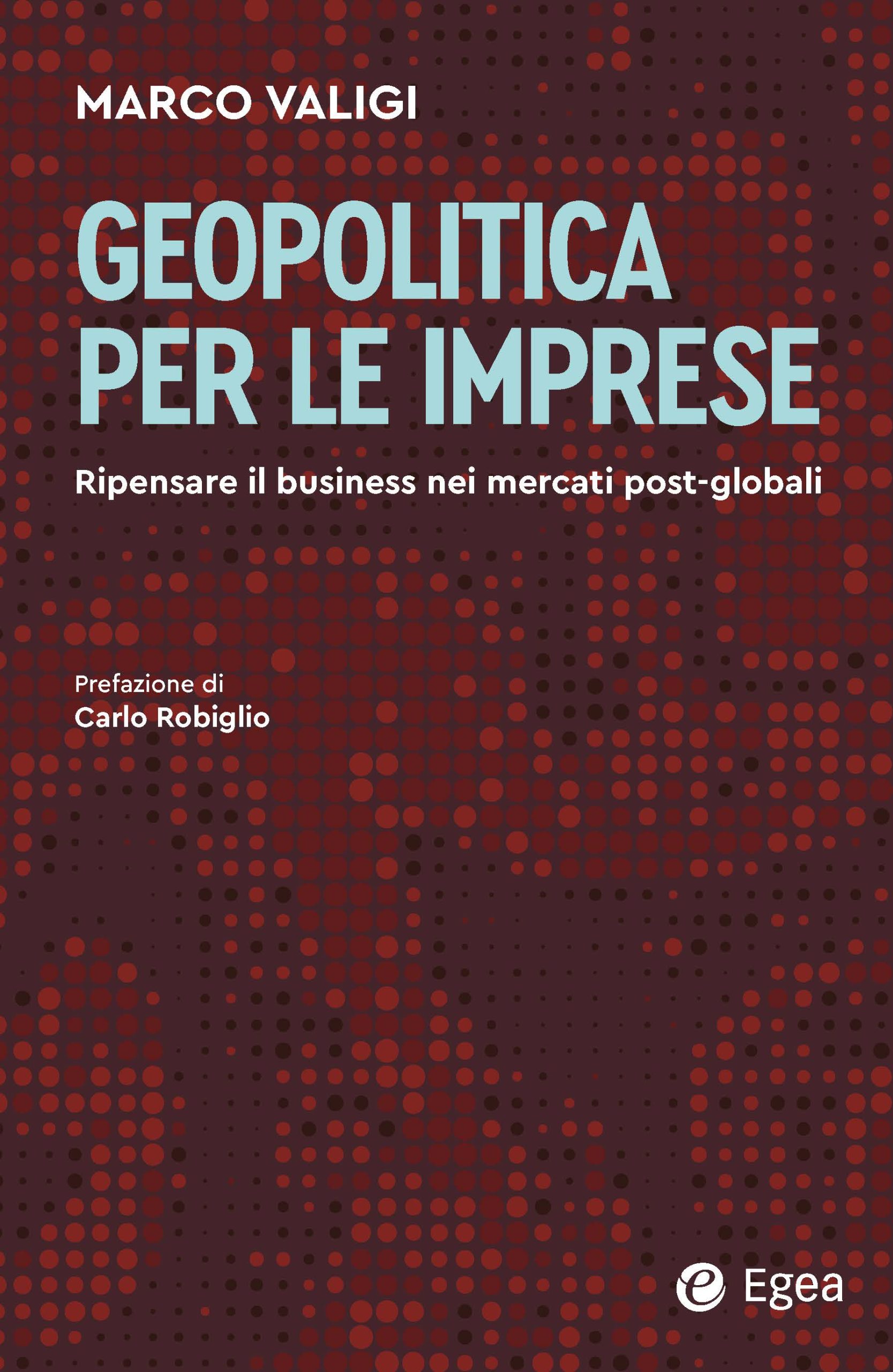
The landscape —  and, above all, the system of relations — within which companies must operate today can be defined as complex and multifaceted. It is a context that is new in many respects and must first be understood before it can be approached with great care. Although readings on the issue may not provide an instruction manual, they can offer a way of interpreting reality that can inform the best choices. This is why ‘Geopolitica per le imprese.  Ripensare il business nei mercati post-globali’ (Geopolitics for business. Rethinking business in post-global markets) written by Marco Valigi, a political scientist and lecturer at ESCP Business School and the University Cattolica, is a useful read.

The book opens with the following observation: since 2020, a series of events that have been incorrectly labelled ‘geopolitical’ have had a significant impact on individuals, societies, and economic activities. Faced with a globalisation that has become patchy, with interconnectedness and divisions coexisting and fuelling increasingly identity- and, in many cases, military-based trade conflicts, ‘business’ has become much more complicated than in the past. As mentioned at the beginning, this is an activity that has to take place in a complex and multifaceted landscape.

Entrepreneurs and managers must respond to this challenge, often without the necessary knowledge. In other words, there is an increasing demand for individuals who can perceive and interpret signals beyond the scope of companies, as well as for leadership training and greater sensitivity among those involved.

This is where Valigi’s book comes in useful, as it seeks to shed light on the link between business and geopolitics, and thus demonstrate the usefulness of taking the latter into account in business activities. The book begins with a definition of geopolitics and then moves on to consider the international context as a potential source of value generation, before examining this subject in the context of production organisations. It then goes on to consider some specific elements of the relationships that need to be established,  such as the training of people, sensitivity to risk, company size and the ability to ‘look beyond the company’.

In the last few pages of his book, the author concludes that, ‘Taking a geopolitical approach to thinking about one’s business (…) and designing an organisation structured in a way that is adequate to operate in today’s internationalised context will require one to go in search of the financial resources to build it, the specialist know-how needed to make it work, and, finally, the human capital suitable to govern it’.

Geopolitica per le imprese. Ripensare il business nei mercati post-globali

Marco Valigi

Egea, 2025

Doing (good) business in a complex and multifaceted context

The role and function of geopolitics in corporate management

The landscape —  and, above all, the system of relations — within which companies must operate today can be defined as complex and multifaceted. It is a context that is new in many respects and must first be understood before it can be approached with great care. Although readings on the issue may not provide an instruction manual, they can offer a way of interpreting reality that can inform the best choices. This is why ‘Geopolitica per le imprese.  Ripensare il business nei mercati post-globali’ (Geopolitics for business. Rethinking business in post-global markets) written by Marco Valigi, a political scientist and lecturer at ESCP Business School and the University Cattolica, is a useful read.

The book opens with the following observation: since 2020, a series of events that have been incorrectly labelled ‘geopolitical’ have had a significant impact on individuals, societies, and economic activities. Faced with a globalisation that has become patchy, with interconnectedness and divisions coexisting and fuelling increasingly identity- and, in many cases, military-based trade conflicts, ‘business’ has become much more complicated than in the past. As mentioned at the beginning, this is an activity that has to take place in a complex and multifaceted landscape.

Entrepreneurs and managers must respond to this challenge, often without the necessary knowledge. In other words, there is an increasing demand for individuals who can perceive and interpret signals beyond the scope of companies, as well as for leadership training and greater sensitivity among those involved.

This is where Valigi’s book comes in useful, as it seeks to shed light on the link between business and geopolitics, and thus demonstrate the usefulness of taking the latter into account in business activities. The book begins with a definition of geopolitics and then moves on to consider the international context as a potential source of value generation, before examining this subject in the context of production organisations. It then goes on to consider some specific elements of the relationships that need to be established,  such as the training of people, sensitivity to risk, company size and the ability to ‘look beyond the company’.

In the last few pages of his book, the author concludes that, ‘Taking a geopolitical approach to thinking about one’s business (…) and designing an organisation structured in a way that is adequate to operate in today’s internationalised context will require one to go in search of the financial resources to build it, the specialist know-how needed to make it work, and, finally, the human capital suitable to govern it’.

Geopolitica per le imprese. Ripensare il business nei mercati post-globali

Marco Valigi

Egea, 2025

Milan thrives on market and innovation but it also needs good policy

‘In a city, it is not the seven or seventy-seven wonders that you enjoy, but the answers it provides to your questions,’ wrote Italo Calvino in The Invisible Cities, considered ‘a final love poem to cities at a time when experiencing them is becoming increasingly difficult’. This was in 1972, at the start of a challenging and contentious period marked by terrorist and criminal violence (the ‘years of lead’), as well as political and social tensions, aspirations, and reforms, including the introduction of the Workers’ Statute, the establishment of the National Health Service, and the passage of laws on divorce and abortion, alongside the abolition of mental asylums, among other developments.

After the economic boom of the Roaring Sixties, Italy was trying to come to terms with a modernity full of shadows and contrast. Consumption and customs were changing, but many national vices remained, starting with the widespread lack of civic sense. Cities were the greatest focal point and the most obvious symbol of this struggle. “Hard to live in”, in fact. It is indispensable, if anything, over time, ‘to look for and recognise who and what, in the middle of hell, is not hell, and to make it last, and give it space.’.

In these days when we are once again reflecting on current events and the future of Milan, Calvino’s wise and poignant words come to mind. Like any true poet, he reminds us to balance our satisfaction at the positive news (such as the preparations for the 2026 Milan-Cortina Olympics, the completion of the Torre Velasca restoration project, the launch of the City Council’s housing plan for 10,000 affordable homes, and the San Cristoforo and Scalo Farini real estate projects— to name just a few) with our concerns over unresolved issues. The aim is to understand how to cope with the ‘Urgencies of Milan’, the theme of the latest meeting of the Centro Studi Grande Milano. Chaired by Daniela Mainini, the meeting was attended by a wide range of scholars and key figures from the worlds of economics, culture and society. It took place in a hall at the Triennale, next to the spaces where the large international exhibition on ‘Shapes of Inequalities’ is being set up.

The point is this: Milan must finally try to answer the Calvinian question. How can it reproduce its historic capacity to be productive and supportive, competitive and socially inclusive? In short, how can it build wealth and social cohesion? This is important because the economic, cultural, geopolitical, generational and cognitive gaps — the ‘inequalities’ of the exhibition at the Triennale — are growing and becoming increasingly intolerable. Strategic choices are therefore needed to avoid fractures that undermine the relationship between democracy, the market economy and welfare, and alter the balance between freedom, resourcefulness and well-being, even here in Italy and in other Western societies. In short, to be able to continue to be ‘free and equal’, even in our uncertain and lacerating times, using the terms of the ‘Manifesto for a Just Society’ written by Daniel Chandler, an economist and philosopher at the London School of Economics (the book just published by Laterza has been described by Amartya Sen, Nobel Prize winner for economics, as ‘a lucid and important essay’).

What is the answer? It is not the nostalgia of the past or the melancholic amusement of being ‘with one’s heart in one’s hand’. Nor is it the arrogance of success, or the boast of always working and producing, despite everything. It is not the exasperation of the fear of insecurity — violent crime and robberies have decreased, yet there are still those who remember the seventies, when terrorism and massacres dominated the city, as did shootings between criminal gangs such as those of Turatello, Vallanzasca and Epaminonda. Nor is it the indifference to social hardship in the suburbs, nor the just concern for microcrime and scams against the elderly.

Milan is a city of contradictions because it ‘contains multitudes’. To face these contradictions, it needs intelligent planning and a strong cultural, economic, political and administrative foundation. For example, we should heed the words of Lewis Mumford, one of the greatest sociologists of the 20th century, who distinguished between the ‘utopia of flight’ (building castles in the sky while leaving the world as it is) and the ‘utopia of reconstruction’, which involves positive thinking in order to imagine and find the tools and methods needed to create the future.

Let’s return to the Torre Velasca. A symbol of Milan’s dynamic and innovative Fifties and Sixties, it was not initially popular with many Milanese, who called it ‘the skyscraper with suspenders’. After years of restoration, it has returned to the top of the luxury rankings. Owned by Hines American, it has 26 floors of offices and apartments. It opens onto a well-kept pedestrian area in front of the Assolombarda palace, which was designed by Gio Ponti and has recently been renovated. It is also well connected to the solemn Renaissance building of the Ca’ Granda on Via Festa del Perdono, which is home to the State University. It is therefore located in a unique urban space: the Milan of history and innovation, of great architecture and enterprise, of visible prosperity and of the most sophisticated knowledge economy.

But Milan is also much more. It is both the flashy ‘thousand lights’ of the new international elite, attracted by post-Expo Milan’s reputation as the place to be, and the fashionable events. And the housing hardship of tens of thousands of middle-class people who are unable to cope with the boom in real estate values. This is a disparity that needs to be addressed through political choices and good administration.
Milan is, in fact, a metropolis with a strong corporate and market culture, and it can only continue to be so. However, it must not be left to market dynamics alone; otherwise, it will deteriorate into a ‘city of the rich’ that pushes out young people, scholars, novice entrepreneurs, researchers, tram drivers, company and bank employees, high school professors and traders who are unfamiliar with luxury but who are indispensable to daily life.
In short, it risks continuing to lose citizens who are attentive to the positive dynamics of daily life, and who follow the fashions and rhythms of city users. Losing its very soul and its complex ‘social capital’, which is strong in diversity of backgrounds, characters and aspirations, as well as in a solid sense of belonging.

So it is good news that the Municipality, led by Mayor Beppe Sala, has announced a housing plan for 10 thousand low-cost homes over the next ten years. The first 24 offers for the areas to be developed have already been received (Il Sole24Ore, 29 May). In the real estate world, alongside the large international funds, new players in the affordable housing sector are emerging.
Discussions are ongoing on the urgent issues for the city’s relaunch, considering it is a large metropolitan area and its interconnectedness with other metropolises (Turin, Bologna) and medium and medium-sized cities (Brescia, Bergamo, Verona, Pavia, etc.). Milan has the ability to be critical and self-critical and to recover in the face of crises, such as after the end of the boom, the years of lead and the storm of Tangentopoli, and the end of the ‘moral capital’ myth. It can also count on its available resources: its continued appeal to people, ideas and capital; the spread of the ‘knowledge economy’, thanks to its growing prestigious universities; and widespread resourcefulness in relations between cities and their industrial areas. Not to mention the solidity of its civil virtues, which are both ancient and contemporary.

It is crucial that political forces address these issues responsibly in view of the upcoming mayoral elections in 2027. Rather than discussing potential candidates or power games between parties and factions, it is crucial to address real issues, such as balanced development, security, relations with Europe, the impact on national life, quality of life, the increasing ageing and loneliness of citizens (28% of Milan’s population is over 60, compared to a national average of 21%, and 56.7% of Milanese households consist of one person), new poverty, and the legitimate concerns of the younger generations, who continue to view Milan with interest and hope.

So, once again, we return to Calvino and the qualities a city needs: combining security and the pursuit of happiness, growth and sustainability, individual needs and general values, and pragmatism with a long-term vision. Thanks to the effective leadership of its mayors in the recent past, Milan has succeeded in being a virtuous mixture of reformism, political wisdom and administrative skills. It is worth revisiting and repeating this lesson.

(photo Getty Images)

Milan thrives on market and innovation but it also needs good policy

‘In a city, it is not the seven or seventy-seven wonders that you enjoy, but the answers it provides to your questions,’ wrote Italo Calvino in The Invisible Cities, considered ‘a final love poem to cities at a time when experiencing them is becoming increasingly difficult’. This was in 1972, at the start of a challenging and contentious period marked by terrorist and criminal violence (the ‘years of lead’), as well as political and social tensions, aspirations, and reforms, including the introduction of the Workers’ Statute, the establishment of the National Health Service, and the passage of laws on divorce and abortion, alongside the abolition of mental asylums, among other developments.

After the economic boom of the Roaring Sixties, Italy was trying to come to terms with a modernity full of shadows and contrast. Consumption and customs were changing, but many national vices remained, starting with the widespread lack of civic sense. Cities were the greatest focal point and the most obvious symbol of this struggle. “Hard to live in”, in fact. It is indispensable, if anything, over time, ‘to look for and recognise who and what, in the middle of hell, is not hell, and to make it last, and give it space.’.

In these days when we are once again reflecting on current events and the future of Milan, Calvino’s wise and poignant words come to mind. Like any true poet, he reminds us to balance our satisfaction at the positive news (such as the preparations for the 2026 Milan-Cortina Olympics, the completion of the Torre Velasca restoration project, the launch of the City Council’s housing plan for 10,000 affordable homes, and the San Cristoforo and Scalo Farini real estate projects— to name just a few) with our concerns over unresolved issues. The aim is to understand how to cope with the ‘Urgencies of Milan’, the theme of the latest meeting of the Centro Studi Grande Milano. Chaired by Daniela Mainini, the meeting was attended by a wide range of scholars and key figures from the worlds of economics, culture and society. It took place in a hall at the Triennale, next to the spaces where the large international exhibition on ‘Shapes of Inequalities’ is being set up.

The point is this: Milan must finally try to answer the Calvinian question. How can it reproduce its historic capacity to be productive and supportive, competitive and socially inclusive? In short, how can it build wealth and social cohesion? This is important because the economic, cultural, geopolitical, generational and cognitive gaps — the ‘inequalities’ of the exhibition at the Triennale — are growing and becoming increasingly intolerable. Strategic choices are therefore needed to avoid fractures that undermine the relationship between democracy, the market economy and welfare, and alter the balance between freedom, resourcefulness and well-being, even here in Italy and in other Western societies. In short, to be able to continue to be ‘free and equal’, even in our uncertain and lacerating times, using the terms of the ‘Manifesto for a Just Society’ written by Daniel Chandler, an economist and philosopher at the London School of Economics (the book just published by Laterza has been described by Amartya Sen, Nobel Prize winner for economics, as ‘a lucid and important essay’).

What is the answer? It is not the nostalgia of the past or the melancholic amusement of being ‘with one’s heart in one’s hand’. Nor is it the arrogance of success, or the boast of always working and producing, despite everything. It is not the exasperation of the fear of insecurity — violent crime and robberies have decreased, yet there are still those who remember the seventies, when terrorism and massacres dominated the city, as did shootings between criminal gangs such as those of Turatello, Vallanzasca and Epaminonda. Nor is it the indifference to social hardship in the suburbs, nor the just concern for microcrime and scams against the elderly.

Milan is a city of contradictions because it ‘contains multitudes’. To face these contradictions, it needs intelligent planning and a strong cultural, economic, political and administrative foundation. For example, we should heed the words of Lewis Mumford, one of the greatest sociologists of the 20th century, who distinguished between the ‘utopia of flight’ (building castles in the sky while leaving the world as it is) and the ‘utopia of reconstruction’, which involves positive thinking in order to imagine and find the tools and methods needed to create the future.

Let’s return to the Torre Velasca. A symbol of Milan’s dynamic and innovative Fifties and Sixties, it was not initially popular with many Milanese, who called it ‘the skyscraper with suspenders’. After years of restoration, it has returned to the top of the luxury rankings. Owned by Hines American, it has 26 floors of offices and apartments. It opens onto a well-kept pedestrian area in front of the Assolombarda palace, which was designed by Gio Ponti and has recently been renovated. It is also well connected to the solemn Renaissance building of the Ca’ Granda on Via Festa del Perdono, which is home to the State University. It is therefore located in a unique urban space: the Milan of history and innovation, of great architecture and enterprise, of visible prosperity and of the most sophisticated knowledge economy.

But Milan is also much more. It is both the flashy ‘thousand lights’ of the new international elite, attracted by post-Expo Milan’s reputation as the place to be, and the fashionable events. And the housing hardship of tens of thousands of middle-class people who are unable to cope with the boom in real estate values. This is a disparity that needs to be addressed through political choices and good administration.
Milan is, in fact, a metropolis with a strong corporate and market culture, and it can only continue to be so. However, it must not be left to market dynamics alone; otherwise, it will deteriorate into a ‘city of the rich’ that pushes out young people, scholars, novice entrepreneurs, researchers, tram drivers, company and bank employees, high school professors and traders who are unfamiliar with luxury but who are indispensable to daily life.
In short, it risks continuing to lose citizens who are attentive to the positive dynamics of daily life, and who follow the fashions and rhythms of city users. Losing its very soul and its complex ‘social capital’, which is strong in diversity of backgrounds, characters and aspirations, as well as in a solid sense of belonging.

So it is good news that the Municipality, led by Mayor Beppe Sala, has announced a housing plan for 10 thousand low-cost homes over the next ten years. The first 24 offers for the areas to be developed have already been received (Il Sole24Ore, 29 May). In the real estate world, alongside the large international funds, new players in the affordable housing sector are emerging.
Discussions are ongoing on the urgent issues for the city’s relaunch, considering it is a large metropolitan area and its interconnectedness with other metropolises (Turin, Bologna) and medium and medium-sized cities (Brescia, Bergamo, Verona, Pavia, etc.). Milan has the ability to be critical and self-critical and to recover in the face of crises, such as after the end of the boom, the years of lead and the storm of Tangentopoli, and the end of the ‘moral capital’ myth. It can also count on its available resources: its continued appeal to people, ideas and capital; the spread of the ‘knowledge economy’, thanks to its growing prestigious universities; and widespread resourcefulness in relations between cities and their industrial areas. Not to mention the solidity of its civil virtues, which are both ancient and contemporary.

It is crucial that political forces address these issues responsibly in view of the upcoming mayoral elections in 2027. Rather than discussing potential candidates or power games between parties and factions, it is crucial to address real issues, such as balanced development, security, relations with Europe, the impact on national life, quality of life, the increasing ageing and loneliness of citizens (28% of Milan’s population is over 60, compared to a national average of 21%, and 56.7% of Milanese households consist of one person), new poverty, and the legitimate concerns of the younger generations, who continue to view Milan with interest and hope.

So, once again, we return to Calvino and the qualities a city needs: combining security and the pursuit of happiness, growth and sustainability, individual needs and general values, and pragmatism with a long-term vision. Thanks to the effective leadership of its mayors in the recent past, Milan has succeeded in being a virtuous mixture of reformism, political wisdom and administrative skills. It is worth revisiting and repeating this lesson.

(photo Getty Images)

Beyond the dollar

A book on monetary history helps to better understand the economy’s evolution and prospects

Although it is often said that understanding the past helps us to better navigate the present,  it is always worth remembering,  even when the topic seems far removed from one’s own area of interest. This is the case with monetary economics and economic history, which Kenneth Rogoff discusses in his book, ‘Our Dollar, Your Problem’, just published in Italy under the title ‘L’impero del dollaro’.

In the book, Rogoff — who was chief economist at the International Monetary Fund for many years — argues that the rise of the US currency to global prominence was also due to a certain amount of luck. This is a thesis that certainly needs to be carefully evaluated and verified, but it is based on his direct experience of interacting with policymakers and world leaders. In particular, the author recounts the exceptional post-war period of the ‘greenback’,  how it outperformed the Japanese yen, the Soviet rouble and the euro. The book then moves on to discuss the challenges the dollar faces today,  from cryptocurrencies and the Chinese yuan to the end of an era of persistently low interest rates and inflation, and political instability and the possible break-up of the dollar bloc.

The narrative begins with a description of past ‘challengers’ to the dollar’s dominance, moves on to explore the situation of the current ‘challenger’ (China), and then considers the implications of ‘living with the dollar’ and the potential for alternative currencies.  Indeed, Rogoff believes that the era of the so-called Pax Dollar is by no means destined to last forever. Rogoff analyses how the US currency has managed to maintain its supremacy despite widespread discontent among many countries with the global monetary system. He shows how unchallenged power and an unrivalled set of privileges can lead to a future of increasing financial instability worldwide.

Kenneth Rogoff’s book on economics and monetary history is one that should be read carefully, as doing so can help readers develop a more conscious understanding of reality.

L’impero del dollaro

Kenneth Rogoff

Egea, 2025

Beyond the dollar
Beyond the dollar

A book on monetary history helps to better understand the economy’s evolution and prospects

Although it is often said that understanding the past helps us to better navigate the present,  it is always worth remembering,  even when the topic seems far removed from one’s own area of interest. This is the case with monetary economics and economic history, which Kenneth Rogoff discusses in his book, ‘Our Dollar, Your Problem’, just published in Italy under the title ‘L’impero del dollaro’.

In the book, Rogoff — who was chief economist at the International Monetary Fund for many years — argues that the rise of the US currency to global prominence was also due to a certain amount of luck. This is a thesis that certainly needs to be carefully evaluated and verified, but it is based on his direct experience of interacting with policymakers and world leaders. In particular, the author recounts the exceptional post-war period of the ‘greenback’,  how it outperformed the Japanese yen, the Soviet rouble and the euro. The book then moves on to discuss the challenges the dollar faces today,  from cryptocurrencies and the Chinese yuan to the end of an era of persistently low interest rates and inflation, and political instability and the possible break-up of the dollar bloc.

The narrative begins with a description of past ‘challengers’ to the dollar’s dominance, moves on to explore the situation of the current ‘challenger’ (China), and then considers the implications of ‘living with the dollar’ and the potential for alternative currencies.  Indeed, Rogoff believes that the era of the so-called Pax Dollar is by no means destined to last forever. Rogoff analyses how the US currency has managed to maintain its supremacy despite widespread discontent among many countries with the global monetary system. He shows how unchallenged power and an unrivalled set of privileges can lead to a future of increasing financial instability worldwide.

Kenneth Rogoff’s book on economics and monetary history is one that should be read carefully, as doing so can help readers develop a more conscious understanding of reality.

L’impero del dollaro

Kenneth Rogoff

Egea, 2025

A ‘new’ future

The latest research collection from the Luigi Einaudi Centre comprises a series of analyses offering different perspectives on potential outcomes


Sometimes, a pair of new glasses is needed to see reality more clearly. This is also true of today’s complex, unpredictable and ever-changing economy and society.  Everyone ought to try on these new glasses, but first they must find them. The annual research series published by the Luigi Einaudi Centre in Turin might provide an answer by offering insights into the reality that surrounds us.

‘Un futuro da riprogettare’ (A future to be redesigned) is the title of the collection coordinated by Mario Deaglio.  It is based on the idea that the already unstable global balances are becoming increasingly ‘under stress’.  To this, the effects of what has happened in recent months are added. This raises the question of not only what future we can expect, but also the fate of democracies. In an attempt to answer these questions, Deaglio’s collection of studies does not analyse what is changing in terms of economics, geopolitics, society, the production system and the climate, nor does it attempt to ‘put the pieces of shattered globalisation back together again’. This year, the Luigi Einaudi Centre starts with an analysis — albeit a summary one — of the new traits that can be glimpsed, which could lead to a structure that differs from the traditional one. The aim is to offer a fresh perspective on the world around us.

The collection provides insights into the role of the United States, the new characteristics of capitalism, the changing role of electricity, food and nutrition, artificial intelligence and the labour market, and the growing presence of Africa, Islam and the Middle East. It also covers the changing role of Europe, environmental issues and the relationship between the Old Continent and the rest of the world. The research coordinated by the Einaudi Centre covers all aspects of Italy, from its economic problems and social issues to its political attitudes, and even some positive surprises. Each study is entrusted to a different author (and, this year, to new authors for the Centre, such as Marco Zatterin and Marco Cantamessa).

The Luigi Einaudi Centre’s annual report is once again a vital and thought-provoking resource, essential for those looking for new glasses to grasp our current situation and gain new perspectives.

Un futuro da riprogettare

Mario Deaglio (curated by)

Guerini e Associati, 2025

A ‘new’ future
A ‘new’ future

The latest research collection from the Luigi Einaudi Centre comprises a series of analyses offering different perspectives on potential outcomes


Sometimes, a pair of new glasses is needed to see reality more clearly. This is also true of today’s complex, unpredictable and ever-changing economy and society.  Everyone ought to try on these new glasses, but first they must find them. The annual research series published by the Luigi Einaudi Centre in Turin might provide an answer by offering insights into the reality that surrounds us.

‘Un futuro da riprogettare’ (A future to be redesigned) is the title of the collection coordinated by Mario Deaglio.  It is based on the idea that the already unstable global balances are becoming increasingly ‘under stress’.  To this, the effects of what has happened in recent months are added. This raises the question of not only what future we can expect, but also the fate of democracies. In an attempt to answer these questions, Deaglio’s collection of studies does not analyse what is changing in terms of economics, geopolitics, society, the production system and the climate, nor does it attempt to ‘put the pieces of shattered globalisation back together again’. This year, the Luigi Einaudi Centre starts with an analysis — albeit a summary one — of the new traits that can be glimpsed, which could lead to a structure that differs from the traditional one. The aim is to offer a fresh perspective on the world around us.

The collection provides insights into the role of the United States, the new characteristics of capitalism, the changing role of electricity, food and nutrition, artificial intelligence and the labour market, and the growing presence of Africa, Islam and the Middle East. It also covers the changing role of Europe, environmental issues and the relationship between the Old Continent and the rest of the world. The research coordinated by the Einaudi Centre covers all aspects of Italy, from its economic problems and social issues to its political attitudes, and even some positive surprises. Each study is entrusted to a different author (and, this year, to new authors for the Centre, such as Marco Zatterin and Marco Cantamessa).

The Luigi Einaudi Centre’s annual report is once again a vital and thought-provoking resource, essential for those looking for new glasses to grasp our current situation and gain new perspectives.

Un futuro da riprogettare

Mario Deaglio (curated by)

Guerini e Associati, 2025

Anti-Mafia Investigation Directorate warning: never underestimate the mafia, which has its eye on public contracts and invests with ‘opaque’ financial flows

‘The truth is a losing currency,’ writes Beatrice Monroy in her intense and poignant novel, which has just been published by Zolfo. The novel tells the story of the desperation experienced by the people of Palermo, and their subsequent cultural and civil revolt against the Mafia massacres and the silence imposed by complicity and fear towards the bosses of the ‘Cosa Nostra’ and the ‘grey world’ of those who turn a blind eye. The story begins with the murders of Giovanni Falcone, Paolo Borsellino, and the men and women of their security detail in May and then July 1992. And that provocative phrase about the defeat of truth actually highlights its opposite:  the irrepressible need for truth and justice, for civil life and democracy, which is growing within the city and Sicily. This will finally mark the end of the mafia era and the beginning of a society based on rights, duties, freedoms and responsibilities. The exact opposite, in fact, of Cosa Nostra, the ‘ndrangheta and the Camorra.

The need for truth, legality, civil life, the market economy, social development and sustainable entrepreneurship naturally extends beyond the island’s borders. It is back in the spotlight right now due to certain news events. The warning from the Anti-Mafia Investigation Directorate (DIA) about criminal clans’ renewed interest in public contracts throughout Italy (we will discuss this in more detail below). And the release from prison of Giovanni Brusca, a ferocious mafia murderer who has served his sentence for 150 murders and for pressing the detonator that caused Falcone’s death. After 25 years in prison and 4 years of probation, he was granted freedom as a consequence of his decision to become a ‘collaborator of justice’, informing magistrates on Mafia activities, crimes and strategies. This was an application of the ‘pentiti’ law, whereby informants receive reduced sentences or even freedom in exchange for information. Advocated by Giovanni Falcone himself, the law was introduced in an attempt to break the Mafia’s code of silence and prevent the massacres organised by the ‘Corleonesi’, led by Totò Riina. Brusca was one of the leaders of this group and one of its most ruthless assassins.

A law to be respected and applied. However, if we read the statements of the victims’ relatives carefully, it is clear that there is a feeling that justice is not being served. Among them is Alfredo Morvillo, the brother of Francesca Morvillo, who was married to Falcone and was also killed in the Capaci massacre along the Punta Raisi highway. Morvillo said:  ‘Brusca has served his sentence, but he remains a criminal.’ And Maria Falcone, sister of the magistrate: “The law was applied, but I am very bitter. I don’t believe that this is justice, either for the family members or for decent people” (Corriere della Sera, 6 June).

Setting aside the bitterness, the excellent work carried out by the magistrates of Palermo against Cosa Nostra in the last fifteen years of the twentieth century remains a positive legacy. This work was made possible thanks to the contribution of two ‘collaborators of justice’, Tommaso Buscetta in particular, but also Salvatore Contorno. The work culminated in the large-scale trial that began in February 1986 and concluded with hundreds of convictions, confirmed by the Court of Cassation in spring 1992.

‘The State has won, the Mafia has lost’ is an accurate summary of that period, given that the bosses are in prison and Mafia activity has been drastically reduced. Taking into account the fact that the trials were conducted in full compliance with the procedures and guarantees, and based on serious police and carabiniere investigations, it is a fair summary.  However, unfortunately, this is not the full story. Other criminal organisations, starting with the Calabrian ‘Ndrangheta, have replaced the Sicilian clans in the international drug trafficking circuit, forming alliances with South American and Eastern ‘narcos’. And, in any case, the links between organised crime and ‘grey areas’ in economic, political and public administration circles have been restored, despite being disrupted by judicial investigations in Palermo, Rome and Milan.

Several comments on the anniversary of the Capaci massacre bear witness to this: ‘Falcone and Borsellino, the still open accounts and the risk of new pollution’ (Corriere della Sera, 23 May); ‘33 years after the massacre, the mafia still has its troops’ (Il Sole24Ore, 24 May).

And the President of the Republic, Sergio Mattarella, offered words of commemoration that are important for collective memory and civil conscience: ‘The mafia has suffered very heavy blows, but the work of eradication must continue, taking into account its transformations, its new links with economic and financial activities, and the grey areas that emerge where civic commitment gives way to indifference’.

Here we are again, reminded that the need for truth cannot be a ‘losing currency’. And neither can the need for effective government action and responsible political commitment against organised crime, with preventive and repressive interventions and transparent administration.

Moreover, the law introducing new, more severe, specific and effective measures to combat the Mafia was developed by parliamentarians of different political persuasions: the Communist Pio La Torre and the Christian Democrat Virginio Rognoni, who was Minister of the Interior at the time. It was approved by a large majority in Parliament on 13 September 1982, just a few days after General Carlo Alberto Dalla Chiesa was assassinated in Palermo. He had been sent there by the government as Prefect, but without the necessary powers of authority. It is a well-constructed law capable of tackling mafia associations by following the threads of their interests and business criminal ties. The investigations of Falcone, Borsellino and the other anti-Mafia magistrates would have made intelligent and competent use of it.

The latest Anti-Mafia Investigation Directorate report (Il Sole24Ore, 28 May) reveals the reality of the mafia threat. In 2024, it identified ‘opaque’ financial activities totalling 49.2 billion euros, and detailed investment operations and money laundering from illicit sources within seemingly legitimate activities. The ‘Ndrangheta is at the forefront, but the Camorra and Sicilian clans are also active, particularly in Milan (‘Mafia, the shadows over Lombardy. A spotlight on contracts, football ultras and the Olympics’, was the headline in La Repubblica, 28 May) but also in Piedmont, Liguria, Veneto and Emilia. And there is a timely focus on subcontracting in the public works sector and related activities, particularly in finance and services, which are susceptible to money laundering.

In short, the risk of market and economic pollution, and of business activity being disrupted, is always high. In addition to the necessary commemorations, it is worthwhile intensifying political and administrative initiatives to guarantee legality, transparency and the functioning of markets and competition. This is an essential economic and civil choice.

(photo Getty Images)

Anti-Mafia Investigation Directorate warning: never underestimate the mafia, which has its eye on public contracts and invests with ‘opaque’ financial flows

‘The truth is a losing currency,’ writes Beatrice Monroy in her intense and poignant novel, which has just been published by Zolfo. The novel tells the story of the desperation experienced by the people of Palermo, and their subsequent cultural and civil revolt against the Mafia massacres and the silence imposed by complicity and fear towards the bosses of the ‘Cosa Nostra’ and the ‘grey world’ of those who turn a blind eye. The story begins with the murders of Giovanni Falcone, Paolo Borsellino, and the men and women of their security detail in May and then July 1992. And that provocative phrase about the defeat of truth actually highlights its opposite:  the irrepressible need for truth and justice, for civil life and democracy, which is growing within the city and Sicily. This will finally mark the end of the mafia era and the beginning of a society based on rights, duties, freedoms and responsibilities. The exact opposite, in fact, of Cosa Nostra, the ‘ndrangheta and the Camorra.

The need for truth, legality, civil life, the market economy, social development and sustainable entrepreneurship naturally extends beyond the island’s borders. It is back in the spotlight right now due to certain news events. The warning from the Anti-Mafia Investigation Directorate (DIA) about criminal clans’ renewed interest in public contracts throughout Italy (we will discuss this in more detail below). And the release from prison of Giovanni Brusca, a ferocious mafia murderer who has served his sentence for 150 murders and for pressing the detonator that caused Falcone’s death. After 25 years in prison and 4 years of probation, he was granted freedom as a consequence of his decision to become a ‘collaborator of justice’, informing magistrates on Mafia activities, crimes and strategies. This was an application of the ‘pentiti’ law, whereby informants receive reduced sentences or even freedom in exchange for information. Advocated by Giovanni Falcone himself, the law was introduced in an attempt to break the Mafia’s code of silence and prevent the massacres organised by the ‘Corleonesi’, led by Totò Riina. Brusca was one of the leaders of this group and one of its most ruthless assassins.

A law to be respected and applied. However, if we read the statements of the victims’ relatives carefully, it is clear that there is a feeling that justice is not being served. Among them is Alfredo Morvillo, the brother of Francesca Morvillo, who was married to Falcone and was also killed in the Capaci massacre along the Punta Raisi highway. Morvillo said:  ‘Brusca has served his sentence, but he remains a criminal.’ And Maria Falcone, sister of the magistrate: “The law was applied, but I am very bitter. I don’t believe that this is justice, either for the family members or for decent people” (Corriere della Sera, 6 June).

Setting aside the bitterness, the excellent work carried out by the magistrates of Palermo against Cosa Nostra in the last fifteen years of the twentieth century remains a positive legacy. This work was made possible thanks to the contribution of two ‘collaborators of justice’, Tommaso Buscetta in particular, but also Salvatore Contorno. The work culminated in the large-scale trial that began in February 1986 and concluded with hundreds of convictions, confirmed by the Court of Cassation in spring 1992.

‘The State has won, the Mafia has lost’ is an accurate summary of that period, given that the bosses are in prison and Mafia activity has been drastically reduced. Taking into account the fact that the trials were conducted in full compliance with the procedures and guarantees, and based on serious police and carabiniere investigations, it is a fair summary.  However, unfortunately, this is not the full story. Other criminal organisations, starting with the Calabrian ‘Ndrangheta, have replaced the Sicilian clans in the international drug trafficking circuit, forming alliances with South American and Eastern ‘narcos’. And, in any case, the links between organised crime and ‘grey areas’ in economic, political and public administration circles have been restored, despite being disrupted by judicial investigations in Palermo, Rome and Milan.

Several comments on the anniversary of the Capaci massacre bear witness to this: ‘Falcone and Borsellino, the still open accounts and the risk of new pollution’ (Corriere della Sera, 23 May); ‘33 years after the massacre, the mafia still has its troops’ (Il Sole24Ore, 24 May).

And the President of the Republic, Sergio Mattarella, offered words of commemoration that are important for collective memory and civil conscience: ‘The mafia has suffered very heavy blows, but the work of eradication must continue, taking into account its transformations, its new links with economic and financial activities, and the grey areas that emerge where civic commitment gives way to indifference’.

Here we are again, reminded that the need for truth cannot be a ‘losing currency’. And neither can the need for effective government action and responsible political commitment against organised crime, with preventive and repressive interventions and transparent administration.

Moreover, the law introducing new, more severe, specific and effective measures to combat the Mafia was developed by parliamentarians of different political persuasions: the Communist Pio La Torre and the Christian Democrat Virginio Rognoni, who was Minister of the Interior at the time. It was approved by a large majority in Parliament on 13 September 1982, just a few days after General Carlo Alberto Dalla Chiesa was assassinated in Palermo. He had been sent there by the government as Prefect, but without the necessary powers of authority. It is a well-constructed law capable of tackling mafia associations by following the threads of their interests and business criminal ties. The investigations of Falcone, Borsellino and the other anti-Mafia magistrates would have made intelligent and competent use of it.

The latest Anti-Mafia Investigation Directorate report (Il Sole24Ore, 28 May) reveals the reality of the mafia threat. In 2024, it identified ‘opaque’ financial activities totalling 49.2 billion euros, and detailed investment operations and money laundering from illicit sources within seemingly legitimate activities. The ‘Ndrangheta is at the forefront, but the Camorra and Sicilian clans are also active, particularly in Milan (‘Mafia, the shadows over Lombardy. A spotlight on contracts, football ultras and the Olympics’, was the headline in La Repubblica, 28 May) but also in Piedmont, Liguria, Veneto and Emilia. And there is a timely focus on subcontracting in the public works sector and related activities, particularly in finance and services, which are susceptible to money laundering.

In short, the risk of market and economic pollution, and of business activity being disrupted, is always high. In addition to the necessary commemorations, it is worthwhile intensifying political and administrative initiatives to guarantee legality, transparency and the functioning of markets and competition. This is an essential economic and civil choice.

(photo Getty Images)

Sign up for the newsletter