Help with your research

To request to view the materials in the Historical Archive and in the libraries of the Pirelli Foundation for study and research purposes and/or to find out how to request the use of materials for loans and exhibitions, please fill in the form below. You will receive an email confirming receipt of the request and you will be contacted.

Pirelli Foundation Educational Courses

Select the education level of the school

Visit the Foundation

For information about the Foundation's activities, guided tours and accessibility, please call +39 0264423971 or fill in the form below, providing details of your request in the notes field.

2016 Corporate Culture Week

The annual Corporate Culture Week is back – the event promoted by Confindustria in collaboration with Museimpresa is now in its 15th edition, taking place 10-24 November with the following theme: The beautiful factory: culture, creativity, sustainability”.Once again, the Pirelli Foundation will open its doors to the public, with four events organised especially for the occasion. It begins on Saturday 12 November, with guided tours of the Pirelli Headquarters at the fourteenth century Bicocca degli Arcimboldi and of thePirelli Foundation’s historical archive. The visits will featureprofessional actors who will interpret stories ofcreativityandinnovation. It’s back to the Pirelli Foundation on Sunday  13 November for entertainment especially for children: “Music of the factory!”, making musical instruments with objects from the world ofmanufacturing and work.

On Friday 18 November, the Auditorium of the Pirelli Headquarters will transform itself into a theatre where the actors Giuseppe Cedernaand Sara Bertelà  will interpret written scripts from the “Pirelli” magazine by some of greatest writers of the twentieth century, includingUmberto Eco, Bruno Munari and Leonardo Sinisgalli. Then on Sunday 20 November, the Week draws to a close with a guided bicycle tour fromPirellone to the Bicocca quarter, discovering some of the places in Milan where Pirelli has left its mark.

We look forward to seeing you there!

Download the complete programme schedule of our events

2016 Corporate Culture Week

The annual Corporate Culture Week is back – the event promoted by Confindustria in collaboration with Museimpresa is now in its 15th edition, taking place 10-24 November with the following theme: The beautiful factory: culture, creativity, sustainability”.Once again, the Pirelli Foundation will open its doors to the public, with four events organised especially for the occasion. It begins on Saturday 12 November, with guided tours of the Pirelli Headquarters at the fourteenth century Bicocca degli Arcimboldi and of thePirelli Foundation’s historical archive. The visits will featureprofessional actors who will interpret stories ofcreativityandinnovation. It’s back to the Pirelli Foundation on Sunday  13 November for entertainment especially for children: “Music of the factory!”, making musical instruments with objects from the world ofmanufacturing and work.

On Friday 18 November, the Auditorium of the Pirelli Headquarters will transform itself into a theatre where the actors Giuseppe Cedernaand Sara Bertelà  will interpret written scripts from the “Pirelli” magazine by some of greatest writers of the twentieth century, includingUmberto Eco, Bruno Munari and Leonardo Sinisgalli. Then on Sunday 20 November, the Week draws to a close with a guided bicycle tour fromPirellone to the Bicocca quarter, discovering some of the places in Milan where Pirelli has left its mark.

We look forward to seeing you there!

Download the complete programme schedule of our events

Music from the factory

Images

Bike Tour

La cultura d’impresa per le scuole: il caso Pirelli – RAI

La cultura d’impresa per le scuole: il caso Pirelli – RAI

I libri entrano in fabbrica: Pirelli apre due biblioteche

I libri entrano in fabbrica: Pirelli apre due biblioteche

Pirelli inaugura due biblioteche in Bicocca e a Bollate

Pirelli inaugura due biblioteche in Bicocca e a Bollate

Pirelli opens libraries in Bicocca and Bollate

Two new company libraries  were opened this morning in Milan Bicocca and at the Bollate plant at the presence of Pirelli Executive Vice President and CEO Marco Tronchetti Provera, Municipal Councillor for Culture Filippo Del Corno, Fondazione Pirelli Managing Director Antonio Calabrò and AIE President Federico Motta. Lella Costa, in her capacity as Honorary Member of Fondo Scuola Italia, also attended. The opening of the libraries at the Pirelli Headquarters is part of the promotional campaign #ioleggoperché 2016 (why I read) organised by AIE (the Italian Publishers Association) of which Pirelli is main partner and that this year focuses on the development of promotional activities and the creation of company and school libraries.

Approximately 3500 books (at the Milan Headquarters and the Bollate Plant) will be made available to employees for lending and reference: titles include the most recent best-sellers, novels, non-fiction, thrillers, science-fiction and much more. The opening of these libraries follows the tradition of Pirelli as promoter of activities aimed at fostering reading and the dissemination of culture at the work place, in the steps of the first library opened in 1928 and the Pirelli Cultural Centre established with the goal of “grouping and coordinating educational activities” that has organised musical events and plays, exhibitions, film festivals and conferences with world-famed writers and artists over the years. The libraries join the one successfully operating at the Pirelli Industrial Hub in Settimo Torinese.

Watch the video

Pirelli opens libraries in Bicocca and Bollate

Two new company libraries  were opened this morning in Milan Bicocca and at the Bollate plant at the presence of Pirelli Executive Vice President and CEO Marco Tronchetti Provera, Municipal Councillor for Culture Filippo Del Corno, Fondazione Pirelli Managing Director Antonio Calabrò and AIE President Federico Motta. Lella Costa, in her capacity as Honorary Member of Fondo Scuola Italia, also attended. The opening of the libraries at the Pirelli Headquarters is part of the promotional campaign #ioleggoperché 2016 (why I read) organised by AIE (the Italian Publishers Association) of which Pirelli is main partner and that this year focuses on the development of promotional activities and the creation of company and school libraries.

Approximately 3500 books (at the Milan Headquarters and the Bollate Plant) will be made available to employees for lending and reference: titles include the most recent best-sellers, novels, non-fiction, thrillers, science-fiction and much more. The opening of these libraries follows the tradition of Pirelli as promoter of activities aimed at fostering reading and the dissemination of culture at the work place, in the steps of the first library opened in 1928 and the Pirelli Cultural Centre established with the goal of “grouping and coordinating educational activities” that has organised musical events and plays, exhibitions, film festivals and conferences with world-famed writers and artists over the years. The libraries join the one successfully operating at the Pirelli Industrial Hub in Settimo Torinese.

Watch the video

Multimedia

Images

Cultura d’impresa, la scuola Pirelli

Cultura d’impresa, la scuola Pirelli

Nasce Distretto Bicocca. Cultura e nuove tecnologie accendono il Nord Milano

Nasce Distretto Bicocca. Cultura e nuove tecnologie accendono il Nord Milano

The Pirelli Foundation among the “Open Archives” of the Photography Network

The Pirelli Foundation will take part in the “Archivi Aperti”, an initiative from the “Rete Fotografia” – the foundation is a member from this year – which will take place during the week 21-28 October to promote the awareness and study of the photographic heritage of Milan and Lombardy.

The photographic archives represent an extraordinary resource in terms of historical and cultural testimony: the Milanese territory and the Lombardy region in general have a great deal of organisations involved in the conservation and promotion of these photographic archives. In fact, many other cultural institutions from Lombardy have signed up to the Photography Network – active since 2011 – including the Civic Photography Archive of the Milan City Council, the Museum of Contemporary Photography, the Museum of Science and Technology of Milan, the Milan Triennale Foundation, the Italian Touring Club, the ISEC Foundation, the Fiera Milan Foundation, the Dalmine Foundation and the FORMA Foundation, among others.

For the “Open Archives”, the Pirelli Foundation has announced that on the days of Saturday 22 October (at 2.30pm, 4pm and 5.30pm) and Thursday 27 October (at 5.30pm), special guided tours will be made of three locations: the Pirelli Headquarters with its historic cooling tower, the fourteenth century Bicocca of the Arcimboldi, and the foundation itself with a visit to the historical archive of the company. The guided tours will focus on the photographic heritage: visitors will be able to browse a wide range of documents from the Pirelli photography bank, made up of more than 700,000 pieces, between negatives on plates and film, stamps and slides, the subjects of which are factories, products, exhibitions, fairs, car, motorcycling and cycling races and fashion. Photos – produced or commissioned by the Department of Marketing and Communication between the 1910s and the 1990s – taken to illustrate the company magazines and production catalogues or to be used in Pirelli advertising campaigns. Among the photographers are great names of photography like Federico Patellani, Ugo Mulas, Arno Hammacher, Fulvio Roiter, Aldo Ballo and Gabriele Basilico, and well known agencies such as Publifoto and Farabola. The catalogue of photographs relating to car racing, fashion and exhibitions is currently available online in a dedicated area of our website //search.fondazionepirelli.org/pirelli/fotografico.The projects of the categorisation and digitalisation of the photobank in progress will in the coming months enable the enhancement of the digital catalogue with the publication of new series relating to the construction of the Pirelli skyscraper, cycling races from 1920 to 1951 and the inner workings of the factories from the 1950s and 1960s.

For information and tour bookings: visite@fondazionepirelli.org– tel. 02 64423971

For information on the “Open Archives” calendar: www.retefotografia.it

|
|

The Pirelli Foundation will take part in the “Archivi Aperti”, an initiative from the “Rete Fotografia” – the foundation is a member from this year – which will take place during the week 21-28 October to promote the awareness and study of the photographic heritage of Milan and Lombardy.

The photographic archives represent an extraordinary resource in terms of historical and cultural testimony: the Milanese territory and the Lombardy region in general have a great deal of organisations involved in the conservation and promotion of these photographic archives. In fact, many other cultural institutions from Lombardy have signed up to the Photography Network – active since 2011 – including the Civic Photography Archive of the Milan City Council, the Museum of Contemporary Photography, the Museum of Science and Technology of Milan, the Milan Triennale Foundation, the Italian Touring Club, the ISEC Foundation, the Fiera Milan Foundation, the Dalmine Foundation and the FORMA Foundation, among others.

For the “Open Archives”, the Pirelli Foundation has announced that on the days of Saturday 22 October (at 2.30pm, 4pm and 5.30pm) and Thursday 27 October (at 5.30pm), special guided tours will be made of three locations: the Pirelli Headquarters with its historic cooling tower, the fourteenth century Bicocca of the Arcimboldi, and the foundation itself with a visit to the historical archive of the company. The guided tours will focus on the photographic heritage: visitors will be able to browse a wide range of documents from the Pirelli photography bank, made up of more than 700,000 pieces, between negatives on plates and film, stamps and slides, the subjects of which are factories, products, exhibitions, fairs, car, motorcycling and cycling races and fashion. Photos – produced or commissioned by the Department of Marketing and Communication between the 1910s and the 1990s – taken to illustrate the company magazines and production catalogues or to be used in Pirelli advertising campaigns. Among the photographers are great names of photography like Federico Patellani, Ugo Mulas, Arno Hammacher, Fulvio Roiter, Aldo Ballo and Gabriele Basilico, and well known agencies such as Publifoto and Farabola. The catalogue of photographs relating to car racing, fashion and exhibitions is currently available online in a dedicated area of our website //search.fondazionepirelli.org/pirelli/fotografico.The projects of the categorisation and digitalisation of the photobank in progress will in the coming months enable the enhancement of the digital catalogue with the publication of new series relating to the construction of the Pirelli skyscraper, cycling races from 1920 to 1951 and the inner workings of the factories from the 1950s and 1960s.

For information and tour bookings: visite@fondazionepirelli.org– tel. 02 64423971

For information on the “Open Archives” calendar: www.retefotografia.it

Multimedia

Images

Reading and Pirelli: from the library of the 1920s to the brand new libraries of today

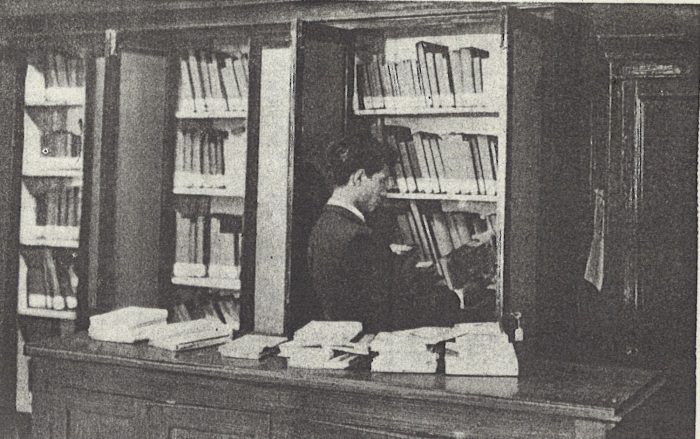
A document from 23 October 1928 conserved in our historical archive makes the first reference to a company library: it describes a travelling library available to staff who have signed up to “After Work for Pirelli Companies”, with 800 books and its own borrowing system. The “Firm, as well as supporting the costs of managing the library, will also contribute to its growth with an annual sum for the acquisition of new works”; book loans were for no longer than 20 days, with a maximum of two books to be borrowed at a time. In the next few years the library found a home at the Bicocca of the Arcimboldi before, after a period of closure during the war, it was reopened in October 1945 in a new location.The “Notiziario Pirelli” of 1 February 1946 referred to the opening of a “Section of our library at Milan-Brusada on the second floor of a building in G.B. Pirelli Road,” with the objective of “Increasing the amount of volumes with appropriate purchases in order to supply everybody with that powerful tool for recreation and education: the book.” .In 1946 there were approximately 3,000 books in the new library, chosen by the workers using catalogues provided by the company. The importance given by Pirelli to the spread of reading among its employees is further evident in the “Notiziaio Pirelli” in a piece titled “The Worker Does Not Read”: “You have to meet the worker after the trials and tribulations of the working day are over and try to improve his home life, creating in him the desire to extend himself beyond the world of the factory.” And it was with this in mind that the Pirelli Centre of Culture was created, from the initiative of the News Report Editorial Board.As Silvestro Severgnini, promoter of the Centre of Culture, relates in Culture is Like Bread (La cultura è come il pane) for the Pirelli Magazine in 1951, the centre was created with the aim of “Bringing together and coordinating the various initiatives, either already present or in the planning stage, and the educational framework relating to our firm, with the goal of raising the average cultural level of the workers.”  Among the activities of the centre were not only the “Pirelli library”, but also “factory meetings”, “the internal selection school”, musical and theatrical events, exhibitions, film festivals and conventions to which world famous writers and artists were invited, including Milan Kundera and Cesare Zavattini.

Over the next few years the library would grow to reach 10,000 books by 1956; in 1957 an entire page of “Facts and Information” was dedicated to the renovation of the library, which received a new space at 183 Sarca Avenue, where it stayed until 1972. The newest addition was a reading room dedicated to newspapers and magazines and browsing books directly from the shelves. Library loans rose to 50,000 units, a tangible sign of the interest reading held for many of the employees. In 1972 the company library was transferred from the “Creative Activities” building to building 120, still on Sarca Avenue, where it was provided with an information desk managed by the “Group for Social Activities.” Pirelli also made  a Technical-Scientific Library available for its researchers and engineers with around 16,000 books on tyre and cable technology from the nineteenth century until the present day.Since 2010 this library can be found at the Pirelli Foundation

Today, in line with this long tradition and in support of #ioleggoperchè (I read because), an initiative supported by the AIE (Italian Association of Publishers) to promote reading, Pirelli will soon open two new company libraries at the Milan Bicocca Headquarters and in the Bollate factory after the positive experience garnered from the Polo Industriale company library in Settimo Torinese, currently the only private library included in the SBAM (Library System of  the Turin Metropolitan Area). The contents of the three company libraries will be supplemented every year with new volumes, including literature books for children.

The same spirit which inspired the first travelling library in 1928 continues today with the opening of these new company libraries, creating a new meeting point where reading is the channel of communication, of exchange and of bringing people together.

Reading and Pirelli: from the library of the 1920s to the brand new libraries of today

A document from 23 October 1928 conserved in our historical archive makes the first reference to a company library: it describes a travelling library available to staff who have signed up to “After Work for Pirelli Companies”, with 800 books and its own borrowing system. The “Firm, as well as supporting the costs of managing the library, will also contribute to its growth with an annual sum for the acquisition of new works”; book loans were for no longer than 20 days, with a maximum of two books to be borrowed at a time. In the next few years the library found a home at the Bicocca of the Arcimboldi before, after a period of closure during the war, it was reopened in October 1945 in a new location.The “Notiziario Pirelli” of 1 February 1946 referred to the opening of a “Section of our library at Milan-Brusada on the second floor of a building in G.B. Pirelli Road,” with the objective of “Increasing the amount of volumes with appropriate purchases in order to supply everybody with that powerful tool for recreation and education: the book.” .In 1946 there were approximately 3,000 books in the new library, chosen by the workers using catalogues provided by the company. The importance given by Pirelli to the spread of reading among its employees is further evident in the “Notiziaio Pirelli” in a piece titled “The Worker Does Not Read”: “You have to meet the worker after the trials and tribulations of the working day are over and try to improve his home life, creating in him the desire to extend himself beyond the world of the factory.” And it was with this in mind that the Pirelli Centre of Culture was created, from the initiative of the News Report Editorial Board.As Silvestro Severgnini, promoter of the Centre of Culture, relates in Culture is Like Bread (La cultura è come il pane) for the Pirelli Magazine in 1951, the centre was created with the aim of “Bringing together and coordinating the various initiatives, either already present or in the planning stage, and the educational framework relating to our firm, with the goal of raising the average cultural level of the workers.”  Among the activities of the centre were not only the “Pirelli library”, but also “factory meetings”, “the internal selection school”, musical and theatrical events, exhibitions, film festivals and conventions to which world famous writers and artists were invited, including Milan Kundera and Cesare Zavattini.

Over the next few years the library would grow to reach 10,000 books by 1956; in 1957 an entire page of “Facts and Information” was dedicated to the renovation of the library, which received a new space at 183 Sarca Avenue, where it stayed until 1972. The newest addition was a reading room dedicated to newspapers and magazines and browsing books directly from the shelves. Library loans rose to 50,000 units, a tangible sign of the interest reading held for many of the employees. In 1972 the company library was transferred from the “Creative Activities” building to building 120, still on Sarca Avenue, where it was provided with an information desk managed by the “Group for Social Activities.” Pirelli also made  a Technical-Scientific Library available for its researchers and engineers with around 16,000 books on tyre and cable technology from the nineteenth century until the present day.Since 2010 this library can be found at the Pirelli Foundation

Today, in line with this long tradition and in support of #ioleggoperchè (I read because), an initiative supported by the AIE (Italian Association of Publishers) to promote reading, Pirelli will soon open two new company libraries at the Milan Bicocca Headquarters and in the Bollate factory after the positive experience garnered from the Polo Industriale company library in Settimo Torinese, currently the only private library included in the SBAM (Library System of  the Turin Metropolitan Area). The contents of the three company libraries will be supplemented every year with new volumes, including literature books for children.

The same spirit which inspired the first travelling library in 1928 continues today with the opening of these new company libraries, creating a new meeting point where reading is the channel of communication, of exchange and of bringing people together.

Multimedia

Images

Pirelli and the MITO Festival: Music “At Work”

Pirelli started collaborating with the MITO SettembreMusica Festival back in 2007; a bond in keeping with the custom of consolidating relationship between enterprises and culture that Pirelli has always fostered by promoting artistic, cultural and educational activities.

The tradition runs deep: suffice it to mention that in 1954 the eclectic American music composer John Cage, famous for the composition entitled 4’33” (which are the minutes of silence of the piece), performed at the Pirelli Cultural Centre with David Tudor in a “concerto for prepared pianos”. Screws, metal balls, spoons, clothing pegs, bamboo sticks, clock gears and other objects were applied to the strings of the two pianos to produce unprecedented effects and shock – both positively and negatively – the members of what was said to be “one of the most educated audiences in town”. In this context, Pirelli started promoting the events of the MITO Festival in 2010 in the company’s industrial spaces, to reassert the bond between the places of work and those of music as an expression of the industrial humanism which historically identifies the corporation.

An orchestra pitted against factory spaces in the 2010 edition of the Festival: the old plant in Settimo Torinese hosted “I Fiati di Torino” of the local RAI Symphonic Orchestra. The performance  included compositions by Mozart, Bach, Beethoven, Berio, Gabrieli, Saglietti and Stravinskij and was held in front of an audience of over four hundred people.

Following the success of the 2010 edition, musicians returned to the factory for MITO 2011: this time, the “Pomeriggi Musicali” orchestra, conducted by maestro Luca Pfaff, performed in the revamped spaces of the Settimo Torinese Industrial Hub. The programme featured compositions by Darius Milhaud (suite from the ballet “Le boeuf sur le toit”), Artur Honegger (“Pastoral d’été”), Manuel De Falla (suite from the ballet “El Amor Brujo”) and Igor Stravinskij (“Suite for chamber orchestra No. 1 and No. 2″).

In September 2014, instead, the Torino Philharmonic Orchestra performed at the Settimo Torinese Industrial Hub. The musicians conducted by Micha Hamel performed “Symphony No. 1 in C Major, op. 21” and “Symphony No. in A major, op. 92” by Ludwig van Beethoven and were applauded by one thousand people. “La Settima a Settimo” – a play on words: the seventh in Settimo, which in addition to being the name of the town also means “seventh” in Italian – always draws many Pirelli employees.

For the 2016 edition, under the guidance of the new artistic director Nicola Campogrande, Pirelli will be hosting one of the musical appointments this time in the headquarters instead of in the factory. On Sunday 18 September, at 9 p.m., the Auditorium of the HQ1 building – erected around the old cooling tower of the Milano Bicocca plant – will stage of the performance entitled “I figli di Beethoven”: “Altus Trio” will play “Trio in E-flat major, op. 70 n. 2” by Ludwig van Beethoven and “Trio in F major, op. 80” by Robert Schumann.


Pirelli and the MITO Festival: Music “At Work”

Pirelli started collaborating with the MITO SettembreMusica Festival back in 2007; a bond in keeping with the custom of consolidating relationship between enterprises and culture that Pirelli has always fostered by promoting artistic, cultural and educational activities.

The tradition runs deep: suffice it to mention that in 1954 the eclectic American music composer John Cage, famous for the composition entitled 4’33” (which are the minutes of silence of the piece), performed at the Pirelli Cultural Centre with David Tudor in a “concerto for prepared pianos”. Screws, metal balls, spoons, clothing pegs, bamboo sticks, clock gears and other objects were applied to the strings of the two pianos to produce unprecedented effects and shock – both positively and negatively – the members of what was said to be “one of the most educated audiences in town”. In this context, Pirelli started promoting the events of the MITO Festival in 2010 in the company’s industrial spaces, to reassert the bond between the places of work and those of music as an expression of the industrial humanism which historically identifies the corporation.

An orchestra pitted against factory spaces in the 2010 edition of the Festival: the old plant in Settimo Torinese hosted “I Fiati di Torino” of the local RAI Symphonic Orchestra. The performance  included compositions by Mozart, Bach, Beethoven, Berio, Gabrieli, Saglietti and Stravinskij and was held in front of an audience of over four hundred people.

Following the success of the 2010 edition, musicians returned to the factory for MITO 2011: this time, the “Pomeriggi Musicali” orchestra, conducted by maestro Luca Pfaff, performed in the revamped spaces of the Settimo Torinese Industrial Hub. The programme featured compositions by Darius Milhaud (suite from the ballet “Le boeuf sur le toit”), Artur Honegger (“Pastoral d’été”), Manuel De Falla (suite from the ballet “El Amor Brujo”) and Igor Stravinskij (“Suite for chamber orchestra No. 1 and No. 2″).

In September 2014, instead, the Torino Philharmonic Orchestra performed at the Settimo Torinese Industrial Hub. The musicians conducted by Micha Hamel performed “Symphony No. 1 in C Major, op. 21” and “Symphony No. in A major, op. 92” by Ludwig van Beethoven and were applauded by one thousand people. “La Settima a Settimo” – a play on words: the seventh in Settimo, which in addition to being the name of the town also means “seventh” in Italian – always draws many Pirelli employees.

For the 2016 edition, under the guidance of the new artistic director Nicola Campogrande, Pirelli will be hosting one of the musical appointments this time in the headquarters instead of in the factory. On Sunday 18 September, at 9 p.m., the Auditorium of the HQ1 building – erected around the old cooling tower of the Milano Bicocca plant – will stage of the performance entitled “I figli di Beethoven”: “Altus Trio” will play “Trio in E-flat major, op. 70 n. 2” by Ludwig van Beethoven and “Trio in F major, op. 80” by Robert Schumann.

Multimedia

Images

Sign up for the newsletter