Help with your research

To request to view the materials in the Historical Archive and in the libraries of the Pirelli Foundation for study and research purposes and/or to find out how to request the use of materials for loans and exhibitions, please fill in the form below. You will receive an email confirming receipt of the request and you will be contacted.

Pirelli Foundation Educational Courses

Select the education level of the school

Visit the Foundation

For information about the Foundation's activities, guided tours and accessibility, please call +39 0264423971 or fill in the form below, providing details of your request in the notes field.

Pirelli and Italy on the move. Research and technology. Cinturato conquers markets of the world

It’s back to the sixties for the Pirelli Foundation thanks to an exhibit that provides a sort of metaphoric voyage through Italy, telling the story of the country’s economic, social and cultural development throughout that decade.

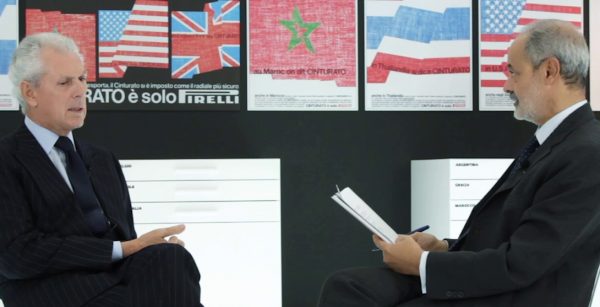
The starting point is the famous Cinturato ad campaign by PinoTovaglia in 1968, which featured the flags of 16 countries around the world accompanied by a headline translated into as many languages: “In Italia si dice Cinturato”, “in England they say Cinturato”, “en France on dit Cinturato”…. The 16 full-colour plates serve as the newly restored backdrop of the Pirelli Foundation’s Historical Archives, along with posters and photos of Pirelli’s most successful products, which tell the story of a season of great vibrancy, of economic boom, of appreciation for the Italian lira by the Financial Times with its monetary “Oscar” for stability, and the first signs of generalised public wellbeing. An Italy of growth, change and movement. It was a youthful time, marked by the Autostrada del Sole (Motorway of the Sun), by television, by rock music, and by Italian-style comedy. In this contemporary age, Pirelli played a leading role in the form of industry. There was the Pirelli tower, which dominated the skyline of Milan, a city of innovation. There was the graphic design work by Noorda, Lamm and Munari and signs of great culture in the Pirelli magazine, whose articles and investigative reporting took the temperature of a world that was on the move.

The exhibit is open to the public (appointment required) Monday through Friday from 10:00am to 5:00pm. For information, visit fondazionepirelli.org

It’s back to the sixties for the Pirelli Foundation thanks to an exhibit that provides a sort of metaphoric voyage through Italy, telling the story of the country’s economic, social and cultural development throughout that decade.

The starting point is the famous Cinturato ad campaign by PinoTovaglia in 1968, which featured the flags of 16 countries around the world accompanied by a headline translated into as many languages: “In Italia si dice Cinturato”, “in England they say Cinturato”, “en France on dit Cinturato”…. The 16 full-colour plates serve as the newly restored backdrop of the Pirelli Foundation’s Historical Archives, along with posters and photos of Pirelli’s most successful products, which tell the story of a season of great vibrancy, of economic boom, of appreciation for the Italian lira by the Financial Times with its monetary “Oscar” for stability, and the first signs of generalised public wellbeing. An Italy of growth, change and movement. It was a youthful time, marked by the Autostrada del Sole (Motorway of the Sun), by television, by rock music, and by Italian-style comedy. In this contemporary age, Pirelli played a leading role in the form of industry. There was the Pirelli tower, which dominated the skyline of Milan, a city of innovation. There was the graphic design work by Noorda, Lamm and Munari and signs of great culture in the Pirelli magazine, whose articles and investigative reporting took the temperature of a world that was on the move.

The exhibit is open to the public (appointment required) Monday through Friday from 10:00am to 5:00pm. For information, visit fondazionepirelli.org

HB School Programme in collaboration with the Fondazione Pirelli

HB School is a programme of courses developed by the educational department of HangarBicocca and inspired by the theory of teaching art appreciation.

Basing on the themes that emerge from the exhibitions housed at HangarBicocca, HB School offers a series of courses aimed at children and teens aged 3 to 18 which last two hours and are divided into two sessions, one for looking at works of art and one for experiments in the workshop.

This year’s new feature is the partnership formed with the Pirelli Foundation. Thanks to the convergence of themes found in both contemporary art and Pirelli’s corporate culture, the Foundation has opened up its historical archive for the creation of a specific educational programme.

The courses organised by the Pirelli Foundation are designed for primary and secondary school pupils and students and tackle subjects such as memory and experimentation. After a short visit to the exhibition at HangarBicocca, the participants are accompanied to the spaces of the Pirelli Foundation for a visit to the Historical Archive and for their workshop activities.

Students will learn what an archive is and how it is used. They will also learn what an original sketch is and the processes which lead, starting from the sketch, to the creation of an advertising poster. They will therefore learn the concept of uniqueness of a document and work of art and the multiplicity of production in series.

The complete programme and all the information required for participating can be downloaded from the HangarBicocca website

When:

The workshops are to be held on Thursdays and Fridays for a total of approximately 3 hours.

Enrolment: directly via the Pirelli Foundation. Please write to

scuole@fondazionepirelli.org

or

school@fondazionepirelli.org

HB School is a programme of courses developed by the educational department of HangarBicocca and inspired by the theory of teaching art appreciation.

Basing on the themes that emerge from the exhibitions housed at HangarBicocca, HB School offers a series of courses aimed at children and teens aged 3 to 18 which last two hours and are divided into two sessions, one for looking at works of art and one for experiments in the workshop.

This year’s new feature is the partnership formed with the Pirelli Foundation. Thanks to the convergence of themes found in both contemporary art and Pirelli’s corporate culture, the Foundation has opened up its historical archive for the creation of a specific educational programme.

The courses organised by the Pirelli Foundation are designed for primary and secondary school pupils and students and tackle subjects such as memory and experimentation. After a short visit to the exhibition at HangarBicocca, the participants are accompanied to the spaces of the Pirelli Foundation for a visit to the Historical Archive and for their workshop activities.

Students will learn what an archive is and how it is used. They will also learn what an original sketch is and the processes which lead, starting from the sketch, to the creation of an advertising poster. They will therefore learn the concept of uniqueness of a document and work of art and the multiplicity of production in series.

The complete programme and all the information required for participating can be downloaded from the HangarBicocca website

When:

The workshops are to be held on Thursdays and Fridays for a total of approximately 3 hours.

Enrolment: directly via the Pirelli Foundation. Please write to

scuole@fondazionepirelli.org

or

school@fondazionepirelli.org

Less classic, More multidisciplinary: Training looks to companies

Enrolments in high schools for classical studies have dropped sharply (from the 10.2% of 2007 to the 6.1% of this year, a national average with strong regional imbalances, as shown by the 4% in Lombardy and the 9.7% in Lazio and the 8.6% in Sicily). More young people want to attend a politecnico. Good news? Some are celebrating in the corporate world: there’s a move towards awareness of education of greater use for finding a job and an educational gap is beginning to be bridged between Italy and the other great industrial countries in the OECD zone. Italy has a decent humanities culture but a poor scientific one. This is a vital issue for discussion, without rigid patterns however or injudicious utilitarian tendencies.

Let’s start with some figures, for example the Pisa (program for international student assessment) score, from a standardised maths and science test given to fifteen-year-olds from 70 countries to reveal the quality of teaching and education in maths and science (two key elements of innovation). The scores in Italy are 483 for maths and 489 for science, very low compared to the 513 and 520 in Germany. China with Shanghai, top in the ranking, has 600 for maths and 575 for science, Finland is second with 541 and 554. In Europe Great Britain, France, The Netherlands, Switzerland, Slovenia, Poland, Ireland and Belgium score better than Italy and only Spain and Greece do worse. To sum up, Italian students have a limited and inadequate familiarity with a scientific culture which affects the competitiveness of the country as a system and also other key dimensions of civilian life. We live in a world where scientific skills are necessary in order to have a barely well-informed opinion on subjects which impact on health, personal and social equilibrium, the future, such as the environment and energy, and the more innovative medicine and biotechnologies. The fact of not having the tools for critical judgement and understanding conditions day-to-day living and the actual quality of democracy, therefore more science is required in education and for balanced economic and social development.

Young people and their families appear to be aware of this, as demonstrated by the 9,500 applications for the tests for admission to engineering at the Milan Politecnico (they were less than 6,000 in the autumn of 2010), in addition to the 3,000 applications for architecture and 2,500 for design. In engineering the places available are just over 5,000. Students who take up that course know that they will almost definitely find, immediately after graduation, a good job. The Excelsior-UnionCamere survey shows that companies have difficulty in covering 12% of the positions required, starting above all with engineers.

Useful degrees, therefore, and a good step forwards (albeit accompanied by a cautious) revaluation of vocational training and technical colleges). However can we be satisfied at the increasing abandonment of classics as a subject? Not at all, as from the actual standpoint of a good corporate culture, alongside technicians with a strong scientific training, entrepreneurs and managers are needed with a cultural training able to tackle intelligently and flexibly the challenges set by modern complexity, concerning the use and effects of technologies, the environmental impact of production processes, the market trends and management of the work force (people and not numbers, above all when the first factor of competitiveness is linked to the quality of the human capital). The ideal would be an engineer with a solid education in the classics, who has read and understood Plato and Pascal, Descartes and Kant, Weber and Berlin, who demonstrates mastery of literature and drama and constructs and manages original cultural patterns. One example is Corrado Passera, good economics training at the Bocconi university and a successful career in industry, finance and, recently, politics: “Greek, Latin, literature, philosophy and history help to develop a critical attitude, increasingly necessary given the enormous quantity of opposite viewpoints and information which bombard us, and teach how to handle complexity”. A sophisticated and solid corporate culture in fact.

Enrolments in high schools for classical studies have dropped sharply (from the 10.2% of 2007 to the 6.1% of this year, a national average with strong regional imbalances, as shown by the 4% in Lombardy and the 9.7% in Lazio and the 8.6% in Sicily). More young people want to attend a politecnico. Good news? Some are celebrating in the corporate world: there’s a move towards awareness of education of greater use for finding a job and an educational gap is beginning to be bridged between Italy and the other great industrial countries in the OECD zone. Italy has a decent humanities culture but a poor scientific one. This is a vital issue for discussion, without rigid patterns however or injudicious utilitarian tendencies.

Let’s start with some figures, for example the Pisa (program for international student assessment) score, from a standardised maths and science test given to fifteen-year-olds from 70 countries to reveal the quality of teaching and education in maths and science (two key elements of innovation). The scores in Italy are 483 for maths and 489 for science, very low compared to the 513 and 520 in Germany. China with Shanghai, top in the ranking, has 600 for maths and 575 for science, Finland is second with 541 and 554. In Europe Great Britain, France, The Netherlands, Switzerland, Slovenia, Poland, Ireland and Belgium score better than Italy and only Spain and Greece do worse. To sum up, Italian students have a limited and inadequate familiarity with a scientific culture which affects the competitiveness of the country as a system and also other key dimensions of civilian life. We live in a world where scientific skills are necessary in order to have a barely well-informed opinion on subjects which impact on health, personal and social equilibrium, the future, such as the environment and energy, and the more innovative medicine and biotechnologies. The fact of not having the tools for critical judgement and understanding conditions day-to-day living and the actual quality of democracy, therefore more science is required in education and for balanced economic and social development.

Young people and their families appear to be aware of this, as demonstrated by the 9,500 applications for the tests for admission to engineering at the Milan Politecnico (they were less than 6,000 in the autumn of 2010), in addition to the 3,000 applications for architecture and 2,500 for design. In engineering the places available are just over 5,000. Students who take up that course know that they will almost definitely find, immediately after graduation, a good job. The Excelsior-UnionCamere survey shows that companies have difficulty in covering 12% of the positions required, starting above all with engineers.

Useful degrees, therefore, and a good step forwards (albeit accompanied by a cautious) revaluation of vocational training and technical colleges). However can we be satisfied at the increasing abandonment of classics as a subject? Not at all, as from the actual standpoint of a good corporate culture, alongside technicians with a strong scientific training, entrepreneurs and managers are needed with a cultural training able to tackle intelligently and flexibly the challenges set by modern complexity, concerning the use and effects of technologies, the environmental impact of production processes, the market trends and management of the work force (people and not numbers, above all when the first factor of competitiveness is linked to the quality of the human capital). The ideal would be an engineer with a solid education in the classics, who has read and understood Plato and Pascal, Descartes and Kant, Weber and Berlin, who demonstrates mastery of literature and drama and constructs and manages original cultural patterns. One example is Corrado Passera, good economics training at the Bocconi university and a successful career in industry, finance and, recently, politics: “Greek, Latin, literature, philosophy and history help to develop a critical attitude, increasingly necessary given the enormous quantity of opposite viewpoints and information which bombard us, and teach how to handle complexity”. A sophisticated and solid corporate culture in fact.

Companies as a mine of knowledge

It is a known fact that knowledge circulates in companies but it is now more important than ever to understand how this knowledge spreads and, above all, how to create it and make it circulate better. This is the area of so-called shared knowledge and of knowledge management, that set of corporate processes, attitudes, routines and methods which increase the level of common knowledge and information among those who effectively spend a good part of their time in the company. Shared knowledge is a difficult process which requires careful and shrewd management, unusual for most companies. A transformation of the same production culture which should permeate all companies.

It helps therefore to read La conoscenza partecipata: nuove pratiche di knowledge management [“Shared knowledge: new knowledge management practices”], the latest opus by Dunia Astrologo and Federica Garbolino (the former a lecturer in knowledge management and organisational communication at Turin university and Politecnico, the latter a partner with Coreconsulting), which bases on the idea of considering knowledge management not as a technique but as a process which has to involve people. Easy to say, complicated to do, as what is defined summarily as a sharing approach requires a new way of managing relations and communication with people. The goal to be achieved is the possibility of creating in the firm efficient and fast decision-making processes and solutions within easy reach as well as enabling the firm to compete more efficaciously.

The work by Astrologo and Garbolino, however, is not just technical reasoning. The first part does cover the main theories on the subject yet the second part analyses specific cases basing on the observation of the potential offered by the new technologies and the Web. The cases of Eni, Tyres Campus Pirelli, Sea-Aeroporti di Milano and Selex Elsag are examined in depth.

The introductory part of the book forms the general basis: “most knowledge management initiatives implemented by organisations fail because they do not take into adequate account the emotional, psychological and social needs of individuals”.

La conoscenza partecipata: nuove pratiche di knowledge management

Dunia Astrologo, Federica Garbolino

Egea, June 2013

It is a known fact that knowledge circulates in companies but it is now more important than ever to understand how this knowledge spreads and, above all, how to create it and make it circulate better. This is the area of so-called shared knowledge and of knowledge management, that set of corporate processes, attitudes, routines and methods which increase the level of common knowledge and information among those who effectively spend a good part of their time in the company. Shared knowledge is a difficult process which requires careful and shrewd management, unusual for most companies. A transformation of the same production culture which should permeate all companies.

It helps therefore to read La conoscenza partecipata: nuove pratiche di knowledge management [“Shared knowledge: new knowledge management practices”], the latest opus by Dunia Astrologo and Federica Garbolino (the former a lecturer in knowledge management and organisational communication at Turin university and Politecnico, the latter a partner with Coreconsulting), which bases on the idea of considering knowledge management not as a technique but as a process which has to involve people. Easy to say, complicated to do, as what is defined summarily as a sharing approach requires a new way of managing relations and communication with people. The goal to be achieved is the possibility of creating in the firm efficient and fast decision-making processes and solutions within easy reach as well as enabling the firm to compete more efficaciously.

The work by Astrologo and Garbolino, however, is not just technical reasoning. The first part does cover the main theories on the subject yet the second part analyses specific cases basing on the observation of the potential offered by the new technologies and the Web. The cases of Eni, Tyres Campus Pirelli, Sea-Aeroporti di Milano and Selex Elsag are examined in depth.

The introductory part of the book forms the general basis: “most knowledge management initiatives implemented by organisations fail because they do not take into adequate account the emotional, psychological and social needs of individuals”.

La conoscenza partecipata: nuove pratiche di knowledge management

Dunia Astrologo, Federica Garbolino

Egea, June 2013

The strange case of corporate capital and social capital

Multinationals heedless of their host areas and societies. Production bulldozers concentrated on results, out of step with the context. This is the image which often goes with MNEs, i.e. those large companies with locations scattered throughout the world, with globalised production and possibly a strong corporate culture. However they too ultimately become involved in the debate between local and global, which opens up the way to the need for a rethink in strategies and approaches towards economic growth. Territorial focus, in a geographical and cultural sense, becomes an important cultural stance and a positive means of growth also for large groups.

This is the explanation given by Kurt Pedersen, Gunnar Lind Haase Svendsen and Gert Tinggaard Svendsen (from the University of Southern Denmark and University of Aarhus in Denmark respectively) in Multinational Enterprises and Social Capital as Location Factor: A Review, published in August in Business and Management Research, in which they trace a map useful for understanding the paths which link up MNEs to the areas where they are located, via social capital, i.e. that particular combination of culture, technology and sociality which is a feature of every territory.

If MNEs, the authors explain, are often understood to be particularly “volatile” enterprises with respect to the territories where they are located, so-called social capital is a potential tool for reducing the level of volatility. This is a renewable source, within easy reach, the manifestation of the corporate culture of a specific country, a substratum which is invisible yet which undeniably shapes production in economic and social terms. The reference for those large companies, namely MNEs, who wish to go beyond the traditional stereotype which cages them in.

The work by the three Danish scholars contains reasoning on a vast scale over the issue and a careful analysis of what has already been processed. The three academics wrote that their review suggested that social capital can be the missing link and a concept useful also in the area of direct foreign investments and in the management of multinationals.

Multinational Enterprises and Social Capital as Location Factor: A Review

Kurt Pedersen, Gunnar Lind Haase Svendsen, Gert Tinggaard Svendsen

Business and Management Research, Vol. 2, No. 3; 2013

Multinationals heedless of their host areas and societies. Production bulldozers concentrated on results, out of step with the context. This is the image which often goes with MNEs, i.e. those large companies with locations scattered throughout the world, with globalised production and possibly a strong corporate culture. However they too ultimately become involved in the debate between local and global, which opens up the way to the need for a rethink in strategies and approaches towards economic growth. Territorial focus, in a geographical and cultural sense, becomes an important cultural stance and a positive means of growth also for large groups.

This is the explanation given by Kurt Pedersen, Gunnar Lind Haase Svendsen and Gert Tinggaard Svendsen (from the University of Southern Denmark and University of Aarhus in Denmark respectively) in Multinational Enterprises and Social Capital as Location Factor: A Review, published in August in Business and Management Research, in which they trace a map useful for understanding the paths which link up MNEs to the areas where they are located, via social capital, i.e. that particular combination of culture, technology and sociality which is a feature of every territory.

If MNEs, the authors explain, are often understood to be particularly “volatile” enterprises with respect to the territories where they are located, so-called social capital is a potential tool for reducing the level of volatility. This is a renewable source, within easy reach, the manifestation of the corporate culture of a specific country, a substratum which is invisible yet which undeniably shapes production in economic and social terms. The reference for those large companies, namely MNEs, who wish to go beyond the traditional stereotype which cages them in.

The work by the three Danish scholars contains reasoning on a vast scale over the issue and a careful analysis of what has already been processed. The three academics wrote that their review suggested that social capital can be the missing link and a concept useful also in the area of direct foreign investments and in the management of multinationals.

Multinational Enterprises and Social Capital as Location Factor: A Review

Kurt Pedersen, Gunnar Lind Haase Svendsen, Gert Tinggaard Svendsen

Business and Management Research, Vol. 2, No. 3; 2013

“Eco’s Triangle” and the economy of science and culture

It was an ode to Italian excellence and international prestige for the country’s culture and our particular approach to science, not to mention an implicit indication of strategy: Italy’s future lies it the development of the country’s cultural heritage, in Italian creativity, and in the nation’s ability to construct and disseminate research and innovation. In his speech for the appointment of Claudio Abbado, Elena Cattaneo, Renzo Piano and Carlo Rubbia as senators for life, Italian President Giorgio Napolitano was very clear, as was his explicit reference to the lesson of Luigi Einaudi (who had, in his time, appointed great intellectuals such as Arturo Toscanini, Umberto Zanotti Bianco, and Trilussa as senators for life).  Institutional roots and a forward-looking Office of the President. Memories. And a high-profile political reference insisting, convincingly, on the need to bring a much-awaited end to government after government cutting spending on culture, education and research, thereby compromising the future of the new generations and the proper development of the nation.

With this speech, Napolitano embodies the best in Italian culture of enterprise. The new sources of competitiveness lie in the quality of human capital, in social capital (the relationships of skills; the ability to work together, which continue to characterise the best in widespread capitalism; the territory, districts and networking), in “innovation capital”. Despite it all, Italian industry has managed to survive through these years of great crisis only by promoting innovation in products and processes, by challenging the competition on international markets, and by taking advantage of that particular Italian trait that is a constantly changing mix of design, quality, business sophistication, and resilience to change— the result of a culture and of a type of intelligence that keeps pace with the times and looks to the future.

Bruno Arpaia and Pietro Greco, in their book La cultura si mangia! (published by Guanda), offer up data in this regard that provide some food for thought. In this work, the authors refer to the “triangle of culture” (as defined by Umberto Eco) and its important insights into the economy. The three points of this triangle are: a) the cultural industry of design, craftsmanship, the visual arts, audio-visual media, publishing, entertainment, and new media; b) the full cycle of education and learning, from elementary school through to secondary school, university and then life-long learning; and c) scientific research, technological development and the production of high-tech products and services.

These are the pillars of development in many countries around the world—from the US to China, from Korea to Germany and on to Brazil— and they already underlie a large part of the world’s economy. Indeed, the goods and services of this system of production based on scientific research (the whole world of high-tech) account for 30% of global GDP. The creative industry is worth another 15% of GDP. Education, roughly 6%. In other words, over half of the world’s GDP is based on “Eco’s triangle”. It is the knowledge economy, and a challenge for Italy and for Europe as a whole—an essential tool in the new frontier of “record manufacturing” and in retaining competitiveness. Thus far, Italy has responded poorly, investing just 1% of GDP in research and cutting investment in education—largely coming out of the salaries of school and university personnel—year after year. Conversely, the other major European nations, from Germany to France, have increased spending in these areas in what Massimo Sideri (in Corriere della Sera of 1 September) calls the “cocktail of innovation” or the “trilateral network”: industries that invest; universities that conduct research and education to train highly-skilled students; and a series of other conditions created by governments and public bodies to favour start-ups, starting with both physical and intangible infrastructures (e.g. the Silicon Valley in the US, London’s Tech City, the Silicon Wadi in Israel, and other high-tech districts in India, in China and in Russia). These are examples that we would finally learn to follow, as we have now also been reminded by the senators for life appointed by Napolitano.

It was an ode to Italian excellence and international prestige for the country’s culture and our particular approach to science, not to mention an implicit indication of strategy: Italy’s future lies it the development of the country’s cultural heritage, in Italian creativity, and in the nation’s ability to construct and disseminate research and innovation. In his speech for the appointment of Claudio Abbado, Elena Cattaneo, Renzo Piano and Carlo Rubbia as senators for life, Italian President Giorgio Napolitano was very clear, as was his explicit reference to the lesson of Luigi Einaudi (who had, in his time, appointed great intellectuals such as Arturo Toscanini, Umberto Zanotti Bianco, and Trilussa as senators for life).  Institutional roots and a forward-looking Office of the President. Memories. And a high-profile political reference insisting, convincingly, on the need to bring a much-awaited end to government after government cutting spending on culture, education and research, thereby compromising the future of the new generations and the proper development of the nation.

With this speech, Napolitano embodies the best in Italian culture of enterprise. The new sources of competitiveness lie in the quality of human capital, in social capital (the relationships of skills; the ability to work together, which continue to characterise the best in widespread capitalism; the territory, districts and networking), in “innovation capital”. Despite it all, Italian industry has managed to survive through these years of great crisis only by promoting innovation in products and processes, by challenging the competition on international markets, and by taking advantage of that particular Italian trait that is a constantly changing mix of design, quality, business sophistication, and resilience to change— the result of a culture and of a type of intelligence that keeps pace with the times and looks to the future.

Bruno Arpaia and Pietro Greco, in their book La cultura si mangia! (published by Guanda), offer up data in this regard that provide some food for thought. In this work, the authors refer to the “triangle of culture” (as defined by Umberto Eco) and its important insights into the economy. The three points of this triangle are: a) the cultural industry of design, craftsmanship, the visual arts, audio-visual media, publishing, entertainment, and new media; b) the full cycle of education and learning, from elementary school through to secondary school, university and then life-long learning; and c) scientific research, technological development and the production of high-tech products and services.

These are the pillars of development in many countries around the world—from the US to China, from Korea to Germany and on to Brazil— and they already underlie a large part of the world’s economy. Indeed, the goods and services of this system of production based on scientific research (the whole world of high-tech) account for 30% of global GDP. The creative industry is worth another 15% of GDP. Education, roughly 6%. In other words, over half of the world’s GDP is based on “Eco’s triangle”. It is the knowledge economy, and a challenge for Italy and for Europe as a whole—an essential tool in the new frontier of “record manufacturing” and in retaining competitiveness. Thus far, Italy has responded poorly, investing just 1% of GDP in research and cutting investment in education—largely coming out of the salaries of school and university personnel—year after year. Conversely, the other major European nations, from Germany to France, have increased spending in these areas in what Massimo Sideri (in Corriere della Sera of 1 September) calls the “cocktail of innovation” or the “trilateral network”: industries that invest; universities that conduct research and education to train highly-skilled students; and a series of other conditions created by governments and public bodies to favour start-ups, starting with both physical and intangible infrastructures (e.g. the Silicon Valley in the US, London’s Tech City, the Silicon Wadi in Israel, and other high-tech districts in India, in China and in Russia). These are examples that we would finally learn to follow, as we have now also been reminded by the senators for life appointed by Napolitano.

Enterprising conversation

In business, we produce and we talk. We work and we meet. Now more than every, a company is a place where information is shared and interests coalesce and so is a source of knowledge, news and communication. We must now increasingly think in terms of the “open enterprise”, of dialoguing with the marketplace. The world is changing, but not all businesses have been able to fully grasp the scope of this change. As technology evolves, social networking and the availability of convergent, connected devices that cost less and are smaller, more powerful and more versatile are constantly challenging business people in new ways.

To navigate these waters, we need new maps and new compasses, such as the book L’impresa nell’era della convergenza – Da emittente di messaggi a nodi di conversazioni (The enterprise in the age of convergence – From broadcaster of messages to a node of conversation), by Luigi Ferrari, Massimo Bartoccioli and Mario Ruotolo (all experts in business communication and instructors at IULM, Università Cattolica in Milan, and the University of Milan).

The underlying assumption of the three authors is that the change we are currently witnessing is about more than just an ability to use new technologies. We are also seeing a dense interweaving of aspects of culture and relationships that are crucial in business, particularly concerning the evolution of the skills and mentality of the individual consumers as they become increasingly capable, autonomous explorers who readily reject companies that are unable to adapt to change.

The book—which features a contribution by Nando Pagnoncelli (President of IPSOS)—takes a close look at the need for businesses to make profound changes in their approach to the market, away from what the authors feel to be a still all to common stance of opposition to the consumer and towards a more open dialogue with the market. As the authors explain, “The views and analysis in this work, particularly concerning the evolution of public opinion, the growing phenomenon of online sharing and the transparency and immediacy of information available to all free of charge, lead us to believe that this culture can be rapidly embraced by the most forward-looking organisations, those that have already felt the winds of change and have placed the strengthening of their mission and their responsibility towards the generations to come at the forefront of their strategic organisational and financial decisions.”

L’impresa nell’era della convergenza. Da emittente di messaggi a nodo di conversazioni

Luigi Ferrari, Massimo Bartoccioli, Mario Ruotolo

Unicopli, June 2013

In business, we produce and we talk. We work and we meet. Now more than every, a company is a place where information is shared and interests coalesce and so is a source of knowledge, news and communication. We must now increasingly think in terms of the “open enterprise”, of dialoguing with the marketplace. The world is changing, but not all businesses have been able to fully grasp the scope of this change. As technology evolves, social networking and the availability of convergent, connected devices that cost less and are smaller, more powerful and more versatile are constantly challenging business people in new ways.

To navigate these waters, we need new maps and new compasses, such as the book L’impresa nell’era della convergenza – Da emittente di messaggi a nodi di conversazioni (The enterprise in the age of convergence – From broadcaster of messages to a node of conversation), by Luigi Ferrari, Massimo Bartoccioli and Mario Ruotolo (all experts in business communication and instructors at IULM, Università Cattolica in Milan, and the University of Milan).

The underlying assumption of the three authors is that the change we are currently witnessing is about more than just an ability to use new technologies. We are also seeing a dense interweaving of aspects of culture and relationships that are crucial in business, particularly concerning the evolution of the skills and mentality of the individual consumers as they become increasingly capable, autonomous explorers who readily reject companies that are unable to adapt to change.

The book—which features a contribution by Nando Pagnoncelli (President of IPSOS)—takes a close look at the need for businesses to make profound changes in their approach to the market, away from what the authors feel to be a still all to common stance of opposition to the consumer and towards a more open dialogue with the market. As the authors explain, “The views and analysis in this work, particularly concerning the evolution of public opinion, the growing phenomenon of online sharing and the transparency and immediacy of information available to all free of charge, lead us to believe that this culture can be rapidly embraced by the most forward-looking organisations, those that have already felt the winds of change and have placed the strengthening of their mission and their responsibility towards the generations to come at the forefront of their strategic organisational and financial decisions.”

L’impresa nell’era della convergenza. Da emittente di messaggi a nodo di conversazioni

Luigi Ferrari, Massimo Bartoccioli, Mario Ruotolo

Unicopli, June 2013

The subtle alchemy for success in a new country

Local and global have become virtually indistinguishable. It’s become a given that, when a business looks to expand abroad, they have to adapt to different social and economic contexts—often very different from those of their home nation—and must do so in a hurry. This is the only real path to growth, but it’s a path to be followed in measured steps, taking with you the essence of your roots, the heart of your own culture of enterprise, while being able to make the best of the new markets and the essence of other business cultures, particularly when you head abroad to do more than just sell your wares.

Nonetheless, what is truly happening is need of greater study in order to understand it fully, because success comes from a delicate balance that changes from one company to the next and from one place to another.

Tamara Katharina Kürzdörfer and José Carlos Santana Lopes have made their own contribution in this direction with their thesis for the Masters in Business Administration programme at the Jönköping International Business School, Sweden. The work, published in May, seeks to understand the effects of transferring cultural and organisational models of a given business to other countries and other cultures. As the authors explain, “it is crucial to transfer […] already developed business models to other countries with different cultures in order to keep a competitive advantage as well as a strong position in [the] corresponding industry.”

Entitled “Cultural Influence on the Success Factors of Business Models”, the thesis goes beyond a mere analysis of previous studies to also analyse the case of Volvo Construction Equipment (Volvo CE), which transferred its model to Germany, Denmark, Sweden and Finland. This exploration of Volvo’s range of experiences proves two things according to the authors. The first is that “the heart of the whole business model” of an organisation as important and as structured as Volvo is not influenced by the national culture of an individual country. The second is that the national culture of a given country can influence the success of a business model, but limited to certain factors. It is this fragile alchemy that comes about when a business moves into a new setting that can lead to the success or failure of a great many enterprises, and this work out of Jönköping offers up some proof.

Cultural Influence on the Success Factors of Business Models

Tamara Katharina Kürzdörfer & José Carlos Santana Lopes

Jönköping International Business School – Jönköping University, May 2013.

Local and global have become virtually indistinguishable. It’s become a given that, when a business looks to expand abroad, they have to adapt to different social and economic contexts—often very different from those of their home nation—and must do so in a hurry. This is the only real path to growth, but it’s a path to be followed in measured steps, taking with you the essence of your roots, the heart of your own culture of enterprise, while being able to make the best of the new markets and the essence of other business cultures, particularly when you head abroad to do more than just sell your wares.

Nonetheless, what is truly happening is need of greater study in order to understand it fully, because success comes from a delicate balance that changes from one company to the next and from one place to another.

Tamara Katharina Kürzdörfer and José Carlos Santana Lopes have made their own contribution in this direction with their thesis for the Masters in Business Administration programme at the Jönköping International Business School, Sweden. The work, published in May, seeks to understand the effects of transferring cultural and organisational models of a given business to other countries and other cultures. As the authors explain, “it is crucial to transfer […] already developed business models to other countries with different cultures in order to keep a competitive advantage as well as a strong position in [the] corresponding industry.”

Entitled “Cultural Influence on the Success Factors of Business Models”, the thesis goes beyond a mere analysis of previous studies to also analyse the case of Volvo Construction Equipment (Volvo CE), which transferred its model to Germany, Denmark, Sweden and Finland. This exploration of Volvo’s range of experiences proves two things according to the authors. The first is that “the heart of the whole business model” of an organisation as important and as structured as Volvo is not influenced by the national culture of an individual country. The second is that the national culture of a given country can influence the success of a business model, but limited to certain factors. It is this fragile alchemy that comes about when a business moves into a new setting that can lead to the success or failure of a great many enterprises, and this work out of Jönköping offers up some proof.

Cultural Influence on the Success Factors of Business Models

Tamara Katharina Kürzdörfer & José Carlos Santana Lopes

Jönköping International Business School – Jönköping University, May 2013.

Markets are conversations in English, but also in good Italian

Abbot Ferdinando Galiani, the Neapolitan economist very popular in French enlightenment salons, maintained that markets are conversations. This is the phrase used in the opening of the Cluetrain Manifesto, the book by Levine, Locke, Searls and Weinberger which in 2000, with its passionate supporters and harsh critics, attempted to define the new era of Internet communication which turned marketing and corporate cultures upside down. It maintained that firms have to ask themselves where their corporate culture ends and, if it ends before the community starts, then they have no market. The train of thought is fascinating and the relationship between the lucid awareness of one of the finest brains of the eighteenth century in Italy and the vision of US hi-tech environments confirms the degree of strength the European cultural and philosophical tradition can still have in uncertain times in which past and future have to build new synergies for development.

“Conversations”, therefore. Abbot Galiani used, like all cultured people of that time, an elegant French which won over Madame Louise d’Épinay, Rousseau’s patroness. Today the language of markets is English or, more precisely, that meagre hybrid of British English and American English which allows people in finance, trade and business to talk to and understand each other from Hong Kong to New York, London to Mumbai, Qatar to Singapore and so on, globalising. A sort of contemporary sabir, the language (a blend of Italian and Arab dialects, Spanish, French and Greek) which over the centuries had allowed merchants and sailors to understand each other along the shores and in the ports of the Mediterranean.

English, therefore. Top language on markets in the global world. A language that needs to be known, spoken well and considered carefully and respectfully on account of its function in relationships, information and communication. A business language and an essential language (in the dual sense of its unavoidable usefulness and also the fact that it is reduced to the minimum of the terms that are indispensable for exchanging goods, property and services). And also the language of fundamental scientific relationships and international relations.

Here it is worthwhile stopping a moment to reflect on why one language is much more than a means of economic and political exchange. It expresses history, culture, personal and social values, ideas, habits and customs. It bears witness to complex identities, ways of seeing power and faith and also law, hope and love. It reveals projects for building and managing communities. A language is life and therefore a mobile and variable structure with its roots and contemporary side.

Italian business is flexible, innovative, creative and capable of winning over markets not because our entrepreneurs speak English (they have to speak it, but that’s not where their strength lies) but above all because they have a multiple cultural, artistic and social history behind them, filled with imagination. All this cultural heritage is manifested in a language, Italian. A language to be saved and valued therefore, both in schools and at work.

And conversation? In English, around the world, yet with national languages as a background present at the same time as an indispensable value. Good Italian multinational companies know, because in fact they are used to the intelligent Italian flexibility and the importance of culture, creativity and imagination (expressed above all in national languages), that you need to be “Brazilian in Brazil, Turkish in Turkey, Chinese in China”, “resilient”, therefore, and adaptable to change. The richness and competitiveness of Italian entrepreneurship and management lie in fact in Italians’ ability to free themselves of the patterns of managerial culture with an Anglo-Saxon imprint which until recently was prevalent (and today in serious hegemony difficulties after the great crisis of financial rapaciousness born in London and New York). Of caring for and promoting, in Italian business, the values, cultures and languages of the countries where we go to invest, export and build factories and service structures. A small Italian supremacy which has to be sustained and maintained.

Abbot Ferdinando Galiani, the Neapolitan economist very popular in French enlightenment salons, maintained that markets are conversations. This is the phrase used in the opening of the Cluetrain Manifesto, the book by Levine, Locke, Searls and Weinberger which in 2000, with its passionate supporters and harsh critics, attempted to define the new era of Internet communication which turned marketing and corporate cultures upside down. It maintained that firms have to ask themselves where their corporate culture ends and, if it ends before the community starts, then they have no market. The train of thought is fascinating and the relationship between the lucid awareness of one of the finest brains of the eighteenth century in Italy and the vision of US hi-tech environments confirms the degree of strength the European cultural and philosophical tradition can still have in uncertain times in which past and future have to build new synergies for development.

“Conversations”, therefore. Abbot Galiani used, like all cultured people of that time, an elegant French which won over Madame Louise d’Épinay, Rousseau’s patroness. Today the language of markets is English or, more precisely, that meagre hybrid of British English and American English which allows people in finance, trade and business to talk to and understand each other from Hong Kong to New York, London to Mumbai, Qatar to Singapore and so on, globalising. A sort of contemporary sabir, the language (a blend of Italian and Arab dialects, Spanish, French and Greek) which over the centuries had allowed merchants and sailors to understand each other along the shores and in the ports of the Mediterranean.

English, therefore. Top language on markets in the global world. A language that needs to be known, spoken well and considered carefully and respectfully on account of its function in relationships, information and communication. A business language and an essential language (in the dual sense of its unavoidable usefulness and also the fact that it is reduced to the minimum of the terms that are indispensable for exchanging goods, property and services). And also the language of fundamental scientific relationships and international relations.

Here it is worthwhile stopping a moment to reflect on why one language is much more than a means of economic and political exchange. It expresses history, culture, personal and social values, ideas, habits and customs. It bears witness to complex identities, ways of seeing power and faith and also law, hope and love. It reveals projects for building and managing communities. A language is life and therefore a mobile and variable structure with its roots and contemporary side.

Italian business is flexible, innovative, creative and capable of winning over markets not because our entrepreneurs speak English (they have to speak it, but that’s not where their strength lies) but above all because they have a multiple cultural, artistic and social history behind them, filled with imagination. All this cultural heritage is manifested in a language, Italian. A language to be saved and valued therefore, both in schools and at work.

And conversation? In English, around the world, yet with national languages as a background present at the same time as an indispensable value. Good Italian multinational companies know, because in fact they are used to the intelligent Italian flexibility and the importance of culture, creativity and imagination (expressed above all in national languages), that you need to be “Brazilian in Brazil, Turkish in Turkey, Chinese in China”, “resilient”, therefore, and adaptable to change. The richness and competitiveness of Italian entrepreneurship and management lie in fact in Italians’ ability to free themselves of the patterns of managerial culture with an Anglo-Saxon imprint which until recently was prevalent (and today in serious hegemony difficulties after the great crisis of financial rapaciousness born in London and New York). Of caring for and promoting, in Italian business, the values, cultures and languages of the countries where we go to invest, export and build factories and service structures. A small Italian supremacy which has to be sustained and maintained.

Machiavelli, entrepreneur and manager

These days captains of industry are definitely captains courageous, even if care is needed in order not to overly idealise figures who, although important, deal with a variety of situations and human types. It is however crucial to understand how to “give out commands”. Increasingly in firms, and elsewhere, commands are given not through authority but rather through authoritativeness.

Having Niccolò Machiavelli as tutor is without doubt the dream of many. This dream has now partly come true with Machiavelli per i manager. Dalla mente più acuta del Rinascimento, massime e sentenze a uso della vita moderna nelle aziende e fuori [“Machiavelli for managers. From the sharpest mind of the Renaissance maxims and sentences for use in modern living in firms and elsewhere”] by Elena and Luigi Spagnol. This is a short book, just over one hundred pages, filled with Machiavellian turns of phrase, which can accompany those who every day have to manage, decide, valuate, prepare, promote – in a word “give the commands” in firms.

Also taking into account how the “boss”, the captain of industry, is often seen, rightly or wrongly, by his staff. This is why the approach to reading the book given by Piero Ottone in his preface is both appealing and accurate: “in the sixteenth century the aristocracy ruled: now the lords of the economy rule, the men of industry and managers of finance. The cast has changed yet the script is the same. The new prince is the head of a firm. The fate of those who work for him, their fortune or their disgrace, depends on his decisions and possibly on his whims. He often has absolute power. Around him therefore the courtesan mentality spreads. When in the morning he enters his company building, which is the equivalent of the old castle, when he sits in his chair behind his desk, which is the equivalent of the throne, the atmosphere in the corridors and in the offices immediately changes: there are those who hope to meet him, who anxiously await his call, those who fear him and hate him. There are the courtesans ready to worship him, the infidels who weave a plot because the dilemma, for every careerist around, is inexorable: you either win his favours or dethrone him. Tertium non datur”. Machiavelli, therefore, is prescribed reading for manages and entrepreneurs too, called on to perform increasingly difficult tasks. It was Machiavelli who wrote in his Istorie Fiorentine that it is easier to learn to obey than to command.

Machiavelli per i manager. Dalla mente più acuta del Rinascimento, massime e sentenze a uso della vita moderna nelle aziende e fuori

Elena Spagnol, Luigi Spagnol

Ponte alle Grazie, 2012.

These days captains of industry are definitely captains courageous, even if care is needed in order not to overly idealise figures who, although important, deal with a variety of situations and human types. It is however crucial to understand how to “give out commands”. Increasingly in firms, and elsewhere, commands are given not through authority but rather through authoritativeness.

Having Niccolò Machiavelli as tutor is without doubt the dream of many. This dream has now partly come true with Machiavelli per i manager. Dalla mente più acuta del Rinascimento, massime e sentenze a uso della vita moderna nelle aziende e fuori [“Machiavelli for managers. From the sharpest mind of the Renaissance maxims and sentences for use in modern living in firms and elsewhere”] by Elena and Luigi Spagnol. This is a short book, just over one hundred pages, filled with Machiavellian turns of phrase, which can accompany those who every day have to manage, decide, valuate, prepare, promote – in a word “give the commands” in firms.

Also taking into account how the “boss”, the captain of industry, is often seen, rightly or wrongly, by his staff. This is why the approach to reading the book given by Piero Ottone in his preface is both appealing and accurate: “in the sixteenth century the aristocracy ruled: now the lords of the economy rule, the men of industry and managers of finance. The cast has changed yet the script is the same. The new prince is the head of a firm. The fate of those who work for him, their fortune or their disgrace, depends on his decisions and possibly on his whims. He often has absolute power. Around him therefore the courtesan mentality spreads. When in the morning he enters his company building, which is the equivalent of the old castle, when he sits in his chair behind his desk, which is the equivalent of the throne, the atmosphere in the corridors and in the offices immediately changes: there are those who hope to meet him, who anxiously await his call, those who fear him and hate him. There are the courtesans ready to worship him, the infidels who weave a plot because the dilemma, for every careerist around, is inexorable: you either win his favours or dethrone him. Tertium non datur”. Machiavelli, therefore, is prescribed reading for manages and entrepreneurs too, called on to perform increasingly difficult tasks. It was Machiavelli who wrote in his Istorie Fiorentine that it is easier to learn to obey than to command.

Machiavelli per i manager. Dalla mente più acuta del Rinascimento, massime e sentenze a uso della vita moderna nelle aziende e fuori

Elena Spagnol, Luigi Spagnol

Ponte alle Grazie, 2012.

Sign up for the newsletter