

Bicocca degli Arcimboldi
13 April 2016

Accessibility Come visit us.
Find out moreHelp with your research To access the Historical Archive's documents and materials, please fill out the form to request an appointment.
Request an appointmentHelp with your research To access the Historical Archive's documents and materials, please fill out the form to request an appointment.
Request an appointmentThe Pirelli Foundation Educational Programs
Explore pathsCome visit us.
Come visit us.
To access the Historical Archive's documents and materials, please fill out the form to request an appointment.
Grazie per la tua richiesta
Riceverai una mail di conferma dell'avvenuta ricezione della richiesta e sarai ricontattato.
Grazie per la tua richiesta
Abbiamo ricevuto la tua richiesta. Sarai ricontattato dallo staff di Fondazione Pirelli Educational.
Grazie per la tua richiesta
Abbiamo ricevuto la tua richiesta. Sarai ricontattato al più presto.
The most important traits of corporate welfare summed up in a few pages.
A good workplace makes for better work. And the company, the enterprise, not only grows, but develops, produces well-being in addition to balance sheets in the black. An indicator of the importance of so-called corporate welfare is nothing new but it’s still good to be able to fall back on a method that recalls the guiding principles, the fundamental features. Which is where Il welfare aziendale, by Fabio Bonali, Rosa Anna Maresca, Annamaria Mazzitelli and Mariachiara Melsa comes in. This research thesis was written as part of the Fondazione ISTUD’s 2015–16 Master in Human Resources and Organization.
The work is divided into eight chapters that deal with the topic, starting from its origins and development, then examines the rule of law that must be applied today, then a series of useful indications for its application in the company. The authors then analyse the effects that corporate welfare has on the worker and on the business, with the Italian situation under the microscope. The conclusion is an overview of SMEs that network and a large-scale company like ENI.
The authors conclude that corporate welfare was devised to enhance the wellbeing of workers, while filling in the gaps in the state system, and has evolved into an essential tool that increases competitive advantage in business.
Then Bonali, Maresca, Mazzitelli and Melsa indicate a method for improving the effectiveness of corporate welfare (extending cooperation among businesses and the state, and B2B), thereby retrieving one of its original definitions, coined by Adriano Olivetti who spoke of the factory on a human scale, explaining that a factory has to look beyond profit margins. It has to distribute wealth, culture, services, democracy. He said “I think of the factory for the person, not the person for the factory, you see? We must overcome the divisions between capital and labour, industry and agriculture, production and culture. Sometimes, when I’m working late, I see the lights of the line workers on a double shift, office workers, engineers, and I get the urge to go and thank them, to express my gratitude.”
The research undertaken by Bonali, Maresca, Mazzitelli and Melsa is not a milestone in welfare studies but it has two strong points at least: it’s clear and concise, rendering a precise idea of the theme in just twenty pages. To be read and kept on hand.
Il welfare aziendale
Fabio Bonali, Rosa Anna Maresca, Annamaria Mazzitelli, Mariachiara Melsa
Master in Human Resources and Organization, 2015–16
Fondazione ISTUD
The most important traits of corporate welfare summed up in a few pages.
A good workplace makes for better work. And the company, the enterprise, not only grows, but develops, produces well-being in addition to balance sheets in the black. An indicator of the importance of so-called corporate welfare is nothing new but it’s still good to be able to fall back on a method that recalls the guiding principles, the fundamental features. Which is where Il welfare aziendale, by Fabio Bonali, Rosa Anna Maresca, Annamaria Mazzitelli and Mariachiara Melsa comes in. This research thesis was written as part of the Fondazione ISTUD’s 2015–16 Master in Human Resources and Organization.
The work is divided into eight chapters that deal with the topic, starting from its origins and development, then examines the rule of law that must be applied today, then a series of useful indications for its application in the company. The authors then analyse the effects that corporate welfare has on the worker and on the business, with the Italian situation under the microscope. The conclusion is an overview of SMEs that network and a large-scale company like ENI.
The authors conclude that corporate welfare was devised to enhance the wellbeing of workers, while filling in the gaps in the state system, and has evolved into an essential tool that increases competitive advantage in business.
Then Bonali, Maresca, Mazzitelli and Melsa indicate a method for improving the effectiveness of corporate welfare (extending cooperation among businesses and the state, and B2B), thereby retrieving one of its original definitions, coined by Adriano Olivetti who spoke of the factory on a human scale, explaining that a factory has to look beyond profit margins. It has to distribute wealth, culture, services, democracy. He said “I think of the factory for the person, not the person for the factory, you see? We must overcome the divisions between capital and labour, industry and agriculture, production and culture. Sometimes, when I’m working late, I see the lights of the line workers on a double shift, office workers, engineers, and I get the urge to go and thank them, to express my gratitude.”
The research undertaken by Bonali, Maresca, Mazzitelli and Melsa is not a milestone in welfare studies but it has two strong points at least: it’s clear and concise, rendering a precise idea of the theme in just twenty pages. To be read and kept on hand.
Il welfare aziendale
Fabio Bonali, Rosa Anna Maresca, Annamaria Mazzitelli, Mariachiara Melsa
Master in Human Resources and Organization, 2015–16
Fondazione ISTUD
A book based on empirical research describes the reasons why companies live to a ripe old age.
Business success is based on intangible capacities and values too. It’s the overall effect of production culture, which is a material and immaterial fusion of the peculiarities of each manufacturing organization that in itself forms corporate action.
And a glance at history will help us to understand better the (many) cases of companies that have traversed the century. Giacomo Büchi and Monica Cugno did just that in their Le imprese ultracentenarie di successo in Italia. Strategie e governance di impresa nel lungo periodo [Successful Italian companies more than a century old. Corporate strategies and governance in the long term].
The book deals with the theme of corporate success and longevity, studying a sample of 178 ultra-centenarian Italian companies. The text of less than two hundred pages is thus based on an analysis of situations that brought to light the factors moulding the company’s evolution over the years, finally achieving a business reality that is completely different from the original.
Italian ultra-centenarian companies, according to the two authors (both professors of business economics and management), are unquestionably representative of a successful business model and are have actually survived two world wars, economic recessions and booms, the advent of ICT and the recent global crisis.
The question that the book wants to answer is: how did they do it? The answer is manifold, starting from a theoretical overview of the topic, then moving immediately on to research methodology. The third step is to identify factors that the entrepreneur considers essential for the survival of their organization. These are conditions (derived from a series of 200 interviews) summarized in key words such as identity, brand, reputation, product, work, attention, quality, ethics, territory, capital, family, and others. Subsequently, Büchi and Cugno assess the changes that have arisen in reality and look closely at the organizational structure and human resources of companies with more than a hundred years of age, now dealing with globalization of the economy and the need to safeguard value created over time, to mention but two aspects.
The results of the research (the volume also shows the entire research in great detail, starting from the initial questionnaires) reveal that the centenarian enterprises have been able to thrive over time, producing a value based – among other things – on culture and on being well established in their area of origin. Intangible factors, as we said earlier, that deserve to be exploited and made available to the community to build the future for new generations of businesspeople.
Büchi and Cugno’s research efforts present a good monograph on the theme of showcasing corporate culture in specific industrial cases, and which may be useful in offering a rational snapshot of a past which does not comprise just numbers but also, and above all, sentiments and words. It would have been nice, however, to read more of the interviews conducted.
Le imprese ultracentenarie di successo in Italia. Strategie e governance di impresa nel lungo periodo
Giacomo Büchi, Monica Cugno
Franco Angeli, 2016

A book based on empirical research describes the reasons why companies live to a ripe old age.
Business success is based on intangible capacities and values too. It’s the overall effect of production culture, which is a material and immaterial fusion of the peculiarities of each manufacturing organization that in itself forms corporate action.
And a glance at history will help us to understand better the (many) cases of companies that have traversed the century. Giacomo Büchi and Monica Cugno did just that in their Le imprese ultracentenarie di successo in Italia. Strategie e governance di impresa nel lungo periodo [Successful Italian companies more than a century old. Corporate strategies and governance in the long term].
The book deals with the theme of corporate success and longevity, studying a sample of 178 ultra-centenarian Italian companies. The text of less than two hundred pages is thus based on an analysis of situations that brought to light the factors moulding the company’s evolution over the years, finally achieving a business reality that is completely different from the original.
Italian ultra-centenarian companies, according to the two authors (both professors of business economics and management), are unquestionably representative of a successful business model and are have actually survived two world wars, economic recessions and booms, the advent of ICT and the recent global crisis.
The question that the book wants to answer is: how did they do it? The answer is manifold, starting from a theoretical overview of the topic, then moving immediately on to research methodology. The third step is to identify factors that the entrepreneur considers essential for the survival of their organization. These are conditions (derived from a series of 200 interviews) summarized in key words such as identity, brand, reputation, product, work, attention, quality, ethics, territory, capital, family, and others. Subsequently, Büchi and Cugno assess the changes that have arisen in reality and look closely at the organizational structure and human resources of companies with more than a hundred years of age, now dealing with globalization of the economy and the need to safeguard value created over time, to mention but two aspects.
The results of the research (the volume also shows the entire research in great detail, starting from the initial questionnaires) reveal that the centenarian enterprises have been able to thrive over time, producing a value based – among other things – on culture and on being well established in their area of origin. Intangible factors, as we said earlier, that deserve to be exploited and made available to the community to build the future for new generations of businesspeople.
Büchi and Cugno’s research efforts present a good monograph on the theme of showcasing corporate culture in specific industrial cases, and which may be useful in offering a rational snapshot of a past which does not comprise just numbers but also, and above all, sentiments and words. It would have been nice, however, to read more of the interviews conducted.
Le imprese ultracentenarie di successo in Italia. Strategie e governance di impresa nel lungo periodo
Giacomo Büchi, Monica Cugno
Franco Angeli, 2016
Italians like enterprise and consider it the main driver of economic development, especially if it’s an SME.
But they don’t like entrepreneurs. A bit of a paradox. A country quite unaware that industry is it strength and wealth. In a nutshell, these are the results of a survey just conducted by IPSOS, the respected research institute headed by Nando Pagnoncelli. The study was presented last Friday in Parma, at the Centro Studi Confindustria conference on the theme of “entrepreneurs, geniuses of development”. An unsettling result and not so much because it’s surprising (the popularity of entrepreneurs has long been waning in the general crisis of credibility and reliability affecting the entire ruling class) but because at the very moment when the fragile reprise needs all the support it can get, it threatens to overshadow the positive energies that even during the long recession have built wealth, work, social cohesion: enterprises, those who head them and who can guarantee their future.
An IPSOS survey, conducted on a sample of 1,000 Italians and confirmed by various other statistical data, documents that setting up a business is far less appealing than a decade ago, when over a quarter of the population was in favour of it, and today this is down to just a fifth. And if respondents are asked for advice on which profession to seek, the sample equates “entrepreneur” and “civil servant” (20%), conversely expressing much appreciation of “freelancers” (35%). This is an Italy mainly of office workers, doctors and lawyers. Who don’t wonder who builds wealth and innovation. Pagnoncelli says, “There is no up-to-date image of the industrialist that combines growth, competitiveness and social engagement. So 45% of interviewees think that the work of entrepreneurs has regressed compared to the past.
Italy has the second largest manufacturing sector in Europe, after Germany, and is among the top five countries in the world with a manufacturing surplus in excess of 100 billion dollars (mostly due to its excellent mechanical engineering industry, followed closely by furniture, clothing and food). But Italians are unaware of it. And they don’t care. Yet if we want to get ahead on the path of economic development, competitiveness, employment opportunities for the younger generation, it is precisely the entrepreneurs who have to learn to face the great cultural, social and also political challenge, for a new and better awareness of their role.
“The challenge awaiting Confindustria,” says Giorgio Squinzi to an audience of industrialists meeting in Parma, when handing over, in a manner of speaking, to his successor Vincenzo Boccia, “is the need to build a new vision and a new awareness of our production world.” This means a better description of enterprise which will also engage politicians, economists, men and women of the worlds of culture and creativity: entrepreneurs as innovators, but also as social players responsible for the quality of economic and employment growth, skilled at handling new technologies as keys to environmental and social sustainable development.
Top companies have already embarked on this route, escaping the traps of familyism and the distorted ideologies of “small is beautiful”. Nonetheless, the pursuit must go on, in the wake of the strategies already defined by “pocket-size” multinationals, medium and medium-large companies with strong family roots yet with strong management structure, innovative, present on their home ground, but with a far-sighted attention to international markets: manufacturing companies that are the face of the best of “Made in Italy”.
There is certainly a very widespread anti-enterprise sub-culture around. And there are areas of public opinion (and institutional players) persuaded that entrepreneurs and managers are interested only in profit, in business that aims only for success, who are unscrupulous and will stoop to any compromise, however low. It is a conviction to be countered.
“Beat the corrupt, not the market,” wrote Antonio Polito quite rightly in his editorial for Corriere della Sera, on 9 April: “Corruption must be fought without quarter because it is destructive for the economy, but woe betide us if we think of decimating business to kill it off: the quality of our lives and our income depends on the level of development and technology of the country in which we live.”
The challenge is not only in business, culture and society. It is also moral. The Positive Economy Forum held at San Patrignano on Friday and Saturday, by initiative of Letizia Moratti, discussed this during an international debate attended by entrepreneurs, economists and artists: “Reshape the spirit of capitalism, making altruism prevail over egoism, and the interests of the whole over the interests of the individual” said Il Sole24Ore. Responsibility, sustainability, engagement, quality of development, “doing well by doing good”, says Kasturi Rangar, professor at the Harvard Business School. The new frontier of enterprise is development and quality. An achievable objective.

Italians like enterprise and consider it the main driver of economic development, especially if it’s an SME.
But they don’t like entrepreneurs. A bit of a paradox. A country quite unaware that industry is it strength and wealth. In a nutshell, these are the results of a survey just conducted by IPSOS, the respected research institute headed by Nando Pagnoncelli. The study was presented last Friday in Parma, at the Centro Studi Confindustria conference on the theme of “entrepreneurs, geniuses of development”. An unsettling result and not so much because it’s surprising (the popularity of entrepreneurs has long been waning in the general crisis of credibility and reliability affecting the entire ruling class) but because at the very moment when the fragile reprise needs all the support it can get, it threatens to overshadow the positive energies that even during the long recession have built wealth, work, social cohesion: enterprises, those who head them and who can guarantee their future.
An IPSOS survey, conducted on a sample of 1,000 Italians and confirmed by various other statistical data, documents that setting up a business is far less appealing than a decade ago, when over a quarter of the population was in favour of it, and today this is down to just a fifth. And if respondents are asked for advice on which profession to seek, the sample equates “entrepreneur” and “civil servant” (20%), conversely expressing much appreciation of “freelancers” (35%). This is an Italy mainly of office workers, doctors and lawyers. Who don’t wonder who builds wealth and innovation. Pagnoncelli says, “There is no up-to-date image of the industrialist that combines growth, competitiveness and social engagement. So 45% of interviewees think that the work of entrepreneurs has regressed compared to the past.
Italy has the second largest manufacturing sector in Europe, after Germany, and is among the top five countries in the world with a manufacturing surplus in excess of 100 billion dollars (mostly due to its excellent mechanical engineering industry, followed closely by furniture, clothing and food). But Italians are unaware of it. And they don’t care. Yet if we want to get ahead on the path of economic development, competitiveness, employment opportunities for the younger generation, it is precisely the entrepreneurs who have to learn to face the great cultural, social and also political challenge, for a new and better awareness of their role.
“The challenge awaiting Confindustria,” says Giorgio Squinzi to an audience of industrialists meeting in Parma, when handing over, in a manner of speaking, to his successor Vincenzo Boccia, “is the need to build a new vision and a new awareness of our production world.” This means a better description of enterprise which will also engage politicians, economists, men and women of the worlds of culture and creativity: entrepreneurs as innovators, but also as social players responsible for the quality of economic and employment growth, skilled at handling new technologies as keys to environmental and social sustainable development.
Top companies have already embarked on this route, escaping the traps of familyism and the distorted ideologies of “small is beautiful”. Nonetheless, the pursuit must go on, in the wake of the strategies already defined by “pocket-size” multinationals, medium and medium-large companies with strong family roots yet with strong management structure, innovative, present on their home ground, but with a far-sighted attention to international markets: manufacturing companies that are the face of the best of “Made in Italy”.
There is certainly a very widespread anti-enterprise sub-culture around. And there are areas of public opinion (and institutional players) persuaded that entrepreneurs and managers are interested only in profit, in business that aims only for success, who are unscrupulous and will stoop to any compromise, however low. It is a conviction to be countered.
“Beat the corrupt, not the market,” wrote Antonio Polito quite rightly in his editorial for Corriere della Sera, on 9 April: “Corruption must be fought without quarter because it is destructive for the economy, but woe betide us if we think of decimating business to kill it off: the quality of our lives and our income depends on the level of development and technology of the country in which we live.”
The challenge is not only in business, culture and society. It is also moral. The Positive Economy Forum held at San Patrignano on Friday and Saturday, by initiative of Letizia Moratti, discussed this during an international debate attended by entrepreneurs, economists and artists: “Reshape the spirit of capitalism, making altruism prevail over egoism, and the interests of the whole over the interests of the individual” said Il Sole24Ore. Responsibility, sustainability, engagement, quality of development, “doing well by doing good”, says Kasturi Rangar, professor at the Harvard Business School. The new frontier of enterprise is development and quality. An achievable objective.
A good workplace makes for better work. And the company, the enterprise, not only grows, but develops, produces well-being in addition to balance sheets in the black. An indicator of the importance of so-called corporate welfare is nothing new but it’s still good to be able to fall back on a method that recalls the guiding principles, the fundamental features. Which is where Il welfare aziendale, by Fabio Bonali, Rosa Anna Maresca, Annamaria Mazzitelli and Mariachiara Melsa comes in. This research thesis was written as part of the Fondazione ISTUD’s 2015–16 Master in Human Resources and Organization.
The work is divided into eight chapters that deal with the topic, starting from its origins and development, then examines the rule of law that must be applied today, then a series of useful indications for its application in the company. The authors then analyse the effects that corporate welfare has on the worker and on the business, with the Italian situation under the microscope. The conclusion is an overview of SMEs that network and a large-scale company like ENI.
The authors conclude that corporate welfare was devised to enhance the wellbeing of workers, while filling in the gaps in the state system, and has evolved into an essential tool that increases competitive advantage in business.
Then Bonali, Maresca, Mazzitelli and Melsa indicate a method for improving the effectiveness of corporate welfare (extending cooperation among businesses and the state, and B2B), thereby retrieving one of its original definitions, coined by Adriano Olivetti who spoke of the factory on a human scale, explaining that a factory has to look beyond profit margins. It has to distribute wealth, culture, services, democracy. He said “I think of the factory for the person, not the person for the factory, you see? We must overcome the divisions between capital and labour, industry and agriculture, production and culture. Sometimes, when I’m working late, I see the lights of the line workers on a double shift, office workers, engineers, and I get the urge to go and thank them, to express my gratitude.”
The research undertaken by Bonali, Maresca, Mazzitelli and Melsa is not a milestone in welfare studies but it has two strong points at least: it’s clear and concise, rendering a precise idea of the theme in just twenty pages. To be read and kept on hand.
Il welfare aziendale
Fabio Bonali, Rosa Anna Maresca, Annamaria Mazzitelli, Mariachiara Melsa
Master in Human Resources and Organization, 2015–16
Fondazione ISTUD
A good workplace makes for better work. And the company, the enterprise, not only grows, but develops, produces well-being in addition to balance sheets in the black. An indicator of the importance of so-called corporate welfare is nothing new but it’s still good to be able to fall back on a method that recalls the guiding principles, the fundamental features. Which is where Il welfare aziendale, by Fabio Bonali, Rosa Anna Maresca, Annamaria Mazzitelli and Mariachiara Melsa comes in. This research thesis was written as part of the Fondazione ISTUD’s 2015–16 Master in Human Resources and Organization.
The work is divided into eight chapters that deal with the topic, starting from its origins and development, then examines the rule of law that must be applied today, then a series of useful indications for its application in the company. The authors then analyse the effects that corporate welfare has on the worker and on the business, with the Italian situation under the microscope. The conclusion is an overview of SMEs that network and a large-scale company like ENI.
The authors conclude that corporate welfare was devised to enhance the wellbeing of workers, while filling in the gaps in the state system, and has evolved into an essential tool that increases competitive advantage in business.
Then Bonali, Maresca, Mazzitelli and Melsa indicate a method for improving the effectiveness of corporate welfare (extending cooperation among businesses and the state, and B2B), thereby retrieving one of its original definitions, coined by Adriano Olivetti who spoke of the factory on a human scale, explaining that a factory has to look beyond profit margins. It has to distribute wealth, culture, services, democracy. He said “I think of the factory for the person, not the person for the factory, you see? We must overcome the divisions between capital and labour, industry and agriculture, production and culture. Sometimes, when I’m working late, I see the lights of the line workers on a double shift, office workers, engineers, and I get the urge to go and thank them, to express my gratitude.”
The research undertaken by Bonali, Maresca, Mazzitelli and Melsa is not a milestone in welfare studies but it has two strong points at least: it’s clear and concise, rendering a precise idea of the theme in just twenty pages. To be read and kept on hand.
Il welfare aziendale
Fabio Bonali, Rosa Anna Maresca, Annamaria Mazzitelli, Mariachiara Melsa
Master in Human Resources and Organization, 2015–16
Fondazione ISTUD
Taking the culture route to foster growth and competitiveness in our companies: good manufacturing, quality and innovation culture. And consolidation of “culture factories”, publishing, theatres, conservatories, film and TV locations, the creative networks where memory blends with new digital languages and basically brings industry to life by talking about it. This is the dual challenge that Italy and its entrepreneurs and intellectuals are facing, at a time of deep and radical transformation of the economy, but also of social and cultural relations. A challenge that will be played out above all by businesswomen and businessmen seeking new, enhanced legitimacy, an equilibrium that balances “value” (profit, legitimate economic interests hinging on the business) with “values” like environmental and social sustainability, competitiveness with the need for community (both words originating in the Latin root “cum”, together).
These are the themes that underpinned “La cultura che racconta l’impresa”, a conference on how culture can speak about business, the closing appointment last Sunday at Vicenza’s traditional three-day “Festival Città Impresa”, in which entrepreneurs, economists, ministers, politicians, trade unionists, cultural figures meet to discuss the economic and social state of play in Italy, especially in the north east, where enterprise plays a sturdy central role, both in the past and for the future. Stories of innovation and of production and cultural challenges, of the local roots of manufacturing and international perspectives; the decline of “small is beautiful” ideology (with the “amoral familism” that cripples the viability of local capitalism), and the need to explore issues of productivity, competition and sustainable development. And of good corporate culture.
Culture, we have said, as a distinctive competitive edge for Italian companies. To understand this better, a brief quotation from a great economic historian, Carlo Maria Cipolla was in order: “Italians, used since the Middle Ages to producing beautiful things that please the world, in the shadow of the bell towers.” That sentence sums up the substance of the country’s industrial identity: long-established tradition, the firmly-rooted widespread enterprise (“in the shadow of the bell towers”), manufacturing, design (“beautiful things”), and venerable international expertise. These venerable values are very topical, producing economic value. This boils down to a “polytechnic culture” as a constantly renewed fusion of humanistic wisdom and scientific expertise, which is exquisitely Italian in this sphere.
Culture as an essential tool for supporting all the new challenges posed by innovation in these times of digital manufacturing, 3D printers, big data, cloud computing, etc.. Culture to decrypt and rearrange the complexities and contradictions, and to give economic drive to an innovation that invests in productions and products, materials, communication and marketing languages, training, industrial relations, governance processes, stakeholder relations, understanding of cultural and social diversity in the countries where the best Italian companies grow and internationalize.
“Polytechnic culture”, we might add, as the relationship between science, technology and their representation. As found, for example, in the reflections of Leonardo Sinisgalli, engineer-poet and Pirelli manager in the 1950s, also working for Olivetti (two of the best creative sites in the Italian business culture), later running Civiltà delle macchine, the Finmeccanica Iri magazine that made such a positive impact on the period of the economic boom. Nature to be transformed, respecting it. And science. Manufacturing and good culture once again. Sinisgalli writes: “Nature knows how to manufacture objects, it doesn’t manufacture instruments. Nature doesn’t feel the need to control or measure, doesn’t need to repeat exactly the same gestures, to linger in the same thought, in the same formula. [. . .] Nature can manufacture perfect polyhedrons, cubic lattices, hexagonal lattices; pentagonal symmetries, ovoids, logarithmic spirals. [. . .] The wheel is not a creature, it is only a symbol, little more than a number, a figurative number that can go here or there. It cannot stop, nor go back. If not by accident. Nature has tasked humanity with these responsibilities.”
Another keyword that resounded at Vicenza was responsibility, for a better way of producing, but also of consuming, of building a more balanced relationship between the economy, society, people. And to make this working tell a great story using the media that culture offers us: writing, theatre, photography, cinema, digital products, or – why not? – music (compose a concert, a suite, a symphony, a “choral”, starting from factory atmosphere and noise?). In a word: factories open to culture, with men and women of culture going to factories. To open debate and understand each other. To recognize that they are essential parts of Italian development. And forge the bonds of a community. By the way, “community” was the keyword for Adriano Olivetti’s best corporate culture.
Taking the culture route to foster growth and competitiveness in our companies: good manufacturing, quality and innovation culture. And consolidation of “culture factories”, publishing, theatres, conservatories, film and TV locations, the creative networks where memory blends with new digital languages and basically brings industry to life by talking about it. This is the dual challenge that Italy and its entrepreneurs and intellectuals are facing, at a time of deep and radical transformation of the economy, but also of social and cultural relations. A challenge that will be played out above all by businesswomen and businessmen seeking new, enhanced legitimacy, an equilibrium that balances “value” (profit, legitimate economic interests hinging on the business) with “values” like environmental and social sustainability, competitiveness with the need for community (both words originating in the Latin root “cum”, together).
These are the themes that underpinned “La cultura che racconta l’impresa”, a conference on how culture can speak about business, the closing appointment last Sunday at Vicenza’s traditional three-day “Festival Città Impresa”, in which entrepreneurs, economists, ministers, politicians, trade unionists, cultural figures meet to discuss the economic and social state of play in Italy, especially in the north east, where enterprise plays a sturdy central role, both in the past and for the future. Stories of innovation and of production and cultural challenges, of the local roots of manufacturing and international perspectives; the decline of “small is beautiful” ideology (with the “amoral familism” that cripples the viability of local capitalism), and the need to explore issues of productivity, competition and sustainable development. And of good corporate culture.
Culture, we have said, as a distinctive competitive edge for Italian companies. To understand this better, a brief quotation from a great economic historian, Carlo Maria Cipolla was in order: “Italians, used since the Middle Ages to producing beautiful things that please the world, in the shadow of the bell towers.” That sentence sums up the substance of the country’s industrial identity: long-established tradition, the firmly-rooted widespread enterprise (“in the shadow of the bell towers”), manufacturing, design (“beautiful things”), and venerable international expertise. These venerable values are very topical, producing economic value. This boils down to a “polytechnic culture” as a constantly renewed fusion of humanistic wisdom and scientific expertise, which is exquisitely Italian in this sphere.
Culture as an essential tool for supporting all the new challenges posed by innovation in these times of digital manufacturing, 3D printers, big data, cloud computing, etc.. Culture to decrypt and rearrange the complexities and contradictions, and to give economic drive to an innovation that invests in productions and products, materials, communication and marketing languages, training, industrial relations, governance processes, stakeholder relations, understanding of cultural and social diversity in the countries where the best Italian companies grow and internationalize.
“Polytechnic culture”, we might add, as the relationship between science, technology and their representation. As found, for example, in the reflections of Leonardo Sinisgalli, engineer-poet and Pirelli manager in the 1950s, also working for Olivetti (two of the best creative sites in the Italian business culture), later running Civiltà delle macchine, the Finmeccanica Iri magazine that made such a positive impact on the period of the economic boom. Nature to be transformed, respecting it. And science. Manufacturing and good culture once again. Sinisgalli writes: “Nature knows how to manufacture objects, it doesn’t manufacture instruments. Nature doesn’t feel the need to control or measure, doesn’t need to repeat exactly the same gestures, to linger in the same thought, in the same formula. [. . .] Nature can manufacture perfect polyhedrons, cubic lattices, hexagonal lattices; pentagonal symmetries, ovoids, logarithmic spirals. [. . .] The wheel is not a creature, it is only a symbol, little more than a number, a figurative number that can go here or there. It cannot stop, nor go back. If not by accident. Nature has tasked humanity with these responsibilities.”
Another keyword that resounded at Vicenza was responsibility, for a better way of producing, but also of consuming, of building a more balanced relationship between the economy, society, people. And to make this working tell a great story using the media that culture offers us: writing, theatre, photography, cinema, digital products, or – why not? – music (compose a concert, a suite, a symphony, a “choral”, starting from factory atmosphere and noise?). In a word: factories open to culture, with men and women of culture going to factories. To open debate and understand each other. To recognize that they are essential parts of Italian development. And forge the bonds of a community. By the way, “community” was the keyword for Adriano Olivetti’s best corporate culture.
How production culture can change: a quick look at a book by an economic journalist.
Businesses must change with the society around them. To exist, they must accept new challenges, get on board and modify organization, changing the very culture it applies to produce and to create value. This is a different way of viewing business and corporate organization compared to the past. Nonetheless, for businesspeople and managers, it is the only possible way to think – really – of having a future.
Paul Mason’s Post Capitalism. A Guide to Our Future (now published in Italian) raises debate around all consolidated archetypes and thus lays the foundations for changes also within production organization. Not everyone will agree with this reading, which will also arouse “issues” in the minds of those who are closer to the author’s line of thought. Certainly Mason’s words offer a serious – at times disturbing – message that is often difficult to grasp immediately, about how the way we produce has been transformed: from a traditional capitalist industrial system to what we see today and, above all, what it could be in a few years. Precisely post capitalism.
After a dense introduction (effectively a summary of the whole book), Mason divides his argument into three clearly defined parts: the first is about the crisis and how we got there; the second outlines the essential features of post capitalism; the third describes today’s transition from one system to another.
Mason, as befits a good economic journalist (he worked for UK’s Channel 4), has a flowing, incisive style; he argues and narrates, reviewing the best classic economic literature and provides a good analysis of recent events. Above all, he does not simply lambast any negatives he notices in the history of the Western industrial system, but right from the very first pages suggests what he thinks would be recommendable for achieving a new, different and better social and production system.
Which is clearly all connected to a snapshot of today. He explains how the recession that exploded in 2008 became a social crisis and then turned into an outright overturning of world order. But it is possible to head in a positive direction, starting with the new technologies we have available: IT, changing market mechanisms, collaborative production.
In the first pages Mason suggests that society overall is a factory and that communication networks vital for daily work and profit are teeming with shared wisdom and malcontent. The Web of today is like the factory of yesteryear and it cannot be shut up and dispersed. Mason then develops his thoughts in an easy-to-grasp style with examples that explain a lot, and half way through the book he says: “An airliner looks like old technology. But from the atomic structure of the fan blades, to the compressed design cycle, to the stream of data it is firing back to its fleet HQ, it is ‘alive’ with information. This phenomenon, merging the virtual world with the real, can be seen across many sectors: auto engines whose physical performance is dictated by a silicon chip; digital pianos that can pick from thousands of real samples of real pianos, depending on how hard you stroke the keys. Today we watch movies that consist of pixels instead of grains of celluloid and contain whole scenes in which nothing real ever stood before a camera. On car production lines each component is barcoded: what the humans do, alongside the whizz and purr of robots, is ordered and checked by computer algorithm. The relationship between physical work and information has changed.”
Of course not everyone will agree with Post Capitalism, although that should be the main function of any good analyst of reality: create debate to improve understanding. Nor is it casual that in the last paragraphs of the book, Mason says that we should be shamelessly utopian and the sharpest entrepreneurs of the dawn of capitalism were precisely that, like all pioneers of human liberation.
Post Capitalism. A Guide to Our Future
Paul Mason
Allen Lane, 2015

How production culture can change: a quick look at a book by an economic journalist.
Businesses must change with the society around them. To exist, they must accept new challenges, get on board and modify organization, changing the very culture it applies to produce and to create value. This is a different way of viewing business and corporate organization compared to the past. Nonetheless, for businesspeople and managers, it is the only possible way to think – really – of having a future.
Paul Mason’s Post Capitalism. A Guide to Our Future (now published in Italian) raises debate around all consolidated archetypes and thus lays the foundations for changes also within production organization. Not everyone will agree with this reading, which will also arouse “issues” in the minds of those who are closer to the author’s line of thought. Certainly Mason’s words offer a serious – at times disturbing – message that is often difficult to grasp immediately, about how the way we produce has been transformed: from a traditional capitalist industrial system to what we see today and, above all, what it could be in a few years. Precisely post capitalism.
After a dense introduction (effectively a summary of the whole book), Mason divides his argument into three clearly defined parts: the first is about the crisis and how we got there; the second outlines the essential features of post capitalism; the third describes today’s transition from one system to another.
Mason, as befits a good economic journalist (he worked for UK’s Channel 4), has a flowing, incisive style; he argues and narrates, reviewing the best classic economic literature and provides a good analysis of recent events. Above all, he does not simply lambast any negatives he notices in the history of the Western industrial system, but right from the very first pages suggests what he thinks would be recommendable for achieving a new, different and better social and production system.
Which is clearly all connected to a snapshot of today. He explains how the recession that exploded in 2008 became a social crisis and then turned into an outright overturning of world order. But it is possible to head in a positive direction, starting with the new technologies we have available: IT, changing market mechanisms, collaborative production.
In the first pages Mason suggests that society overall is a factory and that communication networks vital for daily work and profit are teeming with shared wisdom and malcontent. The Web of today is like the factory of yesteryear and it cannot be shut up and dispersed. Mason then develops his thoughts in an easy-to-grasp style with examples that explain a lot, and half way through the book he says: “An airliner looks like old technology. But from the atomic structure of the fan blades, to the compressed design cycle, to the stream of data it is firing back to its fleet HQ, it is ‘alive’ with information. This phenomenon, merging the virtual world with the real, can be seen across many sectors: auto engines whose physical performance is dictated by a silicon chip; digital pianos that can pick from thousands of real samples of real pianos, depending on how hard you stroke the keys. Today we watch movies that consist of pixels instead of grains of celluloid and contain whole scenes in which nothing real ever stood before a camera. On car production lines each component is barcoded: what the humans do, alongside the whizz and purr of robots, is ordered and checked by computer algorithm. The relationship between physical work and information has changed.”
Of course not everyone will agree with Post Capitalism, although that should be the main function of any good analyst of reality: create debate to improve understanding. Nor is it casual that in the last paragraphs of the book, Mason says that we should be shamelessly utopian and the sharpest entrepreneurs of the dawn of capitalism were precisely that, like all pioneers of human liberation.
Post Capitalism. A Guide to Our Future
Paul Mason
Allen Lane, 2015
Books. In a factory. Culture and work. But also the culture of work. And this shared reality of passions and competences that they form, in an industrial company, and more specifically in a factory, which is much more than a place where production activities, technologies and various types of capital all combine (starting with human capital and social capital). A kind of community. And in certain aspects, even embodying conflicts. But a place full of life, in which converge knowledge, rights and duties, inclusion, citizenship. Questions dealt with by books. And questions that good books enable us to understand better.
So, it’s great news that on Tuesday 22, the company library will be inaugurated at the Pirelli Industrial Complex in Settimo Torinese, in collaboration with the Municipality, within the framework of the project “Archimede fuori di sé” and with the company group in the plant.
There was already a company library in a large community room in the “Spine”, the edifice containing services and laboratories designed by Renzo Piano, as the link between the two production plants: a thousand volumes, run by volunteers among the employees, well-attended, a service for the promotion of reading and the sharing of good books.
Now the initiative is expanding. And the Pirelli employees can take advantage of 110 thousand volumes, 220 magazines, 14 daily papers, 4500 films and documentaries on DVD, 4 thousand music CDs and 400 audio books, in short, the rich heritage of the Archimedes Municipal Library, which is supplemented by the even more extensive heritage from Sbam, the library system for the Turin metropolitan area (11 million books that can be searched for and booked using the ErasmoNet catalogue).
In fact – quite a lot to read. And hassle-free. The desk at the company library allows members registered with Cral Pirelli (i.e. the company group) to take out and return books, CDs and DVDs at the most convenient library, including the factory library. As Elena Piastra, Deputy Mayor of Settimo Torinese points out: “The Archimedes Beyond project has thus become enriched through an important new support structure. After the smaller libraries that were opened in past years at the Civic Hospital and the first private library included within Sbam. And we are very grateful to Pirelli for making possible this absolutely novel and highly innovative solution “.
In a word, Settimo working with Pirelli and L’Oréal as the trail blazers for a far wider distribution of books. This means factories that are viewed as communities in which reading itself becomes a channel for communication, encounters, positive relationships arising through working together, and developing further. Experiences worthy of expansion.
This seems to be an important card to play, especially at the time of the “I’m reading because…” initiative, which is planned for next November and organised by the AIE, the Association of Publishers. The idea behind the “Company culture week”, which is also being discussed by the Culture Group of Confindustria, is that of creating a positive relationship between municipal libraries, company libraries and school libraries, an active virtuous circle for reading and participation. The libraries as a “public service”. And factories that are regarded as special locations in which culture is created, where people are productive and live together. The story retold in all good books.
Books. In a factory. Culture and work. But also the culture of work. And this shared reality of passions and competences that they form, in an industrial company, and more specifically in a factory, which is much more than a place where production activities, technologies and various types of capital all combine (starting with human capital and social capital). A kind of community. And in certain aspects, even embodying conflicts. But a place full of life, in which converge knowledge, rights and duties, inclusion, citizenship. Questions dealt with by books. And questions that good books enable us to understand better.
So, it’s great news that on Tuesday 22, the company library will be inaugurated at the Pirelli Industrial Complex in Settimo Torinese, in collaboration with the Municipality, within the framework of the project “Archimede fuori di sé” and with the company group in the plant.
There was already a company library in a large community room in the “Spine”, the edifice containing services and laboratories designed by Renzo Piano, as the link between the two production plants: a thousand volumes, run by volunteers among the employees, well-attended, a service for the promotion of reading and the sharing of good books.
Now the initiative is expanding. And the Pirelli employees can take advantage of 110 thousand volumes, 220 magazines, 14 daily papers, 4500 films and documentaries on DVD, 4 thousand music CDs and 400 audio books, in short, the rich heritage of the Archimedes Municipal Library, which is supplemented by the even more extensive heritage from Sbam, the library system for the Turin metropolitan area (11 million books that can be searched for and booked using the ErasmoNet catalogue).
In fact – quite a lot to read. And hassle-free. The desk at the company library allows members registered with Cral Pirelli (i.e. the company group) to take out and return books, CDs and DVDs at the most convenient library, including the factory library. As Elena Piastra, Deputy Mayor of Settimo Torinese points out: “The Archimedes Beyond project has thus become enriched through an important new support structure. After the smaller libraries that were opened in past years at the Civic Hospital and the first private library included within Sbam. And we are very grateful to Pirelli for making possible this absolutely novel and highly innovative solution “.
In a word, Settimo working with Pirelli and L’Oréal as the trail blazers for a far wider distribution of books. This means factories that are viewed as communities in which reading itself becomes a channel for communication, encounters, positive relationships arising through working together, and developing further. Experiences worthy of expansion.
This seems to be an important card to play, especially at the time of the “I’m reading because…” initiative, which is planned for next November and organised by the AIE, the Association of Publishers. The idea behind the “Company culture week”, which is also being discussed by the Culture Group of Confindustria, is that of creating a positive relationship between municipal libraries, company libraries and school libraries, an active virtuous circle for reading and participation. The libraries as a “public service”. And factories that are regarded as special locations in which culture is created, where people are productive and live together. The story retold in all good books.
Work is good for us all. This seems to be an obvious and undisputed concept but it’s not. Above all if we think of conflicts in the workplace, namely the tough relationship between the company and the worker. Nonetheless, a new work concept channels much of a new business culture that can go a long way in terms of growth and development possibilities. Jacob Morgan’s The Future of Work: Attract New Talent, Build Better Leaders, and Create a Competitive Organization, just translated into Italian [Il futuro del lavoro. Le persone, i manager, le imprese], is a great read for understanding the changes under way.
For years Morgan has been observing large companies and generally shifting work trends in the economy. He is co-founder of the Chess Media Group, a strategy consultancy, but has also worked for companies like Safeway, Sodexo, Siemens, Lowe Bricolage, Franklin Templeton Investments, and analyses changes in the work system by comparing it to a game of chess. Morgan says the secret of winning is the same, namely the ability to subvert the traditional rules and patterns of the game. Starting from this premise, the book begins to describe – in 11 chapters – what is changing and how to adapt (the same rule for company or worker) to an evolving mechanism.
So, if the worker of today is merely the pawn on the chessboard, they have to obey “seven rules” to become a pawn that counts in a modern workplace game, and in dealing with managers able to decide the employment fate of many (but also risking their own future). Morgan then considers the role of organization and technology which are the two key elements, as well as the pawn’s abilities, in deciding the progress of the game.
Morgan’s book is a good read and offers readers a positive albeit complex scenario.
And it is also something of a visionary book, woven with utopias, and an engaging tale. Towards the end the author says that the years to come will be hectic and full of opportunities for workers, managers and companies. We’re facing noticeable changes affecting the way we work, management practices, the way companies are run, and the way we consider work in general. In future, the employee will not be seen just as a pawn, a manager as a slave driver, the company as a gang of scoundrels, and work as a chore. Work is an experience that the company and the employees build together, and this works to the advantage of both. The valorization of the worker goes far beyond a mere pay packet. It’s about personal satisfaction, empowerment, happiness, sense of fulfilment and accomplishment, and other non-monetary benefits. And as far as workers are concerned, in the foreseeable future they will be people who work for a company because they want to, not because they have to.
They believe in what the company does, appreciate their work and the people they interact with, and the company of which they are a part. While managers areleaders serving co-workers, aiming to empower not to control them or manage them in a frenzied way.
Managers consider employees as a fundamental resource for the company, not as mere pawns. Last but not least, for Morgan, companies are institutions that want to improve the employee’s work experience, as well as that of the customer, and believe in engaging the former, to encourage them. As we said, visionary, but business culture needs this too.
The Future of Work: Attract New Talent, Build Better Leaders, and Create a Competitive Organization.
Jacob Morgan
Wiley, 2014
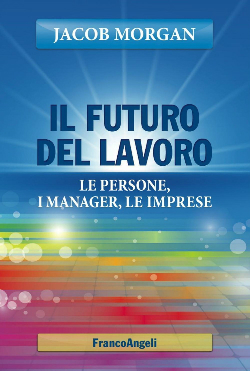
Work is good for us all. This seems to be an obvious and undisputed concept but it’s not. Above all if we think of conflicts in the workplace, namely the tough relationship between the company and the worker. Nonetheless, a new work concept channels much of a new business culture that can go a long way in terms of growth and development possibilities. Jacob Morgan’s The Future of Work: Attract New Talent, Build Better Leaders, and Create a Competitive Organization, just translated into Italian [Il futuro del lavoro. Le persone, i manager, le imprese], is a great read for understanding the changes under way.
For years Morgan has been observing large companies and generally shifting work trends in the economy. He is co-founder of the Chess Media Group, a strategy consultancy, but has also worked for companies like Safeway, Sodexo, Siemens, Lowe Bricolage, Franklin Templeton Investments, and analyses changes in the work system by comparing it to a game of chess. Morgan says the secret of winning is the same, namely the ability to subvert the traditional rules and patterns of the game. Starting from this premise, the book begins to describe – in 11 chapters – what is changing and how to adapt (the same rule for company or worker) to an evolving mechanism.
So, if the worker of today is merely the pawn on the chessboard, they have to obey “seven rules” to become a pawn that counts in a modern workplace game, and in dealing with managers able to decide the employment fate of many (but also risking their own future). Morgan then considers the role of organization and technology which are the two key elements, as well as the pawn’s abilities, in deciding the progress of the game.
Morgan’s book is a good read and offers readers a positive albeit complex scenario.
And it is also something of a visionary book, woven with utopias, and an engaging tale. Towards the end the author says that the years to come will be hectic and full of opportunities for workers, managers and companies. We’re facing noticeable changes affecting the way we work, management practices, the way companies are run, and the way we consider work in general. In future, the employee will not be seen just as a pawn, a manager as a slave driver, the company as a gang of scoundrels, and work as a chore. Work is an experience that the company and the employees build together, and this works to the advantage of both. The valorization of the worker goes far beyond a mere pay packet. It’s about personal satisfaction, empowerment, happiness, sense of fulfilment and accomplishment, and other non-monetary benefits. And as far as workers are concerned, in the foreseeable future they will be people who work for a company because they want to, not because they have to.
They believe in what the company does, appreciate their work and the people they interact with, and the company of which they are a part. While managers areleaders serving co-workers, aiming to empower not to control them or manage them in a frenzied way.
Managers consider employees as a fundamental resource for the company, not as mere pawns. Last but not least, for Morgan, companies are institutions that want to improve the employee’s work experience, as well as that of the customer, and believe in engaging the former, to encourage them. As we said, visionary, but business culture needs this too.
The Future of Work: Attract New Talent, Build Better Leaders, and Create a Competitive Organization.
Jacob Morgan
Wiley, 2014
Thank you for your request
You will receive an email confirming your subscription to the newsletter.