


Corporate culture curated by Antonio Calabrò
Industry at its finest gives rise to culture, forging original combinations of value and values, profitability and social relations
| Level | Photographic shoot |
| Definition of the object | Various materials (6 positives and 1 negative) (7) |
| Author | Editorial Haynes Lda. S.A. |
| Period | 21 January 1954 - 10 November 1954 |
| Place taken | Buenos Aires |
| General description of the subject | Buenos Aires Grand Prix 1954 |
| Technical data |
6 positives - 23.5 x 17; 14 x 19.5 - B/W - gelatin silver bromide/paper 1 negative - 23.7 x 17.7 - B/W - gelatin silver bromide/glass |
| People | Marimon, Onofre Farina, Nino González, José Froilán Fangio, Juan Manuel Maglioli, Umberto |
| Categories | Sport > Car races > City of Buenos Aires Grand Prix |
| Vehicles > Automobiles > Maserati |
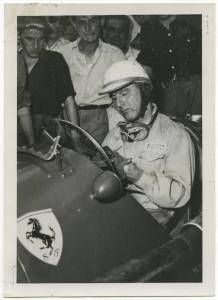
| Image 1 di 5 | |
| Number | 9290 |
| Definition | print on paper |
| Full description of the subject | Driver Nino Farina of Ferrari at the Buenos Aires Grand Prix in 1954 |
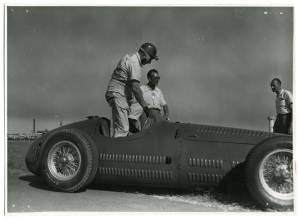
| Image 1 di 5 | |
| Number | 9286 |
| Definition | print on paper |
| Full description of the subject | Driver Juan Manuel Fangio of Maserati fitted with Pirelli tyres at the Buenos Aires Grand Prix in 1954 |
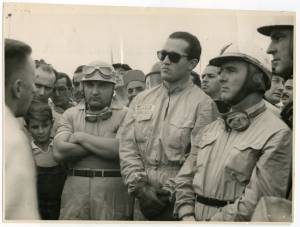
| Image 1 di 5 | |
| Number | 9288 |
| Definition | print on paper |
| Full description of the subject | Buenos Aires Grand Prix 1954: from left to right, drivers José Froilán González, Umberto Maglioli and Nino Farina |
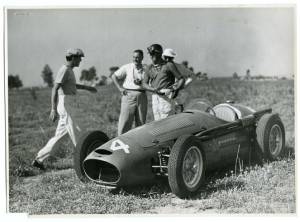
| Image 1 di 5 | |
| Number | 9289 |
| Definition | print on paper |
| Full description of the subject | Driver Onofre Marimon stopped due to vehicle damage during the Buenos Aires Grand Prix in 1954 |
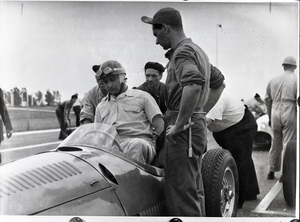
| Image 1 di 5 | |
| Number | 9287 c740 s/43 |
| Definition | negative on plate |
| Full description of the subject | Driver Juan Manuel Fangio of Maserati fitted with Pirelli tyres at the Buenos Aires Grand Prix in 1954 |

Established in 2008 Pirelli Foundation starts to operate in 2009 at the request of the Group and of the Pirelli family, in order to protect and disseminate knowledge of the company's cultural, historical and contemporary heritage and to promote its business culture. The Pirelli Foundation is headquartered at "Fabbricato 134", a historical building in the former Pirelli industrial district at the heart of a major urban redevelopment project in 1985 called "Progetto Biccocca", a symbol of transformation from the industrial age to the post-industrial era.