
Milan’s vibrancy and the triumphs of design. Gio Ponti’s wisdom comes to the fore once again


‘In construction, it’s not concrete, it’s not wood, it’s not stone, it’s not steel, it’s not glass that’s the most resilient element. The most resilient material in construction is art.’ These are the words of Gio Ponti. And with them, he identifies, as the cornerstone of a building’s life (and, by extension, of an object), not so much and not merely the strength of the material, but that other dimension, far more difficult to define, which is beauty, the artistic quality of a building.
Construction of the Pirelli Tower in Milan began in 1956 and it opened in 1960. A symbol of Italy’s economic boom, it continues to serve as a distinctive landmark and a symbol of the city’s identity, even though other beautiful and famous skyscrapers have been built in Milan over the years. Why has it defied the passage of time? Designed by Ponti himself, with the structural elements designed by Pier Luigi Nervi, the skyscraper has become an icon thanks to its distinctive octagonal shape. Over the years it has come to symbolise modernity. Only time will tell how many and which other buildings will share these same characteristics. In the meantime, however, the tower, known affectionately as the ‘Pirellone’ (The Big Pirelli), remains. It’s impossible not to look at it, whether you’re visiting Milan for the first or the thousandth time.
Another quote from Ponti that is particularly worth bearing in mind at this time of year, with all the Salone del Mobile events in full swing, is: ‘In Italy, art fell in love with industry. That’s why industry is a cultural matter.’
Of course, it is impossible to know how many of the exhibition’s over 300,000 visitors are familiar with, or even have a vague recollection of, Ponti’s theoretical ideas and insights. The fact remains that Italian design has continued to play a pioneering role on the world stage precisely thanks to the synthesis of form and function, the working of materials, and the evolution of construction techniques (and thus thanks to the ‘great masters of design’, from Ponti and Enzo Mari to Achille Castiglioni, Gae Aulenti, Carlo Scarpa and Franco Albini, and all those who came after them). Industrial design and everyday objects. Products that are part of our daily lives and enhance their quality. Not mere decoration, but art and industry.
The figures confirm this once again this year, despite concerns in the run-up to the Salone del Mobile (wars, transport issues, international tensions, etc.). Over 300,000 visitors and more than 1,900 exhibitors from 32 countries spanning various sectors, including woodworking and mechanical engineering, came together to generate a production turnover of almost €28 billion, confirming the event’s status as a benchmark for the finest ‘Made in Italy’ products. These include mechanical and mechatronics engineering, robotics, the automotive sector, shipbuilding and aerospace, rubber and plastics, chemicals and pharmaceuticals, food and furniture.
The green economy was also represented. The latest edition of the Design Economy Report, presented by Symbola, Deloitte, PoliDesign and ADI (Il Sole 24 Ore, 16 April), confirms that, as Realacci, president of Symbola notes, Italy’s leadership in design reaffirms its role as the intangible infrastructure of ‘Made in Italy’ and puts it at the forefront of the global drive towards sustainability.
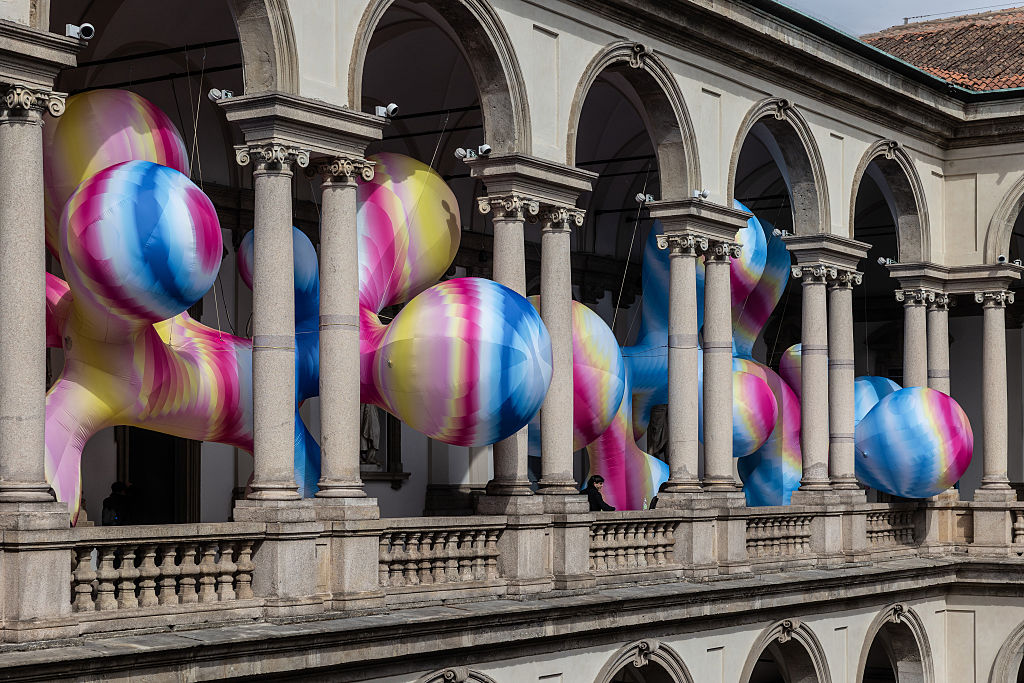
Thanks to events such as the Salone and others organised by Fiera Milano abroad, Milan continues to be a popular destination for students, designers, entrepreneurs, artists and media and photography professionals. And whilst the health of a metropolis can be gauged in many ways, it is precisely events such as the Salone del Mobile (and the international activities of the ADI, the Association of Industrial Design, with its ‘Compasso d’Oro’ awards) that serve as a barometer of the dynamic interplay between industry and culture, design and product, creativity and the development of various art forms.
Milan: a metropolis in the making, with all its limitations and dark sides. Nonetheless, it is a city to be studied, nurtured and lived in, balancing commerce and community life, cultural productivity and high-level education.
Milan: a work in progress. One of the city’s most iconic squares, the rectangular space between Via Pantano and Via Festa del Perdono right beneath Torre Velasca (another of Milan’s landmarks currently undergoing a transformation), has just been renovated.
Opposite Torre Velasca, the Assolombarda building, home to the business association, has also been refurbished and now features steel and glass façades and an internal garden. It was designed in the late 1950s by Gio Ponti himself.
And so we return to Ponti. A special exhibition space dedicated to his work will open by the end of the year, with 700 square metres devoted to his oeuvre, thanks to an agreement between the Lombardy Region and the ADI Museum. It will be a tribute to his memory. But also a lesson for all those who wish to continue visiting Milan to see how a city changes and grows, never forgetting its culture, and ever mindful of preserving its modernity, despite everything. Ultimately, Boccioni has been proven right: ‘The City Rises…’
(photo Getty Images)