

Dall’Alessi alla Pirelli. Tutti in gita in azienda
06 June 2019

Accessibility Come visit us.
Find out moreHelp with your research To access the Historical Archive's documents and materials, please fill out the form to request an appointment.
Request an appointmentHelp with your research To access the Historical Archive's documents and materials, please fill out the form to request an appointment.
Request an appointmentThe Pirelli Foundation Educational Programs
Explore pathsCome visit us.
Come visit us.
To access the Historical Archive's documents and materials, please fill out the form to request an appointment.
Grazie per la tua richiesta
Riceverai una mail di conferma dell'avvenuta ricezione della richiesta e sarai ricontattato.
Grazie per la tua richiesta
Abbiamo ricevuto la tua richiesta. Sarai ricontattato dallo staff di Fondazione Pirelli Educational.
Grazie per la tua richiesta
Abbiamo ricevuto la tua richiesta. Sarai ricontattato al più presto.
From Ermanno Scopinich to Annie Leibovitz: photography in Pirelli’s modern visual communication
Twenty-five years have gone by since Annie Leibovitz took her shot for the famous Pirelli advertising campaign with the American sprinter Carl Lewis in the starting blocks wearing red stilettos. “Power is nothing without control” reads the celebrated headline, the brainchild of the Young & Rubicam agency, which worked on the company’s advertising for several years. The image of the many-times Olympic champion was also used in 1996 by the photographer Albert Watson – who shot the Pirelli Calendar in 2019 – for motorcycle tyres.
During PhotoWeek 2019, the Pirelli Foundation is celebrating the anniversary with a journey through the evolution of photography in Pirelli’s modern visual communication: from the experiments of Ermanno Scopinich just after the war to Bob Noorda’s collages in the 1950s, through to the ingenious “Tyre with a Capital P” of 1978, and the international wave of creativity in the 1980s and 1990s. The stars are the photographers who, over the years, worked with the Agenzia Centro, and whose successors today illustrate the Pirelli Annual Report.
Photographs from the Pirelli Historical Archive and Advertising with a Capital P, the exhibition now running at the Pirelli Foundation, retrace the inextricable bond that unites photography with the world of business.
Free of charge, while places last.
DATE AND TIMES: Friday 7 June / 5.30 p.m. and 7 p.m.
An aperitif will be offered at the end of each tour.

From Ermanno Scopinich to Annie Leibovitz: photography in Pirelli’s modern visual communication
Twenty-five years have gone by since Annie Leibovitz took her shot for the famous Pirelli advertising campaign with the American sprinter Carl Lewis in the starting blocks wearing red stilettos. “Power is nothing without control” reads the celebrated headline, the brainchild of the Young & Rubicam agency, which worked on the company’s advertising for several years. The image of the many-times Olympic champion was also used in 1996 by the photographer Albert Watson – who shot the Pirelli Calendar in 2019 – for motorcycle tyres.
During PhotoWeek 2019, the Pirelli Foundation is celebrating the anniversary with a journey through the evolution of photography in Pirelli’s modern visual communication: from the experiments of Ermanno Scopinich just after the war to Bob Noorda’s collages in the 1950s, through to the ingenious “Tyre with a Capital P” of 1978, and the international wave of creativity in the 1980s and 1990s. The stars are the photographers who, over the years, worked with the Agenzia Centro, and whose successors today illustrate the Pirelli Annual Report.
Photographs from the Pirelli Historical Archive and Advertising with a Capital P, the exhibition now running at the Pirelli Foundation, retrace the inextricable bond that unites photography with the world of business.
Free of charge, while places last.
DATE AND TIMES: Friday 7 June / 5.30 p.m. and 7 p.m.
An aperitif will be offered at the end of each tour.
“Over the years, the magazine has won and continues to win a chorus of approval. Sometimes it really tests our nerve, but in actual fact – but don’t you tell anyone – we enjoy it, just as we enjoy all our work, which is very varied and puts us in contact with artists, writers, architects, journalists: people who are singular, to say the least, sometimes a bit strange, but always fascinating.”
These words of Arrigo Castellani, who for a long time headed the Pirelli Advertising department and was the director of Pirelli magazine, open the book Industrial Humanism: An Anthology of Thoughts, Words, Images and Innovations, in bookstores from June. Edited by the Pirelli Foundation and published by Mondadori, the book documents the experience of Pirelli. Rivista d’informazione e di tecnica, published from 1948 to 1972.
The Historical Archive of the Pirelli Group contains a complete collection of the magazine, with 131 original issues and a photographic collection of about 6,000 images, with 3,500 photographs that accompanied the original articles and almost 2,500 unpublished pictures, some of which have been selected for this book. The aim of the publishing project is to highlight the multidisciplinary nature of the magazine, which was launched with the declared aim of bringing together scientific and technical culture and liberal culture, commissioning articles and investigations from the most authoritative names of the period. These included Dino Buzzati, Camilla Cederna, Gillo Dorfles, Umberto Eco, Carlo Emilio Gadda, Eugenio Montale, Umberto Saba, Leonardo Sciascia, Salvatore Quasimodo, Giuseppe Ungaretti, and Umberto Veronesi. The magazine was beautifully illustrated with splendid photo shoots by such masters of photography as Arno Hammacher, Pepi Merisio, Ugo Mulas, Federico Patellani, Fulvio Roiter, and Enzo Sellerio and with illustrations by artists like Renato Guttuso, Riccardo Manzi, and Alessandro Mendini. The preface by Marco Tronchetti Provera and essays by Antonio Calabrò, Gian Arturo Ferrari and Philippe Daverio, are followed by an anthological section in which articles from the magazine, reproduced in their entirety or in selected excerpts, are divided into thematic areas. The publishing project accompanies the rivistapirelli.org platform (soon to be online), which examines the content of the book also in a digital environment.
The book will be presented on 19 June at the Teatro Franco Parenti in Milan in the presence of Marco Tronchetti Provera, Executive Vice Chairman and CEO of Pirelli and President of the Pirelli Foundation, Gian Arturo Ferrari, writer, and Antonio Calabrò, Managing Director and Director of the Pirelli Foundation. During the evening, stories, readings and musical interludes will create a show entirely devoted to the world of Pirelli magazine. Guests will include the singer Ornella Vanoni and the actress Anna Ammirati.

“Over the years, the magazine has won and continues to win a chorus of approval. Sometimes it really tests our nerve, but in actual fact – but don’t you tell anyone – we enjoy it, just as we enjoy all our work, which is very varied and puts us in contact with artists, writers, architects, journalists: people who are singular, to say the least, sometimes a bit strange, but always fascinating.”
These words of Arrigo Castellani, who for a long time headed the Pirelli Advertising department and was the director of Pirelli magazine, open the book Industrial Humanism: An Anthology of Thoughts, Words, Images and Innovations, in bookstores from June. Edited by the Pirelli Foundation and published by Mondadori, the book documents the experience of Pirelli. Rivista d’informazione e di tecnica, published from 1948 to 1972.
The Historical Archive of the Pirelli Group contains a complete collection of the magazine, with 131 original issues and a photographic collection of about 6,000 images, with 3,500 photographs that accompanied the original articles and almost 2,500 unpublished pictures, some of which have been selected for this book. The aim of the publishing project is to highlight the multidisciplinary nature of the magazine, which was launched with the declared aim of bringing together scientific and technical culture and liberal culture, commissioning articles and investigations from the most authoritative names of the period. These included Dino Buzzati, Camilla Cederna, Gillo Dorfles, Umberto Eco, Carlo Emilio Gadda, Eugenio Montale, Umberto Saba, Leonardo Sciascia, Salvatore Quasimodo, Giuseppe Ungaretti, and Umberto Veronesi. The magazine was beautifully illustrated with splendid photo shoots by such masters of photography as Arno Hammacher, Pepi Merisio, Ugo Mulas, Federico Patellani, Fulvio Roiter, and Enzo Sellerio and with illustrations by artists like Renato Guttuso, Riccardo Manzi, and Alessandro Mendini. The preface by Marco Tronchetti Provera and essays by Antonio Calabrò, Gian Arturo Ferrari and Philippe Daverio, are followed by an anthological section in which articles from the magazine, reproduced in their entirety or in selected excerpts, are divided into thematic areas. The publishing project accompanies the rivistapirelli.org platform (soon to be online), which examines the content of the book also in a digital environment.
The book will be presented on 19 June at the Teatro Franco Parenti in Milan in the presence of Marco Tronchetti Provera, Executive Vice Chairman and CEO of Pirelli and President of the Pirelli Foundation, Gian Arturo Ferrari, writer, and Antonio Calabrò, Managing Director and Director of the Pirelli Foundation. During the evening, stories, readings and musical interludes will create a show entirely devoted to the world of Pirelli magazine. Guests will include the singer Ornella Vanoni and the actress Anna Ammirati.
The gears, the wheels, the pulleys, the propellers. Water, fire, wind. Physics and chemistry. Machines and their movement, in Leonardo da Vinci’s drawings, represent a civilization of science and technology that still today needs to be considered and reconsidered, as the essential foundation of our original industrial humanism that, with wisdom, links memory and future and is a positive paradigm in the limelight of scientific thought and the international economy.In the great context of events, exhibitions and initiatives to commemorate and celebrate the five hundredth anniversary of the death of a genius of art and science, it is worth dwelling on one of Leonardo’s main attitudes: the fact that he was an extraordinary, visionary mechanic, as also testified by the drawings of the Codex Atlanticus kept in the Biblioteca Ambrosiana and now on display in Rome, at the Scuderie del Quirinale, for an exhibition with the evocative title, “Leonardo, science before science”: projects, machines and precious codes “to tell the story of an artist who, with his research, anticipated modern technologies”.”Genius & enterprise”, therefore. This is the name of the initiative organized by Assolombarda and Confindustria Firenze, on May 3, to talk about Leonardo and insist on innovation as an essential cornerstone of knowledge and development. The idea of the two presidents, Carlo Bonomi and Luigi Salvatori, is “to unite the capitals of Italian know-how”, through the entrepreneurial associations “that best express the Italian manufacturing that the world likes”, enhancing a figure like Leonardo who is “a model of strategic innovation able to stimulate the entrepreneurial culture”, a “symbol of planning”.Leonardo, in fact, is a “spirit of research” but also a constant aptitude to set in motion consequent production processes, governing the regime of the waters of the canals, building fortifications and war machines, designing objects and gears, working with workshop tools specially created. A mechanical genius, in fact. “Genio & impresa” is the combination that is repeated also for a research that Assolombarda has started in collaboration with the Leadership Design and Innovation Lab of Politecnico di Milano, to enhance the historical relationships between research and business (testimonial of some of the best Italian industries, such as Pirelli) and identify and give space to new realities in which innovation creates economic value and development. The basic idea is to take advantage of Leonardo’s inventive ability and his ability to represent and implement the transformation of invention into teak, which is currently effective and productive, to let the imagination run wild to find new solutions to the demands that came to him from customers fascinated by the new possibilities offered by contemporary science (such as Ludovico il Moro). Leonardo is the pinnacle of this. But there are also extraordinary examples of this in the laboratories, workshops and construction sites where Brunelleschi and Michelangelo lay the foundations for their extraordinary architectural and sculptural operations, in the colour workshops of Antonello da Messina, Raphael, Michelangelo and Titian as chemical factories and in the foundries of engravers such as Cellini. Our “knowing how to do beautiful things that the world likes”, to use the essential definition of a great European historian of economics, Carlo Maria Cipolla, has its roots in this “polytechnic culture” that feeds on science, taste, beauty. And even today, Italian industrial skills, in mechanics and mechatronics, rubber, chemistry and pharmaceuticals, in the traditional sectors of Made in Italy such as clothing, furniture and agribusiness, but also in worlds such as automotive, avionics and shipbuilding are strongly marked by a competitiveness that has historical roots in manufacturing areas and cultural antennas sensitive to the changes and innovations of the most unscrupulous creativity and passion for research and innovative technology. And to his proactive spirit. Luigi Salvadori insists: “Our alliance, between Assolombarda and Confindustria Firenze, is intended as an appeal to Italy to push on the attraction of talent, to become a society open to innovation and modernity.

The gears, the wheels, the pulleys, the propellers. Water, fire, wind. Physics and chemistry. Machines and their movement, in Leonardo da Vinci’s drawings, represent a civilization of science and technology that still today needs to be considered and reconsidered, as the essential foundation of our original industrial humanism that, with wisdom, links memory and future and is a positive paradigm in the limelight of scientific thought and the international economy.In the great context of events, exhibitions and initiatives to commemorate and celebrate the five hundredth anniversary of the death of a genius of art and science, it is worth dwelling on one of Leonardo’s main attitudes: the fact that he was an extraordinary, visionary mechanic, as also testified by the drawings of the Codex Atlanticus kept in the Biblioteca Ambrosiana and now on display in Rome, at the Scuderie del Quirinale, for an exhibition with the evocative title, “Leonardo, science before science”: projects, machines and precious codes “to tell the story of an artist who, with his research, anticipated modern technologies”.”Genius & enterprise”, therefore. This is the name of the initiative organized by Assolombarda and Confindustria Firenze, on May 3, to talk about Leonardo and insist on innovation as an essential cornerstone of knowledge and development. The idea of the two presidents, Carlo Bonomi and Luigi Salvatori, is “to unite the capitals of Italian know-how”, through the entrepreneurial associations “that best express the Italian manufacturing that the world likes”, enhancing a figure like Leonardo who is “a model of strategic innovation able to stimulate the entrepreneurial culture”, a “symbol of planning”.Leonardo, in fact, is a “spirit of research” but also a constant aptitude to set in motion consequent production processes, governing the regime of the waters of the canals, building fortifications and war machines, designing objects and gears, working with workshop tools specially created. A mechanical genius, in fact. “Genio & impresa” is the combination that is repeated also for a research that Assolombarda has started in collaboration with the Leadership Design and Innovation Lab of Politecnico di Milano, to enhance the historical relationships between research and business (testimonial of some of the best Italian industries, such as Pirelli) and identify and give space to new realities in which innovation creates economic value and development. The basic idea is to take advantage of Leonardo’s inventive ability and his ability to represent and implement the transformation of invention into teak, which is currently effective and productive, to let the imagination run wild to find new solutions to the demands that came to him from customers fascinated by the new possibilities offered by contemporary science (such as Ludovico il Moro). Leonardo is the pinnacle of this. But there are also extraordinary examples of this in the laboratories, workshops and construction sites where Brunelleschi and Michelangelo lay the foundations for their extraordinary architectural and sculptural operations, in the colour workshops of Antonello da Messina, Raphael, Michelangelo and Titian as chemical factories and in the foundries of engravers such as Cellini. Our “knowing how to do beautiful things that the world likes”, to use the essential definition of a great European historian of economics, Carlo Maria Cipolla, has its roots in this “polytechnic culture” that feeds on science, taste, beauty. And even today, Italian industrial skills, in mechanics and mechatronics, rubber, chemistry and pharmaceuticals, in the traditional sectors of Made in Italy such as clothing, furniture and agribusiness, but also in worlds such as automotive, avionics and shipbuilding are strongly marked by a competitiveness that has historical roots in manufacturing areas and cultural antennas sensitive to the changes and innovations of the most unscrupulous creativity and passion for research and innovative technology. And to his proactive spirit. Luigi Salvadori insists: “Our alliance, between Assolombarda and Confindustria Firenze, is intended as an appeal to Italy to push on the attraction of talent, to become a society open to innovation and modernity.
Europe: the Mediterranean offers good examples. Spain registered a growth of 2.6% in 2018 (three times higher than Italy’s sluggish 0.9%), and 2.2% growth is forecast for 2019 (compared to zero or lower for Italy). Portugal’s GDP grew 2% in 2018 (after a solid 2.7% in 2017), and the country estimates a further 1.5% growth for 2019. Both are fragile economies, naturally. They are emerging from a season of heavy recession when they had to made serious adjustments to the public finances that entailed significant social costs. They have experienced lagging production and partial absence from strategic sectors of the digital economy. Yet they are changing, growing, innovating and attracting investments at the same time. They are endeavouring to develop new forms of economic and social balance. In hard times of crisis and protests against the EU, these countries have chosen to remain clearly tied to the regulations and strategies of Brussels, the focal point of commitments towards economic reform and recovery, instead of indulging in anti-Euro populism and dead-end sovereignism.
Until a few years ago, they were considered a problem for Europe, two of the four PIGS ‒ a crude acronym indicating Portugal, Italy, Greece and Spain ‒ the Mediterranean adrift, hotbeds of crisis that jeopardised the stability of the EU, bad apples on the Southern rim. These initials are now outdated in Europe’s public discourse. Public finances are not at risk in Spain and Portugal. These countries do not fuel harsh controversies against the single currency, nor do arguments against the “bureaucrats” of Brussels monopolize their political debate. More importantly, their economies are in clear recovery even amidst the recent difficult months of slowdown in the global economy. Greece is struggling to find its way back on the road to reform, closing the improbable and extremist chapter of Tsipras-Varoufakis. The former Minister of Economy is no longer a player in political games and instead travels around giving speeches. Premier Tsipras, after leading his country to the verge of a Grexit and bankruptcy, is now the spokesman for responsible politics.
The case is still open for Italy: zero growth, alarmingly increasing public deficit on the verge of post-Maastricht tolerance and public debt well over 130% of the GDP with no credible signs of abatement. The spread is much higher than that of Spain and Portugal, still over 250 points, with repercussions on much higher costs to finance the debt. Indeed, in a time of global crisis with a government that wields controversy with the EU as a tool for heated electoral campaigns, Italy is the weak link of Europe. It is a problem for us and for the whole eurozone.
It is worthwhile to consider additional data (the financial daily Il Sole24Ore has published a detailed news report on Mediterranean Europe in recent weeks). We can look at international investments, for example. Spain (data from the Banco Santander Research Unit) has a stock of foreign investments amounting to $650 billion, equivalent to 50% of its GDP. Compare this to Germany’s 30% or France and Italy’s 20%. The Spanish deficit dropped to 2.6% of its GDP, still one of the highest in the EU, but it is characterised by a virtuous reduction pathway that should lead to concluding the EU Excessive Deficit procedure in a matter of months. The debt is falling steadily, it was at 97.2% of the GDP in late 2018, almost one point below that of 2017. The spread is low, one third of Italy’s.
Consolidation of public finances and renewed investments are the keys to a successful economic policy. Exportation, attracting international capital and stimulating internal demand are also essential. All of this has to happen within the solid boundaries of Europe and the Euro. The basic political choices have been shared over time from one government to the next, from the People’s Party to the Socialists, even in the case of fragile political alliances and severe tension (extremist Catalan autonomists clashing with Barcelona and Madrid). Despite the limits and contradictions, these measures are bringing benefits in terms of equilibrium, recovery and a returned sense of well-being.
Portugal also provides data worth considering. The deficit is barely 0.5% of the GDP, the sign of healthy public finances able to free resources for investments (in 2017 the deficit was at 3%, after climbing to 11% at the height of the Great Crisis). Although the debt remains above 120% of the GDP, the primary surplus generated fosters confidence in a clear debt reduction pathway. ‘Portugal has managed to attain a level of credibility it had never enjoyed before,’ affirms Mario Centeno, Minister of Finance in the government headed by the Socialist Antonio Costa and, since 2018, president of the Brussels Eurogroup (the coordinating body for the Finance Ministers of the 19 eurozone countries). Centeno explains: ‘We have launched a positive mechanism based on growth, public finances and the resulting credibility that has had a multiplier effect on market confidence, which has translated into reducing interest rates to a historic minimum.’
In Lisbon as well, the successive governments led by conservatives then by the Socialists as of 2016, have concurred on the pathway of recovery and relaunch, developing a long-term perspective that places priority on the interests of Portugal rather than electoral propaganda. There is no sign of populism nor sovereignism. These countries maintain intelligent ties with Brussels, including a wise use of the European Funds available (a skill Italy, especially the Southern regions, appears to be particularly incapable of doing).
Carlo Cottarelli, as executive director of the International Monetary Fund, monitored Portugal’s situation for several years. He recently commented (Il Sole24Ore, 29 March): ‘The Costa government has always confirmed its firm intent to formulate and implement economic and fiscal policies that promote sustained and fair growth in a context of fiscal consolidation’, promoting ‘a fiscal adjustment completely in line with international commitments’, especially by ‘controlling costs and eliminating waste, which is necessary in a country with a high public debt’.
The results: two countries on a path of growth in the context of Europe, which considers them positive examples.
Italy could learn quite a lot from their Mediterranean lesson.

Europe: the Mediterranean offers good examples. Spain registered a growth of 2.6% in 2018 (three times higher than Italy’s sluggish 0.9%), and 2.2% growth is forecast for 2019 (compared to zero or lower for Italy). Portugal’s GDP grew 2% in 2018 (after a solid 2.7% in 2017), and the country estimates a further 1.5% growth for 2019. Both are fragile economies, naturally. They are emerging from a season of heavy recession when they had to made serious adjustments to the public finances that entailed significant social costs. They have experienced lagging production and partial absence from strategic sectors of the digital economy. Yet they are changing, growing, innovating and attracting investments at the same time. They are endeavouring to develop new forms of economic and social balance. In hard times of crisis and protests against the EU, these countries have chosen to remain clearly tied to the regulations and strategies of Brussels, the focal point of commitments towards economic reform and recovery, instead of indulging in anti-Euro populism and dead-end sovereignism.
Until a few years ago, they were considered a problem for Europe, two of the four PIGS ‒ a crude acronym indicating Portugal, Italy, Greece and Spain ‒ the Mediterranean adrift, hotbeds of crisis that jeopardised the stability of the EU, bad apples on the Southern rim. These initials are now outdated in Europe’s public discourse. Public finances are not at risk in Spain and Portugal. These countries do not fuel harsh controversies against the single currency, nor do arguments against the “bureaucrats” of Brussels monopolize their political debate. More importantly, their economies are in clear recovery even amidst the recent difficult months of slowdown in the global economy. Greece is struggling to find its way back on the road to reform, closing the improbable and extremist chapter of Tsipras-Varoufakis. The former Minister of Economy is no longer a player in political games and instead travels around giving speeches. Premier Tsipras, after leading his country to the verge of a Grexit and bankruptcy, is now the spokesman for responsible politics.
The case is still open for Italy: zero growth, alarmingly increasing public deficit on the verge of post-Maastricht tolerance and public debt well over 130% of the GDP with no credible signs of abatement. The spread is much higher than that of Spain and Portugal, still over 250 points, with repercussions on much higher costs to finance the debt. Indeed, in a time of global crisis with a government that wields controversy with the EU as a tool for heated electoral campaigns, Italy is the weak link of Europe. It is a problem for us and for the whole eurozone.
It is worthwhile to consider additional data (the financial daily Il Sole24Ore has published a detailed news report on Mediterranean Europe in recent weeks). We can look at international investments, for example. Spain (data from the Banco Santander Research Unit) has a stock of foreign investments amounting to $650 billion, equivalent to 50% of its GDP. Compare this to Germany’s 30% or France and Italy’s 20%. The Spanish deficit dropped to 2.6% of its GDP, still one of the highest in the EU, but it is characterised by a virtuous reduction pathway that should lead to concluding the EU Excessive Deficit procedure in a matter of months. The debt is falling steadily, it was at 97.2% of the GDP in late 2018, almost one point below that of 2017. The spread is low, one third of Italy’s.
Consolidation of public finances and renewed investments are the keys to a successful economic policy. Exportation, attracting international capital and stimulating internal demand are also essential. All of this has to happen within the solid boundaries of Europe and the Euro. The basic political choices have been shared over time from one government to the next, from the People’s Party to the Socialists, even in the case of fragile political alliances and severe tension (extremist Catalan autonomists clashing with Barcelona and Madrid). Despite the limits and contradictions, these measures are bringing benefits in terms of equilibrium, recovery and a returned sense of well-being.
Portugal also provides data worth considering. The deficit is barely 0.5% of the GDP, the sign of healthy public finances able to free resources for investments (in 2017 the deficit was at 3%, after climbing to 11% at the height of the Great Crisis). Although the debt remains above 120% of the GDP, the primary surplus generated fosters confidence in a clear debt reduction pathway. ‘Portugal has managed to attain a level of credibility it had never enjoyed before,’ affirms Mario Centeno, Minister of Finance in the government headed by the Socialist Antonio Costa and, since 2018, president of the Brussels Eurogroup (the coordinating body for the Finance Ministers of the 19 eurozone countries). Centeno explains: ‘We have launched a positive mechanism based on growth, public finances and the resulting credibility that has had a multiplier effect on market confidence, which has translated into reducing interest rates to a historic minimum.’
In Lisbon as well, the successive governments led by conservatives then by the Socialists as of 2016, have concurred on the pathway of recovery and relaunch, developing a long-term perspective that places priority on the interests of Portugal rather than electoral propaganda. There is no sign of populism nor sovereignism. These countries maintain intelligent ties with Brussels, including a wise use of the European Funds available (a skill Italy, especially the Southern regions, appears to be particularly incapable of doing).
Carlo Cottarelli, as executive director of the International Monetary Fund, monitored Portugal’s situation for several years. He recently commented (Il Sole24Ore, 29 March): ‘The Costa government has always confirmed its firm intent to formulate and implement economic and fiscal policies that promote sustained and fair growth in a context of fiscal consolidation’, promoting ‘a fiscal adjustment completely in line with international commitments’, especially by ‘controlling costs and eliminating waste, which is necessary in a country with a high public debt’.
The results: two countries on a path of growth in the context of Europe, which considers them positive examples.
Italy could learn quite a lot from their Mediterranean lesson.
The 14th National Geographic Science Festival opens today at the Auditorium Parco della Musica in Rome. The Pirelli Foundation is present at the event in the exhibition Inside Invention: Dentro la creatività italiana, curated by Vittorio Marchis. The title of the show that the Pirelli Foundation is offering to the public is Pirelli, A Passion for Rubber: A Long History of Commitment and Innovation, telling the story of how tyres have evolved through scientific and technological progress, from the first patents in the late nineteenth century to the “smart” tyres of today, by way of the revolutionary Cinturato and the concept of the low-profile tyre. During the seven days that the exhibition will be open – from today to Sunday, 14 April – visitors, including about 18,000 students from schools of various levels, will be able to retrace the great landmarks in the history of Long-P tyres. The display includes cross-sections of tyres, patents, catalogues, advertising posters, and photographs from the Pirelli Historical Archive.
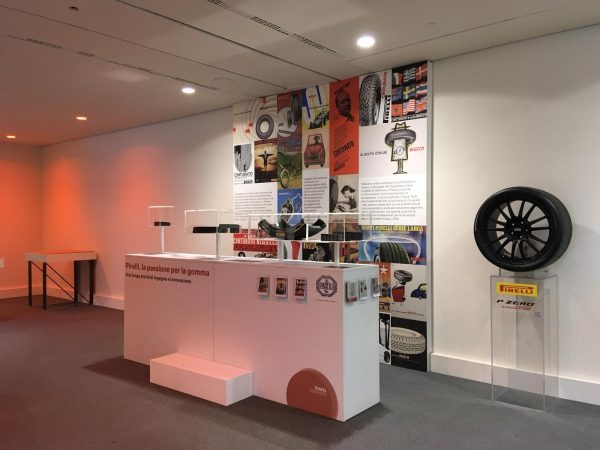
The 14th National Geographic Science Festival opens today at the Auditorium Parco della Musica in Rome. The Pirelli Foundation is present at the event in the exhibition Inside Invention: Dentro la creatività italiana, curated by Vittorio Marchis. The title of the show that the Pirelli Foundation is offering to the public is Pirelli, A Passion for Rubber: A Long History of Commitment and Innovation, telling the story of how tyres have evolved through scientific and technological progress, from the first patents in the late nineteenth century to the “smart” tyres of today, by way of the revolutionary Cinturato and the concept of the low-profile tyre. During the seven days that the exhibition will be open – from today to Sunday, 14 April – visitors, including about 18,000 students from schools of various levels, will be able to retrace the great landmarks in the history of Long-P tyres. The display includes cross-sections of tyres, patents, catalogues, advertising posters, and photographs from the Pirelli Historical Archive.
Multimedia


Tackling some aspects of contemporary history in the classroom can be tricky at times, and the Cinema & History course, promoted by the Pirelli Foundation, the Fondazione ISEC (Institute for the Study of Contemporary History) and the Fondazione Cineteca Italiana, has been an educational mainstay for secondary school teachers for the past seven years. A new course for 2019, entitled “State, Nation, Sovereignty: Change and Conflict in Politics, Society, and the Economy”, examined the experience of nation states and their rise and fall in history, in the light of the globalisation processes currently under way.
The course came in the form of four lectures and guided tours at the Pirelli Foundation, three film screenings at the Museo Interattivo del Cinema (MIC) and a closing workshop at the Fondazione ISEC.
The first lecture held by Marco Meriggi, a professor at the University of Naples, investigated the historical cycle of the contemporary state and was followed by Wolfgang Becker’s film Goodbye Lenin.
Nationalisms in the nineteenth and twentieth centuries were examined in a meeting with Alessio Petrizzo of the University of Padua, and the screening that accompanied his lecture was Raoul Peck’s The Young Karl Marx.
Thanks to his professional experience as an international official, Guido Acquaviva was able to describe aspects concerning the state and sovereignty in an age of globalisation. The analysis continued with the third film selected for the teachers: Lucas Belvaux’s This Land is Our Land.
The last lecture, given by Antonio Calabrò, director of the Pirelli Foundation, took a close look at the birth of Europe and open markets from the point of view of Italian businesses also through Pirelli magazine, which was published from 1948 to 1972, and from which some articles on economics and politics were selected:
L’Europa fra «mercato comune» e «libero scambio», Ugo Alloisio, Pirelli magazine no. 4, 1961
Il paradosso americano, Arrigo Levi, Pirelli magazine no. 5, 1968
Emigrazione e mobilità del lavoro, Francesco Forte, Pirelli magazine no. 11, 1970
The final considerations and the focus group of the course were held this afternoon during the workshop organised by the educational section of the Fondazione ISEC.

Tackling some aspects of contemporary history in the classroom can be tricky at times, and the Cinema & History course, promoted by the Pirelli Foundation, the Fondazione ISEC (Institute for the Study of Contemporary History) and the Fondazione Cineteca Italiana, has been an educational mainstay for secondary school teachers for the past seven years. A new course for 2019, entitled “State, Nation, Sovereignty: Change and Conflict in Politics, Society, and the Economy”, examined the experience of nation states and their rise and fall in history, in the light of the globalisation processes currently under way.
The course came in the form of four lectures and guided tours at the Pirelli Foundation, three film screenings at the Museo Interattivo del Cinema (MIC) and a closing workshop at the Fondazione ISEC.
The first lecture held by Marco Meriggi, a professor at the University of Naples, investigated the historical cycle of the contemporary state and was followed by Wolfgang Becker’s film Goodbye Lenin.
Nationalisms in the nineteenth and twentieth centuries were examined in a meeting with Alessio Petrizzo of the University of Padua, and the screening that accompanied his lecture was Raoul Peck’s The Young Karl Marx.
Thanks to his professional experience as an international official, Guido Acquaviva was able to describe aspects concerning the state and sovereignty in an age of globalisation. The analysis continued with the third film selected for the teachers: Lucas Belvaux’s This Land is Our Land.
The last lecture, given by Antonio Calabrò, director of the Pirelli Foundation, took a close look at the birth of Europe and open markets from the point of view of Italian businesses also through Pirelli magazine, which was published from 1948 to 1972, and from which some articles on economics and politics were selected:
L’Europa fra «mercato comune» e «libero scambio», Ugo Alloisio, Pirelli magazine no. 4, 1961
Il paradosso americano, Arrigo Levi, Pirelli magazine no. 5, 1968
Emigrazione e mobilità del lavoro, Francesco Forte, Pirelli magazine no. 11, 1970
The final considerations and the focus group of the course were held this afternoon during the workshop organised by the educational section of the Fondazione ISEC.
The conference entitled “Biblioteche in Azienda: strumenti di welfare e di benessere“, organised by CSBNO today, 14 March, at the Stelline Foundation examines the theme of the library at the workplace. The discussion will focus on culture in companies, on the quality of work, and on company libraries, looking at the experiences of various companies. Pirelli will be present with a speech by Antonio Calabrò, Director of the Pirelli Foundation, which now runs the company libraries in Milan and Bollate.
Company libraries are a tradition that Pirelli has kept going for almost a century. The first Pirelli library was set up in 1928, when a subscription library with 800 books was made available to members of the Dopolavoro Aziende Pirelli, the workers’ club. This was one of the first examples of reading being promoted within a company. Pirelli now has three company libraries: in the offices of the Headquarters in Milano Bicocca, in the factory in Bollate, and in the Industrial Centre in Settimo Torinese. These three libraries together offer employees over 10,000 books. The Milan libraries have over 500 registered users and more than 320 subscribers to the periodical newsletter, and they make more than 250 loans and renewals each month. The libraries are just one of many projects introduced by the company to improve the quality of life at the workplace: “The importance of reading for a person’s education has always been written into the company’s DNA. Today we have libraries in Settimo Torinese, in Bollate, and in Bicocca and we are linked up to the entire Milanese Library System (SBM). This provides access to over a million documents, videos, magazines, newspapers, and books. We believe that reading is an important part of people’s lives and it is part of the relationship between Pirelli and culture that has always been at the heart of the open society in which Pirelli has its roots.” These are the words of Marco Tronchetti Provera, Executive Vice President of Pirelli and CEO and President of the Pirelli Foundation, showing how the Pirelli Libraries have become an essential part of the urban fabric in which they are rooted. They have also entered the library systems of the areas they are in: the Milano Bicocca library has been integrated into the Milanese Library System (SBM) and the one in Settimo Torinese collaborates with the Library System of the Turin Metropolitan Area (SBAM). A virtuous system of interaction between public and private.

The conference entitled “Biblioteche in Azienda: strumenti di welfare e di benessere“, organised by CSBNO today, 14 March, at the Stelline Foundation examines the theme of the library at the workplace. The discussion will focus on culture in companies, on the quality of work, and on company libraries, looking at the experiences of various companies. Pirelli will be present with a speech by Antonio Calabrò, Director of the Pirelli Foundation, which now runs the company libraries in Milan and Bollate.
Company libraries are a tradition that Pirelli has kept going for almost a century. The first Pirelli library was set up in 1928, when a subscription library with 800 books was made available to members of the Dopolavoro Aziende Pirelli, the workers’ club. This was one of the first examples of reading being promoted within a company. Pirelli now has three company libraries: in the offices of the Headquarters in Milano Bicocca, in the factory in Bollate, and in the Industrial Centre in Settimo Torinese. These three libraries together offer employees over 10,000 books. The Milan libraries have over 500 registered users and more than 320 subscribers to the periodical newsletter, and they make more than 250 loans and renewals each month. The libraries are just one of many projects introduced by the company to improve the quality of life at the workplace: “The importance of reading for a person’s education has always been written into the company’s DNA. Today we have libraries in Settimo Torinese, in Bollate, and in Bicocca and we are linked up to the entire Milanese Library System (SBM). This provides access to over a million documents, videos, magazines, newspapers, and books. We believe that reading is an important part of people’s lives and it is part of the relationship between Pirelli and culture that has always been at the heart of the open society in which Pirelli has its roots.” These are the words of Marco Tronchetti Provera, Executive Vice President of Pirelli and CEO and President of the Pirelli Foundation, showing how the Pirelli Libraries have become an essential part of the urban fabric in which they are rooted. They have also entered the library systems of the areas they are in: the Milano Bicocca library has been integrated into the Milanese Library System (SBM) and the one in Settimo Torinese collaborates with the Library System of the Turin Metropolitan Area (SBAM). A virtuous system of interaction between public and private.
Thank you for your request
You will receive an email confirming your subscription to the newsletter.