
Archivi aperti per un secolo di fotografie
23 October 2019

Accessibility Come visit us.
Find out moreHelp with your research To access the Historical Archive's documents and materials, please fill out the form to request an appointment.
Request an appointmentHelp with your research To access the Historical Archive's documents and materials, please fill out the form to request an appointment.
Request an appointmentThe Pirelli Foundation Educational Programs
Explore pathsCome visit us.
Come visit us.
To access the Historical Archive's documents and materials, please fill out the form to request an appointment.
Grazie per la tua richiesta
Riceverai una mail di conferma dell'avvenuta ricezione della richiesta e sarai ricontattato.
Grazie per la tua richiesta
Abbiamo ricevuto la tua richiesta. Sarai ricontattato dallo staff di Fondazione Pirelli Educational.
Grazie per la tua richiesta
Abbiamo ricevuto la tua richiesta. Sarai ricontattato al più presto.
An overview of the steps to achieving true innovation in production organisation, as well as errors to avoid.
The process of change and constant renewal, not only to survive in the marketplace but also to gain increasingly profitable positions, can be summed up in just a few words: creating development and well-being. This is the usual recipe, renewal in order to move forward, but seldom is it fully applied, nor, even more importantly, completely understood by those who apply it. This is why reading Alessandro Scaglione’s ‘R-innovare il family business. L’intelligenza naturale dell’imprenditore contro la crisi globale’ (‘re-innovating the family business: the entrepreneur’s natural intelligence against the global crisis’), is the perfect step towards a deeper understanding of these topics.
The author is a management engineer who has long been involved in competitive strategies and globalisation processes, with a special focus on family businesses in the B2B context. In his book, Scaglione starts from the assumption that a family-owned business needs to build a strategy that involves both maintaining brand identity and international action, in order to be competitive in the marketplace. This is a clear indication, which nonetheless is not immune to a series of obstacles. It is thus necessary not only to avoid the most common errors (such as self-referencing, singular passage from father to son, attention solely on the product), but also be able to organise the best structured production. This implies not only making the best of what we call stakeholders, but also a strong propension to innovation (both in product and process) and a move towards globalisation that goes beyond the often negative step of offshoring.
Scaglione explains all this in a book that is densely written yet easy to read. He begins with an introduction on family business organisation before moving on to illustrate a method to analyse it. The author then proceeds to a close analysis of the most common errors that companies fall into, after which he discusses the ‘roads to innovation’: on the one hand, an attentive use of information technology and on the other, taking a new look at the very way production is organised.
The essence of the book (approximately 250 pages) is in the subtitle of the final chapter: ‘Awareness and intelligence as a competitive edge’. The author summarises this well-rounded company culture in the final pages of his work. ‘The company culture merges into the views held by people, who in all respects become the ones who convey its value and worth.’ He continues: ‘We should not be ashamed to be slightly philosophical about our vision and instil in it the ethic of a company culture that places the ‘person’ at the heart of an ecosystem of collective interest. It is only through self-recognition, an identity and a sense of belonging, that we can unlock untapped knowledge and potential, transforming them into a competitive advantage that generates short-, medium- and long-term value.’
‘R-innovare il family business’ is great on the first read and well worth a second after a while.
R-innovare il family business. L’intelligenza naturale dell’imprenditore contro la crisi globale
Alessandro Scaglione
Guerini Next, 2019

An overview of the steps to achieving true innovation in production organisation, as well as errors to avoid.
The process of change and constant renewal, not only to survive in the marketplace but also to gain increasingly profitable positions, can be summed up in just a few words: creating development and well-being. This is the usual recipe, renewal in order to move forward, but seldom is it fully applied, nor, even more importantly, completely understood by those who apply it. This is why reading Alessandro Scaglione’s ‘R-innovare il family business. L’intelligenza naturale dell’imprenditore contro la crisi globale’ (‘re-innovating the family business: the entrepreneur’s natural intelligence against the global crisis’), is the perfect step towards a deeper understanding of these topics.
The author is a management engineer who has long been involved in competitive strategies and globalisation processes, with a special focus on family businesses in the B2B context. In his book, Scaglione starts from the assumption that a family-owned business needs to build a strategy that involves both maintaining brand identity and international action, in order to be competitive in the marketplace. This is a clear indication, which nonetheless is not immune to a series of obstacles. It is thus necessary not only to avoid the most common errors (such as self-referencing, singular passage from father to son, attention solely on the product), but also be able to organise the best structured production. This implies not only making the best of what we call stakeholders, but also a strong propension to innovation (both in product and process) and a move towards globalisation that goes beyond the often negative step of offshoring.
Scaglione explains all this in a book that is densely written yet easy to read. He begins with an introduction on family business organisation before moving on to illustrate a method to analyse it. The author then proceeds to a close analysis of the most common errors that companies fall into, after which he discusses the ‘roads to innovation’: on the one hand, an attentive use of information technology and on the other, taking a new look at the very way production is organised.
The essence of the book (approximately 250 pages) is in the subtitle of the final chapter: ‘Awareness and intelligence as a competitive edge’. The author summarises this well-rounded company culture in the final pages of his work. ‘The company culture merges into the views held by people, who in all respects become the ones who convey its value and worth.’ He continues: ‘We should not be ashamed to be slightly philosophical about our vision and instil in it the ethic of a company culture that places the ‘person’ at the heart of an ecosystem of collective interest. It is only through self-recognition, an identity and a sense of belonging, that we can unlock untapped knowledge and potential, transforming them into a competitive advantage that generates short-, medium- and long-term value.’
‘R-innovare il family business’ is great on the first read and well worth a second after a while.
R-innovare il family business. L’intelligenza naturale dell’imprenditore contro la crisi globale
Alessandro Scaglione
Guerini Next, 2019
Research presented at the Scientific Colloquium on Social Enterprise 2019 provides the basic criteria for evaluating the relationship between a company and the local area.
Business and the local area can work in harmony, giving rise to organisations that, until recently, simply did not exist. These are economic but also social entities. They are communities of production, with profit as their ultimate goal, but also systems of social relations in which profit is accompanied by something else (of equal importance). We often look to hybrid organisations to achieve this development. And these are the organisations it’s worth getting to know.
Paolo Biancone, Silvana Secinaro, Valerio Brescia, and Daniel Iannaci (from the department of management at the University of Turin) have thought about this goal, in their research ‘La misurazione dell’impatto sociale nelle organizzazioni ibride’ (‘measuring the social impact of hybrid organisations’), presented at the XIII Scientific Colloquium on Social Enterprise last May in Rome.
The investigation starts from an assumption that comes from observing the real world; coping with the challenges posed today on a social and economic level implies, according to the four writers, ‘an inclusive entrepreneurial system, in other words one in which companies are the drivers of economic and social inclusion in the areas in which they work.’ But there’s more. Indeed, according to the authors, whereas ‘before the advent of globalisation the competition consisted of individual companies or individual business groups, which could come out as winners or losers, what is happening today is that the fate of companies is linked to that of their local area.’
So new conditions need to be addressed by new organisations. It is here that the working group coordinated by Paolo Biancone categorises hybrid organisations, understood as ‘business models dedicated to melding a social mission with activities that are commercial in nature.’ In other words, these are ‘models that turn the social dimension into a strategic asset that can regenerate resources of a different kind, human resources, by developing new knowledge and new skills: financial, by combining a wide range of sources precisely because of the hybrid nature of the organisation; physical, that is, linked to the process of transforming spaces into places, where relations become the fundamental ingredient for the success of the process.’
Something, that has to be done, however, is to measure and evaluate the economic effects of all of this. But to achieve a goal of this kind, new tools for both investigation and communication have to be developed.
After outlining the theoretical and practical scope of the subject, Biancone and the other researchers, go into popular financial reporting (POP), which is seen today as one of the most effective tools for measuring the impact of a hybrid organisation in terms of economy, finances, shares and society, meeting interested parties’ demand for information and transparency.
The research carried out by Biancone, Secinaro, Brescia and Iannaci deals with a complex theme of today’s economic environment, but it presents the salient aspects to readers clearly, albeit in decidedly technical language.
Misurare l’impatto sociale di un’impresa
Paolo Biancone, Silvana Secinaro, Valerio Brescia, Daniel Iannaci (department of management, University of Turin)
Paper, XIII Scientific Colloquium on Social Enterprise, Rome, May 2019.
Research presented at the Scientific Colloquium on Social Enterprise 2019 provides the basic criteria for evaluating the relationship between a company and the local area.
Business and the local area can work in harmony, giving rise to organisations that, until recently, simply did not exist. These are economic but also social entities. They are communities of production, with profit as their ultimate goal, but also systems of social relations in which profit is accompanied by something else (of equal importance). We often look to hybrid organisations to achieve this development. And these are the organisations it’s worth getting to know.
Paolo Biancone, Silvana Secinaro, Valerio Brescia, and Daniel Iannaci (from the department of management at the University of Turin) have thought about this goal, in their research ‘La misurazione dell’impatto sociale nelle organizzazioni ibride’ (‘measuring the social impact of hybrid organisations’), presented at the XIII Scientific Colloquium on Social Enterprise last May in Rome.
The investigation starts from an assumption that comes from observing the real world; coping with the challenges posed today on a social and economic level implies, according to the four writers, ‘an inclusive entrepreneurial system, in other words one in which companies are the drivers of economic and social inclusion in the areas in which they work.’ But there’s more. Indeed, according to the authors, whereas ‘before the advent of globalisation the competition consisted of individual companies or individual business groups, which could come out as winners or losers, what is happening today is that the fate of companies is linked to that of their local area.’
So new conditions need to be addressed by new organisations. It is here that the working group coordinated by Paolo Biancone categorises hybrid organisations, understood as ‘business models dedicated to melding a social mission with activities that are commercial in nature.’ In other words, these are ‘models that turn the social dimension into a strategic asset that can regenerate resources of a different kind, human resources, by developing new knowledge and new skills: financial, by combining a wide range of sources precisely because of the hybrid nature of the organisation; physical, that is, linked to the process of transforming spaces into places, where relations become the fundamental ingredient for the success of the process.’
Something, that has to be done, however, is to measure and evaluate the economic effects of all of this. But to achieve a goal of this kind, new tools for both investigation and communication have to be developed.
After outlining the theoretical and practical scope of the subject, Biancone and the other researchers, go into popular financial reporting (POP), which is seen today as one of the most effective tools for measuring the impact of a hybrid organisation in terms of economy, finances, shares and society, meeting interested parties’ demand for information and transparency.
The research carried out by Biancone, Secinaro, Brescia and Iannaci deals with a complex theme of today’s economic environment, but it presents the salient aspects to readers clearly, albeit in decidedly technical language.
Misurare l’impatto sociale di un’impresa
Paolo Biancone, Silvana Secinaro, Valerio Brescia, Daniel Iannaci (department of management, University of Turin)
Paper, XIII Scientific Colloquium on Social Enterprise, Rome, May 2019.
Roland Barthes talked about ‘the pleasure of the text.’ The joy of reading lies in discovering, understanding and learning. To enter into other worlds and lives in the pages of books. Umberto Eco put it best: ‘At the age of 70, the man who doesn’t read will have led only one life – his own! The man who reads will have lived five thousand years. He will have been there when Cain killed Abel, when Renzo married Lucia and when Leopardi admired the infinite. Because reading is immortality backwards.’ Each of us could add something of our own to that list: the adventures of Odysseus, the seas of Stevenson and Salgari, swarming with pirates, Hugo Pratt’s free-spirited hero Corto Maltese, John le Carré’s sensitive spies, the nostalgia and ‘terrifying insularity of mind’ of the Leopard, the controversial fascination of the Mediterranean in Matvejević’s work, the pain of love for Anna Karenina and Emma Bovary, the ironic joy of the great family in Gabriel García Márquez’s One Hundred Years of Solitude, the profound yet affectionate light-heartedness of the Little Prince, the Paul Street boys and the little women, Roald Dahl’s chocolate factory and the less wonderful factories of Primo Levi and Elio Vittorini, Gianni Rodari’s Telephone Tales (back in shops, we’re pleased to report, along with his other work, on the eve of the centenary of his birth), the deep uncertainty of Eugenio Montale’s lines ‘Today the only thing that we can tell you is what we are not / and what we do not want’, or the flash of beauty in ‘I illuminate myself with immensity’ by Giuseppe Ungaretti. Books are an endless story of discoveries, encounters, relationships and happiness.
The words of two great masters of the twentieth century, Barthes and Eco, come to mind at the fifth edition of ‘#ioleggoperché’, the initiative for promoting books and reading, a great project organised by the Italian Publishers Association (AIE), whose chairman is Ricardo Franco Levi. The event involves readers, schools, local authorities and businesses, and its aim is to give books to schools (more than 650,000 have been given in previous years, to 15,000 schools). Read for pleasure, for fun, for joy. Read to learn. Read so that we can be more civil and knowledgeable in building a responsible community.
‘La cultura come il pane’ (literally, ‘culture like bread’) is written right above the entrance to the Pirelli library at our headquarters in Bicocca, reflecting the history of close relationships between the Pirelli magazine and big names in Italian and European literature, art, photography, cinema, science and books. Just inside the large space, full of over 6,000 books, there is another essential quote: ‘The founding of libraries was like constructing more public granaries, amassing reserves against a spiritual winter which by certain signs, in spite of myself, I see ahead.’ It is taken from the pages of Memoirs of Hadrian by Marguerite Yourcenar, one of the most important books of the twentieth century. So, libraries like granaries. And culture like bread.
This awareness of reading, nurturing, citizenship, happiness and freedom also inspired ‘Teaming up with books’, an initiative organised by the Pirelli Foundation with AIE for ‘#ioleggoperché’. Three hundred children from primary and middle schools in Milan gathered together to discuss words, competitiveness, passion and good sportsmanship, and the adventure stories and poetry of The Little Prince (the book most read among the children present), with sporting legends Xavier Zanetti, Regina Baresi and Mario Isola, head of Formula 1 for Pirelli, as well as Luigi Garlando, writer and sports journalist, Laura Galimberti, councillor for education on the municipal council of Milan, and Ricardo Franco, president of AIE. It was quite the party. Like all good parties, it ended with a present, from Pirelli to Verga middle school: a voucher for three hundred books for the school library. This was testimony to a wider project, to build strong relationships between public, school and independent libraries, to spread interest and pleasure in books and reading.
Moreover, it is in the name of social improvement. One of the things shown by the data from a recent international OECD survey, published in Social Science Research. ‘Having a well-stocked book shelf at home gives teenagers an advantage in life. Today, children who have at least eighty books at home have above-average linguistic, mathematical and technological skills.’
Greater economic development also depends on books, in these times of great importance for the ‘knowledge economy.’ Also, understanding how to prompt a real ‘paradigm shift’ towards a sustainable economy, in environmental and social terms, and a circular and civil economy, which cares not only about producing new wealth, but also working out how to redistribute it, to drastically reduce inequality and poverty. The Nobel committee awarded its Prize in Economics a few days ago to three scholars, Michael Kremer, Abhijit Banerjee and Esther Duflo, for their research on poverty and how to tackle it.
From books, which are a form of long-term training over much of school and working life, as we wrote in last week’s blog, and by researching and addressing the questions posed by science and technology, we can learn become more knowledgeable and build a better future.
Genetic engineering and the evolution of artificial intelligence pose ethical, social and technical questions, which demand of all of us a sharper, more refined awareness of what we are and what we can become, right from childhood. We need engineers, poets, philosophers, engineers and technicians who know how to ask and present questions, writers and artists who are can take on and explain modernity and its paradoxes. This is a job not only for sophisticated and specialist elites, but from all citizens. Citizenship, with its rights and duties, opportunities and responsibilities, is learned from childhood. Rodari was a teacher (whence his ‘learn to do difficult things,’ as we touched on last week). Twentieth-century literature, with its essential books (by Conrad, Melville, Calvino, Gramsci, Keynes, Don Milani and so many others) is a very generous source.
‘Knowledge that matters’ is the motto of the Bocconi University in Milan. An original contemporary artist, Lorenzo Petrantoni, has made this the basis of an installation that will be unveiled tomorrow afternoon, in the large space in front of the entrance to the university, in Via Röntgen. It consists of large letters covered with thousands of tiny pieces of paper taken from documents, photographs, degree theses, strips of mathematical and economic calculations (‘Calculations and algorithms go beyond economics,’ Petrantoni claims) and books. Again we come back to books, and the duty and above all the pleasure of reading and writing.
Perhaps Stéphane Mallarmé was exaggerating a little when he said that ‘the world exists in order to end up as a book.’ But, brilliance of his aphorism aside, the French poet understood the value of a well-written page. Without the stories buried in books, we will never be better people.

Roland Barthes talked about ‘the pleasure of the text.’ The joy of reading lies in discovering, understanding and learning. To enter into other worlds and lives in the pages of books. Umberto Eco put it best: ‘At the age of 70, the man who doesn’t read will have led only one life – his own! The man who reads will have lived five thousand years. He will have been there when Cain killed Abel, when Renzo married Lucia and when Leopardi admired the infinite. Because reading is immortality backwards.’ Each of us could add something of our own to that list: the adventures of Odysseus, the seas of Stevenson and Salgari, swarming with pirates, Hugo Pratt’s free-spirited hero Corto Maltese, John le Carré’s sensitive spies, the nostalgia and ‘terrifying insularity of mind’ of the Leopard, the controversial fascination of the Mediterranean in Matvejević’s work, the pain of love for Anna Karenina and Emma Bovary, the ironic joy of the great family in Gabriel García Márquez’s One Hundred Years of Solitude, the profound yet affectionate light-heartedness of the Little Prince, the Paul Street boys and the little women, Roald Dahl’s chocolate factory and the less wonderful factories of Primo Levi and Elio Vittorini, Gianni Rodari’s Telephone Tales (back in shops, we’re pleased to report, along with his other work, on the eve of the centenary of his birth), the deep uncertainty of Eugenio Montale’s lines ‘Today the only thing that we can tell you is what we are not / and what we do not want’, or the flash of beauty in ‘I illuminate myself with immensity’ by Giuseppe Ungaretti. Books are an endless story of discoveries, encounters, relationships and happiness.
The words of two great masters of the twentieth century, Barthes and Eco, come to mind at the fifth edition of ‘#ioleggoperché’, the initiative for promoting books and reading, a great project organised by the Italian Publishers Association (AIE), whose chairman is Ricardo Franco Levi. The event involves readers, schools, local authorities and businesses, and its aim is to give books to schools (more than 650,000 have been given in previous years, to 15,000 schools). Read for pleasure, for fun, for joy. Read to learn. Read so that we can be more civil and knowledgeable in building a responsible community.
‘La cultura come il pane’ (literally, ‘culture like bread’) is written right above the entrance to the Pirelli library at our headquarters in Bicocca, reflecting the history of close relationships between the Pirelli magazine and big names in Italian and European literature, art, photography, cinema, science and books. Just inside the large space, full of over 6,000 books, there is another essential quote: ‘The founding of libraries was like constructing more public granaries, amassing reserves against a spiritual winter which by certain signs, in spite of myself, I see ahead.’ It is taken from the pages of Memoirs of Hadrian by Marguerite Yourcenar, one of the most important books of the twentieth century. So, libraries like granaries. And culture like bread.
This awareness of reading, nurturing, citizenship, happiness and freedom also inspired ‘Teaming up with books’, an initiative organised by the Pirelli Foundation with AIE for ‘#ioleggoperché’. Three hundred children from primary and middle schools in Milan gathered together to discuss words, competitiveness, passion and good sportsmanship, and the adventure stories and poetry of The Little Prince (the book most read among the children present), with sporting legends Xavier Zanetti, Regina Baresi and Mario Isola, head of Formula 1 for Pirelli, as well as Luigi Garlando, writer and sports journalist, Laura Galimberti, councillor for education on the municipal council of Milan, and Ricardo Franco, president of AIE. It was quite the party. Like all good parties, it ended with a present, from Pirelli to Verga middle school: a voucher for three hundred books for the school library. This was testimony to a wider project, to build strong relationships between public, school and independent libraries, to spread interest and pleasure in books and reading.
Moreover, it is in the name of social improvement. One of the things shown by the data from a recent international OECD survey, published in Social Science Research. ‘Having a well-stocked book shelf at home gives teenagers an advantage in life. Today, children who have at least eighty books at home have above-average linguistic, mathematical and technological skills.’
Greater economic development also depends on books, in these times of great importance for the ‘knowledge economy.’ Also, understanding how to prompt a real ‘paradigm shift’ towards a sustainable economy, in environmental and social terms, and a circular and civil economy, which cares not only about producing new wealth, but also working out how to redistribute it, to drastically reduce inequality and poverty. The Nobel committee awarded its Prize in Economics a few days ago to three scholars, Michael Kremer, Abhijit Banerjee and Esther Duflo, for their research on poverty and how to tackle it.
From books, which are a form of long-term training over much of school and working life, as we wrote in last week’s blog, and by researching and addressing the questions posed by science and technology, we can learn become more knowledgeable and build a better future.
Genetic engineering and the evolution of artificial intelligence pose ethical, social and technical questions, which demand of all of us a sharper, more refined awareness of what we are and what we can become, right from childhood. We need engineers, poets, philosophers, engineers and technicians who know how to ask and present questions, writers and artists who are can take on and explain modernity and its paradoxes. This is a job not only for sophisticated and specialist elites, but from all citizens. Citizenship, with its rights and duties, opportunities and responsibilities, is learned from childhood. Rodari was a teacher (whence his ‘learn to do difficult things,’ as we touched on last week). Twentieth-century literature, with its essential books (by Conrad, Melville, Calvino, Gramsci, Keynes, Don Milani and so many others) is a very generous source.
‘Knowledge that matters’ is the motto of the Bocconi University in Milan. An original contemporary artist, Lorenzo Petrantoni, has made this the basis of an installation that will be unveiled tomorrow afternoon, in the large space in front of the entrance to the university, in Via Röntgen. It consists of large letters covered with thousands of tiny pieces of paper taken from documents, photographs, degree theses, strips of mathematical and economic calculations (‘Calculations and algorithms go beyond economics,’ Petrantoni claims) and books. Again we come back to books, and the duty and above all the pleasure of reading and writing.
Perhaps Stéphane Mallarmé was exaggerating a little when he said that ‘the world exists in order to end up as a book.’ But, brilliance of his aphorism aside, the French poet understood the value of a well-written page. Without the stories buried in books, we will never be better people.
“A spirit of collaboration: that’s what got us to where we are now.” Who better than the legendary “Nerazzurro” Javier Zanetti could interpret the idea of “teaming up”? And indeed, at the Auditorium of the Pirelli Headquarters in Milan it was he, together with other top names from the worlds of contemporary sport and culture, who explained to over 300 students aged between 10 and 14 how important it is to team up with books.
The vice president of Inter Milan is the ambassador of Fare Squadra con i Libri (“Team up with Books”), a meeting organised by the Pirelli Foundation for the 2019 #ioleggoperché, an event created by the Italian Publishers Association (AIE) to promote reading. During the meeting, Pirelli and the Pirelli Foundation, in collaboration with the AIE, donated over 300 books to the Scuola Media G. Verga in Milan, to be added to the school’s library.
“A book will always be able to show you the way”, said Luigi Garlando, an author of children’s books and a journalist with La Gazzetta dello Sport, who was also on stage at the Pirelli Auditorium, together with Laura Galimberti, the Councillor for Education for the City of Milan, who pointed to the close alliance between the public and private sector in creating a network of libraries. “You’ll never get bored if you have a book in your hands,” said Ricardo Franco Levi, president of the Italian Publishers Association, and Antonio Calabrò, the director of the Pirelli Foundation, added that “you can play” with books, for they are nothing to be afraid of.
The large number of kids were able to talk with the guests: Regina Baresi, the captain of Inter Milan’s women’s team, said “it’s when you set foot on the pitch, waiting for the referee to blow the whistle, that you realise you’re part of a team”, while Zanetti, answering one of the students who had asked: “What’s it like to be so successful?”, recalled that all success brings great responsibility. He also stressed the importance of sacrifice and humility in achieving one’s objectives. Mario Isola, Pirelli’s ambassador for “teaming up” and the Group’s Head of F1 and Car Racing, commented: “teaming up is when everyone contributes to enhancing the qualities of each individual.” Also in the world of Formula 1, “thinking as a team” is the winning strategy for Pirelli: working together to achieve any challenge on the circuit. But there is more, for teaming up means bringing together different talents so that they can achieve a shared objective with passion and hard work.
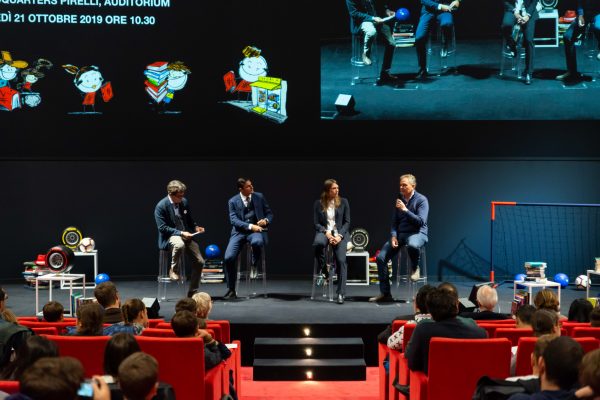
“A spirit of collaboration: that’s what got us to where we are now.” Who better than the legendary “Nerazzurro” Javier Zanetti could interpret the idea of “teaming up”? And indeed, at the Auditorium of the Pirelli Headquarters in Milan it was he, together with other top names from the worlds of contemporary sport and culture, who explained to over 300 students aged between 10 and 14 how important it is to team up with books.
The vice president of Inter Milan is the ambassador of Fare Squadra con i Libri (“Team up with Books”), a meeting organised by the Pirelli Foundation for the 2019 #ioleggoperché, an event created by the Italian Publishers Association (AIE) to promote reading. During the meeting, Pirelli and the Pirelli Foundation, in collaboration with the AIE, donated over 300 books to the Scuola Media G. Verga in Milan, to be added to the school’s library.
“A book will always be able to show you the way”, said Luigi Garlando, an author of children’s books and a journalist with La Gazzetta dello Sport, who was also on stage at the Pirelli Auditorium, together with Laura Galimberti, the Councillor for Education for the City of Milan, who pointed to the close alliance between the public and private sector in creating a network of libraries. “You’ll never get bored if you have a book in your hands,” said Ricardo Franco Levi, president of the Italian Publishers Association, and Antonio Calabrò, the director of the Pirelli Foundation, added that “you can play” with books, for they are nothing to be afraid of.
The large number of kids were able to talk with the guests: Regina Baresi, the captain of Inter Milan’s women’s team, said “it’s when you set foot on the pitch, waiting for the referee to blow the whistle, that you realise you’re part of a team”, while Zanetti, answering one of the students who had asked: “What’s it like to be so successful?”, recalled that all success brings great responsibility. He also stressed the importance of sacrifice and humility in achieving one’s objectives. Mario Isola, Pirelli’s ambassador for “teaming up” and the Group’s Head of F1 and Car Racing, commented: “teaming up is when everyone contributes to enhancing the qualities of each individual.” Also in the world of Formula 1, “thinking as a team” is the winning strategy for Pirelli: working together to achieve any challenge on the circuit. But there is more, for teaming up means bringing together different talents so that they can achieve a shared objective with passion and hard work.


The launch on 2 October 2019 of the revolutionary full-foiling monohull AC75 in Cagliari officially marked the start of the Luna Rossa Prada Pirelli team‘s participation in the 36th America’s Cup. When the partnership between Pirelli and Prada was announced in August 2018, the executive vice president and CEO of Pirelli, Marco Tronchetti Provera, stated that “Pirelli has chosen to be part of this project because it is a sporting and technological challenge that will take the banner of Italy and Pirelli throughout the world. As Formula 1 is for motor racing, so the America’s Cup is the most prestigious trophy in sailing, with a great history and tradition.”
The bond between Pirelli and sailing is a voyage that goes back a long way: this can be seen in Pirelli magazine, the periodical that brought highly topical issues to the public from the 1940s to the 1970s. With sport at centre stage, of course. And sailing enjoys pride of place in terms of sport, as seen through the eyes of Pirelli. The sailor Beppe Croce, who went on to become chairman of the Yacht Club Italiano, wrote an article for the magazine way back in 1954: “It doesn’t take millions to start sailing“, giving the green light for a sport that was still far too unknown at the time. Subsequent articles, such as “Yachts on the high seas” by Bruno Vivarello in 1960 on offshore regattas in America, and “9 o’clock: sailing lesson” by Rodolfo Facchini in 1967, on the Centro Velico Caprera, were further tributes to the “sport of the silent seas”.
Sailing is certainly a sporting challenge. But it’s also a technological one. And Pirelli’s commitment to sea sports has been well established ever since the early 1950s, when Azienda Seregno began producing inflatable vessels, while Azienda Monza created fibreglass hulls. With its inflatable Nautilus and Laros dinghies and its lightweight Alce and Giaguaro outboards, Pirelli has over the years written a long history of the sea. And, once again, also of sailing. 1970 brought the feat of the Celeusta, a large Laros 80 inflatable craft that, skippered by Mario Valli, sailed across the Pacific Ocean from Peru to French Polynesia. Meanwhile, the ability of the Long P brand to create innovative plastic materials took to the seas in boats in Kelesite made for Pirelli by Cantieri Celli in Venice.
The new millennium has seen Pirelli once again contending with sailing and the sea: the Santa Margherita Ligure regattas that saw the launch of the technological series of P Zero inflatable boats are but one example.
And today the adventure continues with Luna Rossa, and with the America’s Cup.

The launch on 2 October 2019 of the revolutionary full-foiling monohull AC75 in Cagliari officially marked the start of the Luna Rossa Prada Pirelli team‘s participation in the 36th America’s Cup. When the partnership between Pirelli and Prada was announced in August 2018, the executive vice president and CEO of Pirelli, Marco Tronchetti Provera, stated that “Pirelli has chosen to be part of this project because it is a sporting and technological challenge that will take the banner of Italy and Pirelli throughout the world. As Formula 1 is for motor racing, so the America’s Cup is the most prestigious trophy in sailing, with a great history and tradition.”
The bond between Pirelli and sailing is a voyage that goes back a long way: this can be seen in Pirelli magazine, the periodical that brought highly topical issues to the public from the 1940s to the 1970s. With sport at centre stage, of course. And sailing enjoys pride of place in terms of sport, as seen through the eyes of Pirelli. The sailor Beppe Croce, who went on to become chairman of the Yacht Club Italiano, wrote an article for the magazine way back in 1954: “It doesn’t take millions to start sailing“, giving the green light for a sport that was still far too unknown at the time. Subsequent articles, such as “Yachts on the high seas” by Bruno Vivarello in 1960 on offshore regattas in America, and “9 o’clock: sailing lesson” by Rodolfo Facchini in 1967, on the Centro Velico Caprera, were further tributes to the “sport of the silent seas”.
Sailing is certainly a sporting challenge. But it’s also a technological one. And Pirelli’s commitment to sea sports has been well established ever since the early 1950s, when Azienda Seregno began producing inflatable vessels, while Azienda Monza created fibreglass hulls. With its inflatable Nautilus and Laros dinghies and its lightweight Alce and Giaguaro outboards, Pirelli has over the years written a long history of the sea. And, once again, also of sailing. 1970 brought the feat of the Celeusta, a large Laros 80 inflatable craft that, skippered by Mario Valli, sailed across the Pacific Ocean from Peru to French Polynesia. Meanwhile, the ability of the Long P brand to create innovative plastic materials took to the seas in boats in Kelesite made for Pirelli by Cantieri Celli in Venice.
The new millennium has seen Pirelli once again contending with sailing and the sea: the Santa Margherita Ligure regattas that saw the launch of the technological series of P Zero inflatable boats are but one example.
And today the adventure continues with Luna Rossa, and with the America’s Cup.
Multimedia


Here is the lesson of a great teacher, Gianni Rodari: ‘It is difficult to do difficult things: / To talk to the deaf, show a rose to the blind. / Children, learn to do difficult things: / Take the blind by hand, sing for the deaf / Set free the slaves who think they are free.’
Rodari was a much-loved writer for generations of parents, who read his Telephone Tales and Il libro delle filastrocche (The Book of Nursery Rhymes) to thousands of children. They went on to become parents themselves and read them to their children to this day. Learning the ‘grammar of the imagination’ and ‘doing difficult things’ is the sign of those who do things well and undertake to change them from an early age.
That phrase about ‘doing difficult things,’ starting from the first years of school, came up several times during discussions at the Aspen Seminars for Leaders in Venice. This year, it was dedicated to discussing Italian identity in the European context, the importance of industry and the ‘new industrial triangle’ (Lombardy, Emilia and Veneto) to the digital revolution, the data-driven society, health, tourism and social inequalities, among other things. In different ways, all the discussions led to a specific focus on the issues of school and education, from the first years of primary school to the most sophisticated university masters. A school where you ‘learn to learn’ and have the necessary tools to cope with the evolution of science, culture, economic processes, society and politics throughout your life. A school that is aware of the ‘obsolescence of knowledge,’ accelerated by the frenetic evolution of the digital society, and therefore knows how to face the challenges of critical knowledge, the time for reflection and understanding, the need to provide useful people to the world of business and work, but also critical people, citizens aware of the complexity of culture and the need for well-informed, critical and responsible thought. General questions, as you can see. Questions about school as an essential tool for wider, more general choices: political, cultural, social and civil.
That is why we are thinking of Rodari’s lesson on ‘difficult things.’ It is essential not to give in to the trivialisation of knowledge, the degradation of language, the flattening of skills, to fall into vulgarity. Making popular, essential culture does not mean giving into sloppiness and vulgar behaviour at all. Rather, we should encourage the growing, widespread awareness of the need for simplicity instead of complexity. We need to understand the direction of change of change as much as possible, in order to try to govern and direct them.
We still have a school system that was built on the model of the industrial era; we study for 17 or 18 years (from primary school to university graduation), acquiring useful knowledge for the rest of our life, then go to work, almost always in the same place, making a career to get skills in the sector or, at very least, a more senior position.
In recent years, the digital economy, globalisation and the rapid progress of science and technology have radically changed the picture. Knowledge becomes redundant over the course of a few years, jobs are changed often. So? Experts say the training cycle must last a lifetime. This changes teaching and learning methods and styles, and also the physical places in which we study. No more traditional classrooms, good for lessons facing the front, but open and dynamic teaching spaces, conversation, interaction, as part of an admirable convergence of work and education, at least from the end of the university onwards. The key point is that education should above all be multi-disciplinary and all-encompassing. We have spoken several times, in this blog, of poets and philosophers, engineers and medical engineers. All are educational activities already in progress, where we keep going with scholastic innovation.
These summary considerations lead us to argue that a country’s major investments should be responsibly concentrated on schools and training, in search of how to build a better future for the next generations. But in Italy, it is over 1.2% of GDP, a pittance. The budget law being prepared by the Conte II cabinet makes no departure from the sloppiness of the past. We object to the anti-youth and anti-development measure that is ‘Quota 100’, which will send too many people into premature retirement and is unjust, costly and unproductive.
In short, there is little money to put into safety and efficiency in buildings, not much for training teachers or awarding for those who work harder, little for new educational technology, little for school and work relations. But without investing in training, no development takes place. Hardy anyone in government circles or most political parties deals with it or even cares.
We remain at the back of the queue among EU countries in terms of number of graduates. The data released a few days ago (La Stampa, 13 October) by the foundation Italia Education and in the Unioncamere-Anpal report show that from now until 2023 at least 165,000 graduates will not meet companies’ work requirements (rising to 182,000 in higher growth estimates).
Too few people graduate in Italy. Many graduate in sectors that do not have target markets. We are lacking mathematicians, engineers, doctors, economists, statisticians, philosophers who can work in the world of big data, and experts in the fields of energy and social and environmental sustainability. There is an abundance of graduates in literature and communication science.
A whole readjustment needs to be designed with intelligence and flexibility. A whole world needs to be restarted along the lines of the ‘polytechnic networks’ that innovate by combining knowledge and work, science, technology and humanities.
How? A government with a responsible policy, willing to prioritise building a better future, should take care of it. Unfortunately, those in parliament and the prime minister’s residence do not even seem to be aware of them. In fact, they would have no idea of how to ‘do difficult things.’

Here is the lesson of a great teacher, Gianni Rodari: ‘It is difficult to do difficult things: / To talk to the deaf, show a rose to the blind. / Children, learn to do difficult things: / Take the blind by hand, sing for the deaf / Set free the slaves who think they are free.’
Rodari was a much-loved writer for generations of parents, who read his Telephone Tales and Il libro delle filastrocche (The Book of Nursery Rhymes) to thousands of children. They went on to become parents themselves and read them to their children to this day. Learning the ‘grammar of the imagination’ and ‘doing difficult things’ is the sign of those who do things well and undertake to change them from an early age.
That phrase about ‘doing difficult things,’ starting from the first years of school, came up several times during discussions at the Aspen Seminars for Leaders in Venice. This year, it was dedicated to discussing Italian identity in the European context, the importance of industry and the ‘new industrial triangle’ (Lombardy, Emilia and Veneto) to the digital revolution, the data-driven society, health, tourism and social inequalities, among other things. In different ways, all the discussions led to a specific focus on the issues of school and education, from the first years of primary school to the most sophisticated university masters. A school where you ‘learn to learn’ and have the necessary tools to cope with the evolution of science, culture, economic processes, society and politics throughout your life. A school that is aware of the ‘obsolescence of knowledge,’ accelerated by the frenetic evolution of the digital society, and therefore knows how to face the challenges of critical knowledge, the time for reflection and understanding, the need to provide useful people to the world of business and work, but also critical people, citizens aware of the complexity of culture and the need for well-informed, critical and responsible thought. General questions, as you can see. Questions about school as an essential tool for wider, more general choices: political, cultural, social and civil.
That is why we are thinking of Rodari’s lesson on ‘difficult things.’ It is essential not to give in to the trivialisation of knowledge, the degradation of language, the flattening of skills, to fall into vulgarity. Making popular, essential culture does not mean giving into sloppiness and vulgar behaviour at all. Rather, we should encourage the growing, widespread awareness of the need for simplicity instead of complexity. We need to understand the direction of change of change as much as possible, in order to try to govern and direct them.
We still have a school system that was built on the model of the industrial era; we study for 17 or 18 years (from primary school to university graduation), acquiring useful knowledge for the rest of our life, then go to work, almost always in the same place, making a career to get skills in the sector or, at very least, a more senior position.
In recent years, the digital economy, globalisation and the rapid progress of science and technology have radically changed the picture. Knowledge becomes redundant over the course of a few years, jobs are changed often. So? Experts say the training cycle must last a lifetime. This changes teaching and learning methods and styles, and also the physical places in which we study. No more traditional classrooms, good for lessons facing the front, but open and dynamic teaching spaces, conversation, interaction, as part of an admirable convergence of work and education, at least from the end of the university onwards. The key point is that education should above all be multi-disciplinary and all-encompassing. We have spoken several times, in this blog, of poets and philosophers, engineers and medical engineers. All are educational activities already in progress, where we keep going with scholastic innovation.
These summary considerations lead us to argue that a country’s major investments should be responsibly concentrated on schools and training, in search of how to build a better future for the next generations. But in Italy, it is over 1.2% of GDP, a pittance. The budget law being prepared by the Conte II cabinet makes no departure from the sloppiness of the past. We object to the anti-youth and anti-development measure that is ‘Quota 100’, which will send too many people into premature retirement and is unjust, costly and unproductive.
In short, there is little money to put into safety and efficiency in buildings, not much for training teachers or awarding for those who work harder, little for new educational technology, little for school and work relations. But without investing in training, no development takes place. Hardy anyone in government circles or most political parties deals with it or even cares.
We remain at the back of the queue among EU countries in terms of number of graduates. The data released a few days ago (La Stampa, 13 October) by the foundation Italia Education and in the Unioncamere-Anpal report show that from now until 2023 at least 165,000 graduates will not meet companies’ work requirements (rising to 182,000 in higher growth estimates).
Too few people graduate in Italy. Many graduate in sectors that do not have target markets. We are lacking mathematicians, engineers, doctors, economists, statisticians, philosophers who can work in the world of big data, and experts in the fields of energy and social and environmental sustainability. There is an abundance of graduates in literature and communication science.
A whole readjustment needs to be designed with intelligence and flexibility. A whole world needs to be restarted along the lines of the ‘polytechnic networks’ that innovate by combining knowledge and work, science, technology and humanities.
How? A government with a responsible policy, willing to prioritise building a better future, should take care of it. Unfortunately, those in parliament and the prime minister’s residence do not even seem to be aware of them. In fact, they would have no idea of how to ‘do difficult things.’
Research from INAPP takes an in-depth look at the gap between production digitalisation and business reality.
Production digitalisation, new technologies and ageing workforces are closely linked these days. It is not just a question of personal data, but also educational levels and the ability to grasp change; in short, to keep in step with the times. No theoretical models are valid for all situations. That’s why it’s certainly worth learning about different experiences in the country and across different production sectors.
It’s therefore helpful to read ‘Lavoratori maturi e nuova occupabilità. L’innovazione tecnologica 4.0 in due studi territoriali’ (‘mature workers and new employability: technological innovation 4.0 in two national studies’) a collection of two national studies, edited by Pietro Checcucci and published by Inapp last August.
The paper aims ‘to define the theoretical framework and the thematic articulation, useful for probing the behaviours and strategies adopted by Italian companies to face the ageing work force, through subsequent investigations, in light of the product and process innovation perspectives brought by the digital revolution, taking into account the specific issues of the production sector, geographical area and socio-economic context.’ So, theory linked to practice. It is for this reason that, after a rapid assessment of the studies that analyse technological change in relation to human resources, that the two cases are presented: the Lazio bioscience technology district and the eye wear district in Belluno. In each case, the paper explains the investigation methods, discusses the results and frames them in a general context, in relation to the ageing workforce.
Everything is then summarised in a general conclusion: ‘The results of the interviews conducted show that there are different approaches to technological innovation, depending on the size of the company. SMEs work in Industry 4.0 because it is a framework that is rich in opportunities, while large companies often have a multinational vision which is governed by different logics. For the latter, technological evolution is the key element of competitiveness, and they are usually able to completely renew their technology systems on their own. In SMEs, on the other hand, innovation follows fairly different paths in relation to the economic sector.’
The wish to preserve the company’s human resources prevails in all cases. The survey does not hide that while ‘the introduction of the new 4.0 technologies is almost certainly destined to determine the problem of occupational stability in the future […] no one thinks that the renewal of the industrial production process to the detriment of employment levels is even thinkable, much less desirable.’
The research edited by Checcucci raises another useful point in understanding the relations between new technologies and work in Italy.
Lavoratori maturi e nuova occupabilità l’innovazione tecnologica 4.0 in due studi territoriali
Edited by Pietro Checcucci
Inapp report, August 2019
Research from INAPP takes an in-depth look at the gap between production digitalisation and business reality.
Production digitalisation, new technologies and ageing workforces are closely linked these days. It is not just a question of personal data, but also educational levels and the ability to grasp change; in short, to keep in step with the times. No theoretical models are valid for all situations. That’s why it’s certainly worth learning about different experiences in the country and across different production sectors.
It’s therefore helpful to read ‘Lavoratori maturi e nuova occupabilità. L’innovazione tecnologica 4.0 in due studi territoriali’ (‘mature workers and new employability: technological innovation 4.0 in two national studies’) a collection of two national studies, edited by Pietro Checcucci and published by Inapp last August.
The paper aims ‘to define the theoretical framework and the thematic articulation, useful for probing the behaviours and strategies adopted by Italian companies to face the ageing work force, through subsequent investigations, in light of the product and process innovation perspectives brought by the digital revolution, taking into account the specific issues of the production sector, geographical area and socio-economic context.’ So, theory linked to practice. It is for this reason that, after a rapid assessment of the studies that analyse technological change in relation to human resources, that the two cases are presented: the Lazio bioscience technology district and the eye wear district in Belluno. In each case, the paper explains the investigation methods, discusses the results and frames them in a general context, in relation to the ageing workforce.
Everything is then summarised in a general conclusion: ‘The results of the interviews conducted show that there are different approaches to technological innovation, depending on the size of the company. SMEs work in Industry 4.0 because it is a framework that is rich in opportunities, while large companies often have a multinational vision which is governed by different logics. For the latter, technological evolution is the key element of competitiveness, and they are usually able to completely renew their technology systems on their own. In SMEs, on the other hand, innovation follows fairly different paths in relation to the economic sector.’
The wish to preserve the company’s human resources prevails in all cases. The survey does not hide that while ‘the introduction of the new 4.0 technologies is almost certainly destined to determine the problem of occupational stability in the future […] no one thinks that the renewal of the industrial production process to the detriment of employment levels is even thinkable, much less desirable.’
The research edited by Checcucci raises another useful point in understanding the relations between new technologies and work in Italy.
Lavoratori maturi e nuova occupabilità l’innovazione tecnologica 4.0 in due studi territoriali
Edited by Pietro Checcucci
Inapp report, August 2019
A book describing the possible scenarios that link employment and new technologies
In the face of the strong technological change that is under way, jobs must, in turn, change profoundly and quickly. But that’s not to say they should disappear. However, it is necessary to have new tools for analysis, knowledge and action. Il lavoro ha un futuro anzi tre. I nuovi orizzonti dell’economia (‘multiple futures in work: the new horizons of the economy’), written by Mario Mantovani, is a good read for beginning to understand more about a complex subject like the link between innovation, technological change and workplaces.
Drawing on his experience in different business situations, all connected by crises and accelerated growth, Mantovani is of the idea that work is the epicentre of the great transformations taking place. According to Mantovani, the social and economic changes that are already under way are bringing an era to a close, one in which the contemporary concept of work has been structured, defined and has assumed a central role in the economic model, which can be correctly defined as ‘labour capital.’ Now, completely new and diversified horizons are opening, based on their time of evolution.
Mantovani proposes three scenarios. The first is in the immediate future (i.e. the next five years), the second in the ‘contemporary future’ (which covers the next 50 years) and the third in what is referred to as the ‘era of access’. Each step is defined by a different situation. In the first horizon, the foundations of a regulatory and organisational transformation must be laid, centred on the concept of ‘organised labour,’ overcoming the distinction between dependent and autonomous jobs. In the ‘contemporary future,’ in which the ‘robotic era’ will begin, the crucial point is the relationship between the technological revolution and the risks of work crises (with all the possible consequences on society). Here the author reveals a scenario referred to as the ‘great separation’ between human and cybernetic organisations, that could pave the way for a potential crisis, mainly driven by more accentuated regional imbalances, which are destined to create the third future scenario, the so-called ‘era of access,’ in which new economic models could replace current ones. These models should strive to look at man in his entirety and in a way that is compatible with technology 4.0 and beyond.
The approximately 200 pages of text are not always easy to read. They need attention and sensitivity, but they are certainly interesting. Mario Mantovani’s book has one great merit: it does not provide pre-packaged solutions, but raises issues and problems in a clear and open manner. On the other hand, this is precisely the objective: to reason and discuss, in order to increase the reader’s informed awareness, which it is really the main tool for understanding where we are and where we are going.
Il lavoro ha un futuro anzi tre. I nuovi orizzonti dell’economia
Mario Mantovani
Guerini Next, 2019

A book describing the possible scenarios that link employment and new technologies
In the face of the strong technological change that is under way, jobs must, in turn, change profoundly and quickly. But that’s not to say they should disappear. However, it is necessary to have new tools for analysis, knowledge and action. Il lavoro ha un futuro anzi tre. I nuovi orizzonti dell’economia (‘multiple futures in work: the new horizons of the economy’), written by Mario Mantovani, is a good read for beginning to understand more about a complex subject like the link between innovation, technological change and workplaces.
Drawing on his experience in different business situations, all connected by crises and accelerated growth, Mantovani is of the idea that work is the epicentre of the great transformations taking place. According to Mantovani, the social and economic changes that are already under way are bringing an era to a close, one in which the contemporary concept of work has been structured, defined and has assumed a central role in the economic model, which can be correctly defined as ‘labour capital.’ Now, completely new and diversified horizons are opening, based on their time of evolution.
Mantovani proposes three scenarios. The first is in the immediate future (i.e. the next five years), the second in the ‘contemporary future’ (which covers the next 50 years) and the third in what is referred to as the ‘era of access’. Each step is defined by a different situation. In the first horizon, the foundations of a regulatory and organisational transformation must be laid, centred on the concept of ‘organised labour,’ overcoming the distinction between dependent and autonomous jobs. In the ‘contemporary future,’ in which the ‘robotic era’ will begin, the crucial point is the relationship between the technological revolution and the risks of work crises (with all the possible consequences on society). Here the author reveals a scenario referred to as the ‘great separation’ between human and cybernetic organisations, that could pave the way for a potential crisis, mainly driven by more accentuated regional imbalances, which are destined to create the third future scenario, the so-called ‘era of access,’ in which new economic models could replace current ones. These models should strive to look at man in his entirety and in a way that is compatible with technology 4.0 and beyond.
The approximately 200 pages of text are not always easy to read. They need attention and sensitivity, but they are certainly interesting. Mario Mantovani’s book has one great merit: it does not provide pre-packaged solutions, but raises issues and problems in a clear and open manner. On the other hand, this is precisely the objective: to reason and discuss, in order to increase the reader’s informed awareness, which it is really the main tool for understanding where we are and where we are going.
Il lavoro ha un futuro anzi tre. I nuovi orizzonti dell’economia
Mario Mantovani
Guerini Next, 2019
“One trillion in green bonds” was the promise made by Paolo Gentiloni, in his role as EU Commissioner for the Economy, during a European Parliament hearing on Friday, 4 October. His words confirm his support for the European Green Deal, launched by European Commission president Ursula von der Leyen in order to re-trigger economic growth in the EU. Europe is currently struggling, caught in the crossfire between the two giants that are America and China, but still has a lot of aces up its sleeves, if it can combine social and environmental sustainability, digital economy and competitiveness, exploiting the values and cultures with which EU countries are especially well-endowed.
That trillion in green bonds, in Gentiloni’s view, is the foundation of a major shift in economic policy that concerns the EU as much as its individual member states. It is an incentive for both public and private investments, triggering a significant transition towards a more “civil” and “just” economy.
In his speech, Gentiloni also mentioned another essential innovation: excluding environmental investments from the computation of the deficit-GDP ratio according to the Maastricht parameters. An ambitious project that has, so far, been rejected by the more hard-line EU countries, obsessed with balancing their budgets (and rightly fearing that loosening budget constraints would encourage incontinent, unproductive spending in unbalanced countries like Italy). But the project that may nevertheless be viable, now that the EU is suffering the consequences – social and political included – of its slow growth. Indeed, there is a growing awareness (even among key players like Germany and France) that economic development requires high-quality public investment, according to virtuous neo-Keynesian principles. And sustainability is the most suitable playing field: the very core of that “change in paradigm” championed by a growing section of the public, from “Generation Greta” to the church, and from the large and medium companies (as discussed in last week’s blog) to consumers themselves (70% of young people surveyed by SWG, on behalf of consulting firm Ernst & Young Italia, would like “a new model of doing business” that prioritises sustainability, according to La Repubblica on 5 October).
Even the current Italian government (the “Conte II Cabinet”) appears a bit more open to the EU and to these issues, in contrast with the belligerent anti-EU stance of Salvini’s sovereigntist Lega party.
“Revamping public investments to support private ones in the area of environmental sustainability” was among the points mentioned in Rome by Minister of the Economy Roberto Gualtieri, during the presentation of the 2019 report by ASVIS, the Italian Alliance for Sustainable Development. Chaired by Pierluigi Stefanini, led by Enrico Giovannini and supported by numerous corporate foundations, this association deserves more attention, as do other bodies dedicated to sustainability and solidarity in the business world, such as Symbola, Sodalitas and Anima. Gualtieri too spoke of green bonds, expressing “confidence that they will be well received by the market” and promising that a “climate committee” will soon be established within CIPE (Italy’s governmental committee for economic development).
Truth to be told, the budget act currently in the works doesn’t say much about resources. But the strategic guidelines are clear and unmistakable. Tying sustainability with the revitalisation of projects for innovation and Industry 4.0. As Gualtieri notes, €135 billion has already been allocated, in addition to the €9 billion share of the €50 billion called for in the EU’s green new deal and the “€40 billion over three years to support corporate investments”, which will be aimed towards circular economy.
However, in its 170-page report centred around the UN’s 17 Sustainable Development Goals or SDGs, ASVIS makes it clear that vague political promises are not enough (the previous Conte cabinet, supported by Lega and the Five Star Movement, also waxed lyrical about the environment but failed to deliver any tangible results). The report explains how the world, Italy included, “is still not on the right path towards sustainable development.” While Italy has improved in nine of the SDGs, including innovation and responsible consumption/production models (thanks to the good work by the country’s best companies), it has got worse in six of them, specifically those pertaining to poverty, sustainable food and agriculture (which could instead be a strength for the Made in Italy market), clean water and sanitation, energy, sea conditions and land ecosystems (and considering the excessive land consumption in our country, we really should embrace initiatives like the one by architect Stefano Boeri, which calls for planting 3 million trees in Milan – one for every inhabitant – and which has been welcomed enthusiastically by the city’s administration). In other words, we need to do more. And the challenge also impinges on the business world (as we’ll see in a bit).
A key strategy could be to add the principle of sustainable development to Italy’s constitution. That would be a difficult task, but it could be made easier with the support of young people and those pro-active businesses that are increasingly aware of the need to combine profit and shareholders’ interests with a respect for the values and demands of people and communities (so-called stakeholder value).
Proof of this economic, moral and civic tension can also be found in the report read last Thursday by Assolombarda president Carlo Bonomi, in his speech at the association’s general assembly, held in a packed La Scala theatre in the presence of the president of the Republic Sergio Mattarella, the president of the Senate Casellati, prime minister Conte and three other ministers. Bonomi, who named the event “The Business of Serving Italy”, introduced his idea for the “Production Chain of the Future” centred on work, young people, women, technology and sustainability. “Our keyword is sustainability.” He spoke of “generational” sustainability, asking for corporate tax breaks to allow younger, newly hired employees to shadow more experienced ones, “in order to pass down skills and expertise.”
His second main point: greater social sustainability, asking unions to redefine industrial relations, from contracts to welfare, with a commitment “to pay young new employees more than the minimum wage” (something which Assolombarda has insisted upon for some time).
Third point: environmental sustainability, with a clear and pragmatic idea: “The recent UN and EU resolutions to fight climate change are excellent and most welcome. But they must be accompanied by a vision founded on real expertise.” How? Here’s an example: “Aside from energy, the number one problem in Italy is that we are unable to properly complete the urban and industrial waste treatment cycle, because our country lacks the necessary facilities to safely process waste”. Another area where green bonds might be useful! Safety, cleanliness and quality of life in our cities. And in this regard, too, Italian companies are prepared to do their part.

“One trillion in green bonds” was the promise made by Paolo Gentiloni, in his role as EU Commissioner for the Economy, during a European Parliament hearing on Friday, 4 October. His words confirm his support for the European Green Deal, launched by European Commission president Ursula von der Leyen in order to re-trigger economic growth in the EU. Europe is currently struggling, caught in the crossfire between the two giants that are America and China, but still has a lot of aces up its sleeves, if it can combine social and environmental sustainability, digital economy and competitiveness, exploiting the values and cultures with which EU countries are especially well-endowed.
That trillion in green bonds, in Gentiloni’s view, is the foundation of a major shift in economic policy that concerns the EU as much as its individual member states. It is an incentive for both public and private investments, triggering a significant transition towards a more “civil” and “just” economy.
In his speech, Gentiloni also mentioned another essential innovation: excluding environmental investments from the computation of the deficit-GDP ratio according to the Maastricht parameters. An ambitious project that has, so far, been rejected by the more hard-line EU countries, obsessed with balancing their budgets (and rightly fearing that loosening budget constraints would encourage incontinent, unproductive spending in unbalanced countries like Italy). But the project that may nevertheless be viable, now that the EU is suffering the consequences – social and political included – of its slow growth. Indeed, there is a growing awareness (even among key players like Germany and France) that economic development requires high-quality public investment, according to virtuous neo-Keynesian principles. And sustainability is the most suitable playing field: the very core of that “change in paradigm” championed by a growing section of the public, from “Generation Greta” to the church, and from the large and medium companies (as discussed in last week’s blog) to consumers themselves (70% of young people surveyed by SWG, on behalf of consulting firm Ernst & Young Italia, would like “a new model of doing business” that prioritises sustainability, according to La Repubblica on 5 October).
Even the current Italian government (the “Conte II Cabinet”) appears a bit more open to the EU and to these issues, in contrast with the belligerent anti-EU stance of Salvini’s sovereigntist Lega party.
“Revamping public investments to support private ones in the area of environmental sustainability” was among the points mentioned in Rome by Minister of the Economy Roberto Gualtieri, during the presentation of the 2019 report by ASVIS, the Italian Alliance for Sustainable Development. Chaired by Pierluigi Stefanini, led by Enrico Giovannini and supported by numerous corporate foundations, this association deserves more attention, as do other bodies dedicated to sustainability and solidarity in the business world, such as Symbola, Sodalitas and Anima. Gualtieri too spoke of green bonds, expressing “confidence that they will be well received by the market” and promising that a “climate committee” will soon be established within CIPE (Italy’s governmental committee for economic development).
Truth to be told, the budget act currently in the works doesn’t say much about resources. But the strategic guidelines are clear and unmistakable. Tying sustainability with the revitalisation of projects for innovation and Industry 4.0. As Gualtieri notes, €135 billion has already been allocated, in addition to the €9 billion share of the €50 billion called for in the EU’s green new deal and the “€40 billion over three years to support corporate investments”, which will be aimed towards circular economy.
However, in its 170-page report centred around the UN’s 17 Sustainable Development Goals or SDGs, ASVIS makes it clear that vague political promises are not enough (the previous Conte cabinet, supported by Lega and the Five Star Movement, also waxed lyrical about the environment but failed to deliver any tangible results). The report explains how the world, Italy included, “is still not on the right path towards sustainable development.” While Italy has improved in nine of the SDGs, including innovation and responsible consumption/production models (thanks to the good work by the country’s best companies), it has got worse in six of them, specifically those pertaining to poverty, sustainable food and agriculture (which could instead be a strength for the Made in Italy market), clean water and sanitation, energy, sea conditions and land ecosystems (and considering the excessive land consumption in our country, we really should embrace initiatives like the one by architect Stefano Boeri, which calls for planting 3 million trees in Milan – one for every inhabitant – and which has been welcomed enthusiastically by the city’s administration). In other words, we need to do more. And the challenge also impinges on the business world (as we’ll see in a bit).
A key strategy could be to add the principle of sustainable development to Italy’s constitution. That would be a difficult task, but it could be made easier with the support of young people and those pro-active businesses that are increasingly aware of the need to combine profit and shareholders’ interests with a respect for the values and demands of people and communities (so-called stakeholder value).
Proof of this economic, moral and civic tension can also be found in the report read last Thursday by Assolombarda president Carlo Bonomi, in his speech at the association’s general assembly, held in a packed La Scala theatre in the presence of the president of the Republic Sergio Mattarella, the president of the Senate Casellati, prime minister Conte and three other ministers. Bonomi, who named the event “The Business of Serving Italy”, introduced his idea for the “Production Chain of the Future” centred on work, young people, women, technology and sustainability. “Our keyword is sustainability.” He spoke of “generational” sustainability, asking for corporate tax breaks to allow younger, newly hired employees to shadow more experienced ones, “in order to pass down skills and expertise.”
His second main point: greater social sustainability, asking unions to redefine industrial relations, from contracts to welfare, with a commitment “to pay young new employees more than the minimum wage” (something which Assolombarda has insisted upon for some time).
Third point: environmental sustainability, with a clear and pragmatic idea: “The recent UN and EU resolutions to fight climate change are excellent and most welcome. But they must be accompanied by a vision founded on real expertise.” How? Here’s an example: “Aside from energy, the number one problem in Italy is that we are unable to properly complete the urban and industrial waste treatment cycle, because our country lacks the necessary facilities to safely process waste”. Another area where green bonds might be useful! Safety, cleanliness and quality of life in our cities. And in this regard, too, Italian companies are prepared to do their part.
Thank you for your request
You will receive an email confirming your subscription to the newsletter.