Help with your research

To request to view the materials in the Historical Archive and in the libraries of the Pirelli Foundation for study and research purposes and/or to find out how to request the use of materials for loans and exhibitions, please fill in the form below. You will receive an email confirming receipt of the request and you will be contacted.

Pirelli Foundation Educational Courses

Select the education level of the school

Visit the Foundation

For information about the Foundation's activities, guided tours and accessibility, please call +39 0264423971 or fill in the form below, providing details of your request in the notes field.

Advertising and Cinema: The Pirellone as a Symbol

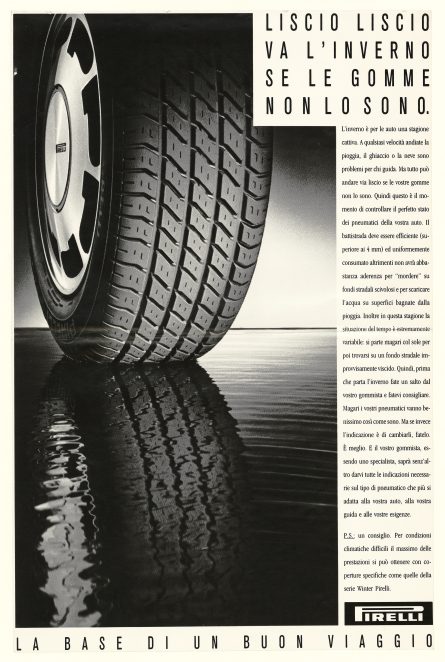
Ever since the foundation stone was laid in July 1956, the scaffolding that protected the Pirellone building site had been used as a wall on which to hang the signs and symbols of a company, Pirelli, that wanted to communicate with Milan and its community. Stretched out between the pylons, the logo with the “Long P” acquired a wavy look, and it may have been this that inspired the designer Alan Fletcher when, in 1963, he created his famously wavy poster for safety in cornering: “Cinturato Pirelli: Sicurezza in curva”. An elephant stood proudly at the centre of the barriers, with its muzzle and trunk transformed into a tyre for industrial vehicles: it was the star of the advertising campaign “Atlas, the giant that will go a long way”, invented by Armando Testa in 1955, and thus used to accompany the growth of another giant – not of rubber, this time, but of reinforced concrete. Other “stories through pictures” commissioned by Pirelli also found their place on those barriers: a plastic boat from the Azienda Monza, for example, and later the Stelvio, the Rolle, the Cinturato and the Winter tyres that were putting Italy on the move. When construction was completed in 1960, there was a party a hundred and twenty metres up and, with the yellow and red banner fluttering alongside the Italian tricolour, the small crowd really could see Milan from on high.

Even after the opening, the Pirellone continued to bring out the creativity of graphic designers, advertisers, and film directors. Among them were Mulas and Noorda – the former a photographer, and the latter a brilliant graphic artist – who in 1959 created a catalogue of Pirelli raincoats set on the tower. With a majestic view of the Pirellone, the misadventures of Mammut, Babbut and Figliut brought the Pirelli Carosello television commercials of 1963-4 to an end. Whether the Cinturato tyre or the wonderful Pirelli foam rubber, the quality of each product was guaranteed by the universally renowned symbol of the Pirelli Centre. And the unmistakable outline of the building appeared in many films, such as Michelangelo Antonioni’s The Night, with Marcello Mastroianni, Monica Vitti, and Jeanne Moreau, and Carlo Lizzani’s La vita agra in 1964, from the novel of the same name by Luciano Bianciardi – with Ugo Tognazzi, who sets out to destroy of the totemic building, but ends up fascinated by it.

Authentic art-house cinema that captured forever a symbol of Milan and Italy on film.

Back to the main page

Ever since the foundation stone was laid in July 1956, the scaffolding that protected the Pirellone building site had been used as a wall on which to hang the signs and symbols of a company, Pirelli, that wanted to communicate with Milan and its community. Stretched out between the pylons, the logo with the “Long P” acquired a wavy look, and it may have been this that inspired the designer Alan Fletcher when, in 1963, he created his famously wavy poster for safety in cornering: “Cinturato Pirelli: Sicurezza in curva”. An elephant stood proudly at the centre of the barriers, with its muzzle and trunk transformed into a tyre for industrial vehicles: it was the star of the advertising campaign “Atlas, the giant that will go a long way”, invented by Armando Testa in 1955, and thus used to accompany the growth of another giant – not of rubber, this time, but of reinforced concrete. Other “stories through pictures” commissioned by Pirelli also found their place on those barriers: a plastic boat from the Azienda Monza, for example, and later the Stelvio, the Rolle, the Cinturato and the Winter tyres that were putting Italy on the move. When construction was completed in 1960, there was a party a hundred and twenty metres up and, with the yellow and red banner fluttering alongside the Italian tricolour, the small crowd really could see Milan from on high.

Even after the opening, the Pirellone continued to bring out the creativity of graphic designers, advertisers, and film directors. Among them were Mulas and Noorda – the former a photographer, and the latter a brilliant graphic artist – who in 1959 created a catalogue of Pirelli raincoats set on the tower. With a majestic view of the Pirellone, the misadventures of Mammut, Babbut and Figliut brought the Pirelli Carosello television commercials of 1963-4 to an end. Whether the Cinturato tyre or the wonderful Pirelli foam rubber, the quality of each product was guaranteed by the universally renowned symbol of the Pirelli Centre. And the unmistakable outline of the building appeared in many films, such as Michelangelo Antonioni’s The Night, with Marcello Mastroianni, Monica Vitti, and Jeanne Moreau, and Carlo Lizzani’s La vita agra in 1964, from the novel of the same name by Luciano Bianciardi – with Ugo Tognazzi, who sets out to destroy of the totemic building, but ends up fascinated by it.

Authentic art-house cinema that captured forever a symbol of Milan and Italy on film.

Back to the main page

Multimedia

Images

Passing the Baton: From Business to Institution

The news came out in the papers on 10 December 1977: Pirelli had decided to sell the Tower. A purchase proposal was put forward by Cesare Golfari, the president of Lombardy Region, and the sale of the building was finalised a few months later, in June 1978. To deal with the crisis the West had been going through for five years, the Pirelli Group launched a five-year industrial restructuring plan, and reinforcing its financial structure by selling the tower was an essential step towards this. In actual fact, the Group occupied only a fifth of the total space of the building at the time.

Lombardy Region, which had been officially set up in 1970, urgently needed to find a single headquarters for all its various offices, which until then had been dotted around Milan. Once again, the bond between Pirelli and its territory became stronger: the “Pirellone”, once a symbol of a Lombard company, became a symbol of the region itself.
One by no means secondary detail: the Rosa Camuna, the symbol of Lombardy Region since 1975, was designed by a pool of artists that included Bob Noorda, Pino Tovaglia, and Bruno Munari. In other words, key name in the history of Pirelli visual communication in the 1950s and 1960s. These designers had considerable first-hand experience of the Pirellone interiors and had certainly met many times up on the twenty-fifth floor, where the company’s advertising offices were located.

In 2002, the twenty-sixth floor of the building was destroyed by a small private aircraft that crashed into the building, causing the death of a number of people. After a long period of closure, for safety reasons, and restoration works that involved reconstructing the facade and the internal premises, the building was reopened in 2004, with a new auditorium named after Giorgio Gaber. The twenty-sixth floor is now a memorial to commemorate the victims of the crash.

Back to the main page

The news came out in the papers on 10 December 1977: Pirelli had decided to sell the Tower. A purchase proposal was put forward by Cesare Golfari, the president of Lombardy Region, and the sale of the building was finalised a few months later, in June 1978. To deal with the crisis the West had been going through for five years, the Pirelli Group launched a five-year industrial restructuring plan, and reinforcing its financial structure by selling the tower was an essential step towards this. In actual fact, the Group occupied only a fifth of the total space of the building at the time.

Lombardy Region, which had been officially set up in 1970, urgently needed to find a single headquarters for all its various offices, which until then had been dotted around Milan. Once again, the bond between Pirelli and its territory became stronger: the “Pirellone”, once a symbol of a Lombard company, became a symbol of the region itself.
One by no means secondary detail: the Rosa Camuna, the symbol of Lombardy Region since 1975, was designed by a pool of artists that included Bob Noorda, Pino Tovaglia, and Bruno Munari. In other words, key name in the history of Pirelli visual communication in the 1950s and 1960s. These designers had considerable first-hand experience of the Pirellone interiors and had certainly met many times up on the twenty-fifth floor, where the company’s advertising offices were located.

In 2002, the twenty-sixth floor of the building was destroyed by a small private aircraft that crashed into the building, causing the death of a number of people. After a long period of closure, for safety reasons, and restoration works that involved reconstructing the facade and the internal premises, the building was reopened in 2004, with a new auditorium named after Giorgio Gaber. The twenty-sixth floor is now a memorial to commemorate the victims of the crash.

Back to the main page

The Tower in Print

Industrial historians agree that the Italian economic boom lasted from 1958 to 1963, which means the Pirelli Tower came into being right at the apex of what was later termed “the miracle”. One photograph in our Historical Archive perfectly captures the moment: a smiling girl aboard a Bianchina Cabriolet, with the Pirellone behind, symbolising Milan growing and producing. Publifoto’s aim was to capture the spirit of the modern, industrious city in 1960. Two years later it was Ugo Mulas, a thirty-year-old up-and-coming photographer in “swinging Milan”, who made the Bianchina with Pirelli Sempione tyres the star in his shots. This Milanese photographer often used to work on the twenty-fifth floor of the building with the Roman Arrigo Castellani, who was then head of Pirelli advertising and the editor-in-chief of Pirelli magazine. The periodical had been launched ten years previously, in 1948, as the brainchild of the poet-engineer Leonardo Sinisgalli and Giuseppe Luraghi, the manager of Bicocca. The magazine looked out over Milan, Italy, and the world from the top of the Pirellone: with the journalist Nino Nutrizio, it analysed the Olympic Games in Rome and it examined the European Community with the economist Gavino Manca, the head of the Research Office and a close collaborator of the chairman, Alberto Pirelli, right up there on the thirtieth floor of the Tower. For Pirelli magazine, the Dutch photographer Arno Hammacher went up to the top of the Pirellone in 1959 to capture in black and white the work of “Man and the Skyscraper”, as his report was titled in the magazine that same year.

In Castellani’s office, Mulas also used to meet the graphic designers, such as Riccardo Manzi, Bob Noorda, and Pino Tovaglia, who were working with the company at the time. These were years of unprecedented creativity for Pirelli visual communication. The “Un viaggio ma…” advertising campaign was the work of Castellani and Tovaglia in 1966, a masterpiece mid-way between Pop Art and Dadaism that was praised by the writer Camilla Cederna. Arrigo Castellani died in December 1968, and a new era was on its way for the Tower. In 1970, on the tenth anniversary of the opening, the Belgian artist Folon painted a picture of it for the magazine and Dino Buzzati told his “little stories” about it. These gems of masterly narrative helped immortalise the Tower in its Pirelli years.

Back to the main page

Industrial historians agree that the Italian economic boom lasted from 1958 to 1963, which means the Pirelli Tower came into being right at the apex of what was later termed “the miracle”. One photograph in our Historical Archive perfectly captures the moment: a smiling girl aboard a Bianchina Cabriolet, with the Pirellone behind, symbolising Milan growing and producing. Publifoto’s aim was to capture the spirit of the modern, industrious city in 1960. Two years later it was Ugo Mulas, a thirty-year-old up-and-coming photographer in “swinging Milan”, who made the Bianchina with Pirelli Sempione tyres the star in his shots. This Milanese photographer often used to work on the twenty-fifth floor of the building with the Roman Arrigo Castellani, who was then head of Pirelli advertising and the editor-in-chief of Pirelli magazine. The periodical had been launched ten years previously, in 1948, as the brainchild of the poet-engineer Leonardo Sinisgalli and Giuseppe Luraghi, the manager of Bicocca. The magazine looked out over Milan, Italy, and the world from the top of the Pirellone: with the journalist Nino Nutrizio, it analysed the Olympic Games in Rome and it examined the European Community with the economist Gavino Manca, the head of the Research Office and a close collaborator of the chairman, Alberto Pirelli, right up there on the thirtieth floor of the Tower. For Pirelli magazine, the Dutch photographer Arno Hammacher went up to the top of the Pirellone in 1959 to capture in black and white the work of “Man and the Skyscraper”, as his report was titled in the magazine that same year.

In Castellani’s office, Mulas also used to meet the graphic designers, such as Riccardo Manzi, Bob Noorda, and Pino Tovaglia, who were working with the company at the time. These were years of unprecedented creativity for Pirelli visual communication. The “Un viaggio ma…” advertising campaign was the work of Castellani and Tovaglia in 1966, a masterpiece mid-way between Pop Art and Dadaism that was praised by the writer Camilla Cederna. Arrigo Castellani died in December 1968, and a new era was on its way for the Tower. In 1970, on the tenth anniversary of the opening, the Belgian artist Folon painted a picture of it for the magazine and Dino Buzzati told his “little stories” about it. These gems of masterly narrative helped immortalise the Tower in its Pirelli years.

Back to the main page

Multimedia

Images

The Birth of a Symbol: The Pirelli Tower

After rejecting the idea of reconstructing the factory after the war, Alberto and Piero Pirelli decided to create a management and administrative headquarters, leaving the manufacturing operations at the Bicocca plant. Two architecture firms, Valtolina-Dell’Orto and Ponti-Fornaroli-Rosselli, were entrusted in 1953 with drawing up the executive design, and overseeing the construction work and testing. The final building plans were completed in late 1954: it was to be a 127-metre, 31-storey reinforced concrete tower, with a ground plan that was wide in the middle, gradually tapering at the ends until it almost closed at the tips.

The architect Gio Ponti was assisted by the engineers Pier Luigi Nervi and Arturo Danusso, who were called in by Pirelli to design the reinforced concrete structure, and the definitive design was completed in 1956. The “Brusada” was demolished and the site prepared between June and December 1955, with the first stone being officially laid on 12 July 1956, in the presence of Alberto and Leopoldo Pirelli. The building was completed in 1960, and it was hailed by the international press as a technically and aesthetically exceptional work: the tallest reinforced concrete building in Europe and the third tallest in the world, it was a work of extraordinary and elegant rationality.

Solutions that had never been tested before in Italy were adopted for the construction site, and especially for vertical lifting: there were no conventional systems taller than 40 metres on the Italian market, so a system of two tower cranes was therefore designed to reach the height necessary for casting the roof slab over the top floor. The concrete production system, which was designed by the Comolli company, the contractor, also had unprecedented features.

The building was quite unique, both from an architectural point of view and in terms of its interior design.

Back to the main page

After rejecting the idea of reconstructing the factory after the war, Alberto and Piero Pirelli decided to create a management and administrative headquarters, leaving the manufacturing operations at the Bicocca plant. Two architecture firms, Valtolina-Dell’Orto and Ponti-Fornaroli-Rosselli, were entrusted in 1953 with drawing up the executive design, and overseeing the construction work and testing. The final building plans were completed in late 1954: it was to be a 127-metre, 31-storey reinforced concrete tower, with a ground plan that was wide in the middle, gradually tapering at the ends until it almost closed at the tips.

The architect Gio Ponti was assisted by the engineers Pier Luigi Nervi and Arturo Danusso, who were called in by Pirelli to design the reinforced concrete structure, and the definitive design was completed in 1956. The “Brusada” was demolished and the site prepared between June and December 1955, with the first stone being officially laid on 12 July 1956, in the presence of Alberto and Leopoldo Pirelli. The building was completed in 1960, and it was hailed by the international press as a technically and aesthetically exceptional work: the tallest reinforced concrete building in Europe and the third tallest in the world, it was a work of extraordinary and elegant rationality.

Solutions that had never been tested before in Italy were adopted for the construction site, and especially for vertical lifting: there were no conventional systems taller than 40 metres on the Italian market, so a system of two tower cranes was therefore designed to reach the height necessary for casting the roof slab over the top floor. The concrete production system, which was designed by the Comolli company, the contractor, also had unprecedented features.

The building was quite unique, both from an architectural point of view and in terms of its interior design.

Back to the main page

Multimedia

Images

Pirelli: The Architecture of Industry

The construction of the tower is a clear illustration of Pirelli’s global approach to industrial architecture. Also the construction of the very first factory, which opened in 1873 in Via Ponte Seveso in Milan, made its mark, for the journalist of L’industriale, who visited the construction site in July 1872, wrote that the building was “of uncommon size, and not devoid of the sturdy elegance of which many foreign factories are so proud”. Those foreign factories were the ones that the young engineer Giovanni Battista Pirelli had visited a couple of years earlier, in the winter of 1870, during a study trip abroad that had been made possible by the scholarship he had won at the Politecnico after his degree course. He had seen factories in France, Germany, Belgium, and Switzerland – a whole new industrial world, with buildings that would later form the skylines of future cities.

The article in L’Industriale in 1872 also informs us that the factory in Via Ponte Sevesowill augment the agreeable aspect of the district, which has been chosen for some years now as home to much of the city’s industry, and appears to be destined for a magnificent future.” While this may have been true for the area then known as “Dei Corpi Santi” in Milan, it became even truer of the suburb around what is now Piazza Duca d’Aosta, with the construction of the Bicocca factory in 1908. This industrial district was destined to expand to a million square metres by the mid-twentieth century and to have an entire district of Milan built around it. At the centre of this “rubber city” stood a cooling tower – on which construction started in 1950 – which was used to recover the steam produced by the manufacture of tyres. A gigantic forty-metre high chimney that formed a concrete hyperboloid towering over the Milan skyline.
That cooling tower is now embedded and protected within a reinforced concrete cube with a glazed facade for looking out and looking in. This is how the Pirelli Headquarters was envisioned by Vittorio Gregotti, when he designed the new urban layout of Bicocca in 1985. The Tower was opened in Milan in 1960, but it was soon accompanied by other symbolic Pirelli buildings: in 1961 Pirelli’s Brazilian branch opened its new headquarters in the Campos Eliseos tower in São Paulo, and in the late 1960s the Group’s Argentinian subsidiary had the Italian architect Mario Bigongiari design its own Pirelli Tower in Buenos Aires. But there were other industrial buildings, and other distinguished architects: in 1958 Roberto Menghi designed the Istituto Piero Pirelli in Viale Fulvio Testi, Milan, while Giuseppe Valtolina had already put his name to the industrial plant in Settimo Torinese in the early 1950s.

It was here that in 2011 the “factory in the cherry orchard” – the new Pirelli Industrial Centre – was built, with the “Spina”, the central services building with offices and laboratories, designed by the architect Renzo Piano. In the words of Vice-President Marco Tronchetti Provera, “the factory is a complex place of activities, relationships, and also of contrasts, but above all of original interaction and synergy. Elements that need visibility, so they can be understood, making it possible to overcome old stereotypes and relationships that have been overtaken by the course of events”.

Back to the main page

The construction of the tower is a clear illustration of Pirelli’s global approach to industrial architecture. Also the construction of the very first factory, which opened in 1873 in Via Ponte Seveso in Milan, made its mark, for the journalist of L’industriale, who visited the construction site in July 1872, wrote that the building was “of uncommon size, and not devoid of the sturdy elegance of which many foreign factories are so proud”. Those foreign factories were the ones that the young engineer Giovanni Battista Pirelli had visited a couple of years earlier, in the winter of 1870, during a study trip abroad that had been made possible by the scholarship he had won at the Politecnico after his degree course. He had seen factories in France, Germany, Belgium, and Switzerland – a whole new industrial world, with buildings that would later form the skylines of future cities.

The article in L’Industriale in 1872 also informs us that the factory in Via Ponte Sevesowill augment the agreeable aspect of the district, which has been chosen for some years now as home to much of the city’s industry, and appears to be destined for a magnificent future.” While this may have been true for the area then known as “Dei Corpi Santi” in Milan, it became even truer of the suburb around what is now Piazza Duca d’Aosta, with the construction of the Bicocca factory in 1908. This industrial district was destined to expand to a million square metres by the mid-twentieth century and to have an entire district of Milan built around it. At the centre of this “rubber city” stood a cooling tower – on which construction started in 1950 – which was used to recover the steam produced by the manufacture of tyres. A gigantic forty-metre high chimney that formed a concrete hyperboloid towering over the Milan skyline.
That cooling tower is now embedded and protected within a reinforced concrete cube with a glazed facade for looking out and looking in. This is how the Pirelli Headquarters was envisioned by Vittorio Gregotti, when he designed the new urban layout of Bicocca in 1985. The Tower was opened in Milan in 1960, but it was soon accompanied by other symbolic Pirelli buildings: in 1961 Pirelli’s Brazilian branch opened its new headquarters in the Campos Eliseos tower in São Paulo, and in the late 1960s the Group’s Argentinian subsidiary had the Italian architect Mario Bigongiari design its own Pirelli Tower in Buenos Aires. But there were other industrial buildings, and other distinguished architects: in 1958 Roberto Menghi designed the Istituto Piero Pirelli in Viale Fulvio Testi, Milan, while Giuseppe Valtolina had already put his name to the industrial plant in Settimo Torinese in the early 1950s.

It was here that in 2011 the “factory in the cherry orchard” – the new Pirelli Industrial Centre – was built, with the “Spina”, the central services building with offices and laboratories, designed by the architect Renzo Piano. In the words of Vice-President Marco Tronchetti Provera, “the factory is a complex place of activities, relationships, and also of contrasts, but above all of original interaction and synergy. Elements that need visibility, so they can be understood, making it possible to overcome old stereotypes and relationships that have been overtaken by the course of events”.

Back to the main page

Multimedia

Images

Milan: The City Rises

For over a century, ever since 1911, the image of Milan has been associated with the image of “The City Rises”, the painting of that name by Umberto Boccioni, which is considered to be a manifesto of Italian Futurism. It was “the architecture of calculation, of audacious temerity and of simplicity; the architecture of reinforced concrete, of steel, glass, cardboard, textile fibre, and of all those substitutes for wood, stone, and brick that enable us to obtain maximum elasticity and lightness.”

With the exception of the Torre Rasini in Corso Venezia and the Torre Snia Viscosa in Piazza San Babila, Milan may not have grown in height in the 1920s and 1930s, but it certainly rose in monumentality: the Palazzo Mezzanotte, which opened in 1932, still remains the magnificent symbol of an entire era. Milan really began to “rise” in 1955, first with the Torre Breda and then with the Torre Velasca, a gem of late 1950s brutalist architecture. In the words of one of the designers of the Torre Velasca, Ernesto Nathan Rogers of the BBPR partnership, “the tower aims to express the atmosphere and the ineffable and yet perceptible nature of the city of Milan, culturally but without imitating the style of any of its buildings.” Standing 106 metres tall, the Torre Velasca rises simultaneously alongside the 127 metres of the Pirelli Tower. For both buildings, the opening came in 1960-1.

The vertical thrust of the city then waned and it was only in the early 1990s that the two FS state railways towers, which later became the Torri Garibaldi, rose up opposite the station, standing 100 metres tall with 25 floors. And then, in 2010, the Palazzo Lombardia was completed, rising 161 metres as the new headquarters of the Region.
The Porta Nuova complex dates from 2014, with the 231-metre Torre Unicredit and the magnificent vertical forest known as the Bosco Verticale,. Those who come down to Milan from the north, along Viale De Gasperi, remain enchanted at the sight of the Tre Torri of CityLife. Symbols of a new Italian metropolis in the world.

Back to the main page

For over a century, ever since 1911, the image of Milan has been associated with the image of “The City Rises”, the painting of that name by Umberto Boccioni, which is considered to be a manifesto of Italian Futurism. It was “the architecture of calculation, of audacious temerity and of simplicity; the architecture of reinforced concrete, of steel, glass, cardboard, textile fibre, and of all those substitutes for wood, stone, and brick that enable us to obtain maximum elasticity and lightness.”

With the exception of the Torre Rasini in Corso Venezia and the Torre Snia Viscosa in Piazza San Babila, Milan may not have grown in height in the 1920s and 1930s, but it certainly rose in monumentality: the Palazzo Mezzanotte, which opened in 1932, still remains the magnificent symbol of an entire era. Milan really began to “rise” in 1955, first with the Torre Breda and then with the Torre Velasca, a gem of late 1950s brutalist architecture. In the words of one of the designers of the Torre Velasca, Ernesto Nathan Rogers of the BBPR partnership, “the tower aims to express the atmosphere and the ineffable and yet perceptible nature of the city of Milan, culturally but without imitating the style of any of its buildings.” Standing 106 metres tall, the Torre Velasca rises simultaneously alongside the 127 metres of the Pirelli Tower. For both buildings, the opening came in 1960-1.

The vertical thrust of the city then waned and it was only in the early 1990s that the two FS state railways towers, which later became the Torri Garibaldi, rose up opposite the station, standing 100 metres tall with 25 floors. And then, in 2010, the Palazzo Lombardia was completed, rising 161 metres as the new headquarters of the Region.
The Porta Nuova complex dates from 2014, with the 231-metre Torre Unicredit and the magnificent vertical forest known as the Bosco Verticale,. Those who come down to Milan from the north, along Viale De Gasperi, remain enchanted at the sight of the Tre Torri of CityLife. Symbols of a new Italian metropolis in the world.

Back to the main page

Multimedia

Images

Gigi Villoresi: A Life Lived as a Champion, from Grand Prix to Formula 1

On 16 May 1909, a future racing champion was born in Milan: Luigi “Gigi” Villoresi was to live a life of Grand Prix and classic road races, in Maseratis, Ferraris, and Lancias, spending an entire career racing on “Victory Tyres” – the Pirelli Stella Bianca and Pirelli Stelvio. He came from a family of illustrious botanists and was the grandson of Eugenio Villoresi, who designed the Ticino channel, which was named after him, but the story of this driver was to have another name and another symbol: that of Maserati and its trident, the car manufacturer that, together with Alfa Romeo, epitomised the glorious pre-war years of Italian motor racing. The good outcome of his debut in a Maserati 4CM at the Coupe du Prince Rainier race in Monte Carlo in 1935 brought him to the attention of Ernesto Maserati, who immediately signed him up in the official team. From then on, Villoresi spent ten years notching up victories in Grand Prix and Targa Florio races, also sharing his wheel with the young up-and-coming Alberto Ascari.

Villoresi had already twice been proclaimed absolute Champion of Italy when Enzo Ferrari decided that he could not do without his talent: the transition to the Prancing Horse team came at the same time as the birth of Formula 1, in 1950. Ascari was there with him, of course, driving the new Ferrari 125, which was attempting to make a definitive assault on the historic rivals Maserati and Alfa Romeo. It was an exciting four years, first with the Ferrari 375F1 and then with the 500, and Pirelli Stelvio tyres made a decisive contribution to the World Championship victories of his friend and teammate Alberto Ascari. In 1954 Villoresi embarked on a new adventure with the Lancia D50, once again with Ascari, until the accident in Monza, on 26 May 1955, in which Ascari lost his life and which ended Vincenzo Lancia’s dreams in the top flight championship. Villoresi’s last races were back with Maserati, but he also allowed himself a victory at the 1958 Acropolis Rally behind the wheel of a Lancia Aurelia GT. Gigi Villoresi was a driver who was in it for the long haul and he was a master for the young champions of the 1950s like Juan Manuel Fangio, as well as Alberto Ascari. We remember him together with Ascari and another motor racing champion, Nino Farina, sitting on the yellow pickup truck of the Pirelli Racing Service: the iconic photo by Federico Patellani, now in our Historical Archive, captures the very birth of Formula 1 in the magical year of 1950.

On 16 May 1909, a future racing champion was born in Milan: Luigi “Gigi” Villoresi was to live a life of Grand Prix and classic road races, in Maseratis, Ferraris, and Lancias, spending an entire career racing on “Victory Tyres” – the Pirelli Stella Bianca and Pirelli Stelvio. He came from a family of illustrious botanists and was the grandson of Eugenio Villoresi, who designed the Ticino channel, which was named after him, but the story of this driver was to have another name and another symbol: that of Maserati and its trident, the car manufacturer that, together with Alfa Romeo, epitomised the glorious pre-war years of Italian motor racing. The good outcome of his debut in a Maserati 4CM at the Coupe du Prince Rainier race in Monte Carlo in 1935 brought him to the attention of Ernesto Maserati, who immediately signed him up in the official team. From then on, Villoresi spent ten years notching up victories in Grand Prix and Targa Florio races, also sharing his wheel with the young up-and-coming Alberto Ascari.

Villoresi had already twice been proclaimed absolute Champion of Italy when Enzo Ferrari decided that he could not do without his talent: the transition to the Prancing Horse team came at the same time as the birth of Formula 1, in 1950. Ascari was there with him, of course, driving the new Ferrari 125, which was attempting to make a definitive assault on the historic rivals Maserati and Alfa Romeo. It was an exciting four years, first with the Ferrari 375F1 and then with the 500, and Pirelli Stelvio tyres made a decisive contribution to the World Championship victories of his friend and teammate Alberto Ascari. In 1954 Villoresi embarked on a new adventure with the Lancia D50, once again with Ascari, until the accident in Monza, on 26 May 1955, in which Ascari lost his life and which ended Vincenzo Lancia’s dreams in the top flight championship. Villoresi’s last races were back with Maserati, but he also allowed himself a victory at the 1958 Acropolis Rally behind the wheel of a Lancia Aurelia GT. Gigi Villoresi was a driver who was in it for the long haul and he was a master for the young champions of the 1950s like Juan Manuel Fangio, as well as Alberto Ascari. We remember him together with Ascari and another motor racing champion, Nino Farina, sitting on the yellow pickup truck of the Pirelli Racing Service: the iconic photo by Federico Patellani, now in our Historical Archive, captures the very birth of Formula 1 in the magical year of 1950.

Multimedia

Images

The Airship Norge
Conquers the North Pole:
A Feat for Pirelli, Too

On 14 May 1926, at 7.30 in the morning, the Norge airship touched down in Alaska. In Teller, to be precise, slightly ahead of schedule, due to unfavourable weather conditions. There was no one on the ground to direct the operation and, upon landing, the airship fell apart. The two captains, Umberto Nobile, a brilliant Italian aeronautics engineer, and Roald Amundsen, a Norwegian explorer, decided to sell what was left of it on the spot. But the mission had been accomplished: a few days earlier, they had flown over the North Pole, where they had dropped the flags of Italy, Norway, and the United States. The inclusion of the American flag was in honour of the industrialist-explorer Lincoln Ellsworth, who had financed the mission. The airship, which was built by Nobile himself, left from Ciampino, near Rome, on 10 April 1926. The plan was to reach Norway and the Svalbard islands and then fly over the North Pole and land on American soil. A total of 13,000 kilometres, to be covered in 170 hours of flying. And thus it was that the mission ended 44 days later in Teller, at latitude 65° north: the North Pole had been conquered.

The “giant of the skies” was doubly Italian, for it was made using an airtight rubber fabric that could protect it from arctic temperatures. The material had been created in Pirelli’s rubber laboratories in the Milano Bicocca plant, which had been studying the art of flight for some time in those far-off days in the 1920s. Air balloons and aeroplane tyres were at the heart of the research work carried out by technicians and engineers, who were certain that the sky was the new way to go. Alberto Pirelli had already experienced flight when, in 1908, he became the first Italian to fly with Wilbur Wright from the Camp d’Auvours near Le Mans. “Wonderful flight today with Wright”, he wrote in a telegram to his family “Arriving Milan 6.40 Monday morning”.

An epic feat to remember, like that of the Norge, which already in 1922 had gone on show in miniature in the Rubber Museum set up at the Bicocca to celebrate the 50th anniversary of the Pirelli Group.

On 14 May 1926, at 7.30 in the morning, the Norge airship touched down in Alaska. In Teller, to be precise, slightly ahead of schedule, due to unfavourable weather conditions. There was no one on the ground to direct the operation and, upon landing, the airship fell apart. The two captains, Umberto Nobile, a brilliant Italian aeronautics engineer, and Roald Amundsen, a Norwegian explorer, decided to sell what was left of it on the spot. But the mission had been accomplished: a few days earlier, they had flown over the North Pole, where they had dropped the flags of Italy, Norway, and the United States. The inclusion of the American flag was in honour of the industrialist-explorer Lincoln Ellsworth, who had financed the mission. The airship, which was built by Nobile himself, left from Ciampino, near Rome, on 10 April 1926. The plan was to reach Norway and the Svalbard islands and then fly over the North Pole and land on American soil. A total of 13,000 kilometres, to be covered in 170 hours of flying. And thus it was that the mission ended 44 days later in Teller, at latitude 65° north: the North Pole had been conquered.

The “giant of the skies” was doubly Italian, for it was made using an airtight rubber fabric that could protect it from arctic temperatures. The material had been created in Pirelli’s rubber laboratories in the Milano Bicocca plant, which had been studying the art of flight for some time in those far-off days in the 1920s. Air balloons and aeroplane tyres were at the heart of the research work carried out by technicians and engineers, who were certain that the sky was the new way to go. Alberto Pirelli had already experienced flight when, in 1908, he became the first Italian to fly with Wilbur Wright from the Camp d’Auvours near Le Mans. “Wonderful flight today with Wright”, he wrote in a telegram to his family “Arriving Milan 6.40 Monday morning”.

An epic feat to remember, like that of the Norge, which already in 1922 had gone on show in miniature in the Rubber Museum set up at the Bicocca to celebrate the 50th anniversary of the Pirelli Group.

Multimedia

Images

“Parole Insieme”, Live-Streamed Conversations:
An All-digital Edition

Pirelli, books, and culture, in a conversation that has been going on for more than a century and that now comes to us through the voices of the protagonists in live-streamed video meetings in this edition of “Parole Insieme” – literally, “words together”.

Over the coming weeks, some conversations between writers and professionals in the publishing world that examine books and the pleasure of reading will be shown on our website.

Here is the programme:

Available from Friday 15 May – Le parole di Fabrizio De André tra musica e poesia [The words of Fabrizio De André in music and poetry]
Enzo Gentile – Amico Faber 

Available from Thursday 21 May – Il grande romanzo storico italiano [The great Italian historical novel]
Giorgio Fontana – Prima di noi [Before us]

Available from Thursday 28 May – L’umanità dell’America di Kent Haruf [The humanity of Kent Haruf’s America]
Fabio Cremonesi, the translator of Kent Haruf – La strada di casa [The way home] (to be published on 18 June)

Pirelli has recently devoted many events to reading, ranging from show cooking to celebrate the first anniversary of our libraries in 2017, with the writer Alessandro Robecchi and the cook Filippo La Mantia, to participation in the 2018 edition of Tempo di Libri, the international publishing fair in Milan. On the occasion of BookCity 2018, an evening was put on in the Auditorium of the Pirelli Headquarters under the title “Stories of Milan, an Industrial City“ in which the actors Rosario Lisma and Marina Rocco told the tale of the city through readings from great authors, interspersed with conversations between Giuseppe LupoPiero Colaprico and Pietro Redondi. 2019 also saw the launch of “Parole Insieme – Le conversazioni della Biblioteca Pirelli”, a programme of conversations in the Pirelli Libraries with writers such as Gianni Biondillo, Giuseppe Lupo, and Marco Malvaldi, and the publisher Eugenia Dubini, which we are again offering in this digital edition of 2020.

Enjoy the read and the videos!

Pirelli, books, and culture, in a conversation that has been going on for more than a century and that now comes to us through the voices of the protagonists in live-streamed video meetings in this edition of “Parole Insieme” – literally, “words together”.

Over the coming weeks, some conversations between writers and professionals in the publishing world that examine books and the pleasure of reading will be shown on our website.

Here is the programme:

Available from Friday 15 May – Le parole di Fabrizio De André tra musica e poesia [The words of Fabrizio De André in music and poetry]
Enzo Gentile – Amico Faber 

Available from Thursday 21 May – Il grande romanzo storico italiano [The great Italian historical novel]
Giorgio Fontana – Prima di noi [Before us]

Available from Thursday 28 May – L’umanità dell’America di Kent Haruf [The humanity of Kent Haruf’s America]
Fabio Cremonesi, the translator of Kent Haruf – La strada di casa [The way home] (to be published on 18 June)

Pirelli has recently devoted many events to reading, ranging from show cooking to celebrate the first anniversary of our libraries in 2017, with the writer Alessandro Robecchi and the cook Filippo La Mantia, to participation in the 2018 edition of Tempo di Libri, the international publishing fair in Milan. On the occasion of BookCity 2018, an evening was put on in the Auditorium of the Pirelli Headquarters under the title “Stories of Milan, an Industrial City“ in which the actors Rosario Lisma and Marina Rocco told the tale of the city through readings from great authors, interspersed with conversations between Giuseppe LupoPiero Colaprico and Pietro Redondi. 2019 also saw the launch of “Parole Insieme – Le conversazioni della Biblioteca Pirelli”, a programme of conversations in the Pirelli Libraries with writers such as Gianni Biondillo, Giuseppe Lupo, and Marco Malvaldi, and the publisher Eugenia Dubini, which we are again offering in this digital edition of 2020.

Enjoy the read and the videos!

Multimedia

Images

Parole insieme

13 May 1950: Formula 1 Comes to Life at Silverstone

On 13 May 1950, the British Grand Prix marked the official start of the Formula 1 World Drivers’ Championship. A total of 7 races were scheduled for the opening season: in addition to the British Grand Prix, there was to be the Monaco Grand Prix in Monte Carlo, the Swiss Grand Prix in Bern, the Belgian Grand Prix on the Spa-Francorchamps circuit, the French Grand Prix in Reims, and the Italian Grand Prix on the Monza circuit. Then, on 30 May, the American classic Indianapolis 500 was added, but it was a lone championship, in view of the total absence of drivers involved in the European races.

The motor racing championship that was destined to become the most important of all time was thus launched on Saturday 13 May, seventy years ago. And it did so on the circuit built on the former RAF military base at Silverstone, just outside London, in front of a hundred thousand spectators, with King George VI in the grandstand.The championship was for drivers only, for the constructors’ title only came in 1958. Almost all the drivers in 1950 had been famous champions since the pre-war period: “almost” all, because there were also some young drivers with promising futures on the starting grid. One of these was the Argentine Juan Manuel Fangio, who with the veterans Nino Farina and Luigi Fagioli was one of the so-called “3 F” trio with Alfa Romeo. their Alfetta 158s were the same ones that had taken them to victory in the previous era of the Grand Prix.

Another promising driver was Alberto Ascari, son of the great Antonio who died in 1925: but it was only at the Monaco Grand Prix that he got to work with the Ferrari 125, together with Gigi Villoresi, Raymond Sommer, and Dorino Serafini.
There were many big names racing with the colours of the various Maserati teams: Toulo de Graffenried and Prince Bira for the Scuderia Enrico Platé, Louis Chiron and Franco Rol for the Officine Alfieri Maserati, and Felice Bonetto and Franco Comotti for the Scuderia Milano. The Argentines José Froilán Gonzalez and Alfredo Piàn of the extremely fierce Scuderia Varzi were yet to come. All these champions had one thing in common at that first Formula 1 World Championship: the Alfa Romeos, Ferraris, and Maseratis they drove were all fitted with the “Victory Tyre” – the Pirelli Stella Bianca. That first race at Silverstone ended in the pre-war order: first Nino Farina, in an Alfa Romeo, second Luigi Fagioli, in an Alfa Romeo, and third, the British driver Reg Parnell, also in an Alfa Romeo. Over ten years since it had made its debut on the racetrack, the Alfetta 158 had lost none of its shine and there was nothing the French drivers in their Talbot-Lagos or the British manufacturers ERA (English Racing Automobiles) and the Alta Car and Engineering Company could do against them. And for the Pirelli Stella Bianca “Victory Tyre”, the age of triumphs was only just beginning.

On 13 May 1950, the British Grand Prix marked the official start of the Formula 1 World Drivers’ Championship. A total of 7 races were scheduled for the opening season: in addition to the British Grand Prix, there was to be the Monaco Grand Prix in Monte Carlo, the Swiss Grand Prix in Bern, the Belgian Grand Prix on the Spa-Francorchamps circuit, the French Grand Prix in Reims, and the Italian Grand Prix on the Monza circuit. Then, on 30 May, the American classic Indianapolis 500 was added, but it was a lone championship, in view of the total absence of drivers involved in the European races.

The motor racing championship that was destined to become the most important of all time was thus launched on Saturday 13 May, seventy years ago. And it did so on the circuit built on the former RAF military base at Silverstone, just outside London, in front of a hundred thousand spectators, with King George VI in the grandstand.The championship was for drivers only, for the constructors’ title only came in 1958. Almost all the drivers in 1950 had been famous champions since the pre-war period: “almost” all, because there were also some young drivers with promising futures on the starting grid. One of these was the Argentine Juan Manuel Fangio, who with the veterans Nino Farina and Luigi Fagioli was one of the so-called “3 F” trio with Alfa Romeo. their Alfetta 158s were the same ones that had taken them to victory in the previous era of the Grand Prix.

Another promising driver was Alberto Ascari, son of the great Antonio who died in 1925: but it was only at the Monaco Grand Prix that he got to work with the Ferrari 125, together with Gigi Villoresi, Raymond Sommer, and Dorino Serafini.
There were many big names racing with the colours of the various Maserati teams: Toulo de Graffenried and Prince Bira for the Scuderia Enrico Platé, Louis Chiron and Franco Rol for the Officine Alfieri Maserati, and Felice Bonetto and Franco Comotti for the Scuderia Milano. The Argentines José Froilán Gonzalez and Alfredo Piàn of the extremely fierce Scuderia Varzi were yet to come. All these champions had one thing in common at that first Formula 1 World Championship: the Alfa Romeos, Ferraris, and Maseratis they drove were all fitted with the “Victory Tyre” – the Pirelli Stella Bianca. That first race at Silverstone ended in the pre-war order: first Nino Farina, in an Alfa Romeo, second Luigi Fagioli, in an Alfa Romeo, and third, the British driver Reg Parnell, also in an Alfa Romeo. Over ten years since it had made its debut on the racetrack, the Alfetta 158 had lost none of its shine and there was nothing the French drivers in their Talbot-Lagos or the British manufacturers ERA (English Racing Automobiles) and the Alta Car and Engineering Company could do against them. And for the Pirelli Stella Bianca “Victory Tyre”, the age of triumphs was only just beginning.

Sign up for the newsletter